Thursday, September 01, 2011

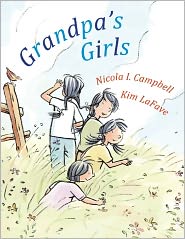
New book! GRANDPA'S GIRLS by Nicola Campbell

One of my favorite authors, Nicola Campbell, has a new book out. Titled Grandpa's Girls, I can't wait to see it! Here's the blurb from Groundwood (the publisher):
A young girl delights in a visit to her grandpa's farm. She and her cousins run through the fields, explore the root cellar where the salmon and jars of fruit are stored, swing on a rope out the barn loft window, visit the Appaloosa in the corral and tease the neighbor's pig. The visit is also an opportunity for this child to ask Grandpa what her grandmother, Yayah, was like, and to explore the "secret room," with its old wooden trunk of ribbons, medals and photos of Grandpa in uniform. 
Nicola's two previous picture books are set in Canada and are about Native families and the boarding schools Native children in the US and Canada were sent to---not by choice---to learn how not to be Native. Pick up a copy of each one: Shi-shi-etko and Shin-shi's Canoe, and look for Grandpa's Girls! I think my dear friend, Jean, is gonna love it... Here's the cover:


Wednesday, August 31, 2011

CADDIE WOODLAWN... in Chinese

Thanks, Minjie, for writing to tell me that Caddie Woodlawn is being published in China. Here's the cover:

Regular readers of American Indians in Children's Literature may recall my daughter's encounter with Caddie Woodlawn... I wonder if it, like Little House on the Prairie, will be placed on the National Curriculum in China?

(A personal note: I've been away from AICL for 3 weeks to provide round-the-clock care for my mom. She lives on our reservation and doesn't have internet. When I left Nambe on Monday morning, she was more herself than she's been in years. It was a difficult six weeks for all of us with many scary moments, but she's made it through an emergency surgery and an extensive hospital stay, and she's literally dancing down her hallway these days.)

Thursday, August 11, 2011

News about Richard Van Camp's THE LESSER BLESSED

Great news! Richard Van Camp's acclaimed The Lesser Blessed is now available on Kindle.  A couple of years ago, I included his novel in a piece I wrote for School Library Journal. There, I said this about The Lesser Blessed:
"Larry is a teenage Dogrib boy whose life includes alcohol, violence, and sex. Realistically drawn, his story is raw and unsettling, yet, in Van Camp’s skilled hands, the account is not depressing. From start to finish, Larry’s Native culture and history are gracefully infused into the compelling narrative."
Here, I'll say straight up that The Lesser Blessed rocks and I'm glad it is on Kindle. I absolutely love Richard's writing in The Lesser Blessed, but elsewhere, too. Readers of AICL know I've written about several of his books. If you want to know more about him, visit his page at Native Wiki.

For another perspective, visit Teaching Van Camp's The Lesser Blessed to see how Professor Jane Haladay uses his novel in a Native lit course. 

Tuesday, August 09, 2011

New Beginnings and a Million Page Visits

Earlier this week I began coursework in San Jose State University's School of Library and Information Science. Most of you know I've got a PhD in Education and have been on the faculty in American Indian Studies at the University of Illinois (UIUC) for several years.

UIUC is a "Research I" university driven by the "publish or perish" motto. Though I've written many book chapters and articles, the powers-that-be determined I was "not a good fit" for a Research I school. Not the right publishers, not the right articles, and, I wasn't "a good fit" in other ways, too. I'm a teacher at heart, and the work I do with teachers and librarians (including this blog) took time away from getting things published in the right books and journals.

In the end, I was (to use the jargon of a university) "not reappointed" to my position on the faculty. You can bet I was more than a little angry about that decision! But we always have to pick our battles, and I chose to quit fighting the University of Illinois. Those of you that have followed my blog and work since the 90s know that I am a founding member of UIUC's Native American House and its American Indian Studies program. You also know that I played a key role in getting rid of "Chief Illiniwek."

So... I was out of a job and contemplating what to do.

One afternoon while reading the newsletter of the New Mexico Librarian's Association, I saw an advertisement for Circle of Learning, an initiative at San Jose State University by which I could get an MLIS. I applied, got in, and as I noted above, my courses have started! The program itself is completely online. My goal is to establish a tribal library and resource center at Nambe. This degree will help me do that.

A few short weeks ago, I was the teacher giving undergraduates assignments for courses I taught at UIUC. Now, I'm completing assignments. It is quite the turn-about as I try to understand what the instructor wants me to do... 

Nonetheless, I am thoroughly enjoying it!

Due to my mom's illness, my posts to AICL over the last three weeks were very few. That will pick back up, though. I've got many books that I've not yet written about, like Gensler's The Revenant. And, I have more to say about being at ALA in June, too.

One last note for today... The "page visits" count on AICL rolled past one million this weekend. Thank you for reading AICL, for recommending it to students and colleagues, and for returning to it yourself.


Saturday, August 06, 2011

Playing Indian and Catherine Bateson's BEING BEE

A reader of AICL wrote to tell me that the main character in Catherine Bateson's Being Bee plays Indian at one point in the novel. On page 65, Bee puts a feather in her hair:
That made me an Indian so I whooped around for a while and pretended to stalk some buffalo, but then Honey, the dog from next door, spotted me, so she stopped being a buffalo.
Bateson is Australian. Being Bee won the Children's Book Council of Australia Award in 2007. Obviously, Bateson is relying on stereotypes of American Indians that circulate around the world.

Bateson is portraying something that kids do (play Indian). Several weeks ago, I used Survey Monkey to see how common the activity is, not knowing that Survey Monkey's free service only applies to the first 100 responses, which I got within a couple of days.  Survey Monkey would let me see additional responses if I subscribed to their service, which is quite expensive!

I immediately closed the Survey Monkey survey and sent out an email letting people know I'd closed it. Several readers replied, suggesting I use Google's survey option next time. I'm grateful for the suggestion and will look into it.

Reading the 100 responses I got gave me some info about the "play Indian" activity, but it also taught me a bit about constructing surveys. For now, here's a summary.
12 of 100 said they've seen it in the last year. Three provided details. One said it was at a school event at Thanksgiving, and one said it was at a girl scout event and the third one person said it was teens, not young children.

12 of 100 saw it within the last ten years.  One provided details, saying it was at a birthday party for a five-year old.

23 of 100 saw it longer than 10 years ago.

20 of 100 saw it longer than 30 years ago.

33 of 100 respondents said they have never seen a child playing Indian at playtime.  Five said they did see it at a school Thanksgiving event, and two saw it at Halloween.

96 respondents saw the playing Indian activity in the US. Two respondents saw it in Australia and 2 saw it in Canada, with all four seeing it over 10 years ago.

What can we conclude from these responses? I could say that almost 10% of the respondents saw it in the last year. For me, that suggests the activity is common--more common amongst young children than I thought.

I see it at the University of Illinois all the time. Adults put on headdresses to go to Illinois basketball and football games, even though the "Indian" mascot is no longer being used here. There were people in headdresses at the World Cup games. My mother has been ill (her illness is the reason my website was not updated for so long), and as I sat with her in the hospital, I saw a patient watching The Price is Right game show. A contestant (is that the right word?!) was wearing a headdress. And the new fashion trend "hipster" is using a lot of "Indian" motifs...

All-in-all, discouraging.


Wednesday, July 20, 2011

"Buffalo Dusk" by Carl Sandburg

Some years back, I came across "Buffalo Dusk" by Carl Sandburg. The poem is in The Random House Book of Poetry for Children: A Treasury of 572 Poems for Today's Child (1983) selected by Jack Prelutsky and illustrated by Arnold Lobel. Here it is:
The buffaloes are gone.
And those who saw the buffaloes are gone.
Those who saw the buffaloes by thousands and how they
     pawed the prairie sod into dust with their great hoofs,
     their great heads down pawing on in a great pageant of dusk,
Those who saw the buffaloes are gone.
And the buffaloes are gone.
Sandburg was wrong, but is that what he thought when he wrote the poem in 1920? How many people, in 1920, thought "those who saw the buffaloes" were gone? It wasn't true then, and it wasn't true in 1983 when Jack Prelutsky chose the poem for the collection... Did Prelutsky think so in 1983? And when Lobel was drawing the buffalo herd that accompanies the poem, did he think so?    

Monday, July 18, 2011

AICL reader on McClure's THE WILDER LIFE

Editor's Note: Today's post is by a Teacher Librarian, NW of Chicago. She writes:

I have spent a long time pondering your comments about the Laura Ingalls Wilder books because, as you can guess, I loved the books when I read them as a child. However, something happened that put everything in perspective for me. I recently listened to the audio book, The Wilder Life: my adventures in the lost world of Little House on the Prairie, written by Wendy McClure. It is a memoir recording her year of visiting all the places Laura had lived and how she felt about the experience. As a Little House fan, I was riveted. I thought that throughout the book, McClure did an adequate job of pointing out Wilder's prejudices when writing about the Indians. However, toward the end of her book, McClure wrote of this incident:
p. 318

I bought a sunbonnet at the museum store, my sixth one.

"I had a feeling you would buy one on this trip," Kara said, as we walked back out to the car. "I bought something, too." She went through her bag in the backseat and pulled out a feathered headband, the kind they used to sell in dime stores for playing cowboys and Indians. "Picture time!" she said.

I started laughing. "Oh my God," I said. "Yes!" We put on our mythical headgear and took pictures of ourselves standing together in the parking lot. It seemed a fitting way to end the trip.
In my mind, the incident was a totally "unfitting" way to end the book. This scene ruined my empathetic feelings toward the author and illustrated how Wilder's stereotypes are still alive and well.