Monday, December 12, 2022

AICL's Year In Review for 2022


New! AICL's Year In Review for 2022

Each year, AICL puts together a list of books we recommend, that we call "Best Books." Our emphasis is on books by Native writers and illustrators published that year. 

"We" at AICL is two people: Debbie Reese and Jean Mendoza. AICL is not an association or an organization or an employer of any sort. It is a blog Debbie founded in 2006. In 2016, she invited Jean to join her as co-editor. We are two people with lived experience, knowledge, and expertise who study and write about depictions of Native peoples in children's books. 


The care we take, we think, is why AICL has a high profile as a reliable source of information. Our work helps educators, librarians, parents, professors, and editors at publishing companies. Our annual lists are not comprehensive. We can’t read every book in the year of its publication. 


This year’s list is different.


This year, we are departing from our goal of populating the annual Best Books list with recommended books published in that year. With the 2022 list, we will be listing books we recommend that were published in any year. Here’s why: these past few years have held challenges for both of us -- some of them positive! -- that have made it difficult for us to keep up with the new books coming out. We have some catching up to do. "So many new books by Native creators" is a good problem to have! We're so pleased by that development. In 2021, for example, we were unable to review Adrienne Keene's Notable Native People, but we did recommend it this year once we got a copy. And, one of our favorite books, Where Did You Get Your Moccasins, by Bernelda Wheeler, came out before we started doing annual Best Books lists. Wheeler’s book initially came out in 1986, and was reissued as an e-book in 2019. 


You will see both of those books on this year’s list. 


A word about the knowledge and lived experience we bring to our reading of books with Native content: there’s always something to learn. For example, we’ve changed how we alphabetize author/illustrator names in Indigenous languages, thanks to correspondence with a writer. That writer is Hetxw’ms Gyetxw. His English name is Brett D. Huson. We’ve included several of his books on our Best Books lists. Recently, he let us know that, for alphabetizing purposes, the usual “Surname comma First Name” does not work for the Gitxsan name. So on this year’s Best Books list, we use the Gitxsan name without treating the second word as a surname. And we put his English name after his Gitxsan name.


Finally, we want you to use books we recommend all year! Of course, you can use them during Native American Heritage Month but Native children are Native all year round, and they should see themselves in books, all year round. (And November’s not the only time non-Native children should see accurate, positive images of Native people, either!)  If you’re doing a classroom lesson or library programming on Native women in politics, include Deb Haaland: First Native American Cabinet Secretary by Doerfler and Martinez and She Persisted: Wilma Mankiller by Traci Sorell. Make room in your science curriculum for books like The Raven Mother by Hetx’wms Gyetxw (Brett D. Huson). Have students in art classes do illustrator studies of award winners Michaela Goade or Julie Flett. Most libraries have many patrons that come in for mysteries. Tell them about Sinister Graves: A Cash Blackbear Mystery by Marcie Rendon. 


We also hope AICL’s lists of recommended reading will inspire you to choose great books by Native creators as gifts during the holiday season, or any time. 


– Debbie and Jean


Comics and Graphic Novels 

Van Camp, Richard (Tłı̨chǫ Dene), The Spirit of Denendah Volume 1: A Blanket of Butterflies, illustrated by Scott B. Henderson and Donovan Yaciuk. Highwater Press (2015/2022), Canada. (This is Richard Van Camp's 2015 graphic novel, re-released in full color in 2022!)

Board Books 

We didn't read any board books during 2022.

Picture Books 

Albert-Peacock, Elizabeth (Ojibwe), Firefly: A Boarding School Story, illustrated by Anna Granholm (not Native). Black Bears and Blueberries Publishing (2022), US.

Coy, John (not Native), Shannon Gibney (not Native), Sun Yung Shin (not Native), and Diane Wilson (Dakota). Where We Come From, illustrated by Dion MBD. Carolrhoda (2022). US.

Davidson, Sara Florence (Haida), and Robert Davidson (Haida), Dancing with Our Ancestors, illustrated by Janine Gibbons (Haida). Highwater Press (2022), Canada.

Davidson, Sara Florence (Haida), and Robert Davidson (Haida), Returning to the Yakoun River, illustrated by Janine Gibbons (Haida). Highwater Press (2022), Canada.

Dumas, William (Cree), Amo's Sapotawan, illustrated by Rhian Brynjolson (not Native). Highwater Press (2022), Canada.

George, Bridget (Kettle & Stony Point First Nation) It's A Mitig!, illustrated by the author. Douglas and McIntyre (2022), Canada. 

Goade, Michaela (Tlingit, member of the Kiks.ådi Clan) Berry Song, illustrated by the author. Little Brown Books for Young Readers (2022), US. 

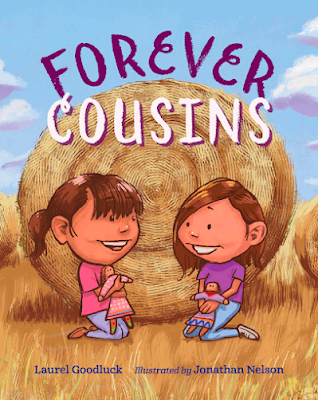
Goodluck, Laurel (Mandan, Hidatsa and Tsimshian member) Forever Cousins, illustrated by Jonathan Nelson (Diné). Charlesbridge (2022), US.

Sainte-Marie, Buffy (Cree), Still This Love Goes On, illustrated by Julie Flett (Cree-Metis). Greystone Kids (2022), Canada. Note from Debbie on Nov 12, 2023: I no longer recommend Buffy Sainte-Marie's work. For details, see About Buffy Sainte-Marie.

Spillette-Sumner, Tasha (Inninewak (Cree) and Trinidadian), Beautiful You, Beautiful Me, illustrated by Salini Perera. Owlkids (2022), Canada.

Thundercloud, Ria (Sandia Pueblo and Ho-chunk Nation) Finding My Dance illustrated by Kalila J. Fuller (not Native). Penguin Workshop (2022), US.

Vandever, Daniel W. (Dine'), Herizon, illustrated by Corey Begay (Dine'). South of Sunrise Creative (2021), US.

Wheeler, Bernelda. (member, George Gordon First Nation), Where Did You Get Your Moccasins, illustrated by Herman Bekkering (not Native). Highwater Press (2019), Canada. This e-book version of Wheeler's book was originally published in 1986 by Manitoba Education. 

Early Chapter Books

Quigley, Dawn. (Citizen, Turtle Mountain Band of Ojibwe) Jo Jo Makoons: Fancy Pants illustrated by Tara Audibert (Wolastoqey). Heartdrum (2022), HarperCollins, US.

For Middle Grades

Doerfler, Jill (White Earth) and Matthew J. Martinez (Ohkay Owingeh), Deb Haaland: First Native American Cabinet Secretary. Lerner (2022), US. 

Hetxw'ms Gyetxw/Brett D. Huson (Gitxsan), The Raven Mother, illustrated by Natasha Donovan (Metis). Highwater Press (2022), Canada. 

Keene, Adrienne (Cherokee), Notable Native People: 50 Indigenous Leaders, Dreamers, and Changemakers from Past and Present, illustrated by Ciara Sana (Chamora). Ten Speed Press (2021), US.

Sorell, Traci (Enrolled citizen of the Cherokee Nation), She Persisted: Wilma Mankiller illustrated by Gillian Flint and Alexandra Boiger. Philomel, (2022) US.

For High School

Gansworth, Eric (Enrolled member of the Onondaga Nation), My Good Man. Levine Querido (2022), US.

Rogers, Andrea (Cherokee), Man Made Monsters, illustrated by Jeff Edwards (Cherokee). Levine Querido (2022), US.

Cross-over Books (written for adults; appeal to young adults)

Harjo, Joy (Muscogee), Weaving Sundown in a Scarlet Light: Fifty Poems for Fifty Years. W.W. Norton and Company (2022), US.

Rendon, Marcie (White Earth Anishinabe), Sinister Graves: A Cash Blackbear Mystery. Soho Crime (2022), U.S. 

Zimmerman, Sam (Ojibwe)/Zhaawanoogiizhik,  Following My Spirit Home: A Collection of Paintings and Stories. Black Bears and Blueberries Publishing (2022), US.
 
Books Written by Non-Native People

Edwardson, Debby Dahl, Blessing's Bead, cover illustration by Nasugraq Rainey Hopson (tribally registered Inupiaq). Tu Books (2009/2022), US. (This is a re-release of Edwardson's 2009 novel for young people, with a new cover and Author's Note.)


Saturday, December 10, 2022

Scott O'Dell and Changes to California's Department of Education "Recommended Literature List"


"No results found." it said. Surely, I thought, that can't be right! 

Let me explain. In 2021 and early in 2022 I was doing some work with teachers in California. A key emphasis in my work involves a critical look at award-winning, classic, and popular children's and young adult books like Scott O'Dell's Island of the Blue Dolphins. Most have stereotypical writing and illustrations that mis-educate readers. 

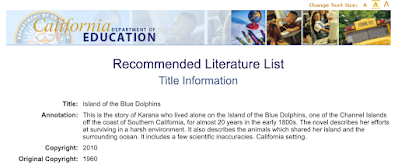
When I do these professional development sessions, I often look at a state's department of education website to see if there are recommendations for children's books, and had looked at California's Department of Education site. It has a database of recommended books. I was not surprised to find Island of the Blue Dolphins in the database. Here's a screen capture of it:


The annotation in the database says there are scientific inaccuracies. I'd love to know what "scientific inaccuracies" refers to! I've analyzed the book. There are many problems with it. For details see A Critical Look at O'Dell's ISLAND OF THE BLUE DOLPHINS. (Note: Author Kate DeCamillo was persuaded not to write uncritically about the book after she read my post and Professor Eve Tuck's tweets that are part of my post.) 

In October of 2022 I was doing some work with another California school system. I went back to the California Recommended Literature List to get a fresh screen capture of the entry for Island of the Blue Dolphins. I entered the title in the search bar, but instead of the annotated entry, I got "No results found." I took a screen cap and shared it on social media, sure that I was doing something wrong in my search of the database. I asked others to search for it and they had the same experience. The book was no longer in the database!

I started looking around the Department of Education website and found this paragraph:
Traditionally, the Recommended Literature List was updated periodically, with new titles being added to the previous lists. This resulted in a Recommended Literature List with over 8000 titles. As of 2022, the CDE is pleased to take the Recommended Literature List in a new direction, with an annual updated and refreshed list of the latest and best in children’s and young adult literature.
An updated and refreshed list of the latest and best? That was exciting! Of course, I did a few searches of names of Native writers and was thrilled to see their books in there!

In February (of 2022) I had also looked up Leo Politi's deeply flawed Song of the Swallows. Published in 1949, it won the Caldecott Medal. It, too, had been in the database and it, too, is not there anymore!
The next paragraph on the site tells us that the previously curated lists are available to download. So I downloaded the "Recommended Literature List through 2020" as an XLSX document and started looking through it. 

I am delighted with what I learned! These books that AICL does not recommend are also not in the database anymore: 
  • Brink, Carol Ryrie. Caddie Woodlawn
  • Gardiner, John Reynolds. Stone Fox
  • Joossie, Barbara M. Mama Do You Love Me?
  • Wilder, Laura Ingalls. Little House on the Prairie
Because my initial look into the database was for Island of the Blue Dolphins I wondered if the database had other books by Scott O'Dell. The answer is that it did. Below, I am listing the ones that focus on, or include, Native content. I know teachers use many of them but I hope they will revisit their use. I've read several of his books but have not written about them. If I had reviewed them for AICL, they'd carry a Not Recommended label. 

NOT RECOMMENDED: 
  • The Serpent Never Sleeps: A Novel of Jamestown and Pocahontas 
  • Sing Down the Moon
  • Thunder Rolling In the Mountains
  • Zia
  • Black Star, Bright Dawn
  • The King's Fifth
In the last few years, there have been significant changes in many spaces! From monuments that are taken down or renamed, to names of children's book awards that are changed... These changes are unsettling to some people but for so many others, these are profound moments of justice. I look forward to more of this. I try to keep up with changes. If you see one that I missed, do let us know!

Sunday, November 27, 2022

HIGHLY RECOMMENDED: NOTABLE NATIVE PEOPLE by Adrienne Keene


Notable Native People: 50 Indigenous Leaders, 
Dreamers, and Changemakers from Past and Present

Written by Adrienne Keene (Cherokee)
Illustrated by Ciara Sana (Chamora)
Published by Ten Speed Press
Reviewed by Jean Mendoza
Review Status: HIGHLY RECOMMENDED

I am so happy to have this book, which does even more than its cover indicates. In a world where Native people still are so frequently treated as invisible, or as stereotypes, Adrienne Keene (co-host of the podcast All My Relations) provides realistic, positive pictures of Native lives. Some years back, I wrote here about a time my young grandson sang at the top of his voice about "500 brave Native Americans" -- mis-hearing the lyrics to an old whaling song, and leading me to wonder if we could in fact find solid information for children about 500 notable Indigenous people. Since that time, a few new books have been published about Native folks who aren't 19-century military leaders. This is one, and I've already given a copy to my grandson's family.

This is one of our "short and sweet" reviews -- a quick look at why we feel enthusiastic about a book.

Reason #1 to recommend Notable Native People: Thoughtfully-chosen one-page bios.

The sketches are brief and reader-friendly but substantial about Native people who have had (are having) a positive impact on their communities and the wider world. Fifty of them!! Plus a bonus of 15 even shorter bios of additional Indigenous notables! This feels like such a gift to young people who want and need to have dozens of Indigenous "leaders, dreamers, and changemakers" lighting the path as they decide what to make of their own lives. Many of the bios incorporate direct quotes from the subjects -- letting them speak for themselves.

Reason #2: Balanced representation, including representation of Black Native and LGBTQ+ people. 

Adrienne Keene explains that her process of selecting people to be in the book was collaborative. And she went over the final list with community members and friends to ensure that it was inclusive. As a result,

"The people in this book represent a small slice of the Native experience, balanced across the three broad cultural groups of American Indian, Alaska Native, and Kanaka Maoli, as well as various gender identities, ages, locations, tribal affiliations, and work." 

You can read more of what Adrienne Keene says about working on the book here.

Reason #3: Sections that highlight key issues affecting Native people.
In several places, the text shifts focus from individuals to ongoing issues that have affected Native communities and the 50 notables. These summaries of such topics as "Settler Colonialism 101", "Who Belongs?" and "Representation Matters" give context to the Native lives being discussed. Great info for readers!

Reason #4: The illustrations.

Using photographs to illustrate biographies lets readers see a person as they were in a given moment, but sometimes photos don't age well. Many of us can remember seeing a photograph of someone famous, and feeling distant from the subject because of outdated hair style, clothing, glasses, or other superficial aspect of appearance. And if the bio is about someone who lived before cameras were used, a photo won't be available. So Ciara Sana's portraits, which are expressive, warm, and pleasing to the eye, engage readers and (I think) extend the life of the book in ways that might not be possible with photographs.

Librarians and educators: Put multiple copies of this book on your shelves, and encourage young people to find out even more about the 50+ notable Natives on its pages! 

Friday, November 25, 2022

UPDATE: Changes made to DINO-THANKSGIVING

Back in October of 2020, I wrote about Dino-Thanksgiving by Lisa Wheeler, illustrated by Barry Gott. It is about dinosaurs gathering to eat at thanksgiving. At one point they gather around the television to watch the "Redscales" game. Players wear uniforms the same colors as the NFL Team now known as the Washington Commanders. 

People at the publishing house saw my post and replied to say they would be making edits to reprints. 

A few days ago, Carol Hinz, Associate Publisher of Millbrook Press and Carolrhoda Books (imprints within Lerner Publishing) wrote about the edits on Lerner's blog. They changed the name of the team name to Rippers. The uniforms they wear are now different, too. Below on left is my screen capture of the first edition. I added the arrows to draw attention to the team name and uniform colors. On right is a sample of the edits Hinz wrote about.  


Those changes, I think, indicate progress. Lots of people at Lerner were involved in the changes. Each one of them now know something they might not have known, before. 

I'm writing this post on Friday, November 25--the day after the 2022 observance of thanksgiving. Some Native families gather on that day to visit and eat, but many do not. Many choose to mark the day as a National Day of Mourning and have been doing so, since 1970, in Plymouth Massachusetts. 

I'm glad to see that change to the mascot name in the series. 

This particular thanksgiving book doesn't repeat the the popular--and wrong--story of Pilgrims and Indians feasting together that hides the facts of imperialism and genocide. That story is one of the many U.S. myths that hurts everyone--Native and not--because it looks away from the horrific things one people can do to another. 

I think there was a time in my life when I thought that the best option was to mark the day as one of gratitude without the Pilgrim and Indian story but in a way, that's like sports teams getting rid of mascots but keeping the team name. It doesn't work. Opposing teams will use those team names to taunt the fans whose team holds that name. Without a massive educational effort to help others see why the mascot is not ok, it lives on in peoples hearts and too often--in their actions.  I've seen that firsthand at the University of Illinois in Urbana Champaign. The mascot itself is gone but the team name is unchanged and fans of the now-absent mascot continue wearing apparel that is easy to get. Worse is that fans of mascots will go on to work in positions where their actions--like doing reenactments of "the first thanksgiving"--will misinform children. 

All of this is part of a cycle that must be interrupted! There are a few new picture books that seek to interrupt the Pilgrim and Indians thanksgiving story. I've not studied them yet. 

One is If You Lived During the Plimoth Thanksgiving by Chris Newell (citizen of the Passamaquoddy Tribe) and illustrated by Winona Nelson (Leech Lake Band of Minnesota Chippewa). Dennis Zotigh at the National Museum of the American Indian has an article about it at Smithsonian Magazine: 'If You Lived During the Plimoth Thanksgiving' by Chris Newell Exposes New Truths about the American Holiday. 

Another is Keepunumuk: Weeâchumun's Thanksgiving Story written by Danielle Greendeer (Mashpee Wampanoag Tribal Citizen), Alexis Bunten (Unangan/Yup'ik), Anthony Perry (Chickasaw), and illustrated by Garry Meeches, Sr. (Anishinaabe). In my quick look at this book, I see a lot I like. I groaned at the back matter for the inclusion of a map by a mapmaker whose methods received criticism from many who observed that he misrepresented their nations and people on his maps. For more information about that, I did a couple of posts here at AICL

A few years ago, We Are Grateful/Otsaliheliga by Traci Sorell (Cherokee) came out. I like what she did in her book and highly recommended it. Much older is Giving Thanks: A Native American Good Morning Message by Chief Jake Swamp (Mohawk). These two don't take the pilgrims as their starting point. 

Before social media took off, people would submit comments to AICL's posts but that dropped significantly as people chose to respond to AICL's posts on Twitter. Media analysts say that Twitter is on its last legs. Your contributions to conversations are likely going to be lost. If you're leaving Twitter, we invite you to submit your comments here. I'm really interested in your observations about thanksgiving and thanksgiving books. 


Friday, November 11, 2022

Ku'daa, University of New Mexico Native Alumni Chapter!

I am deeply honored that the University of New Mexico's Native American Alumni Chapter chose me to receive one of its Outstanding Alumni Awards for 2022.  I received this stunningly beautiful plate, painted by Sherry L. Aragon of Acoma Pueblo


Here's the flyer announcing the gala:


Due to prior commitments, I wasn't able to travel to Albuquerque for the gala, but I did send in a recorded message for them. The gala itself was on the same day as the Brackeen v Haaland oral argument at the Supreme Court on Nov 9. This is what I said:

Good evening. 

This morning, Native people from across the country were gathering in Washington DC or online to listen to the Supreme Court oral arguments in Brackeen v Haaland. 


I’m living in the San Francisco Bay area right now. Wherever I am, I talk about kids and books. or more precisely, the ways that stories in books tell others who we are. That work is why I can’t be with you tonight. I’m in the midst of working with teachers in this area. 


I tell teachers and librarians that our status as sovereign native nations has been left out of popular, classic, and award winning books. Those books shape what people know about us. They shape what the Brackeen’s know about us. Those books are part of why the Indian Child Welfare Act is at risk, right now.


Those books are a threat to our sovereignty. 


I’m grateful to UNM’s Native American Alumni Chapter for selecting me to receive this award. It acknowledges the importance of the work I do to help educators understand what is wrong with those popular and award-winning books. 


And it acknowledges the work I do to bring visibility to Native writers who are creating books that affirm who we are. 


In October, an absolutely terrific picture book by two Native people came out. That book is Forever Cousins. Written by Laurel Goodluck and illustrated by Jonathan Nelson, it is about cousins growing up together in the Bay Area. 


In the Author’s Note, Goodluck writes about the Indian Relocation Act. It is why she grew up in the Bay Area. She also writes about sovereignty! 


I talked about Forever Cousins in a workshop I did earlier this week. After the workshop, one of the participants approached me. She was deeply touched by Goodluck’s book. She is from Tesuque Pueblo, and like Laurel, grew up in the Bay Area. 


Forever Cousins is one book, but it sits amongst a growing number of books by Native writers and illustrators who are creating books that should be in every classroom, and every library.


Like many of you, I’m deeply worried about Brackeen v. Haaland, and, I am confident that as we continue to raise our voices and use books by Native writers, we are disrupting the harms done by older classics that misrepresent who we are. Buy books by Native writers, and talk about them to everyone you know. Help me to bring visibility to books that lift our children and our nations. 


Ku’daa.  


I offer my congratulations to Nicolle Gonzales. She, too, was honored by the Native Alumni chapter. She founded the Changing Woman Initiative. Here's a video of her:


If you are able to support her work, go to the Changing Woman Initiative's website. Down at the bottom of the page is a Donate button. 

Sunday, November 06, 2022

"Never fear," said Gramps. "My great, great grandmother was one quarter Native Bear and I am ready to share."

This morning on Twitter, I saw a tweet that included a photo of a page from a Berenstain Bears book. The person who shared it characterized it as 'yikes' and most of the people who commented about it agreed. Because a lot of what we see online is satire or parody, I wondered if someone was playing around with the Berenstain Bears books. 

Some of the books have stereotypical content and are cringeworthy. In Berenstain Bears Go to Camp (published in 1982 by Random House) shows Grizzly Bob in a feathered headdress and fringed buckskin. In Berenstain Bears Give Thanks (published in 2009 by Zonderkids, a Christian publishing house) the bear family has a turkey named Squanto. This is supposed to be their dinner on Thanksgiving Day but Sister Bear objects and they decide to keep Squanto as a pet. 

I looked for the book where Gramps says his great, great grandmother was "one quarter Native Bear" and found it right away. It is in The Berenstain Bears Thanksgiving Blessings. Like Berenstain Bears Give Thanks, it is from Zonderkids, the Christian publishing house. It came out in 2013.

Thanksgiving Blessings is one of the too-many books that puts forth the feel-good Thanksgiving story (in this one, the "Native Bears" gave the "Pilgrim Bears" food and they all shared in a great feast), but it is also one of those that goes a step further by having a character claim to be Native. That character talks about what they will "share" with others. Some readers will see "share" and think it is a good moral lesson, but some of us read that and see it as an attempt to depict harmony that looks away from the facts of history.

Here, it is Gramps saying that his great, great Grandmother was "one quarter Native Bear." Here's a screencap of the page (I put the red arrow there to draw your attention to Gramps and this bogus claim):


And here's the text on that page:
The whole family helped set the table. It was, indeed, a magnificent Thanksgiving feast. 
"It's a shame there aren't any Native Bears here to share it with us," said Brother. 
"Never fear," said Gramps, seating himself at the head of the table. "My great, great grandmother was one quarter Native Bear an I am ready to share. Let's eat!"
If you follow Native people on social media, you know that there are many conversations about people who claim they are Native. Social media makes it possible for this topic to be more visible than ever before. 

I ran into these claims a lot in the 1990s when I was a student at the University of Illinois, Urbana-Champaign (UIUC). It had a stereotypical mascot they called "Chief Illiniwek." Before I arrived there, Native students, staff and faculty had been asking the university to get rid of it. 

Without fail, we encountered fans who claimed that they are part Native and--with that claim to Native identity--said that the mascot was a good thing. Some of them may have had an ancestor, but some of them were simply recounting family lore, and were using that family lore to dismiss Native people who resist being stereotyped and misrepresented via mascots, children's books, television shows, and movies. 

That dismissal is precisely what I see in Thanksgiving Blessings. Obviously, Mike Berenstain (his parents launched the Berenstain Bears books in the 1960s), uses Gramps and his "one quarter Native Bear" as an attempt to validate the bogus Thanksgiving story. 


If you have a family story that tells us an ancestor was Native and you have no idea what that ancestor's nation was, and you speak from that space of not-knowing, I urge you to stop doing that, especially if you're doing it to counter Native people who speak up about stereotypes, and/or biased and inaccurate information. You are harming the very people you claim to be. You are undermining us. Please stop! 

To learn more about fabricated or unsupported claims to Native identity, you can read through resources I've compiled: Native or Not? And if you see that sort of thing in a children's book, please let me know!


Saturday, October 15, 2022

Dear Kate: An Open Letter to Kate DiCamillo (and Authors of Children's Books)

Update from Debbie on Monday, Oct 17, 2022: Kate DiCamillo responded to me, sharing my letter on her Facebook page. I deeply appreciate her response. Ones like it make me hopeful! Scroll to the bottom of my letter to read her response. 
_____

October 15, 2022

Kate DiCamillo
https://www.facebook.com/KateDiCamillo

Dear Kate,

You and I have never met. I'm tribally enrolled at Nambé Owingeh, a sovereign Native Nation in the southwest. In the early 1990s, I moved from Nambé's reservation to Illinois where I began working on a PhD in the College of Education at UIUC. My husband and our little girl went, too. Since then I've written book chapters and articles about depictions of Native peoples in children's books. In 2018, the American Library Association announced that I had been selected to deliver the 2019 Arbuthnot Honor Lecture. I'm pretty sure you know about the Arbuthnot. 

In 2005, I launched American Indians in Children's Literature, and I use it to do in-depth analyses of children's books. Sometimes--like now--I use it to speak directly to a specific author. 

I read Because of Winn Dixie at some point and had positive feelings about it. More recently I realized that it featured Gone With the Wind. And so, on June 17, 2016, I added it to my page, Books that Reference Racist Classics. And then in 2021 I learned that you had removed Gone With the Wind from your book. That was a good decision. I assume you had engaged in conversations with people who asked you to reconsider using it. 

Earlier this week (October 12, 2022) on your Facebook page, you wrote about being with friends and talking about books you and they loved when you were kids. 


You listed books people mentioned, including Island of the Blue Dolphins. As your conversation continued, you talked about how you had learned about those books. Many talked about how it read aloud to them in class. They remembered the teacher who read the book, too, and you wished those teachers could have heard you talking about those memories. 

You noted that reading aloud is a gift. On that, I concur. I have many warm memories of reading aloud to our daughter on our travels from New Mexico to Illinois. 

You closed your Facebook post with
[T]hank you, Mrs. Boyette, for reading Island of the Blue Dolphins to our second grade class.
For you, and the thousands of people who embraced and shared your post, Mrs. Boyette's reading aloud to you is a positive memory but for Native kids--especially ones who are Aleut, memories are not positive. Here is a thread by Dr. Eve Tuck, recounting her experience (I have her permission to share it). She did the thread in response to my critique of the book.

I appreciate the thorough analysis that has done here. As an Aleut person, I can say that the inaccuracies depiction of Aleut people in this book meant that non-Indigenous people said a lot of painful and ignorant things to me, especially as a kid.
I was a kid growing up in a white rural town in Pennsylvania, and usually ours was the only Native family in the community. I attended a school that had multiple copies of this book in classrooms, the library. I remember there even being a door display of this book.
So I grew up in a white community that only knew of Aleuts (Unangan) from this book.
I was taunted for it. I was asked by children and teachers to explain why Aleuts were “so mean.” And no matter what I said about my family, especially my grandmother, it wasn’t believed.
The book was believed over my real-life knowledge of Aleut people.
Fictionalizing an Indigenous community to make them the violent device of your plot line is a totally settler thing to do. O’Dell had no business writing a word “about” our people.
The book says nothing about us. Like Gerald Vizenor’s analysis of the figure of the ‘indian,’ it says more about the violent preoccupations of the settler, and says nothing about Unangan.
The last thing that I will say is that when I think about colonial violence that Aleut people were *actually* experiencing in their/our homelands in the time period that the book was set, it makes me doubly angry about the falsehoods depicted in this book.
But that would never be a best seller.

I'm writing this letter to you today, Kate DiCamillo, to ask you to extend the action you took regarding Gone With the Wind. Teachers are still using Island of the Blue Dolphins. Native children are negatively impacted, and everyone is being mis-educated by the contents of that book. 

Would you please revise your post, asking teachers not to read Island of the Blue Dolphins aloud, and tell them why they should not? Being able to tell them why they should make a different choice will mean that you need to read my critique. Revising your public remarks about the book is important. You would take a leadership role in doing so. You could speak about this at conferences. You and other writers with large followings could be a force for change! 

I'll close with a note to my readers: if you know DiCamillo, please give her a link to this letter. Consider writing to her, yourself. If you would like to comment to me, please do. I welcome thoughts from those who revisit their warm embrace of books. Please refrain from submitting comments that tell me I'm wrong. 

Sincerely,

Debbie Reese
Founder, American Indians in Children's Literature
Twitter: @debreese
 
_____

At 9:48 AM on October 17, DiCamillo responded to my letter. She wrote the following on her FB page:
When I talk to kids about writing, I tell them that one of the most important tools a writer can cultivate is their ability to listen to other people—to be curious about what other people think, and why.
Last week on this page, I wrote about the powerful experience of having a teacher read a book aloud to a class.  
I thanked my second-grade teacher for reading us Island of the Blue Dolphins.  
After that post, Dr. Debbie Reese, founder of American Indians in Children’s Literature, wrote to tell me about how and why Island of the Blue Dolphins has caused pain.  
I read her letter and her article on Island of the Blue Dolphins and what I thought was: EVERYONE needs to read this, so I’m posting her letter here.
Thank you, Dr. Reese. 
I wish Mrs. Boyette had had the chance to read this letter, to know these things. 
And I am grateful to her for reading aloud to second-grade me.