Friday, July 18, 2014

Picture Books about Christopher Columbus

Earlier this week, a colleague wrote to me about a new picture book about Christopher Columbus. This morning, I was e-talking with Annette Wanamaker, editor of Children's Literature in Educationabout an article in CLE about Columbus! I read it right away.

In "The Columbus Myth: Power and Ideology in Picturebooks About Christopher Columbus," Christina M. Desai shares results of her analysis of depictions of Columbus in picturebooks published since 1992. She looked at a representative sample of over 30 books and found that little has changed. Native peoples are still being misrepresented and stereotyped.

She also points to something very troubling:
In her defense of humanities education, Not for Profit: Why Democracy Needs the Humanities, Nussbaum (2010) warns that, as emphasis on the humanities declines in the U.S., curricula are increasingly designed to advance economic growth. She posits that such curricula will "present national ambition, especially ambition for wealth, as a great good, and will downplay issues of poverty and global accountability" (p. 21). The books examined here certainly exemplify such a curriculum and promote its agenda, by glorifying conquest and profit at the expense of ideals such as human rights and self determination.
That paragraph reminded me of Floca's Locomotive. Though his picture book is about early trains in the US, it is also about conquest and profit at the expense of Native peoples. Locomotive won the Caldecott Medal this year. I found it lacking. Floca responded to my critique.

I think Floca's win and Desai's article tell us how little we've come in terms of a humane society. If you don't have access to Children's Literature in Education, ask your librarian to get a copy of Desai's article. It has a lot to mull over for those of us who read, review, and recommend children's books.

Here's the citation:
Desai, Christina M. (2014). "The Columbus Myth: Power and Ideology in Picturebooks About Christopher Columbus," Children's Literature in Education. DOI: 10.1007/s10583-014-9216-0.


Sunday, July 13, 2014

E.B. White "Did you ever see an Indian..."

A few days ago (June 11) was E.B. White's birthday. Most people know--and love--Charlotte's Web and Stuart Little. 

Do you remember his reference to Indians in Stuart Little, published in 1973 by Harper Row?

It is that part where he's fixed up a birchbark canoe and plans to take Harriet out for a ride in it. There's a string tied to it, though, that he can't untie. He's really annoyed. Harriet says they could go anyway and let the string drag behind them. Stuart is not keen on that at all. On page 122, he says:
"Did you ever see an Indian paddling along some quiet unspoiled river with a great big piece of rope dragging astern?"
Harriet says that they could pretend they are fishing, but Stuart says
"I don't want to pretend I'm fishing."
What does he want to pretend? Does his "Indian paddling along some quiet unspoiled river" tell us he was imagining them as Indians?

Curious if he'd written anything else about Native peoples, I started digging a bit and found a poem called "An Indian Burial Mound" published in 1922 in Art and Archeology. It is as follows:
The sculpted buttes cut cameo-wise
Against the bold blue skies,
Above the grave.
No catafalque, no lordly marble tomb;
But,--in his native hill side carved,-a room
His bones to save.
The tomb profaned, simple would show his needs;
A shard or two, a strand of turquoise beads
The spirit crave.
Here ruled his tribe before we bade them go.
Here buffalo and deer paid tribute to his bow.
Here lies a brave!
Time for some analysis! That'll come. Later. Gotta run for now!

_____

Back (on Monday, July 14th)!

Some things White says in the poem suggest he's thinking of the southwest ("sculpted buttes"), and the room carved in a hill suggest Bandelier National Monument near Los Alamos, New Mexico. Here's a photo of those bold blue skies and what could be the buttes:

Source: http://www.rv-trips.com/wp-content/uploads/2011/06/
Bandelier-National-Monument-3.jpg

And here's a photo that shows the caves:


Source: http://wikitravel.org/upload/shared//thumb/2/28/
Bandelier_cliffdwellings.jpg/300px-Bandelier_cliffdwellings.jpg 


Bandelier, Mesa Verde, and similar sites are ancestral sites of Pueblo peoples. My village, Nambe, is about 30 miles from Bandelier. At one time, the information provided at the park said that the people who lived there disappeared, but now, the information states that Pueblo peoples lived in those sites and moved elsewhere (like Nambe).

If E.B. White visited Bandelier and didn't know the descendants of the people that lived there now live elsewhere, the lamentable tone of his poem makes sense. We could also say that his use of "Indian" rather than a specific tribal nation reflects a lack of knowledge, too.

His poem reflects romantic stereotypes but it also has the vanished Indian theme. In the conversation on Facebook, I noted that it reminds me of the "End of the Trail" statue at the Cowboy Hall of Fame. It depicts a tragic Indian.


Curious (again), I wondered if Trumpet of the Swan (another of his books for children) had any Native content... and it does! In it, Sam (the main character) has "black hair and dark eyes like an Indian" (p. 1). When he leaves the spot from which he watched the swans, he "walked slowly and quietly away, putting one foot in front of the other, Indian-fashion, hardly making a sound" (p. 22).

White did not denigrate Native peoples by using derogatory images, but romantic images are just as bad in terms of providing children with knowledge of who Native peoples were, and who we are, too.

And while most of us love White's writings for children, we ought not shy away from pointing out these stereotypes when we use the books with children. Letting them stand, unchallenged, is not educationally sound.

Wednesday, July 02, 2014

Tim Tingle's keynote at 2014 American Indian Youth Literature Awards

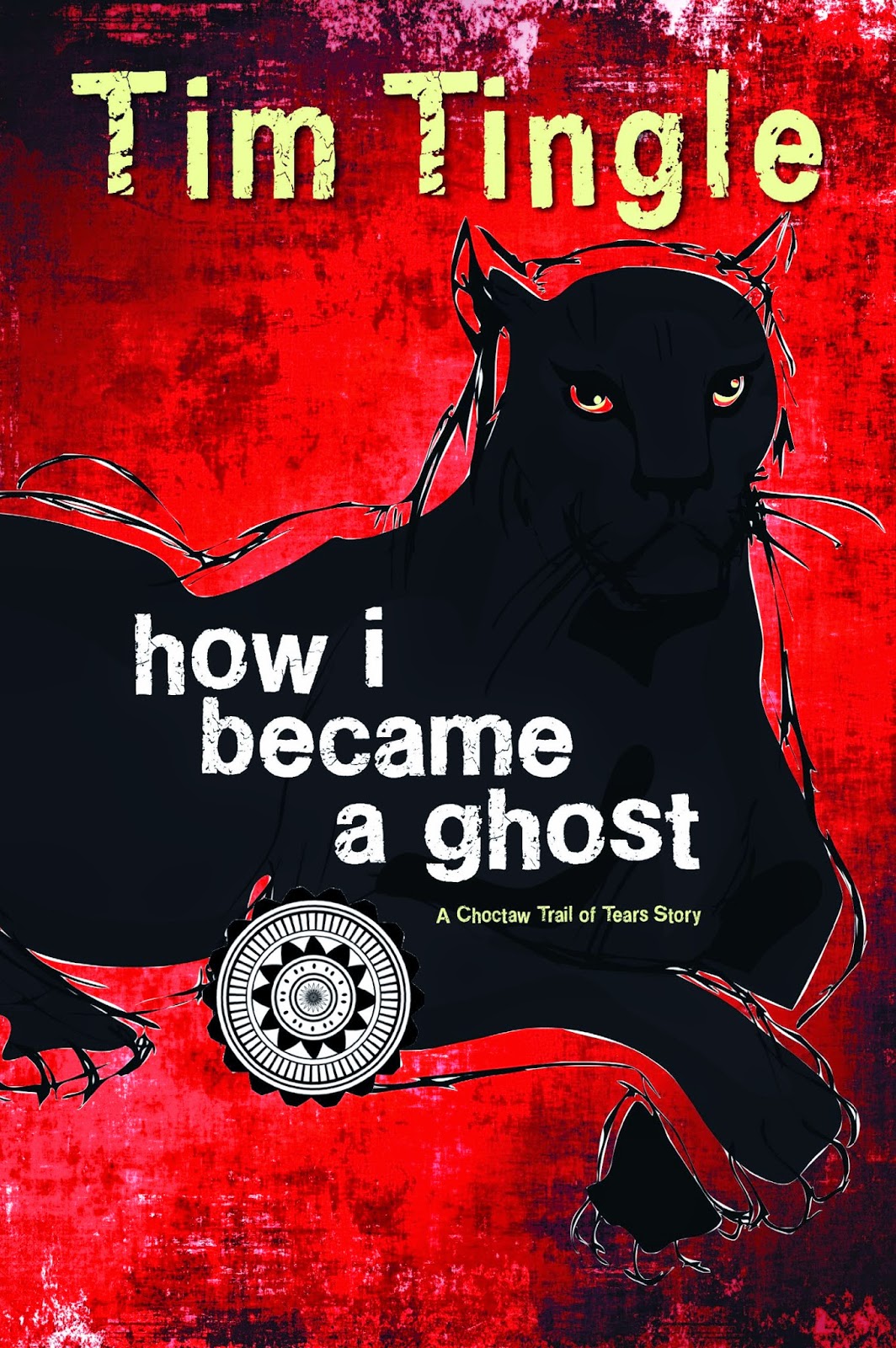
On Sunday, the American Indian Library Association (AILA) presented its 2014 Youth Literature Awards in Las Vegas, Nevada at the annual meeting of the American Library Association. Choctaw author Tim Tingle was the keynote speaker at the event.

Tingle's How I Became A Ghost won the middle school award. I could not be in Las Vegas but have been following happenings there via social media. On Monday,  American Libraries Magazine posted an article about the AILA event. In it, Michele LeSure included an overview of Tingle's remarks:

Tingle spoke about the trials his family endured being discriminated against for being Choctaw tribal members, and the importance of documenting these types of stories. He said the recent decision to revoke trademark rights to the Washington Redskins team name and logo gives Native Americans a big opportunity to raise these types of issues in public discourse, so “we will never be ghosts.”

Tingle's Saltypie recounts some of that discrimination his family experienced. His note to teachers in that book is exceptional. In his books, Tingle brings forth difficult moments in history in which Native peoples were discriminated against. How I Became a Ghost is about the Trail of Tears, and House of Purple Cedar opens with the burning of a Native boarding school in which Choctaw girls were burned to death. Though we would correctly assume that the characters in his stories would be bitter, they aren't. They recognize the humanity in all people, including those who hurt them. Tingle is a master at giving us history in a way that lets us examine brutality and compassion.

Tingle's keynote remarks indicate his courage in taking up current examples of that discrimination. Specifically, he addressed the Washington football team's racist name. He is absolutely right in saying that the public discourse on mascots creates an opportunity for us to examine all misrepresentations of Native people. One of those misrepresentations is the thought that we no longer exist. Here's a couple of tweets that captured more of Tingle's remarks:


Get his books for your classroom, school, or home library. And get them from small bookstores, too! When you booktalk or introduce them, you can say "Tim Tingle is Choctaw." That two letter word (is) will go a long long way at helping your students and patrons correct the misinformation they may carry about us as being extinct.

Wednesday, June 25, 2014

Aaron Carapella's Map: NATIVE AMERICAN NATIONS - OUR OWN NAMES & LOCATIONS

Eds. note, Oct 11, 2016: See updated review: A Second Look at Aaron Carapella's Maps.

Some months ago, I began to see information about Aaron Carapella's map, "Native American Nations - Our Own Names & Locations." It is an admirable and ambitious project, and it held a great deal of promise... But.

The ways in which Carapella writes about the project is a bit off-putting. For example, he writes that "We also honor the Indigenous Nations of this land by giving them ownership of their own names for themselves." I don't know who "we" is (Carapella and his team?) but how do they have the power to give any nation ownership of its own name? Doesn't that sound a bit silly? It is not a small point. The whole point of the map, as I understand it, is to make it clear that Native Nations had concepts of nationhood prior to European contact. That included the names they used--and use--for themselves. Saying that he gives them ownership of their own names does the same thing outsiders did.

The map itself, he tells us, has the "original names" that a nation used (Numuunu instead of Comanche), but that sometimes, the name on Carapella's map is a "given name" because the original one is not known. As far as I can tell, the map itself does not tell us which ones are original and which ones are given.

Because of the massive amount of inaccurate information about American Indians that circulates in a wide range of media, it is especially important that a map such as Carapella's be accurate. I took a look at the part of the map that has Pueblo Indians on it. Carapella shows the current pueblos (some of them are not in what I deem "accurate" locations), but he's also got one on there (Piro) that he would probably put in his "numberless" category -- which I take to be no longer in existence. I think that Piro ought to be in a different font so that we know it is "numberless."

I cross checked the spellings he used for the pueblos and found several errors. That's too bad. That information is easy to get from the Indian Pueblo Cultural Center. In my cross-check, it looks like it may have been Carapella's source, but I could be wrong. Still, those spelling errors make me wonder about the spelling of other Indian nations on the map. From a colleague, I learned that Carapella made similar errors with tribes in California.

If you bought a map already and want to make corrections to the errors for the Pueblo Nations, you can do this as a learning activity with students. First, get out Carapella's map. Second, look at the spreadsheet below (downloadable from Carapella's site). The right column is what Carapella calls "given" names. Third, find that given name on the website for the Indian Pueblo Cultural Center and see what is listed there as the "traditional" name for that tribe. Fourth, see if it matches what Carapella has on his map. If not, make a correction.


You could also look at the tribal seal. For example, on the page for Nambe, the traditional name is listed as "Nambe" but our complete name is on the tribal seal:   "Nambé O-Ween-Gé."


As noted above, Carapella's project is ambitious and has a great deal of potential but I think it needs some visual way of conveying important information ("given" versus "original" names; existing versus "numberless" tribes) and I also think it needs to be sourced.

Update, July 28, 2014:

In addition to comments below, please see the discussion on the Native American and American Indian Issues page on Facebook. Carapella posted a link to the NPR piece on that page yesterday (July 26th). The first response to his post is from Joe Horse Capture, a curator at the National Museum of the American Indian, who said that the map is inaccurate, spreads misinformation, and that he hasn't met any curators or academics who find the map accurate. In his comment, Chad Obiwanishinaabe Uran, a visiting lecturer in American Indian Studies at the University of Washington, pointed to AICL and to a post at Tumblr that lists several concerns with the map. (Update, July 19, 2016: Carapella deleted the post at the Native American and American Indian Issues page, presumably because he did not like the questions he was receiving about the map).

Sunday, June 22, 2014

"Native American Zodiac"

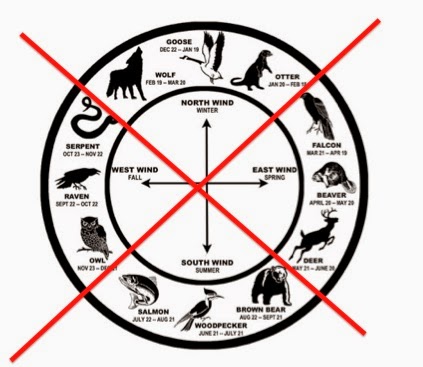
Twice within the last few weeks, people have written to ask me about the "Native American Zodiac" that is popping up on social media. Here's the graphic that is circulating:


Obviously, I've drawn a red X over the graphic to provide a visual comment on the "Native American Zodiac." If you're a regular reader of American Indians in Children's Literature, you know that there is no such thing as a "Native American" tribe.

"Native American" and "American Indian" are broad terms for the Indigenous peoples of the United States. Within those terms are hundreds of different Native nations. We are all over the country, from north to south and east to west. We are not monolithic in the ways we speak, dress, govern, or, in the stories we tell. Things like a "Native American Zodiac" obscure and collapse who we are, and they encourage ignorance!

As I look at the 
"Native American Zodiac" 
I wonder who made it?! 

To someone unfamiliar with Native peoples and our nations, histories, and cultures, it might seem cool, but to those who know, it is bogus.

I view it as akin to New Age appropriation and misrepresentation of Native ways of being and urge you to reject it, AND, if it pops up on your social media, let your friends, family, and colleagues who are sharing it know that it is bogus.


Thursday, June 12, 2014

Donald F. Montileaux's TASUNKA: A LAKOTA HORSE LEGEND

One of the things I look for when reading a traditional story rooted in a Native Nation is an attribution of where the story was heard, and from whom. In Tasunka: A Lakota Horse Legend, Montileaux gives us that information right away in a two-page introduction.


Montileaux heard this story from Alex White Plume, a Lakota elder and storyteller. In a radio interview, Montileaux says more about the story, assuring readers that he is retelling the story as it is told. Initially, White Plume was reluctant to have a traditional story put into print. When he saw what Montileaux had done, he gave him his blessing. In the radio interview, Montileaux also says that Agnes Gay, the woman who did the Lakota translation, works as an archivist at the Oglala Lakota College. She, too, verified the integrity of Montileaux's telling of that story.

Photo credit: Joel Ebert, Capital Journal, South Dakota
The care Montileaux took with the story marks the story itself as distinctive. His art adds a beautiful dimension to the words on the page.

Montileaux's style reflects the ledger art of the 1800s, developed by Plains Indians who drew on ledger pages using pencil, ink, and watercolor. The photo shown here is of Montileaux working in his studio (link to story: A Lakota Legend, Flying Off the Pages).


A third quality of the book that marks it as distinctive is that it is a bilingual text. Above, I noted that Agnes Gay did the translation. Throughout the book, readers can see/read the story in Lakota. Here's a scan of one of my favorite pages:


At that point in the story, the young man on the horse is riding into camp after having spent many months away, looking for and training horses. The horses were new to the people and regarded as a gift from their creator. With them, the people were able to do more than they could before. But, they abused that gift, using it to dominate other peoples on the Plains. The gift was taken away from them. Hundreds of years later, horses return with the conquistadors.

Tasunka: A Lakota Horse Legend is a fascinating story that pays tribute to the stories Native peoples have told for hundreds of years.

I highly recommend 
Tasunka: A Lakota Horse Legend.


Montileaux is an enrolled member of the Oglala Lakota Nation. Tasunka: A Lakota Horse Legend was published by the South Dakota State Historical Society in 2014. Support small bookstores by getting a copy from Birchbark Books.

Tuesday, June 10, 2014

NOT RECOMMENDED: Paul Goble's THE GIRL WHO LOVED WILD HORSES (updated re Goble's identity)


Is Paul Goble's The Girl Who Loved Wild Horses one of your favorite books? Published in 1978 by Bradbury Press, it won the Caldecott Medal thirty-five years ago. Let's take a look at it. 

Here's the first paragraph in the story:
The people were always moving from place to place following the herds of buffalo. They had many horses to carry the tipis and all their belongings. They trained their fastest horses to hunt the buffalo.
With the word 'tipis' in that paragraph Goble suggests that these are Plains people. The buffalo are another clue that suggests the story is one belonging to the Plains tribes.

As the story begins, we learn of "a girl" (we are never given her name) who loved horses. People in the village see that she has a way with them. One day when she is out with the herd of horses, a huge storm erupts. She leaps onto one as the herd races in fear. When the horses stop that night, the girl looks around and realizes that they are lost. The next morning she wakes to the neighing of a handsome stallion who tells her he is the leader of the wild horses that roam the hills. He welcomes her to live with them. She and her herd are happy.

Meanwhile, her people spend the next year looking for her. One day, two hunters see the stallion and the girl, too. She's on a horse, leading a colt. They call and wave at her. She waved back, but the stallion drove her and the herd away from the hunters. Other men join them in an attempt to reach the girl, but the stallion keeps them away from the girl and the colt. But, the girl's horse stumbles, and she falls. The hunters take her back to the village. She was happy to see her parents but she is sad. She misses the colt and the wild horses. At night, the stallion calls to her. The girl is lonely and gets sick. Doctors ask what would make her happy again, and she says she wants to return to the wild horses.

The stallion and wild horses come to the village. The people give the horses blankets and saddles and they give the girl a beautiful dress and the best horse in the village. The girl gives her parents a colt, and she rides away, beside the stallion, reunited with the herd. Each year, she brings her parents another colt. But one year, she doesn't return at all.

Then, the hunters see the stallion again. Beside him is "a beautiful mare with a mane and tail floating with wispy clouds about her." They believe the girl is that mare, that she has become a wild horse, too. The story ends with:
Today we are still glad to remember that we have relatives among the Horse People. And it gives us joy to see the wild horses running free. Our thoughts fly with them.
Nowhere in The Girl Who Loved Wild Horses do we have any sources for that story. As noted earlier, Goble's use of 'tipis' suggests a Plains tribe. What we know as the Great Plains is a vast area. Here's a map from the Smithsonian:


See how that area stretches from the north to south, spanning at least 1500 miles? See the 20 or so tribes listed in that area? There's a lot more than just those 20. They don't speak the same language and they don't tell the same stories.

The question is, who does this story about a girl who became a wild horse belong to? It'd be good to know. If it is a story Goble came up with, then it isn't a Native story, is it?

Though it won the Caldecott, and though a lot of people love Goble's art, I think it is (past) time to set aside The Girl Who Loved Wild Horses. What do you think?


Update, 6:00 AM, June 11, 2014

(1) Elsewhere people are noting how much like they like his art. It is a style most people would recognize as "Goble" but let's pause again. I haven't done a close study of it, but does it suffer from the same ambiguity we see in The Girl Who Loved Wild Horses?

(2) Someone noted that Goble was adopted by a tribe.  His Adopted by the Eagles (Macmillian, 1994) includes this:


Does being given a name and being called "Son" mean he was adopted? Was he adopted by Edgar Red Cloud? Or was it by a tribe, as was done with President Obama? I've ordered Goble's autobiography and will revisit this post when it arrives. It may provide details about how he met Edgar Red Cloud.

(3) The Author's Note for Adopted by the Eagles says:
"I would like to think that Edgar somehow sensed, right from the start (1959), that I would one day make books of some of the stories he told me."
Many authors say something similar to that... about how Native people they know/live amongst asked them to write a story about them. As readers of AICL now, I frown on that phrase.

(4) Goble's note ends with this curious paragraph:
Finally, it needs to be stated that the traditional kola friendship of the two Lakota men, as described in this story, was never a homosexual relationship. Kolas sought to guard each other from all errors; to share their strengths while walking life's Good Red Road together.
I wonder why Goble felt compelled to include that paragraph? Adopted by the Eagles was published in 1994. Perhaps it was prompted by a fear that people wouldn't buy a book about friendship between two men, but, do other books published then have a similar disclaimer?

(5) The last item on the page with the Author's Note is a very important note for teachers. Here it is, in its entirety:
When a book like this has been read in the classroom, students are sometimes asked to write their own "Indian" stories. It is not asked with bad intentions, but it belittles these traditional stories, suggesting that any child can invent them. When studying the Greek myths, or the legends of King Arthur, or Bible stories, students would never be asked to invent stories in the manner of... Instead, children should be encouraged to write down the stories in their own words to help remember them. Over the years they will come to think about the inner meanings which all these stories hold.
I say that, too. I'm glad to see it in Goble's book. But he's invented stories! Is it ok, since he is not a child? I don't think so!

See my previous posts about Goble. I'll have more to say when I get Goble's biography.
July 22, 2009: About Paul Goble and his books...
April 3, 2011: Dear Mr. Goble: