Friday, January 20, 2012

National Association of Multicultural Education responds to closing of Mexican American Studies program

[Note: A chronological list of links to AICL's coverage of the shut-down of the Mexican American Studies Department at Tucson Unified School District is here. Information about the national Mexican American Studies Teach-in is here. The best source for daily updates out of Tucson is blogger David Abie Morales at Three Sonorans.]
______________________________________


On Wednesday, January 18th, Christine Sleeter, President of the National Association of Multicultural Education, posted the following letter to the Save Ethnic Studies page on Facebook. She prefaces the letter by saying she submitted it to the Arizona Daily Star but it had not yet been published.

Dear Editors:

As a long-time educator, I am outraged that the Arizona Department of Education closed a program that has been highly successful in graduating Mexican American students, and is now censoring what can be taught about Mexican American history.

Mexican American students completing Tucson’s ethnic studies program had been graduating at a rate of over 90%, and entering college at a rate of about 80%. This is a remarkable record of closing a huge achievement gap. Its success is supported by social psychology research documenting that Black and Latino students who have a strong, positive ethnic identity and an understanding of racism and how it can be challenged tend to take education more seriously than those who do not.

Banning texts means censoring knowledge that resonates with and explains conditions of life Mexican American students experience everyday. Censorship flies in the face of education in a democracy. Ethnic Studies must be restored.

Christine Sleeter
President, National Association for Multicultural Education

________________________________________________________
FOR A COMPREHENSIVE LIST OF AICL'S COVERAGE, CLICK ON:
AICL Coverage of Arizona Law that resulted in shut down of Mexican American Studies Program and Banning of Books

Thursday, January 19, 2012

What Mark Stegeman said...

[Note: A chronological list of links to AICL's coverage of the shut-down of the Mexican American Studies Department at Tucson Unified School District is here. Information about the national Mexican American Studies Teach-in is here. The best source for daily updates out of Tucson is blogger David Abie Morales at Three Sonorans.]
______________________________________


Earlier today (January 19, 2012), Tucson Citizen uploaded a screen shot of a Facebook page that includes a remark made by Tucson Unified School District president, Mark Stegeman. Stegeman was asked about other "non-approved" books that have to be removed. He said:
This is the first example I know of, because external circumstances made this case urgent. But I suspect that TUSD is using many books which were never legally approved, in many different courses, and we have to track those books down and either remove them or go through proper curriculum approvals. Staff has already begun that search process.
I read that and sat back a minute, stunned at the idea that (presumably) some unfortunate staff person in TUSD is going to (presumably) visit every classroom and every teacher, carrying a list of books the board has approved.

I'm guessing that the staff person is going to need a great big trailer to put those unapproved books onto!

What is the search strategy? Where did the search start? With English teachers? What grade level? What school did they start with? I sure wouldn't want to be that staff person.

And can you imagine being a teacher in the Tucson Unified School District, learning that someone was going to come into your classroom to see what you've got on your shelves?!

When I taught elementary school, I had hundreds of children's books in my classroom. Most elementary school teachers have a lot of books in their classrooms. Did they have each one "legally approved" first? Did they, for example, get last year's winner of the Caldecott Medal approved before taking it into the classroom? (For those who don't know, last year's winner was A Sick Day for Amos McGee, written by Philip C. Stead, illustrated by Erin E. Stead.)

And can you imagine being a first grader with A Sick Day for Amos McGee on your lap when that staff person comes into the room? What will be said to that first grader? Will the child be able to finish reading it? Or will it be taken out of the classroom immediately, as was done with the books that were removed from the Mexican American Studies classrooms?

Stegeman is either very smart or very stupid. His words put the entire district at risk. When he finds a bunch of unapproved books in classrooms, what is he going to do? He can't, of course, shut down a first grade classroom, but I wonder if there are pull-out programs that offer classes for specific reasons. Will those programs be shut down? Could the enforcement of this "legally approved" policy work in favor of the Mexican American Studies program?

Here's my screen shot of the Tucson Citizen screen shot:


Hang on, teachers. It's going to be a rough semester in the Tucson Unified School District.

________________________________________________________
FOR A COMPREHENSIVE LIST OF AICL'S COVERAGE, CLICK ON:
AICL Coverage of Arizona Law that resulted in shut down of Mexican American Studies Program and Banning of Books


What Huppenthal said...

[Note: A chronological list of links to AICL's coverage of the shut-down of the Mexican American Studies Department at Tucson Unified School District is here. Information about the national Mexican American Studies Teach-in is here. The best source for daily updates out of Tucson is blogger David Abie Morales at Three Sonorans.]
______________________________________

On January 18, 2012, the guest on Michel Martin's NPR "Tell Me More" program was Superintendent of Public Instruction in Arizona, John Huppenthal.

Democracy Now had him on its program, too, but they also had Richard Martinez on the program. Martinez is the lawyer for the teachers and students in Tucson.

On both programs, Huppenthal said pretty much the same things. As you might guess, he was pushed harder by Richard Martinez than he was by Michel Martin.

I wish that we (the public) had access to those lesson plans Huppenthal says teach students to resent white people.

And, I wish Huppenthal would provide his analysis of student performance. In their report, the auditors he hired to examine the Mexican American Studies (MAS) program included evidence that shows that students in the program outperformed students who were not in the program. (Note: Students in the classes reflect the demographics of the school district, which means students in the classes are Mexican American, white, American Indian....). Huppenthal rejected the findings of that audit. He did his own analysis. I want to see what he did!

Huppenthal apparently believes the auditors didn't know how to do their job in analyzing student performance. He said they were comparing oranges to apples, and that in his analysis he compared apples to apples. I want to see his analysis.

Huppenthal then goes on to say that students in Tucson Unified School District (not clear if it is the MAS program or the entire school) were not performing as well as students in other districts. That, he says is another of the reasons he had to shut down the MAS program. That seems to me like HE is comparing apples to oranges!  Is he comparing, for example, a district with a lower SES to one with a higher SES? If so, that's not fair.

In both interviews (NPR and Democracy Now), Huppenthal talks about Che Guevara's poster being on the wall in the classroom he visited. From what he says, the lesson he observed was not about Guevara, but had something to do with Benjamin Franklin. Huppenthal says that the teacher called Franklin racist. I wish that teacher was also on the show. I'd like to know more about what Huppenthal observed.

I'm wondering if the class Huppenthal was observing was studying Franklin's "Observations Concerning the Increase of Mankind"? (Note: I found it by searching on "Was Benjamin Franklin racist?" The link I got was to "Did Benjamin Franklin have ulterior motives" which is a pdf housed at Fairfield University in Connecticut. I think the pdf was developed by Professor Dennis G. Hodgson.)

At the end of "Observations...", Franklin was talking about people coming to America. He wrote:
Why should Pennsylvania, founded by the English, become a Colony of Aliens, who will shortly be so numerous as to Germanize us instead of our Anglifying them, and will never adopt our Language or Customs, any more than they can acquire our Complexion. 
24.  Which leads me to add one Remark: That the Number of purely white People in the World is proportionably very small. All Africa is black or tawny. Asia chiefly tawny. America (exclusive of the new Comers) wholly so. And in Europe, the Spaniards, Italians, French, Russians and Swedes, are generally of what we call a swarthy Complexion; as are the Germans also, the Saxons only excepted, who with the English, make the principal Body of White People on the Face of the Earth. I could wish their Numbers were increased. And while we are, as I may call it, Scouring our Planet, by clearing America of Woods, and so making this Side of our Globe reflect a brighter Light to the Eyes of Inhabitants in Mars or Venus, why should we in the Sight of Superior Beings, darken its People? why increase the Sons of Africa, by Planting them in America, where we have so fair an Opportunity, by excluding all Blacks and Tawneys, of increasing the lovely White and Red? But perhaps I am partial to the Compexion of my Country, for such Kind of Partiality is natural to Mankind.


In that passage, Franklin was trying to keep America for the English and American Indians. He didn't want Africans or Germans, Spaniards, Italians, French, Russians or Swedes here! Huppenthal is right in saying that Franklin was president of the Abolitionist Society in Pennsylvania, but that was later in life. Shouldn't students learn that, at one time, he owned slaves, and isn't it accurate to call that racist? Like I said, I wish we could hear from the teacher. Did he drop it at that? Or did he go on to talk more about Franklin's later life?

Huppenthal says a lot that I want to push back on, but I'll finish with this. Talking about Paolo Freire, Huppenthal said:
I mean, he says, explicitly—he says, explicitly, in his book that his—literally, the Pedagogy of the Oppressed, that word "oppressed" is taken right out of—he says it right in the book—that word "oppressed" is taken right out of The Communist Manifesto, where he talks about—Karl Marx talks about the struggle of the history of man—the entire history of mankind being the struggle between the oppressed and the oppressors.
I've got a copy of it, and I can't find the place where Freire says that he got the word oppressed right out of The Communist Manifesto.  A small point, maybe, but Huppenthal did say he read the book. He accuses the teachers in the MAS program of teaching "to inflame feelings".  By linking Freire and the Mexican American Studies program with The Communist Manifesto, I think Huppenthal is trying to inflame feelings.

Maybe Huppenthal can tell us where he read Freire referencing The Communist Manifesto when he gives us access to the lesson plans and his analysis of student performance.

Update: Friday, January 20, 2012, 6:15 AM CST:
Kelly Howe, President of the Pedagogy and Theatre of the Oppressed, Inc, (PTO) posted a letter to NPR at the PTO website.  She did so to provide a more accurate description of Freire's ideas. Here's two excerpts.
Huppenthal also cast suspicion on the term "oppression." The word is a key term for Freire, who believed that as students hone their critical thinking skills they become savvier at recognizing oppressions. As a result, students seek to transform oppressions into more equitable power relationships. But Freire does not advocate "resentment" or demonization. Instead he values processes in which students gain tools to challenge oppressive systems and work lovingly but relentlessly toward new systems that recognize the full humanity of all. "The pursuit of full humanity," Freire writes, must be carried out "in fellowship and solidarity; therefore it cannot unfold in the antagonistic relationship between oppressors and oppressed" (85). Freire hoped for classrooms where everyone-oppressors and oppressed-might become more fully human.


Despite Huppenthal's claims that he has studied Freire, the interview revealed the Superintendent's embarrassing lack of knowledge about one of the core thinkers of contemporary education theory and practice.  

At the end of her letter, she invites Huppenthal to the PTO conference in May and offers to pay all his expenses so that he can deepen his knowledge of Freire.

________________________________________________________
FOR A COMPREHENSIVE LIST OF AICL'S COVERAGE, CLICK ON:
AICL Coverage of Arizona Law that resulted in shut down of Mexican American Studies Program and Banning of Books

Wednesday, January 18, 2012

Copies of books in TUSD libraries?

[Note: A chronological list of links to AICL's coverage of the shut-down of the Mexican American Studies Department at Tucson Unified School District is here. Information about the national Mexican American Studies Teach-in is here. The best source for daily updates out of Tucson is blogger David Abie Morales at Three Sonorans.]
______________________________________


Yesterday's press release from the Tucson Unified School District states that books used in the Mexican American Studies classes are still available to students through their libraries.

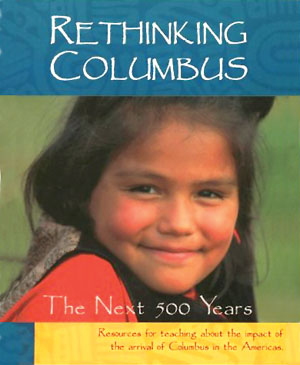
There are over 1,000 students in the classes. Now, I doubt that 1,000 students would head over to the library to check out Rethinking Columbus, but I wondered how many copies there are in the libraries.  It was easy to find out. Their library databases are online. Here's what I found (I wasn't able to access the database at Southwest Alternative High):

Catalina High has 0 copies
Cholla High has 1 copy
Howenstine High School has 0 copies
Palo Verde has 0 copies
Project M.O.R.E. School has 1 copy
Pueblo High has 2 copies
Rincon/University High has 0 copies
Sabino High has 0 copies
Sahuaro High has 0 copies
Santa Rita High has 0 copies
Tucson High has 0 copies

Amongst the TUSD high school libraries, there are 4 copies of Rethinking Columbus.

Perhaps, as I write, the librarians are entering additional copies (the ones taken from the classrooms) into their databases... Anybody know? Are those boxed copies being put on library shelves?

________________________________________________________
FOR A COMPREHENSIVE LIST OF AICL'S COVERAGE, CLICK ON:
AICL Coverage of Arizona Law that resulted in shut down of Mexican American Studies Program and Banning of Books

"Reports of TUSD book ban completely false and misleading"

 [Note: A chronological list of links to AICL's coverage of the shut-down of the Mexican American Studies Department at Tucson Unified School District is here. Information about the national Mexican American Studies Teach-in is here. The best source for daily updates out of Tucson is blogger David Abie Morales at Three Sonorans.]
______________________________________


Yesterday afternoon, the Tucson Unified School District issued the following press release: "Reports of TUSD book ban completely false and misleading."

I've pasted the press release below, placing TUSD's contradictory statements in red. As you'll read, the press release says only seven books were boxed up and removed from the classrooms, but, the press release also says they removed materials from a file cabinet.

Neil Gaiman said it well on his twitter feed:
"Every BannedBookWeek there are people who claim books are never banned in the US. Sometimes they're just put in boxes." 

Another thing to note in the press release... Teachers can teach The Tempest as long as they do it appropriately. To understand the inappropriate way to teach it, according to the law passed in Arizona, listen to Curtis Acosta discussing his pedagogy with school administrators

Here's the press release:
__________________________________

Reports of TUSD book ban completely false and misleading

Posted on: January 17, 2012
Contact: Cara Rene, Communication Director, (520) 225-6101, Cara.Rene@tusd1.org

Tucson Unified School District has not banned any books as has been widely and incorrectly reported.

Seven books that were used as supporting materials for curriculum in Mexcian American Studies classes have been moved to the district storage facility because the classes have been suspended as per the ruling by Arizona Superintendent for Public Instruction John Huppenthal. Superintendent Huppenthal upheld an Office of Adminstriation Hearings’ ruling that the classes were in violation of state law ARS 15-112.

The books are:
  • Critical Race Theory by Richard Delgado
  • 500 Years of Chicano History in Pictures edited by Elizabeth Martinez
  • Message to AZTLAN by Rodolfo Corky Gonzales
  • Chicano! The History of the Mexican Civil Rights Movement by Arturo Rosales
  • Occupied America: A History of Chicanos by Rodolfo Acuna
  • Pedagogy of the Oppressed by Paulo Freire
  • Rethinking Columbus: The Next 500 Years by Bill Bigelow
NONE of the above books have been banned by TUSD. Each book has been boxed and stored as part of the process of suspending the classes. The books listed above were cited in the ruling that found the classes out of compliance with state law.

Every one of the books listed above is still available to students through several school libraries. Many of the schools where Mexican American Studies classes were taught have the books available in their libraries. Also, all students throughout the district may reserve the books through the library system.

Other books have also been falsely reported as being banned by TUSD. It has been incorrectly reported that William Shakespeare’s “The Tempest” is not allowed for instruction. Teachers may continue to use materials in their classrooms as appropriate for the course curriculum. “The Tempest” and other books approved for curriculum are still viable options for instructors.

The suspended Mexican American Studies classes were converted last week to standard grade-level courses with a general curriculum featuring multiple perspectives, as per the directive by the state superintendent. Students remained in classes with their teachers, who are now teaching general curriculum.

As the district has taken action to comply with the order from the state, the goal of the district has continued to be to prevent disruption to student learning. Books used as instructional materials in the former Mexican American Studies classes were collected only from classrooms in schools where the courses were taught. Again, all the books are still available to students through the TUSD library system.

In one instance, at Tucson High Magnet School, materials were collected from a filing cabinet while students were in class though teaching did not stop during the process.

Tucson High Magnet School Principal Dr. Abel Morado acknowledges that the gathering of materials could have been accomplished outside of class time in all instances.

“We had a directive to be in compliance with the law and acted quickly to meet that need,” says Morado. “Part of that directive is communicating with teachers, students and parents, and collecting materials. We regret that in one instance materials were collected during class time.”

________________________________________________________
FOR A COMPREHENSIVE LIST OF AICL'S COVERAGE, CLICK ON:
AICL Coverage of Arizona Law that resulted in shut down of Mexican American Studies Program and Banning of Books

TUSD vs The Tempest: To teach or not to teach

[Note: A chronological list of links to AICL's coverage of the shut-down of the Mexican American Studies Department at Tucson Unified School District is here. Information about the national Mexican American Studies Teach-in is here. The best source for daily updates out of Tucson is blogger David Abie Morales at Three Sonorans.]
______________________________________


Yesterday afternoon, the Tucson Unified School District issued a press release that says reports of book banning are misleading. They specifically say that teachers can teach The Tempest. As this audio demonstrates, teachers who taught in the Mexican American Studies program can teach it if they can do it without talking about race or oppression. [Source for video: Three Sonorans YouTube channel]


"Once you begin to describe the Natives, and once you begin to delve into issues that are going to be from a critical race theory perspective, that's when you're not in that safe harbor, so to speak."


________________________________________________________
FOR A COMPREHENSIVE LIST OF AICL'S COVERAGE, CLICK ON:
AICL Coverage of Arizona Law that resulted in shut down of Mexican American Studies Program and Banning of Books

Tuesday, January 17, 2012

Authors banned in Tucson Unified School District respond

[Note: A chronological list of links to AICL's coverage of the shut-down of the Mexican American Studies Department at Tucson Unified School District is here. Information about the national Mexican American Studies Teach-in is here. The best source for daily updates out of Tucson is blogger David Abie Morales at Three Sonorans.]

Editors Note on Feb 25, 2018: Please see my apology about promoting Alexie's work. --Debbie
______________________________________


As I find them, I will add responses from authors whose books were taught in the now-outlawed Mexican American Studies program at Tucson Unified School District:

SHERMAN ALEXIE 

On January 17th, 2012, Sherman Alexie tweeted:


Teachers who taught in the Mexican American Studies program that was shut down last week are no longer allowed to teach two of his books:


On January 29, 2012, I read Alexie's response at The Progressive. He wrote:
Let's get one thing out of the way: Mexican immigration is an oxymoron. Mexicans are indigenous. So, in a strange way, I'm pleased that the racist folks of Arizona have officially declared, in banning me alongside Urrea, Baca, and Castillo, that their anti-immigration laws are also anti-Indian. I'm also strangely pleased that the folks of Arizona have officially announced their fear of an educated underclass. You give those brown kids some books about brown folks and what happens? Those brown kids change the world. In the effort to vanish our books, Arizona has actually given them enormous power. Arizona has made our books sacred documents now.


RUDOLFO ANAYA (added on Jan 25, 2012):

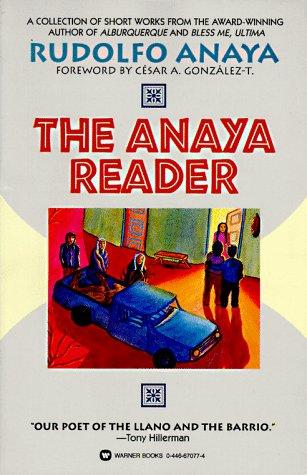
On Friday, January 21, Rudolfo Anaya was on Jay Nightwolf's radio program. You can listen to the program by going to the Zinn Education Project website. Anaya is the author of Bless Me Ultima, and The Anaya Reader, two books that were taught in the Tucson Unified School District's Mexican American Studies program that was shut down.


JIMMY SANTIAGO BACA

On January 28, 2012, I read Jimmy Santiago Baca's response at The Progressive. In part, he writes:
The banning in Tucson is a political tactic to oppress us, just the latest attempt of many to lie to us, to spread distortions, to enfeeble us by taking away our rights to education. They know that education is a way to achieve equality, to empower ourselves, to see ourselves with pride and enhance our self-esteem. Books that see us as intelligent, that reflect our experience in a healthy light, lend themselves to invigorating our resistance against injustice.
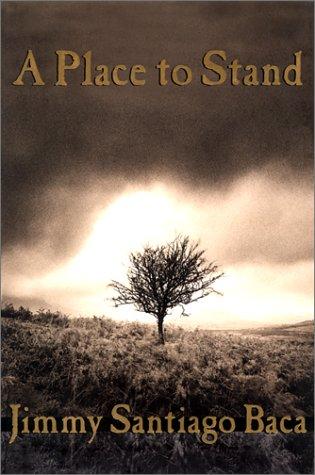
Six of his books were used in the now-banned Mexican American Studies program, including A Place to Stand.


BILL BIGELOW

On January 13, 2012, Bill Below wrote on the Rethinking Schools blog: 
Rethinking Schools learned today that for the first time in its more-than-20-year history, our book Rethinking Columbus was banned by a school district: Tucson, Arizona.  [...] What’s to fear? Rethinking Columbus offers teaching strategies and readings that teachers can use to help students consider perspectives that are too often silenced in the traditional curriculum. 

Teachers who taught in the Mexican American Studies program that was shut down last week are no longer allowed to teach Rethinking Columbus, a book he edited that includes essays, poems, and prose by American Indian writers.


JOSEPH BRUCHAC

In an email to me on January 17, 2012, Joseph Bruchac said:

In the long run, I think the actions of the Tucson
School Board may end up in a positive way--by
drawing attention back to RETHINKING COLUMBUS
and creating further awareness of the complex legacy
of Cristobal Colon. Either this was their intention all
along (closet progressives that they are on the school
board) or (thinking in terms of nautical metaphors), they
are attempting to save the sinking ship of the myth of
heroic European colonialism by an action as effective as
bailing with a tea cup!
His essay, "A Friend of the Indians" is in Rethinking Columbus, a book that teachers who taught in the Mexican American Studies program are no longer allowed to teach.

RICHARD DELGADO and JEAN STEFANCIC (added Jan 31, 2012):

On January 31, 2012, I read Richard Delgado and Jean Stefancic's response at The Progressive. Here's an excerpt:
Young minds will not learn about critical race theory or Latino history or the historic struggles of their predecessors for school desegregation, immigration reform, and equal rights. They may learn about them piecemeal, but without an overarching framework, it will be difficult for them to develop a comprehensive view of race in American society. 
Their book, Critical Race Theory, was taught in the now-shut down Mexican American Studies department at Tucson Unified School District.


JUNOT DIAZ (added January 29, 2012):

On January 29, 2012, I read Junot Diaz's response at The Progressive:
This is covert white supremacy in the guise of educational standard-keeping--nothing more, nothing less. Given the sharp increase of anti-Latino rhetoric, policies, and crimes in Arizona and the rest of the country, one should not be surprised by this madness and yet one is. The removal of those books before those students' very eyes makes it brutally clear how vulnerable communities of color and our children are to this latest eruption of cruel, divisive, irrational, fearful, and yes racist politics. Truly infuriating. And more reason to continue to fight for a just society. 
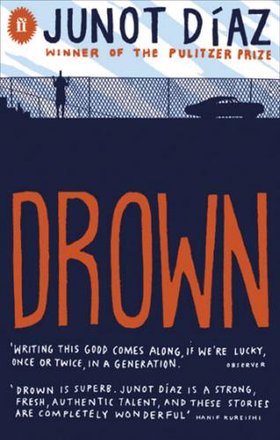
His book, Drown was taught in the now-banned Mexican American Studies program.


MARTIN ESPADA (added January 31, 2012)

Earlier today, I read Martin Espada's response at the Progressive website. He said, in part:
In the end, this is just another bomb threat. All they have done is force us to evacuate the building. We will gather ourselves in the dark, and keep reading to each other in whatever light we can find.
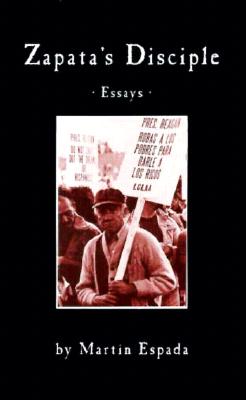
His book, Zapata's Disciple: Essays, can no longer be taught by teachers who taught in the now-banned Mexican American Studies Department at Tucson Unified School District.


DAGOBERTO GILB (added January 31, 2012)

Yesterday, I read Dagoberto's response at The Progressive website:
What subversive information did those Tucson students learn? What is kept from the government-approved textbooks and classrooms all across the West?: You don’t have to be from somewhere else more important and better to be a lawyer or an artist or a doctor or scientist. You don’t have to leave your culture. You don’t have to be ashamed that your parents struggled with English. We don’t have to accept being only the cooks and maids, custodians and gardeners.
Two of his books are on the Cambium audit and can no longer be taught by the teachers in the now-banned Mexican American Studies Department.


SUZAN HARJO

In an email to me on January 18, 2012, Susan Harjo said:
The banned books and other materials removed from the Tucson public schools are a good start for a required reading list. I consider it a mark of distinction to be among the banned authors for my part of Rethinking Columbus. I am honored to be in the company of other writers who are targeted in Arizona's war on ethnic studies. I hope their reckless actions help raise awareness among more and more people of good will about what this last gasp of white supremacy is doing to our children and young people. 
Her essay, "We Have No Reason to Celebrate" is in Rethinking Columbus, a book that teachers who taught in the Mexican American Studies program are no longer allowed to teach.

Update, January 25th, 2012: Harjo wrote an extended essay for Indian Country Today. For more on her response to being banned, see Rethinking Columbus: Book Banning in Tucson.

WINONA LADUKE (added January 25, 2012):

On January 21, 2012, Winona LaDuke's response to being banned was published at INFORUM. Her essay is in Rethinking Columbus, one of the books boxed up and removed from classrooms in Tucson Unified School District. Rethinking Columbus is no longer being taught in TUSD. See LaDuke's "On Being Banned in Tucson."

WILLIAM L. KATZ

On January 18, 2012, via email, I received William L. Katz's response:
As the writer of two essays contributed from my Black Indians: A Hidden Heritage to Rethinking Columbus, a former public school teacher for fourteen years, and the writer of forty history books that have earned praise from sources ranging from the Wall Street Journal to Howard Zinn, I can only hope this pathetic censorship of ideas and knowledge that aims to keep young people uninformed about their lives, their society and the struggles that shaped their country and world, that this stupid decision in Arizona, will finally lead to a resounding victory for an inclusive, multicultural curriculum. We all deserve that, to read what we want, to learn what we need, and to understand our history not as patriotic, tasteless pablum, but something substantial and true enough to enable us to live in a country and world that was built by women and men of every race and region, and to appreciate and enjoy our neighbors. Part of this is learning that women and men were not handed democracy and justice but often had fight and sometimes die for it, and this is particularly true if they were in the way of those bent on conquest, exploitation, or just the pursuit of obscene profits.

His essay, "Black Indians and Resistance" is in Rethinking Columbus, a book that teachers who taught in the Mexican American Studies program are no longer allowed to teach.

MATT DE LA PENA

On January 16th, Matt de la Pena wrote on his blog:
A truly scary situation. Tucson schools have just “shut down” all courses related to Mexican American Studies (in essence, banning Chicano authors). If you’re familiar with Tucson’s racial makeup, you know this means that literally thousands of Chicano students will no longer be allowed to see a reflection of themselves in literature. The teachers literally had to pack up the books and remove them from their classrooms.

Teachers who taught in the Mexican American Studies program that was shut down last week are no longer allowed to teach his book, Mexican WhiteBoy.


BOB PETERSON (added Jan 31, 2012)

On January 16, 2012, Bob Peterson wrote on his blog:
What’s most disturbing is the banning’s broader context, in particular Arizona’s anti-immigrant legislation and the move across the country toward scripted curriculum that too often ignores students’ cultural heritages and that undermines the ability to promote critical thinking. On a more positive note, however, the banning can be seen as the flailing of small-minded bigots attempting to derail multicultural, anti-racist curriculum. In this sense, the move is similar to the anti-gay rantings of Santorum and Company. 
Teachers who taught in the Mexican American Studies program that was shut down last week are no longer allowed to teach Rethinking Columbus, a book he edited that includes essays, poems, and prose by American Indian writers.


CORNEL PEWEWARDY

On January 20, 2012, Cornel Pewewardy sent me the following comment by email:

The "Empire" Strikes Back via a Neoliberal Agenda

His essay, "A Barbie-Doll Pocahontas" is in Rethinking Columbus, a book that teachers who taught in the Mexican American Studies program are no longer allowed to teach.


ROBERTO RODRIGUEZ (added on Jan 25, 2012):

On Friday, January 21, Roberto Rodriguez was on Jay Nightwolf's radio program. You can listen to the program by going to the Zinn Education Project website. Rodriguez is the author of Justice: A Question of Race and The X in La Raza II (I am unable to locate a cover of the book; please send me a link or image), both of which were used in the Tucson Unified School District's Mexican American Studies program that was shut down.


LUIS ALBERTO URREA (added January 29, 2012)

On January 29, 2012, I read Luis Alberto Urrea's response at The Progressive website:

The issue seems to be the power boys and girls are afraid that studying MacArthur winning Tohon O'odam poet Ofelia Zepeda is un-American. Cult-like. Divisive. Yes, that's right--Indians are out too. Sherman Alexie, that notorious wetback, has been ba--ed, boxed. As well as that notorious narco, Guillermo Shakespeare. Thoreau--well. Come on. When isn't Thoreau banned? I hereby make him an Honorary Homeboy.

Urrea is the author of five books on the list of works taught by teachers in the now-banned Mexican American Studies program, including The Devil's Highway: A True Story. 

 
________________________________________________________
FOR A COMPREHENSIVE LIST OF AICL'S COVERAGE, CLICK ON:
AICL Coverage of Arizona Law that resulted in shut down of Mexican American Studies Program and Banning of Books