
Thursday, June 09, 2011

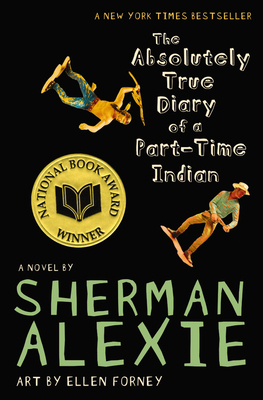
Australian cover for ABSOLUTELY TRUE DIARY OF A PART TIME INDIAN

Editors Note on Feb 25, 2018: Please see my apology about promoting Alexie's work. --Debbie


This is the Australian cover for Sherman Alexie's The Absolutely True Diary of a Part Time Indian! Wow! It does what Scott Andrews suggested yesterday in his comment to my post about the original cover and one created by a teen reader.

This cover-conversation started on the yalsa-bk listserv when Joy shared the cover the teen created. This morning (reading the yalsa-bk discussion via digest), I read Lucy's email with the Australian cover. She said that basketball isn't big in Australia, so, she didn't think a cover with a basketball would work there.

Doing a search in Google images, it looks like this cover is also the one used in New Zealand. I'm wondering if it is available anywhere in the U.S.?

Notice, too, the comment from Neil Gaiman? It says "I have no doubt that in a year or so it'll be winning awards and being banned."


In my search of covers, I also found a couple of others. This one, with the white background, is the copy I got. It is the cover used on the ARC (advanced reader copy):


This one is for the audio book:


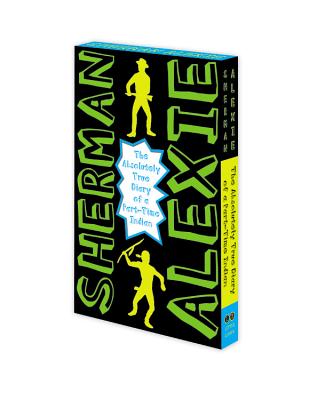
This one, I gather, is the collector's edition. The website with this cover says it is "beautifully designed with a nifty new look that includes a foil-stamped, die-cut slipcase and 4-color interior art." 

And here's a page of that 4-color interior art:


Interesting all around...

__________________________
Update, 7:20 CST, June 9, 2011

I sent out a request, asking colleagues to point me to additional covers. Thanks, Alison in the UK, for these from Amazon!

The editors for this version are Gunthild Porteous-Schwier and Ingrid Becker-Ross.  


This one doesn't list editors but there is a colon after the title, followed by "Lekturen Englisch."
I clicked on the look inside option. Inside is an "About the Author" page that is not in the U.S. editions I have on my shelf.  The text in this version is in English, but along the margins are numbers that function like footnotes to notes included at the bottom of the page.  The author's note says that Alexie was "often teased and bullied by other children on the reservation." At the bottom is a note that says:
to tease and bully hanseln, tyrannisieren

I think that language is Dutch.

I'll add other titles as I learn of them. 

_______________________________

Update, 5:38 AM CST, June 10, 2011

Melanie in the UK pointed me to the French cover. See the shadow image on the wall? See the feather? Suggesting his Native identity is a shadow...  It would be fascinating to collect the thoughts and decision making process of the individuals who created the new covers.


John in Illinois suggested a search of Amazon UK. I did so, and found this one. No accompanying info on language, editors, etc... [Update: 6:26 AM CST, June 10. Sarah on child_lit says the language is Japanese.]


Mary in North Carolina pointed me to another cover for the audio book:


Using WorldCat, I found the Spanish version:


I think this is German (please let me know if I'm wrong):


Here's a book talk of Das Absolut:


_______________________________
Update: 9:08 AM CST, June 13, 2011

Malin in Sweden wrote to point me to the cover used on the Swedish translation:


Cammie submitted a comment (below in comments) directing me to another cover for the French translation:


Wednesday, June 08, 2011

Dang...

Nothing quite like starting a new novel and running into 'native as in born here, not savage' on the first page.

The book is What Happened to Lani Garver by Carol Plum-Ucci.

Teen-created cover for Alexie's PART-TIME INDIAN

Editors Note on Feb 25, 2018: Please see my apology about promoting Alexie's work. --Debbie

On the yalsa-bk listserv, a librarian in California wrote that some books are a hard sell to students because they have unattractive covers. Her example is Sherman Alexie's The Absolutely True Diary of a Part Time Indian. Here's the cover:


I love the cover. For me, it reflects the narrow way that a lot of Americans see American Indians. Not as people, but as toys in a cowboy and Indian context.  But I am a Pueblo Indian woman. My perspective is different from, say, the students in Joy's library.  One of her students created a new cover for the book. Here's the cover, available at Joy's wiki:


Cassie (another subscriber) says the book cover is great because the basketball and the geometry book speak directly to a teen reader, and that the necklace on the book "adds a touch of the unknown."

It would be interesting to find out which cover appeals to whom. I'm definitely going to ask my nephews on the reservation to tell me which one they'd pick up first... I'll let you know what they say.

What do you think? Which one do you prefer? Which one do you think teens would prefer?
__________

Update, 11:44 AM CST, June 8, 2011
Below are comments I receive on my facebook posts, and, by private email:

Martina, Dine (Navajo) said her teens picked up the book on their own last summer. The cover didn't turn them away. Their actions suggest they were drawn to the book because of the cover.

Susan in Oklahoma works with Creek, Euchee, and white students in their Summer Reading Program. She asked the group and says that they "all liked the original cover best."

"Others: 31%"

The New York Times has an interactive mapping feature called Mapping America available where you can "Browse local data from the Census Bureau's American Community Survey..." to see the distribution of racial and ethnic groups in an area of the US by searching on a zip code.

Data is presented as dots that represent specific groups of people. There are green dots for Whites, blue dots for Blacks, yellow dots for Hispanics, red dots for Asians, and gray dots for Others.

There is no dot for American Indians.

Most survey's don't list us as an option. I've gotten several phone surveys over the years about politics wherein the caller is also collecting demographic data. "American Indian" is never one of the choices I'm given. We are, to use the jargon, "statistically insignificant" in terms of the data. We are, however, overrepresented in terms of Native images on commercial products (like Land O'Lakes) or for school mascots. But wait! Those images are stereotypes, not reality. 

Who we are, in reality, is... invisible. Invisible as "other." 

At the Times page, I entered the zip code for Nambe Pueblo in the search box. You can do it to, and see what I mean. Our zip code is 87506. You'll end up on a map that includes Santa Fe. Lot of yellow dots clustered there, and some white ones, too.


If you hover your mouse over the map (at the Times site), specific "census tracts" pop up. In those pop up boxes, you'll get data on that tract. When I hover the mouse over the area where Nambe is located, the data I get says:
Census tract 10103
Population estimate: 1,710
Whites: 13%
Blacks: 0%
Hispanics: 55%
Asians: 1%
Others: 31% 

Interesting! "Others: 31%" is the tribal members of a federally recognized tribal nation.

When I hover the mouse over the area south of Santa Fe where Kewa Pueblo (formerly known as Santo Domingo) is, here's what the box says:

Census tract 9402
Population estimate: 3,574
Whites: 1%
Blacks: 0%
Hispanics: 3%
Asians: 0%
Others: 96%
In that box, "Others: 96%" is tribal members of another federally recognized tribal nation.

Messed up, don't you think? The people (American Indians) that Americans purport to "honor" with mascots and other stereotypical images don't rate high enough for who we are IN REALITY to be listed...  What would happen if all those defenders of that stereotypical imagery rallied around us as people of the present day instead of defending the use of those stereotypes?

Monday, June 06, 2011

A Right to Justice: Native Youth Theater Play about Police Brutality

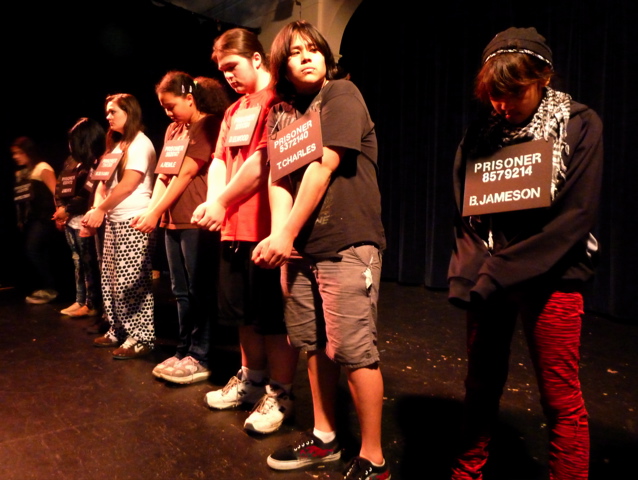
Photo credit: Charla Bear, KPLU, Seattle


The young people in this photograph are Native actors in A Right to Justice, a play being done in Seattle on June 12th, 2011 at the Rainier Valley Cultural Center. Produced by Red Eagle Soaring, it isn't the play the group had intended to do...  They wanted to do a play about basketball but the young actors couldn't get into it because they are trying to understand police brutality:
This play (written by our students and their teaching artists Drew Hobson and Hannah Franklin) explores our relationship as Natives with police and other authority figures, and touches on the haunting tragedy of Chief Leschi, whose story still evokes the sting of injustice 153 years after his hanging. 
The brutality the play is about spans a great length of time.

On a summer afternoon in August, 2010, John T. Williams, a Native woodcarver, was shot and killed by Ian Birk, a Seattle police officer. An investigation by the Seattle Police Department found the shooting was not justified.

The police officer's dash camera was on during the shooting. In it, you'll see Williams crossing the street in the crosswalk, in front of the police car. As he walks, he is carving a plank of wood. He goes out of camera view.

Birk got out of his car and called out "Hey, hey, hey! Put the knife down! Put the knife down!" He, too, goes out of camera view, and you hear gunshots. The video lasts over six minutes, during which you hear Birk say that he told Williams to put the knife down and that he was using it to carve the board.

This shooting has been featured prominently in Native news media since then. I cannot imagine what it must feel like to Seattle's Native community to see this video. Watching it, I understand how the shooting would shadow the youth in the community, and, I'm glad to see Red Eagle Soaring's efforts to help them process what happened.

Friday, June 03, 2011

TRIBES OF NATIVE AMERICA - series

This morning a librarian in New Jersey wrote to ask about the Tribes of Native America series published n 2002 by Blackbirch Press.

I don't know the series, but did a bit of searching and found a review of the Zuni volume in the series. That review is on Amazon, and it was submitted by Codi Hooee, a library media assistant at Zuni High School. She writes that she was "very disappointed" with the book. The historical information is correct, she says, but many of the captions for photographs and drawings are incorrect. And, she wrote:
What I found most offensive was the use of a photograph of our very sacred Sha'la'ko ceremony. Overall this book was poorly written, an example from the Customs section on page 25, "Among these are the June Rain Dance, held in August,..." The editors needed to be more thorough in researching the topic. 
She doesn't recommend the book.

Here's the cover for the Cahuilla volume. It is the same cover used for all the books in the series. The only thing that changes is the name of the tribal nation, at the bottom. It is a one-size-fits-all cover that suggests to me that the publisher didn't want to take the time or invest much money in developing the series. Codi's review notes that the book lists "the June Rain Dance" that is "held in August." Oops! Didn't the series have an editor who'd catch that sort of error?!

If that is the care and attention given to the entire series, it is not one I'd spend any money on...  If you're considering it for your collection, pass it up.

Thursday, June 02, 2011

Tim Tingle and Matt Dembicki at ALA

Tim Tingle, enrolled member of the Choctaw Nation of Oklahoma, and author of some of my favorite picture books, and Matt Dembicki will be at ALA this year as part of a panel that will discuss Dembicki's graphic novel, Trickster.

According to the ALA press release, a third person on the panel will be Michael Thompson, a high school English teacher in New Mexico. Thompson is a member of the Muscogee (Creek) Tribe. Forty percent of the students in his high school are Navajo.

The panel, "Trickster: Engaging Readers, Honoring Traditions" is scheduled for Sunday from 4 to 5:30 in room 284 o the Morial New Orleans Convention Center. It is sponsored by ALA's Committee on Rural, Native, and Tribal Libraries of All Kinds, the American Indian Library Association (AILA), and, ALA's Young Adult Library Services Association (YALSA).

I'm attending ALA this year and am really looking forward to hearing what they have to say!