Tuesday, August 13, 2024

Highly Recommended: WINGS OF AN EAGLE: THE GOLD MEDAL DREAMS OF BILLY MILLS, by Billy Mills and Donna Janell Bowman, illustrated by S. D. Nelson

                  HIGHLY RECOMMENDED 

Wings of an Eagle: The Gold Medal Dreams of Billy Mills
by Billy Mills (Oglala Lakota) and Donna Janell Bowman (not Native)
Illustrated by S. D. Nelson (Standing Rock Sioux Tribe)
Published in 2024
Publisher: Little, Brown Books for Young Reader
Reviewer: Debbie Reese
Review Status: Highly Recommended

****


I spent several hours over the last two weeks, watching the 2024 Olympics. Part way in, I saw that Billy Mills was there. He was sharing photos to his Facebook page. I pulled up the video of his race and shared it with my family. I've seen it many times before, but every time I watch it, I feel a huge surge of excitement. And joy, and pride. Take a look:


Pretty cool, isn't it?!

Now, order a copy of his autobiographical picture book, Wings of an Eagle: The Gold Medal Dreams of Billy Mills! I've heard him speak and know some of his life story but I'm really glad to see his book. Published on July 2, 2024 by Little, Brown Books for Young Readers, I got my copy during the 2024 Olympics. 

There are many pages that stood out as I read the book. His parents died when he was a child. His dad's words after his mother's death become a refrain as he grows into adulthood. A photographer asked him to step away from a group of runners because of his skin color. 

In this post, I focus on the page in his adulthood when he's a Marine at a base in California. Up to then, he ran in high school at Haskell Institute in Kansas, and then in college at the University of Kansas. On the page where he talks about the grueling training he does while he's in the Marines, we read:
I visualize the finish-line tape breaking across my chest 
again and again, 
as if fueled by Indigenous ancestors
who didn't give up when all odds were against them.
Their footsteps are etched into the earth
like a story waiting to be told.
When I qualify for the 1964 Olympics,
I carry the hopes of many.
Because we are stronger together.

I'm going to repeat (and put in bold) some of those words, here: "fueled by Indigenous ancestors who didn't give up when all odds were against them." Across the US and Canada, I hear similar words from Native people. Fueled by Indigenous ancestors who didn't give up. Heck, that guides me, too! When things feel weighty I remember Po'Pay and Pueblo ancestors who didn't give up in the 1500s when European invaders sought to destroy us. Native leaders negotiated to protect the generations that came after them. I suppose some of you are thinking my words here are sappy, but that's ok. I'm here. Billy's here. We're here. 

And he's leading, still! Mills established an organization called Running Strong for American Indian Youth. The final pages of the book provide many photos of his work with youth. Back matter also includes a terrific note from Mills, one from the illustrator, S. D. Nelson, and one from the co-author, Donna Janell Bowman. If you've heard me in a professional development workshop, you know I direct teachers, librarians, parents, and caregivers to study the back matter before using the book with children! There, you'll get information you probably never had before you picked up this wonderful book. 

Update at 4PM on August 13: There's a curriculum guide! Written by Dr. Natalie Martinez! She rocks. Download and use it. 

I'll end this review with a request to get multiple copies of the book for your classroom and school library, and with S.D. Nelson's illustration of Billy crossing the finish line. See the joy in Billy's face? And look at that eagle (remember I said his dad's words become a refrain?)! Highly recommended! 


Monday, July 08, 2024

NOT RECOMMENDED: BACK IN THE BEFORETIME. TALES OF THE CALIFORNIA INDIANS by Jane Louise Curry

A reader wrote to ask if I've read Back in the Beforetime: Tales of the California Indians by Jane Louise Curry. 

The answer? I had not, but the reader's question prompted me to take a look. 

It came out in 1987 from Margaret K. McElderry Books and again in 2001 from Aladdin. It is written  by a person who (as far as I can tell) is not Native.  Back in the Beforetime is one of several books Jane Louise Curry has written about Native peoples. I was able to get an electronic copy of her book. The first thing I do when taking a critical look at a book is to see if there's an Author's Note. There is one in this book. Reading it, I was pretty sure I would not recommend the book. Let me show you what I mean. 

The first sentence of the note starts with "The Indian tales." That word -- tales -- is familiar. You see it with "folk" and "fairy" and "tall" but you rarely see it used with Bible stories. In my work, I've come to see that as a problem. Many "tales" are creation stories considered sacred to the people who tell them, but their stories aren't treated with the same respect given to Bible stories. You don't see Bible stories categorized or shelved as folktales. As I read further, would I find a lack of respect in Back in the Beforetime?

Let's see. The first sentence in its entirety is:
The Indian tales of Back in the Beforetime come from a number of California tribes, from the Klamath River region in the north to the inland desert mountains and the southern coastlands. 
Here's the second one:
In reading through the many tales and fragments of tales recorded during the past century, I chose first those legends which could be woven together to tell the larger tale of Creation from the making of the world to man's rise to lordship over the animals, and then a selection of comic or trickster folktales which seemed to fit happily within that framework.
Hmmm. There's a lot to respond to in that sentence. "Lordship over the animals" sticks out and feels very white to me. And where, I wonder, was she finding these "tales and fragments of tales"? Reading to the end of the note, I don't see a list of her sources. That's important information. Knowing them would help us a lot. Her sources are likely ones collected by white people who had no idea what they were doing when they looked upon Native ways. Their lack of knowing meant their account is a misrepresentation of what was going on. The second part of that sentence tells us she chose legends that "could be woven together" to tell what she calls "the larger tale of Creation." What she did, when she wove some together, is a huge red flag. Why? Because she assumes that all these tribes are the same in how they think about the world. Many writers do that. They take something from one tribal nation's stories and then take something from a different one, and put them together as if that's fine. I don't think it is fine, particularly when books will be used in classrooms to teach children about Native peoples. In fact, anybody who reads the book is being miseducated. 

Third sentence:
In several instances, where a story was incomplete or lacking in detail which could be found in a second version from the same or another tribe, I have told a composite tale.
See? She says right there that she pulled from several places (that she must assume are accurate) to create a "composite" tale. You might be thinking that I've being harsh. You might be thinking that Curry and her editor and others who did the same thing didn't know better. That they had good intentions. We can assume ignorance and good intentions but the product is still deeply flawed. The book came out in 1987. By then there were many people writing about misrepresentations. As far back as 1829, Native people were objecting! Take a look at William Apes (Pequot) on Depictions of Native People in Stories. Many people defend what an author does by saying that nobody spoke up, then, and that it is unfair to challenge the author. People say that about Gone With the Wind but when the movie came out, African Americans protested at a theater in 1940. The New York Times article has photos of the protest. My point is that the author and editor may not have known they were publishing a flawed product--but that doesn't mean people weren't objecting. What anyone knows is shaped by who they know and what they read. 

Back to Curry's note. In paragraph two, sentence one:
Several of the California tribes are represented in Back in the Beforetime by more than one tale, and many by none.
Reading that sentence, I thought that when I read the stories in her book, I'd see names of specific tribal nations. Some would be mentioned more than once because "more than one tale" was from one tribe. That was not the case. Here's the table of contents:


See? Titles of stories, but no tribally specific information. Is there some with each story? Easy enough to check. I turned to the first one: 


There is no tribal nation mentioned after the title, and as I read the story, I didn't find one there, either. On the last page of that story, I see that after having created Grizzly Bear, "Old Man" was afraid of him So, Old Man retreated to his ice mountain and began to "hollow it out for a teepee." A teepee? I wonder about that because I associate tipis with Plains Indians. Curry finishes the story by telling us that the animal people Old Man created never saw him again, but sometimes, they'd see smoke coming from "the smokehole of the white teepee mountain and knew he was still there. They called his mountain Shasta. And so do we, for it is still is there." (Note: I am tempted to go down a rabbit hole wherein I search for "Old Man" and "Shasta" to see if I can find the source for Curry's story. I may do that later.) 

In the second paragraph of the Author's Note, the second sentence is:
Being a storyteller rather than a folklorist, I have not sought to make a representative collection, but one which will offer to readers or to a storyteller's audience entertaining tales that can both stand alone and give some sense of what the context of a single story might have been within a tribe's traditional body of tales.
Entertaining? Ok. Stories do that, but within an educational context, the goal is education. Learning. Understanding. When the stories are about Native peoples, it is crucial that they be specific to a tribe. Without specificity, we all fall into stereotypical chasms that suggest all Native peoples are the same. We're not. 

Next is the third paragraph. First sentence:
Many California tribes have dwindled or vanished. 
Too many books use that sort of language. "Vanish" is especially outrageous. It means to disappear suddenly, without a trace. That's not what happened. Things don't just happen.  Colonization, invasions, killings, removals... that's what happened, over a period of time. Native people fought back. There's more to say about that style of writing but I'll move on to the next sentences.
Others still struggle to preserve their traditions and holy places in a world of change. Of some, little trace is left but their tales, recorded long ago by folklorists and anthropologists.
Part of that "struggle" involves pushing back on misrepresentation that started with those long ago recordings. We could insert "white" in front of folklorists and anthropologists but unless you've studied how they got it wrong, inserting white doesn't help much. 

The last sentence in the Author's Note:
For us their tales of the Animal People, in whom animal and human natures are mingled, are both comic and poignant, reminding us that once there was a time when Man was more fully at home in the natural world.
Comic? As in funny? Amusing? Ludicrous? Ridiculous? The author is definitely making a judgment that bothers me. But I remind myself that her sources may have that quality in them --- because the folklorist or anthropologist got things wrong. 

That's the end of the author's note. And from what I've seen, my earlier thought that I'd not be recommending the book stands. I do not recommend Back in the Beforetime. 


I encourage you to stop using it in your classrooms. And as always, if something I've said doesn't make sense or if you want me to say more, let me know in the comments.


Friday, July 05, 2024

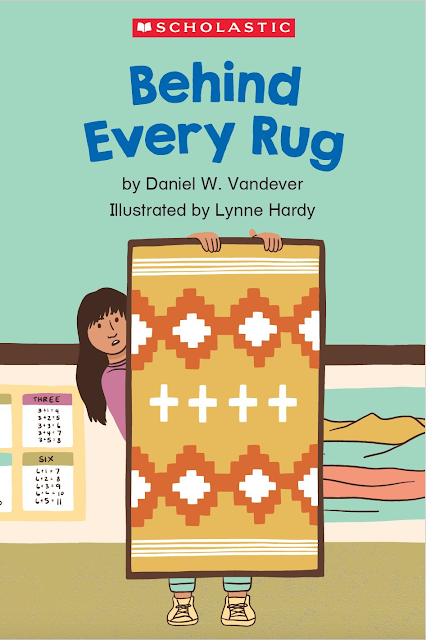
Highly Recommended: BEHIND EVERY RUG by Daniel W. Vandever and Lynne Hardy

Those who follow my work know that I've been frustrated many times with things Scholastic does. Sometimes, though, they do a good thing. Case in point? Behind Every Rug. 


HIGHLY RECOMMENDED


This little book is by Daniel W. Vandever. I highly recommended his previous books. Fall In Line, Holden! came out in 2017 from Salina Bookshelf and his self-published Herizon came out in 2021. Both won the picture book award from the American Indian Library Association. His newest book, Behind Every Rug is for readers 6-8 years old. 

On the first page of Behind Every Rug, we see a little girl, Nizhoni, as she has just gotten off the school bus. Her mom is waiting for her on the sidewalk. Nizhoni is shown in athletic shoes, jeans, a hoodie, and a backpack. Her mother is wearing moccasins, a Navajo-style skirt and woven belt. She's got a set of car keys in her hand. 

In other words? This is a story set in the present day. 

Online, Vandever said this story is based on his own experiences as a child growing up in St. Louis, Missouri. Some of you are nodding because you know Native people are in big cities and on reservations. Those of you who are nodding are gonna want to get this book, ASAP! You know that wherever we are, people in our families may wear items that reflect who we are, and that in our homes we have items that reflect our cultural identity (in Vandever's book, Diné). For Native students, Vandever's book is a terrific mirror of their lives. Those of you surprised by a story about a Native family -- set in the present day -- you need this book ASAP, too, to give students in your school or classroom a window onto a Diné family's life.

The words on that first page are spoken by Nizhoni, who tells her mom that she has to take something to school the next day that shows her Navajo culture. On subsequent pages, her mom makes suggestions. We see the items her mother is suggesting. And we read Nizhoni's responses to her mom. There's a hesitancy, an anxiety. How will classmates respond to her and the item she chooses to share? Finally, she decides to take the rug she and her grandmother made. She's nervous when her teacher calls her name but students respond positively. Her words remind classmates of people in their families and things they do. Nizhoni then gives them more information about how the rug was made. Visually we're in different place. We see her grandmother, and her grandmother's hogan. In the end, Nizhoni realizes that being different is not scary. 

Behind Every Rug is in Scholastic's Our Voices: School & Friends collection. Here's the problem.  I can't figure out a way for you to purchase the book. You have to buy a single-copy collection (one copy of ten different books) for $26.99 but you don't know what the other ten books are. Updating on July 14 to say that the editor for the book sent me a link with the titles of the other books Maybe the information is available and I'm not finding it on the Scholastic website! If you see a way to get just that one book, let me know. If a Scholastic rep sees this post, maybe they'll let us know. Perhaps you can ask your child's teacher or a resource person at your school to order the collection. 

And! Just announced today (July 5) is another self-published book from Vandever. Titled We Weave, he shared the cover: 


Bottom line? Look for books by Daniel W. Vandever! 


Saturday, June 15, 2024

Finally! I got to see myself at City Lights Book Store!

Earlier this month, my mom, and my little sister and her husband were visiting us in California. We went to San Francisco one day. I pulled up Google maps to see where we were and peered at the map because it showed we were near City Lights Bookstore. Last year, the bookstore installed a set of banners about banned books on their exterior wall. My face was part of it. I hadn't seen it yet. So--when I saw we were nearing the store, I said "let's go see!!!!" 

Then I realized we were on the very street where the bookstore is located. With some glee, I said "we're on that street!" and we five started looking at the buildings and... there it was! I snapped a photo from the back seat where I was sitting:


We parked in a nearby garage and walked over. My little sister's reaction makes me smile, remembering it. She told a person who was passing by, "THAT'S MY SISTER!" And of course, they looked up at the banner and at me, and smiled at us and our giddiness. My husband took a photo of us three:


And I asked a person to take one of us all (my mom is on the far left, then my husband, me, and my little sister. In front is my brother-in-law). 


It was such a joyous moment for us all! (For details, see Debbie Reese featured on Banner at City Lights Books.) 


Tuesday, June 11, 2024

HIGHLY RECOMMENDED: THE BEE MOTHER

Imagine an overcast, cold, windy, completely dreary early spring day. A plain brown cardboard envelope arrives from Portage & Main -- it must be a review copy of one of their latest books for young people. Rip the cardboard and what should emerge but a much-larger-than-life portrait of a fuzzy, black and yellow pollen-spotted bumble bee foraging on a bright pink flower! "Spring WILL come," the bee seems to say, "and you'll be seeing me. Here's my story." 

This bee is the creation of Metis artist Natasha Donovan. The book is The Bee Mother by Gitxsan writer Hetxw'ms Gyetxsw (Brett D. Huson). That's Nox Ap in Gitxsanimx.  Here she is on the back of our recliner.


The Bee Mother
Written by Hetxw'ms Gyetxsw (Brett D. Huson) (Gitxsan)
Illustrated by Natasha Donovan (Metis)
Published in 2024
Publisher: Highwater Press
Reviewer: Jean Mendoza
Review Status: Highly Recommended 

AICL has enthusiastically recommended the other six books in the "Mothers of Xsan" series. We've urged educators to use them in science curricula. They blend Indigenous (Gitxsan) knowledge and western science, to follow a year in the lives of different animal species significant to the ecosystem of the Gitxsan homeland: sockeye salmon, grizzly bear, wolf, eagle, raven, and frog. There's growing public awareness of the importance of bees in ecosystems across the continent, so The Bee Mother is a timely and relevant addition to the series.

Nox Ap, the bumblebee queen, is the center of the factual narrative, but the author also spends time on two similar insect species-- yellowjacket wasps (also native to the region), and honeybees, introduced to what's currently called North America by humans but now significant to Gitxsan communities. Teachers are likely to find the distinctions among them helpful, as children often are fearful of stinging insects, and have a lot of misinformation about them.

Like other Mothers of Xsan books, The Bee Mother text is engaging, and centers Gitsxan knowledge and words. Natasha Donovan's illustrations are, as always before, appealing and built on fact, and sometimes incorporate formline figures created the author. It's a very effective collaboration overall. There's a good reason these books garner awards and all kinds of positive recognition.

This series is evidence that good picture books aren't only for younger children. Mothers of Xsan books invite readers to engage with the world outside. By showing connections between Gitsxan life and the animals, they also encourage all readers to think deeply about their own relationships with the other species that make their homes on Earth.

 The Bee Mother would be a great resource anywhere on the continent that bees can be found -- and they're just about everywhere. It would be especially cool to invite students to make observational drawings of bees (whether from careful catch-and-release, or preserved specimens, or photographs). When satisfied with their drawings, they could augment them with accurate colors and textures, moving from basic observation to expressing deeper knowledge and understanding of their subject. 

If you're teaching with The Bee Mother, you and your students might want to check out this Bibliovideo interview with Natasha Donovan. Edited on 6/21/2024 to add a link to a Teacher Guide by Jerica Fraser, available as a free e-book from Portage and Main Press.

 It's been months since that cold gray day when my copy of The Bee Mother arrived, with its promise that Spring would come eventually. Today, my prairie plants are finally in bloom, and outside my front window, a bumblebee buzzes around the sunlit spiderwort and coneflower. I'd better go take a closer look.


Highwater Press in Winnipeg, Manitoba

Tuesday, May 07, 2024

Press Release: Introducing Maawn Doobiigeng - the new classification system of the Saginaw Chippewa Tribal Libraries

Note from Debbie: In this morning's email, I received the press release I'm sharing below. Librarians across the US are looking for ways to revisit their classification systems because they are learning -- as the press release states in the first paragraph -- that existing classification systems are "damaging to Indigenous people and are insufficient for accurately describing and providing access to Native topics." For more information, go directly to the Maawn Doobiigeng (Gather Together) page. There, you'll see this graphic:


Press Release: The Saginaw Chippewa Indian Tribe of Michigan is pleased to announce the introduction of Maawn Doobiigeng, the new classification system of the Saginaw Chippewa Tribal Libraries. The three primary systems of classification that were in place – the Dewey Decimal System (DDC), the Library of Congress Classification  System (LCC), and the Library of Congress Subject Headings (LCSH) – are inherently damaging to Indigenous people and are insufficient for accurately describing and providing access to Native topics. In 2019, The Saginaw Chippewa Tribal Libraries were awarded the IMLS National Leadership Grant to facilitate the creation of a new classification system by members of the community. As of April 2024, this new system, titled Maawn Doobiigeng (Gather Together), has been created and is being implemented into the libraries.

Arionna Crispin, project facilitator mentions, “When I heard about a project that was aiming to decolonize and Indigenize the Tribal Libraries, I knew I had to be a part of it. I learned so much about how harmful the previously utilized classification systems are, and I worked with truly amazing people in the creation of this new system. I’m grateful to have been a part of something so incredible and revolutionary, and I hope this work inspires others to make similar changes.”


The Saginaw Chippewa Tribal Libraries were awarded the National Leadership Grant from the Institute of Museum and Library Services (IMLS) in 2019 with the purpose of addressing the question: “How can tribal libraries use traditional ways of knowing and being to break free of the colonialist epistemology of existing library organizational systems that reinforce a damaging worldview?”


There were four phases of the grant project. The first phase was to Assess the cataloging and classification systems currently in place through a decolonizing lens. Next, the team had to Create a system of organization for cataloging and classifying library materials according to Anishinaabe ways of knowing and being. This was followed by having the ability to Implement this system to decolonize and indigenize the Tribal Libraries collections. Finally, gathering data to Analyze results and share documentation that outlines how this project was conducted, provided a framework that other libraries could use as a template for decolonizing the knowledge organization of their collections.


Anne Heidemann, tribal librarian shares, “Over the years of doing the work of cataloging and classifying the books and other materials in the Tribal Libraries, it became clear to me that the existing systems weren’t working well for the community I serve, which led me to write the application for the IMLS National Leadership Grant.


Heidemann continues explaining, “The opportunity to turn this work over to the community, to see dedicated community members gather to use their knowledge and experience to create an entirely new-to-libraries classification system, was so exciting and truly an honor. The Tribal Libraries team has now begun the work of reclassifying all the items in the collection, and we look forward to seeing the community enjoy using Maawn Doobiigeng in their libraries.”


A work group of community members was established to create a new system of organization for cataloging and classifying library materials according to Anishinaabe ways of knowing and being. The work group created this new system, Maawn Doobiigeng, based on the seven original clans and their respective responsibilities, as described in the “Mishomis Book” by Edward Benton-Banai, and based on the cultural knowledge of the group members. The clan responsibilities were adapted into subcategories that the committee felt best represent both the clan and the types of knowledge traditionally shared in books and libraries. Careful thought was put into each clan and subcategory, with the understanding that it may need additions or adjustments after implementation. It was important to the committee that the new classification system also double as a teaching tool, with users of the libraries gaining knowledge of the clans and the Anishinaabemowin language.


Please contact Anne Heidemann, Tribal Librarian, at (989) 775-4519 or at aheidemann@sagchip.org for more information on the announcement.        


###   


The Saginaw Chippewa Tribal Libraries include the public Saginaw Chippewa Tribal Library (SCTL), the preK-5th grade Saginaw Chippewa Academy elementary school library (SCA), and the public two-year community college Saginaw Chippewa Tribal College library (SCTC). For classification, the former two used DDC, the latter used LCC, and all used LCSH, all of which employ colonialist logic to classify and describe items relating to Indigenous people.


The Institute of Museum and Library Services is the primary source of federal support for the nation's approximately 120,000 libraries and 35,000 museums and related organizations. The agency’s mission is to inspire libraries and museums to advance innovation, lifelong learning, and cultural and civic engagement. Its grant making, policy development, and research help libraries and museums deliver valuable services that make it possible for communities and individuals to thrive. To learn more, visit www.imls.gov and follow us on Facebook and Twitter.

Monday, May 06, 2024

HIGHLY RECOMMENDED: Andrea L. Rogers and Madelyn Goodnight's WHEN WE GATHER (OSTADAHLISIHA): A CHEROKEE TRIBAL FEAST

 
When We Gather (Ostadahlisiha): A Cherokee Tribal Feast 
Written by Andrea L. Rogers (Citizen of the Cherokee Nation)
Illustrated by Madelyn Goodnight (Citizen of the Chickasaw Nation)
Published by Heartdrum (HarperCollins)
Pub Year: 2024
Reviewer: Debbie Reese
Status: Highly Recommended


In professional development workshops that I do where I ask people to bring books with Native content, I look over what they've brought. Lots of old -- and not good -- nonfiction (series books and biographies) and fiction. I also see dreadful books by Paul Goble that look like they're Native, but they're not. A better way to describe them is "white man's Indian" which means a white imagining of Native life and culture. 

More and more, in recent years, I see that someone has brought in a terrific book. An example is Jenny Kay Dupuis's I Am Not A Number. A librarian bought that one in last week. Another had Lindstrom and Goade's We Are Water Protectors. And another had Christine Day's biography of Maria Tall Chief. Terrific, for me, is books by Native writers who are writings stories from their own nation(s) and family experiences (like Jenny's), or who give readers a Native point of view on someone who has significance to Native communities (like Christine's), or that are set in the present day (like Carole and Michaela's). 

Due out this week is another that I hope every library will add to their shelves. Of course, I'm talking about Andrea Rogers and Madelyn Goodnight's When We Gather (Ostadahlisiha): A Cherokee Tribal Feast.  

Some things I love:

On the first page we see a luscious green landscape. Why does that matter? When they think "Native" a lot of people imagine deserts or plains. A face: Native people were, and are, everywhere.  

In that lush landscape, a little girl is kneeling by a plant with slender leaves that rise up out of the grass. We'll come to know it is wild onions. The girl and her family set out harvesting them for a gathering at the community center where families have brought beans, grape dumplings stew, corn soup, and catfish for a wild onion dinner. 

I love seeing Native words in books! Just there, just part of the way it is. The clues are all there to know what Agilisi and Agiduda mean. And they're in a modern day house because, yeah, we are still here and it bugs us to have to say those words. Books like this one, though, help make that point. 

Flipping to the author's note, I read that Rogers visited Cherokee homelands in Georgia. She tells us about the forced removal of the Cherokee, Creek, Chickasaw, Choctaw, and Seminole nations from the southeastern US. She also tells us about a special place: New Echota, their former capital.  I call attention to "capital" because Americans associate that word with a state, but many do not know that we were, and are, sovereign nations. Rogers used "nation" but using additional words like "capital" help readers get further down that path of knowing what Native sovereignty means. 

Any teacher or librarian that is doing something that is about family gatherings can add this book to that unit or program. And if you've got a way to do so, make some of the food you see in the book! Smith provides four recipes. Dig in!