Note from Debbie on April 27: The Durham District School Board in Ontario released a statement today that said they did an accelerated review and returned Robertson's book to library shelves. Unfortunately, they did not elaborate on why it was removed in the first place.
Thoughts on David A. Robertson's THE GREAT being removed from libraries
Friday, April 22--On April 15, I began to see posts on social media about David A. Robertson's The Great Bear being removed from libraries. Published by Puffin (Penguin Random House Canada) in Sept 2021, it was on my to-be-read list.
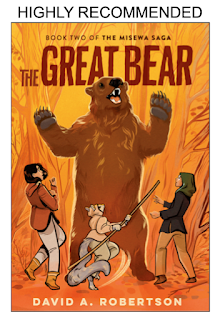
Because of the growing conversations about it, I made time to read it this week. I saw the things I look for when I evaluate a book. The author is Native (Cree) and is writing about their own nation (Robertson's characters are Cree). There is Native (Cree) language in the book. Another item I look for is setting. I prefer books set in the present day because they provide educators with many opportunities for helping children know that we (Native peoples) did not disappear. I'll say more about the book in a review later. Based on my read of it, The Great Bear will carry a Highly Recommended tag.
In my studies and analyses of children's and young adult books, I characterize books like
The Great Bear as mirrors for Native kids (mirrors is one part of Dr. Rudine Sims Bishop's metaphor; I encourage you to
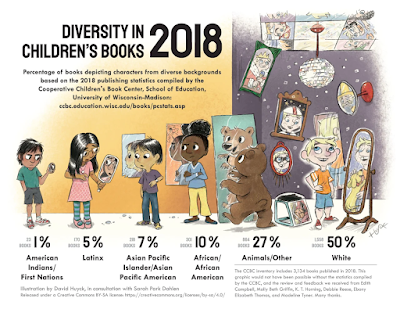
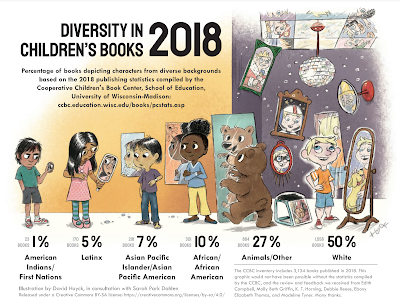
read her article). Books described as mirrors are ones where the characters and their experiences are ones that reflect the reader. Historically, Native children have had very few mirrors. The vast majority of children's books in the past have been written by white writers. In recent years we have seen more Native books by Native writers get published but the numbers are still very low. You can see that by looking at this infographic. At the time the infographic was created in 2018, only 23 of the 3,134 books represented had enough content to be categorized as American Indian/First Nations:
Some brief notes about the book: the main characters in The Great Bear are Morgan, a thirteen-year-old Cree girl who has been in the foster care system since she was two, and Eli, a twelve-year-old Cree boy who recently entered the foster care system. Eli knows his language and culture. He teaches Morgan words and shares stories with her. She feels protective towards him. Their foster parents are not Native but they also aren't foster parents who abuse the children they take into their homes. Books with characters like Morgan and Eli are rare, but there are many Native children in foster care. In short, The Great Bear functions as a good mirror for children like Morgan and Eli, and for children who are Cree, and for children who are Native.
The social media posts I saw were about the book being removed from libraries in the Durham District Schools in Ontario, Canada. The first article I read was in The Toronto Star on April 14. Major points follow:
- The Durham School Board had removed several books that have "content that could be harmful to Indigenous students and families."
- Robertson was stunned and confused to learn that the board had removed his book because its contents could be harmful to Indigenous students.
- An email to principals in the district instructed schools to remove the books, pending a review.
- The email said that schools regularly review collections that are "no longer current, or which may contain content that perpetuates harmful narratives, racial slurs and discriminatory biases, assumptions, and stereotypes." Specific information about the contents deemed "harmful" were not provided.
- Robertson's publisher had attempted to reach the district by emails sent on April 1 and April 6.
Since then I've read several additional articles from news media and I watched the school board meeting that took place on April 19th.
My analysis of children's books is centered on the child/teen reader. I've been critical of Native writers, before. If a book by a Native writer has problems, I note and share those problems. I went into my reading of The Great Bear with the information from the Toronto Star uppermost in my mind. What out-of-date content would I find? What harmful narrative? Racial slur? Discriminatory bias? Assumptions? Stereotypes?
When I finished reading it, the only question I had was the use of "Happy Hunting Ground." It is one of those phrases that gets used a lot to refer to a good place after death. It is one of those phrases that I have wanted to research to figure out its origin. Is "Happy Hunting Ground" an English translation for a concept articulated by people who speak Cree? I don't know. When I see a white writer use it, I note it as a problem. But I hesitate to do so in this case.
Other than that, I think The Great Bear has a lot to offer to Native and non-Native readers!
And so, I echo Robertson's confusion. I've read several of his books. Though the stories vary, I've not found anything in any of them that caused me to think they would harm a Native child. His books are popular. With them being pulled from libraries in Durham (Canada), what are teachers there and elsewhere thinking? Should they use the books? If they do, are they at risk of hurting Native children? In the U.S. librarians and teachers are choosing to avoid books that feature marginalized characters. This is being referred to as "soft censorship." (See Kelly Jensen's article about it at Book Riot:
Soft and Quiet: Self-Censorship in an Era of Book Challenges.) Soft censorship is terrible. It deprives us of so many books by people from communities that have been marginalized.
On social media, I've seen two comments about The Great Bear that stand out. On April 20, 2022, Nancy Rowe asked why it is so hard to believe that Indigenous students, staff, and families do not
"enjoy reading about colonialism, residential school, culture, etc. They live it n don't need to be forced to listen, read n experience colonial-violence."
I don't think anybody enjoys that kind of reading. Her remarks suggest that children were forced to listen to or read The Great Bear. Is that what happened in the Durham schools? Were children forced to listen to it, or forced to read it? What was in the book that hurt them? Did they and/or a parent ask a teacher to stop, and did that teacher dismiss their concerns?
And, what is being asked for with regard to the contents of a story? In a way it sounds like someone wants books with happy Native content.
So--let's look at a couple of things that might have been the issue.
First, Eli wears a braid. He is being bullied about it by kids at school. He cuts it off. Louis, the main character in Eric Gansworth's If I Ever Get Out of Here asks one of his friends to cut his braid for similar reasons. I bring up his book because that is not an uncommon experience for Native boys who wear their hair long or in a braid. They get harassed and decide to cut their hair. In the last few years there have been reports of cases where a Native child's hair is cut without their consent. It is traumatizing, especially with the larger historical context in which the hair of Native children was cut at residential and boarding schools. Children who experienced their own hair being cut without consent, or know that a parent or grandparent went through that experience, might become uncomfortable with a classroom discussion of that part of The Great Bear. If that is the case, then I think the district needs to say so, immediately, so that teachers in other classrooms take care with their discussions of Native hair being cut. Second, Eli says that if he could stop being brown, he'd do that, too. Children with skin like Eli's go through that all the time. It, too, is a common and painful experience. So--these two points (the braid and skin color) are heavy. They may be too heavy for some readers, and there are likely other readers who feel that weight but who also feel seen--who feel a validation of something they went through.
Elsewhere I saw someone say that The Great Bear and the other books had too much culture. Too much culture?! It strikes me as a throwback to "kill the Indian" policies in residential and boarding schools. Saying a book by a Native writer has "too much culture" is telling that writer they're too Indian.
The Great Bear is not the only one that has been pulled from shelves in Durham. As far as I can see, titles of other books are not being made public. I imagine that Native writers in the US and Canada are wondering if their book was pulled. I imagine teachers and librarians and scholars who read, shared, and recommended The Great Bear are now second guessing their evaluation.
Where I end up after several days of reading and thinking is nowhere. The questions I had a week ago are the same ones I have today. What, in the book, caused harm to Native readers? In order to address those concerns, we need to know a page number. We need a passage. We need an explanation for why that passage is a concern. With that information, writers can make edits. Without that information, there is absolutely nothing they can do.