Sunday, October 31, 2021

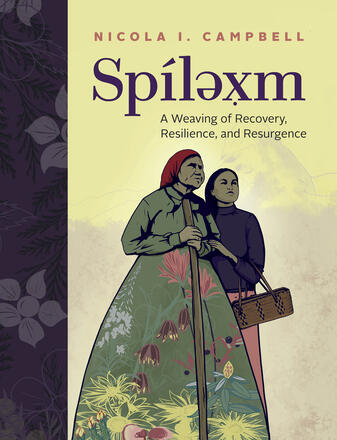
Highly Recommended! Spílexm: A Weaving of Recovery, Resilience, and Resurgence, by Nicola I. Campbell


Spílexm: A Weaving of Recovery, Resilience, and Resurgence

Written by Nicola I. Campbell (Nłeʔkepmx, Syilx, and Métis)
Cover illustration by Published in 2021
Publisher: Highwater Press
Reviewer: Debbie Reese
Review Status: Highly Recommended

****

Today's Short and Sweet Rec is for Nicola I. Campbell's memoir, Spílexm: A Weaving of Recovery, Resilience, and Resurgence. I'll begin with the description from the publisher's site:

If the hurt and grief we carry is a woven blanket, it is time to weave ourselves anew.

In the Nłeʔkepmxcín language, spíləx̣m are remembered stories, often shared over tea in the quiet hours between Elders. Rooted within the British Columbia landscape, and with an almost tactile representation of being on the land and water, Spíləx̣m explores resilience, reconnection, and narrative memory through stories.

Captivating and deeply moving, this story basket of memories tells one Indigenous woman’s journey of overcoming adversity and colonial trauma to find strength through creative works and traditional perspectives of healing, transformation, and resurgence.

And now, the Short and Sweet Rec:

First, Nicola I Campbell is Nłeʔkepmx, Syilx, and Métis, and she's written several excellent books we've recommended before, such as Shin-Chi's Canoe. 

Second: "remembered stories." I don't know why, but those two words are--for me--searing and joyous within the same instance. It it like an eruption of emotion within me. 

Third, the table of contents. I love the words I find in Campbell's picture books. There's a quiet and compassion and strength to them. I see that in the words of the table of contents that tells us what is coming. There are ten sections in this memoir, meant for young adults. These section titles nest within the book's subtitle, A Weaving of Recovery, Resilience, and Resurgence.  
Prairie Letters
Her Blood is from Spetetkw 
Métis 
Nłeʔkepmxcín Lullaby
Land Teachings
Coming to my Senses
sorrow
yemít and merímstn 
this body is a mountain, this body is the land
Resurgence

The section titles hint at recovery. Reading through the entries in each one, I was at times on edge, anxious. Afraid. And laughing. That deer in the basement... that made me laugh, and evoked in me, a remembered story. Or many, really, because at Nambé, our guys hunt and bring deer home. Like the child in this particular story (titled Little People), I remember that moment, walking into a room and there, right there, was a deer.

Fourth, Campbell's use of words. In some instances, she uses poetry. In others she uses story. Some words are in her languages, and some are in English. It isn't ever jarring. It just is. Is, in the way that Native people speak when they use words of their language mixed in with English. It just is. And arrangement of those words! When I turned the page to "alpine mountains" I just looked, for a minute or so. And I was delighted when I turned to "frog whisperers." 

****

From those Prairie Letters about Nikki's birth, through her childhood, her teen years, college, and deaths in the subsequent sections... I release a deep sigh when I get to the end. And as I look back on what I'm saying in this review as I revisit the book, I see some ambiguity, some hesitation in how much to say. I want you to find it, yourself. 

______
*A Short and Sweet Rec is not an in-depth analysis. It is our strategy to tell you that we recommend a book we have read. We will definitely refer to it in book chapters and articles we write, and in presentations we do. Our Short and Sweet Recs include four reasons why we recommend the book.


Friday, October 29, 2021

Highly Recommended! A Girl Called Echo, Volume 4: Road Allowance Era


A Girl Called Echo, Vol.4: Road Allowance Era
Written by Katherena Vermette (Red River Metis)
Illustrated by Scott B. Henderson; Colors by Donovan Yaciuk
Published in 2021
Publisher: Highwater Press
Reviewer: Jean Mendoza
Review Status: Highly Recommended


This will be a "Short and Sweet"* recommendation of the fourth book in the "A Girl Called Echo" graphic novel series. Katherena Vermette, Scott B. Henderson, and Donovan Yaciuk have teamed up again for another chapter in the story of Echo, a time-traveling contemporary Metis teen. 

Here are four of the many reasons to recommend it:

First: Katherena Vermette is Red River Metis, and her story is about Red River Metis people -- historical and contemporary -- in what is currently called Canada. Pivotal, and often traumatic, moments (such as the execution of Louis Riel, and government-sanctioned destruction of Metis communities) are given an Indigenous focus they don't receive in typical history classrooms. As with the previous Echo books, Vermette includes a timeline and other Metis-specific resources to deepen the reader's understanding of Echo's experiences when she travels to the past, and to help create a through-line to her current distresses. 

Second: Meeting one's forebears while time-traveling is a prospect that intrigues writers and consumers of speculative fiction. It may be presented as comedy (e.g., the Back to the Future films), or as drama (as in Octavia Butler's devastating Kindred). Road Allowance is primarily dramatic, though it has some very sweet, tender moments. I appreciate that Vermette keeps Echo from interacting directly with the major historical figures. That would have been a mess. Instead, what's foregrounded is the Metis: how they lived, what they hoped for, what they endured, and how the past may be present in a Metis child and her family, today. 

Third: One of my favorite things about this fourth volume is that it shows Echo and her contemporary family healing from whatever trauma led to Echo's mother being in an institution. Mother hugs daughter. Echo smiles big.  An ancestor tells her she is beautiful. A school friend listens to her expressions of anger and pain, and offers a helpful perspective. And Echo finds that she can decide when she will go to the past, and when she will go home.

Fourth: The story is thought-provoking even though Echo's far from the only fictional character ever to be what Vonnegut called "unstuck in time." For me, an especially lovely bit for thought lies in ways to think about the protagonist's name. Intergenerational trauma reverberates in Echo, at school and at home. She embodies the idea of "echoes of the past." But, when she interacts with her ancestors during their times, she also embodies what I think of as echoes of support or hope from future generations to the forebears who needed reasons to carry on in the face of racism, dispossession, betrayal, and genocide. 

We hope you'll share the whole series, including Volume 4: The Road Allowance Era, with middle schoolers and teens you know. Though it's set in what's currently called Canada, the Indigenous people didn't make the border, and the experiences on either side of it run parallel, when they don't directly intersect.

*A Short and Sweet Rec is not an in-depth analysis. It is our strategy to tell you that we recommend a book we have read. We will definitely refer to it in book chapters and articles we write, and in presentations we do. Our Short and Sweet Recs include four reasons why we recommend the book.

Monday, October 25, 2021

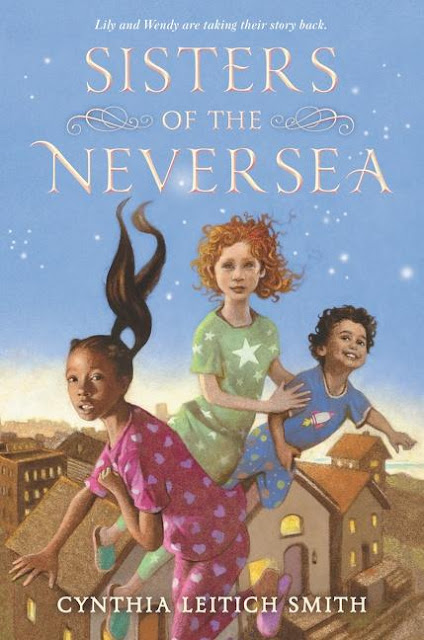
Highly Recommended: SISTERS OF THE NEVERSEA by Cynthia Leitich Smith; cover art by Floyd Cooper

HIGHLY RECOMMENDED! 

Sisters of the Neversea
Written by Cynthia Leitich Smith (Muscogee Nation)
Cover art by Floyd Cooper (Muscogee Creek Nation)
Published in 2021
Publisher: Heartdrum (HarperCollins)
Reviewer: Debbie Reese
Review Status: Highly Recommended

****

Today AICL is pleased to give a Short and Sweet Rec* to Cynthia Leitich Smith’s Sisters of the Neversea. We recommend you get it for your children, your classroom, or your library. Here’s the description:


Lily and Wendy have been best friends since they became stepsisters. But with their feuding parents planning to spend the summer apart, what will become of their family—and their friendship?


Little do they know that a mysterious boy has been watching them from the oak tree outside their window. A boy who intends to take them away from home for good, to an island of wild animals, Merfolk, Fairies, and kidnapped children, to a sea of merfolk, pirates, and a giant crocodile.


A boy who calls himself Peter Pan.


And here is our Short and Sweet Rec! 

Four reasons why AICL recommends Sisters of the Neversea 


First, the author is Native. Cynthia Leitich Smith is a citizen of the Muscogee Nation, telling us a story where the primary character is Muscogee Creek.


Second, Sisters of the Neversea shows readers who Native people are, for real. J.M. Barrie’s stories about Peter Pan have mis-informed generations of readers. His stories encourage others to play Indian in stereotypical ways, and the characters in his story that are meant to be Native (Tiger Lily) are straight-up stereotypes. We are nothing like the “Indians” in his stories. Smith’s take on Peter Pan pushes back on those stereotypes.


Third, Sisters of the Neversea includes Black Indians. Upon seeing Floyd Cooper's cover art, Smith writes that she thought "There you are!" With his art, she saw Lily as Black Muscogee. Later in the book, we meet Strings, a Black Seneca Indian from the Bronx. 


Fourth, Smith's author’s note includes several questions that she poses about the Native people in Barrie’s stories. “How did they get there?” she asks, and “Why were they described in hurtful language?” are two of them. Teachers who use the book in the classroom can draw attention to those questions and encourage students to ask similar questions about Native characters in other books they read.  


We hope you’ll get a copy ASAP, read it, and tell others to read it, too. When you’re at your local library, ask for it! If they don’t have it yet, ask them to order it. 


-----

*A Short and Sweet Rec is not an in-depth analysis. It is our strategy to tell you that we recommend a book we have read. We will definitely refer to it in book chapters and articles we write, and in presentations we do. Our Short and Sweet Recs include four reasons why we recommend the book.  


Thursday, October 07, 2021

NOT RECOMMENDED: Alan Gratz's BAN THIS BOOK


On November 3, 2019, Mike M. submitted this comment to AICL's post about Lois Lenski's Indian Captive
I've come to Dr. Reese's review of Indian Captive because of its appearance in Alan Gratz's 2017 novel Ban this Book. Gratz's story is about a schoolgirl standing up against book-banning in her grade-school library. At one point the avid young reader is suspended and grounded with nothing to read except Indian Captive. There is no commentary about the merits of the book, but it is mentioned several times, giving it a prominence above many of the books named in the story -- enough to send me to investigate. I can see no particular reason why this book was chosen for its role in the story (unless it's a very subtle indication that some books are not as good as others -- but it's quite a stretch to find that interpretation), other than mere carelessness by the author, indifference to the reasons a book may be offensive, or lack of awareness of the harm that books can perpetuate -- a naive belief in the magical goodness of every written word. It seems odd considering the theme of the story. Also odd given another theme of the story: good intentions that lead to bad consequences. As adults, we can understand the complexity of the real world, and the value of ambiguity in literature, but seeing that the issues raised by this one book's inclusion is not developed at all, and this in a novel for children, I can only see it as a flaw in an otherwise worthwhile book.
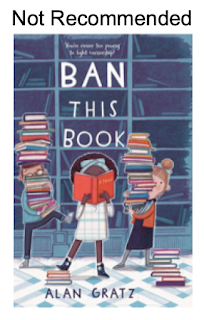
Gratz's Ban This Book came out in 2017. Published by Starscape (an imprint of Tom Doherty Associates with is part of Macmillan), the cover showed a school locker piled high with books. That same year, it was released as an ebook. The cover for the e-book showed three kids on the cover. More on that, later.

Here's the publisher's description of the book:
In Ban This Book by Alan Gratz, a fourth grader fights back when From the Mixed-Up Files of Mrs. Basil E. Frankweiler by E. L. Konigsburg is challenged by a well-meaning parent and taken off the shelves of her school library. Amy Anne is shy and soft-spoken, but don’t mess with her when it comes to her favorite book in the whole world. Amy Anne and her lieutenants wage a battle for the books that will make you laugh and pump your fists as they start a secret banned books locker library, make up ridiculous reasons to ban every single book in the library to make a point, and take a stand against censorship.
The story opens with Amy Anne and her friend, Rebecca, arriving at school. Amy Anne wants to go to the library to check out her favorite book (again) From the Mixed-up Files of Mrs. Basil E. Frankweiler. When she gets to the library shelf where her favorite book should be, it is not there. She sees the librarian, Mrs. Jones, enter the row. She describes her as being "a big white lady" (p. 12).

That detail, that Mrs. Jones is white, gave me pause. I paged back (in my electronic copy of the book) to see if Gratz had identified Amy or Rebecca in similar ways. On page 9, I saw that Rebecca's last name is Zimmerman and her parents are lawyers. When I paged back to the cover, I saw that the child featured prominently on the cover is African American. That is probably meant to be Amy Anne. 

On page 16 we read: 
I like a lot of other books too, especially Island of the Blue Dolphins, Hatchet, My Side of the Mountain, Hattie Big Sky, The Sign of the Beaver, and Julie of the Wolves. Basically any story where the main character gets to live alone. Indian Captive is pretty great too, even though Mary Jemison has to live in an Indian village. But I would rather live with Indian kidnappers than live with my two stupid younger sisters.
As you might imagine, I was taken aback by her list of favorites. They are full of stereotypes. And, they are old. Island of the Blue Dolphins came out in 1960, Sign of the Beaver in 1983, Julie of the Wolves in 1972, and Indian Captive in 1941. 

The other three favorites have a word or two about Native peoples. 

In Hatchet the main character, alone in the forest after a plane crash, imagines monsters he's read about, including Big Foot. He's talking about Sasquatch, a figure who has been misrepresented over and over in children's books! Sasquatch is not a monster. In chapter two of Charlene Willing McManus's Indian No More, the main character (Regina) is on the Grand Ronde Indian Reservation in Oregon. When Regina was little, she was afraid to play in the woods. Her dad told her that "Old Sasquatch won't bother you. First, he's shy. Second, he's over six feet tall and smells like a wet dog. And third, well, if he does bother you, you must've been misbehaving." In My Side of the Mountain the main character, Sam, imagines "feathers in an Indian quiver," thinks that "Indian bread" is flat and hard, and when looking at aspen and birch trees, sees that they are "bent like Indian bows." The main character in Hattie Big Sky moves from Iowa to work her uncles homestead in Montana. Several times, there are references to "free" land, but no mention of how or why that land is available in the first place. Hattie must know something about Native people, because when a character's face is covered in soot when a barn burns down, she imagines that he has warpaint on his face. 

I wonder how these seven books shape what Amy Anne knows about Native people?!    

There is no reason for any of these books to be named as favorites in 2017, by any reader. And yet, there they are. Why these ones, I'd like to ask Gratz. His book is well regarded by people who fight censorship, but in that fight, did he have to throw Native readers under the bus?  

There's more.

As the book description noted, Amy Anne and others get organized and start filling out the library's Request for Reconsideration forms that people submit when they believe a book is inappropriate in some way. The goal is to make up reasons to ban every book in the library. On page 212, Janna (a student) has "every one of the Little House on the Prairie books in her arms. She starts to fill out the form and pauses. Janna says this to Amy Anne: 
"But what do I say? There's nothing bad about Little House on the Prairie."
And here's what follows:
She was right. But no--that was true about all the books. I had to think like Mrs. Spencer. 
"They get malaria in that one," I said. "That's scary, right? And the settlers think it's because they ate bad watermelon! But that's not how you get malaria. That's deliberately misleading. That could make a kid think you get malaria from watermelons!"
Nothing bad in Little House on the Prairie?! It, too, is old, and full of dehumanizing stereotypes of Native peoples.  

Remember--Ban This Book--came out in 2017. What's up with the books Mrs. Jones is offering to students? Does she have no money to update the collection, adding books that would in some way, be mirrors for the Amy Anne's who are in that school, and, windows for them, too, so they could get better information about Native peoples? Does Mrs. Jones not know about the hashtag, #OwnVoices? It took off in 2015. 

My questions are really for Alan Gratz. He wrote a book about an important topic. But on the way, he just dumped stereotypes all over Native kids and non-Native kids, too. 

Did his editor notice this problem? Did any of the people who gave it positive reviews notice it? Or, any of the people on state award committees that gave it an award? I guess I know the answer. If anyone had any concerns, they probably stayed quiet. The book is about banning books, after all. 

If Amy Anne's favorites included books that have won a Coretta Scott King Book award, I wouldn't be writing this post. If one of her favorites included a book that won an award from the American Indian Library Association, I'd be giving Gratz's book a "recommended" label instead of its "not recommended" one!

But, here we are. Bummer. 

Friday, September 17, 2021

Highly Recommended! THE DINE READER: AN ANTHOLOGY OF NAVAJO LITERATURE


The Diné Reader: An Anthology of Navajo Literature
Edited by Esther G. Belin, Jeff Berglund, Connie A. Jacobs, and Anthony K. Webster
Cover Art by Shonto Begay
Foreword by Sherwin Bitsui, with Contributions by 
Jennifer Nez Denetdale and Michael Thompson
Published in 2021
Publisher: The University of Arizona Press
Status: Highly Recommended
Reviewer: Debbie Reese (Nambé Owingeh)

****

In 2021, two terrific anthologies were published. First was When the Light of the World Was Subdued, Our Songs Came Through: A Norton Anthology of Native Nations Poetry (edited by Joy Harjo). Harjo's anthology has writers from many different nations. I recommend you get a copy of it. Second is The Diné Reader. I recommend you get a copy of it, too, because it gives you depth about one nation. 

Let's start with Shonto Begay's cover art. He is known in children's literature for two books he wrote and illustrated: Ma'ii and Cousin Horned Toad (1992), and Navajo Visions and Voices Across the Mesa (1995). The title of the art on the cover of The Diné Reader is "With Glowing Words." We see a Diné person, reading. In the interview of him on page 182, he said: 
"When I paint people reading, it's also beyond what the picture is, it keeps going on. It's an interpretation of an interpretation of a reader."
As I think about that, I wonder how high school students will interpret what they find in The Diné Reader. Who that reader is and what they've read will shape their interpretations of the poems and stories in the book. 

Sherwin Bitsui did the foreword for the book. Towards the end of the first paragraph, he says that non-Navajo and non-Native people tell him that they learned about Navajo culture through Tony Hillerman's books. Hillerman, you see, is not Native. What he provides is incorrect portrayals of Navajo people. In contrast, when Bitsui talks with young Navajo students who are in universities and learning about Navajo writers, he sees their excitement over stories and poems by Navajo writers that reflect their own experiences. The Diné Reader, he says, provides teachers with authors and resources they case use to bring greater depth and understanding to students who read work by Navajo writers. That depth and understanding is crucial because it can push aside the Hillermans of the book world.  

Are you one of the people who reads or recommends Hillerman? Stop doing that right now! If you're a teacher, your responsibility is to educate students. With Hillerman, you are miseducating them. Get a copy of The Diné Reader and start reading. Find a story or poem that resonates with you in some way, study the interview that precedes that writer's work, and then look in your library for additional materials from that author (start with the Bibliography in the final pages of the reader). If your library doesn't have something you want, ask for it!

And make sure to read Esther Belin's introduction to the history of Navajo literature, Jennifer Nez Denetdale's "Chronology of Important Dates in Diné Political and Literary History," and Michael Thompson's "Resources for Teachers and Readers." All three are excellent for what they provide to teachers who want to step away from the nonsense of Hillerman and do right by Navajo people. Thompson (he is Mvskoke Creek) organized his resources into sections, including one on humor that I like a lot. For each of his sections, he discusses it, follows with "considerations and reflective tasks" and ends with works in the reader that exemplify the idea the section is about. 

The Diné Reader can be used in high schools. As I page through my copy (or click through my e-book copy), I pause to read old favorites, smile at memories of hanging out with the poets, and of course, I read items new to me. As I read the introductory material about Tina Deschenie, I see that her first poem was published in 1973, when she was a high school student. In short, there's so much depth in the pages of this book! Order a copy and sit with it, soon!


Wednesday, September 15, 2021

Books by Native writers are on list of banned books at Central York High School in Pennsylvania

Update on Friday, September 24: Here is a link to Central York Banned Book List, which is a downloadable pdf of all the books. The pdf was made by the Central York Book Club (they used the original list). The original list was a spreadsheet that had tabs at the bottom to the 4th-6th grade and the high school books. And, earlier this week, news media reports indicate that the school board lifted the "freeze" on the books. 

Wednesday, September 15, 2021. This morning, I saw posts on social about books that are being banned in Central York High School in Pennsylvania. The books are outstanding ones by terrific writers like Zetta Elliott, Jacqueline Woodson, Yuyi Morales, Aisha Saeed, Monica Brown, and Minh Lé. It also has a few books on it by white writers like Eve Bunting's Smoky Night (note: Smoky Night is deeply problematic. Its presence on the list tells us the committee may not be aware of those problems.) 

Books by Native writers are on the list, too. 

The list itself is a spread sheet titled Equity Book Resource List. I gather that a diversity committee created the list for teachers to use, but some parents did not like the books and went to the school board, who put the entire list on hold. There are a few media articles about the list and student protests to the books being banned. Some of the articles are disjointed. If you want to get a solid understanding of what is happening, see Kelly Jensen's article at Book Riot): School District Maintains Ban of Antiracist Books Despite Student Protests

The books by Native writers include:

Picture Books K-3
  • Fry Bread: A Native American Story by Kevin Maillard, illustrated by Juana Martinez-Neal
  • The People Shall Continue by Simon Ortiz, illustrated by Sharol Graves 

Books 4-6
  • An Indigenous Peoples' History of the United States, by Roxanne Dunbar-Ortiz (note: because it is listed in the 4th-6th grade section, I think this is the young peoples adaption that Jean Mendoza and I did. Dunbar-Ortiz and Mendoza are not Native, but I am.). 
  • Indian No More by Charlene Willing McManis
  • We Are Grateful by Traci Sorell (Sorell's book is a picture book. Perhaps the committee felt it should be used at the 4-6th grade level. I'm among those who recommend picture books for all readers.) 
Update on Sept 24, 2021:  We do not recommend Jane Yolen's Encounter (it is on the list). And, unfortunately, Brad Meltzer's I Am Rosa Parks is being used on many news article and social media posts about the ban. I would prefer books by Native and Writers/Illustrators of Color receive visibility. 

Update on Jan 18, 2022: We do not recommend Hoffman's Amazing Grace. It is also on the list.  

Monday, September 06, 2021

Highly Recommended! SHARICE'S BIG VOICE: A NATIVE KID BECOMES A CONGRESSWOMAN


Sharice's Big Voice: A Native Kid Becomes a Congresswoman
Written by Sharice Davids (Ho-Chunk) with Nancy K. Mays
Illustrated by Joshua Mangeshig Pawis-Steckley (member of Wasauksing, First Nation)
Published in 2021
Publisher: Harper Collins
Reviewer: Debbie Reese
Review Status: Highly Recommended

****

In some books, I find one thing after another that I absolutely adore. Sharice's Big Voice is one of those books. First example? The back cover. It is a page from inside. It looks like this:


On that page, Sharice is studying. A stack of books is there. The text on that page tells us that she started law school so that she could work to make US laws more just and fair. Those words are cool, but look at the pages behind her! 

My guess is that most readers will recognize "The Constitution of the United States" but why is our attention being drawn to Article 6? Do you know what Article 6 is about? Hint: it has to do with the other pages you see behind Sharice! 

Sharice's Big Voice is a picture book whose contents make the case for why picture books should be read by everyone. If you're teaching social studies, teach this book and do a study of this page. Start by reading Article 6. Then, ask students to do research on the Treaty With the Winnebago, and the other items on that page. Put them into chronological order, after having read Article 6. 

As I reflect on that page, I'm reminded of the article by Sarah B. Shear, Leilani Sabzalian, and Lisa Brown Buchanan.  It is titled "Affirming Indigenous Sovereignty: A Civics Inquiry" and came out in 2018 in an educator's journal called Social Studies and the Young Learner. Here's the first sentence in the article:
Indigenous sovereignty is an essential component of civics education.
Here's the first sentence in the next paragraph:
Elementary social studies curriculum is notoriously silent about Indigenous sovereignty.
My guess is that most teachers want to give their students a solid education and might know a bit about Native sovereignty--but not enough to feel confident in what they do. And so, they are silent about Indigenous sovereignty. The article has key words and definitions, realistic steps for you to take with your students as you begin to fill that silent space, and links to resources to help you.  

Affirming Indigenous Sovereignty (the article) and Sharice's Big Voice can be your starting place to make a difference in what your students learn about Native peoples. Get the picture book, and if your librarian isn't able to get the article for you, let me know. 

There's a lot more to say about Sharice's Big Voice but I gotta get outside and finish the paint job on our fence. I'll be thinking about this book and may be back to say more. It is one of my favorite books of the year. It affirms Native identity, and being physically, educationally, and politically active. This page is so important! It says (in part): "Growing up, I never would have guessed my path would lead to Congress. I didn't know that I would be one of the first Native American women in Congress and the first lesbian representative from Kansas." 


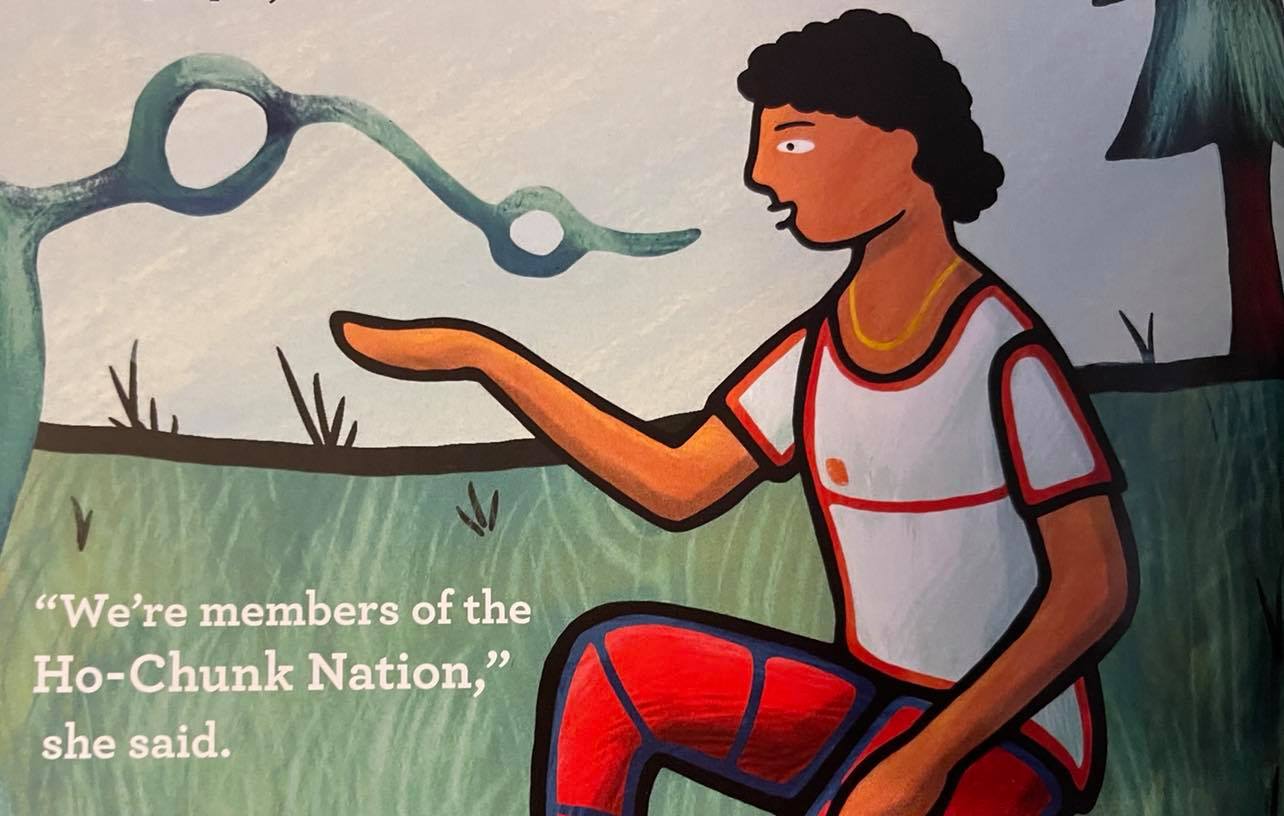
And if you're wondering if it is tribally specific? The answer is yes! There's a page about kids in school asking Sharice "What are you." She tells her mom about it, and her mom tells her "We're members of the Ho-Chunk Nation." When I talk about the book online I'll use #Ho-ChunkVoice--and you should, too.  


Page after page, the words resonate and educate, and Pawis-Steckley's gorgeous Ojibwe art does, too! Get a copy for your classroom library, your home library, and ask your librarian to get copies. Then, talk about it with others. Share the knowledge that Sharice Davids and Nancy K. Mays provide in Sharice's Big Voice. 

-----

Back to say that good nonfiction for young people is very hard to find, especially biography or autobiography about Native people of the present day. If this book had been available when Betsy McEntarffer and I wrote "Indigenous Nations in Nonfiction" for Crisp, Knezek, and Gardner's Reading and Teaching with Diverse Nonfiction Children's Books, we'd have written about it, with tremendous joy.