It's hard to authentically tell stories from the POV of children and youth trying to keep family and self together in the face of parental loss, dysfunction, abuse, or neglect (or institutional abuse). One Native writer who has done that exceptionally well is Vickie L. Sears (Cherokee). Her devastating, often-anthologized "Grace" should be required reading for professionals who work with foster children or other young ones pushed too early into the role of looking out for themselves and their siblings.
"Ballad of Weary Daughters" by Kristine Wyllys (Eastern Band Cherokee) is another insightful story of young people carrying family survival on their shoulders. It's part of an anthology "starring disabled teens" in Unbroken (Farrar Strauss Giroux, 2018, edited by Marieke Nijkamp). We're reviewing it on AICL because of several references to the Tsalagi people and language.
"Ballad" is told in the voice of contemporary high schooler River Smith. River is the daughter of a Tsalagi mother and a white Christian pastor who has recently abandoned his congregation and his family to run off with another woman. River's mother manages to keep putting one foot in front of the other, working long hours to keep food on the table. River steps into the caretaker role for her younger siblings, who are all showing signs of severe stress. It doesn't help that River has a mental illness and her doctors have had trouble getting her medications right.
River and her beloved friend, Lucy, are the "weary daughters" of the story's title. They both feel the stress of barely holding on, and they recognize that their relationship is what gets them through each difficult day. In teaching and social services, when we hear about "resilience factors," this is one of the factors they're talking about: friends who go beyond the typical expectations and serve as literal lifelines for the ones who are struggling. You can't imagine how either River or Lucy could get by without the other's sustaining presence. There is no one else to help them, no support services.
I've read other fiction about teens that feels like a circa-2005 Ruby Payne anecdote catalog of poverty-related dysfunction and catastrophe, where an author just won't stop dumping on the main character. But "Ballad" works for me because Wyllys shows us a family in what could be called a slow-moving emergency -- one that ravels over time. In real life, those aren't the kind that tend to qualify for substantial official help for a family, but the burden on a teen can still be nearly unbearable. River and her family have lived through one emergency -- the days and weeks after the father's departure. Another may be brewing with one of River's sisters, and River's mental health could become more fragile.
The story ended with me loving both River and Lucy. I wanted more for them -- and more about them. I hope Kristine Wyllys will let us hear from them again.
The Cherokee (Tsalagi) content feels matter-of-fact; Wyllys is not teaching readers; she is saying "This is River's life, in which family conversations contain some Tsalagi words, absent Tsalagi family members are important, and the children are aware that their father's congregation views them as Other because they are not white."
I strongly recommend this story. Other entries in Unbroken are also definitely worth reading.

Established in 2006 by Dr. Debbie Reese of Nambé Pueblo, American Indians in Children's Literature (AICL) provides critical analysis of Indigenous peoples in children's and young adult books. Dr. Jean Mendoza joined AICL as a co-editor in 2016. (Site redesign on January 8, 2025)
Sunday, December 01, 2019


Sunday, November 24, 2019
Not Recommended: THE SACRIFICE by Diane Matcheck
A reader wrote to ask if we've seen The Sacrifice by Diane Matcheck. It was published in 2016 by Farrar, Straus and Giroux (Macmillan). Based on what I have read about the book, I am changing the title of this blog post from a "have you seen" to "Not Recommended."

One of the things I (Debbie) do when I get questions about a book is to read the description of the book. Over at Barnes and Noble's website, I saw this:
On the website for the Crow Tribe of Indians, you'll find "Apsaalooke."

I wondered if the sources Matcheck used might have been from older books when the word ended with an 'a' instead of an 'e'. I did a search in Google Books and was surprised to see Paulette Fairbanks Molin's critique of The Sacrifice in her book, American Indian Themes in Young Adult Literature. Molin's book came out in 2005.
From the reader's question, I had assumed--incorrectly--that Matcheck's The Sacrifice is a new book. It isn't. As I showed above, the first year of publication for this book is 1998.
Obviously, people at Macmillan did not read Molin's critique. Were there any changes from the 1998 edition to the 2016 one? I doubt it, based on reviews I read of the 2016 edition.
Through agreements with review journals, Barnes and Noble is able to post the full review of a book on their website page for a given book. I am able to see, for example, the reviews of The Sacrifice from BookList, Publisher's Weekly, and School Library Journal. The first two reviews are unsigned. The one from School Library Journal, however, is signed--by Dr. Loriene Roy who is enrolled at the White Earth Reservation. She's a former president of the American Library Association.
All three reviews begin with similar content (descriptions of what happens in the book). The first two unsigned reviews praise the book in their closing sentences, but Roy does not. Here's what she wrote:
I opened the "Look Inside" option on Amazon to read what I could of The Sacrifice. Just prior to chapter one is a passage from the Bible. That doesn't bode well, at all. In fact, it shouts White Man's Indian (for those who don't know, a "White Man's Indian" is a white depiction of a Native person; for more info see Robert F. Berkhofer's The White Man's Indian, published in 1979). The Bible passage is this one:
On page 4, the author's description of the main character is rife with stereotypes. Her eyes smolder, "like a wildcat's eyes at night from within its den." She's got high cheekbones and a "fine, straight nose." Her hair is black but is "snarled in a grimy black nest" down her back. The very first sentence of the book is "The girl clawed the wind-whipped hair out of her eyes with bloody hands, and listened" (page 3). Her hands are bloody because she's killed three buffalo; the carcass of one is beside her. She imagines everyone praising her and giving her a new name, "the Great One" instead of the name she carries, "Weak-one-who-does-not-last." That desire to be known as "the Great One" is what Roy's critique is describing. Her father approaches her. Matcheck introduces him by talking about his speech, and his teeth. "His talk was stubby-sounding and full of whistles, because all but one of his front teeth were snapped off jagged or gone completely" (p. 6-7).
The passage from the Bible, the author's depiction of the main character and her father, and Roy's critique are enough for me to give The Sacrifice a Not Recommended tag.
Macmillan republished it (with a new cover) because it must be making money for them. That means people are buying it. Money drives book publishing. How about--if you bought it--you take it back to your bookstore and ask for a refund? If you're on Twitter, what if you ask Macmillan why they published it? In other words, I'm asking people to speak up about publishers reissuing old books. Don't be complicit with Macmillan's anti-Native nonsense! Speak up!

One of the things I (Debbie) do when I get questions about a book is to read the description of the book. Over at Barnes and Noble's website, I saw this:
An Apsaalooka (Crow) Indian girl has lived her life as a despised loner, overshadowed by her dead twin brother, who, it was prophesied at their birth, would become a "Great One" among his people. One night, she sets off on a forbidden journey to prove to her village, and her brother's spirit, that she is the one destined to become the true Great One. Her trek over the plains and into the mysterious region of modern-day Yellowstone National Park is a disaster, culminating in her eventual capture by a tribe of Pawnee. Strangely, these foreigners treat her with an unfamiliar respect, and the girl starts to let down her guard. But when it is suddenly revealed that she has been kept alive in order to be killed in a ritual harvest-season sacrifice, the girl is thrown back into her desperate battle for survival...in Diane Matcheck's The Sacrifice.The words in that description prompted a lot of questions. First is the use of "Apsaalooka" (that word, spelled that way, is in the description and throughout the book). I'm glad to see writers using a tribal nation's own name for itself, in their language, but it is important to get it spelled right. When I put "Apsaalooka" in the Google search window, Google asked "Did you mean Apsaalooke"?
On the website for the Crow Tribe of Indians, you'll find "Apsaalooke."

I wondered if the sources Matcheck used might have been from older books when the word ended with an 'a' instead of an 'e'. I did a search in Google Books and was surprised to see Paulette Fairbanks Molin's critique of The Sacrifice in her book, American Indian Themes in Young Adult Literature. Molin's book came out in 2005.
From the reader's question, I had assumed--incorrectly--that Matcheck's The Sacrifice is a new book. It isn't. As I showed above, the first year of publication for this book is 1998.
Obviously, people at Macmillan did not read Molin's critique. Were there any changes from the 1998 edition to the 2016 one? I doubt it, based on reviews I read of the 2016 edition.
Through agreements with review journals, Barnes and Noble is able to post the full review of a book on their website page for a given book. I am able to see, for example, the reviews of The Sacrifice from BookList, Publisher's Weekly, and School Library Journal. The first two reviews are unsigned. The one from School Library Journal, however, is signed--by Dr. Loriene Roy who is enrolled at the White Earth Reservation. She's a former president of the American Library Association.
All three reviews begin with similar content (descriptions of what happens in the book). The first two unsigned reviews praise the book in their closing sentences, but Roy does not. Here's what she wrote:
Weakness lies in the characterization. The young woman appears to have a modern belief in independence and personal achievement and a defiance of the more Native perspectives of respect for elders and thanksgiving for the gifts of nature. Also questionable is the recounting of tribal religious practice, an act of cultural misappropriation.Roy's last two sentences are important. It seems to me that Matcheck's Native character is one with White sensibilities. That's not ok, at all. And I'm glad to see Roy calling out the appropriations she saw in the book.
I opened the "Look Inside" option on Amazon to read what I could of The Sacrifice. Just prior to chapter one is a passage from the Bible. That doesn't bode well, at all. In fact, it shouts White Man's Indian (for those who don't know, a "White Man's Indian" is a white depiction of a Native person; for more info see Robert F. Berkhofer's The White Man's Indian, published in 1979). The Bible passage is this one:
For what is a man profited,
if he shall gain the whole world,
and lose his own soul?
or what shall a man give in exchange for his soul?
--MATTHEW 16:26
On page 4, the author's description of the main character is rife with stereotypes. Her eyes smolder, "like a wildcat's eyes at night from within its den." She's got high cheekbones and a "fine, straight nose." Her hair is black but is "snarled in a grimy black nest" down her back. The very first sentence of the book is "The girl clawed the wind-whipped hair out of her eyes with bloody hands, and listened" (page 3). Her hands are bloody because she's killed three buffalo; the carcass of one is beside her. She imagines everyone praising her and giving her a new name, "the Great One" instead of the name she carries, "Weak-one-who-does-not-last." That desire to be known as "the Great One" is what Roy's critique is describing. Her father approaches her. Matcheck introduces him by talking about his speech, and his teeth. "His talk was stubby-sounding and full of whistles, because all but one of his front teeth were snapped off jagged or gone completely" (p. 6-7).
The passage from the Bible, the author's depiction of the main character and her father, and Roy's critique are enough for me to give The Sacrifice a Not Recommended tag.
Macmillan republished it (with a new cover) because it must be making money for them. That means people are buying it. Money drives book publishing. How about--if you bought it--you take it back to your bookstore and ask for a refund? If you're on Twitter, what if you ask Macmillan why they published it? In other words, I'm asking people to speak up about publishers reissuing old books. Don't be complicit with Macmillan's anti-Native nonsense! Speak up!
Tuesday, November 19, 2019
Mark this day... there's a Native Imprint from a Major Publisher!

Way back when I started graduate school in the mid 1990s, I wanted to see so much more being published by Native writers... and here, in 2019, is the very best news that I could hope for...
Congratulations to Cynthia Leitich Smith (Muscogee) for making it happen!
Thank you, to Rosemary Brosnan and HarperCollins, for your commitment to Heartdrum, to Cyn, and to Native writers and illustrators.
And thank you, Ellen Oh!
And Rainey--the logo... perfect!
[This news was first published by Publishers Weekly.]
Recommended: The Case of the Missing Auntie

How often have you read a middle grade mystery novel that had you in tears just a few pages after making you laugh? That's what happened when I spent yesterday with an ARC of Michael Hutchinson's new Mighty Muskrats Mystery, The Case of the Missing Auntie (Second Story Press, 2019).

Chickadee looks forward to the Exhibition (the Ex), but she's also on a mission. Their Grandpa has told her about his younger sister who was taken from a boarding school decades ago, and lost in "The Scoop" The family hasn't seen or heard from her since, and he wants very much to find her. "The Scoop" is the informal name for a set of Canadian policies that resulted in many First Nations children disappearing, forever separated from their families. Chickadee is determined to find out what happened to Auntie Charlotte, even if that means she has to guilt-trip her cousins into helping her. And even if she has to navigate the city transit system alone while Atim, Samuel, and Otter try to find a ticket for Otter to a sold-out concert by their favorite Indigenous band.
Hutchinson's storytelling is engaging. The kids find some good allies and face some unexpected challenges, even dangers. To say more about the plot lines might give something away. So.
Windy Lake featured some standout prose, and Hutchinson's way with words is evident in Missing Auntie as well. Here are a couple of examples.
a) Chickadee and her older cousin Harold are talking at breakfast about the contrasts between the Windy Lake reserve and the city. Harold says, "City people don't seem to know there is a different life out there. It's like the city mouse killed the country mouse and forgot he ever existed. Our people can get lost in the city." That sly reference to one of Aesop's fables made me smile and think, "Funny!" and "Yikes!" at the same time.
b) And here's part of the description of an arcade and pool hall the Muskrats enter during their effort to get that concert ticket for Otter: "The Crystal Palace was a mixture of deep shadows, colorful neon, and arcade lights. It smelled like the ghosts of greasy burgers and spilled pop....A palisade of pool sticks lined the outside walls. A scattering of players focused on their games. The smack and click of pool balls colliding kept a random tempo."
But you don't get the impression that Hutchinson is bashing urban life -- the Muskrats meet some good people, people of subtle courage and outright heroism, along with racists, criminals, and people who have lost themselves. It's clear that the city can be a combination of the strange, the unfriendly, the wondrous, and the ordinary. And the characters of the Muskrats are developing, too, in ways that are easy to appreciate. These are good-hearted, caring, smart young people, but they're all individuals.
Hutchinson also weaves in factual information as the kids sort out what happened to their Grandpa's little sister. Occasionally that can seem like a lot of exposition, but some readers won't know otherwise about the boarding schools and the Scoop, about present-day bureaucracy, about Canada's Truth and Reconciliation Commission, and about how the old racist policies continue to affect First Nations families today.
I found the ending to be realistic and satisfying, even though it unfolded in a way I didn't expect. Overall, Missing Auntie is a good read, with an emotional "punch," and I can hardly wait for the Mighty Muskrats to take their next case. But Missing Auntie won't be out until spring 2020. Preorder your copy now from Second Story Press!
Recommended! THE RELUCTANT STORYTELLER by Art Coulson; illustrated by Hvresse Christie Blair Tiger
Note from Debbie on Nov 28, 2023: Due to my concerns over Art Coulson's claim of being Cherokee, I am no longer recommending his books.
But!
Don't look away! Benchmark Education offers books that I know--without a doubt--that Native children will be happy to read! One of my favorite books--ever--is Where'd You Get Your Moccasins by Bernelda Wheeler. When I was teaching children's literature way back in grad school in the 1990s, it was on the required list of books I asked pre-service teachers to buy. Some would look at the stapled spine and think less of it without reading the words in the book that made, and makes, my heart soar! They had to learn to set aside elite notions of what a book should be like, and think about the content and what that content could do for readers in their classrooms.

I ask that same thing for The Reluctant Storyteller. The things I look for in a book are all here. It is set in the present day, it is tribally specific, it is written and illustrated by Native people, and it rings true! Coulson knows what he's talking about. The family at the heart of this story is filled with storytellers who adore being out and about, telling Native stories. They're from Oklahoma, but live in the Twin Cities. They do visit, a lot, and a trip is coming up. Chooch, the main character in Coulson's book doesn't want to go. He's rather stay in Minneapolis for the Lacrosse tournament.
Chooch doesn't tell stories and can't imagine himself as a storyteller. His dream? To be a chef. But, nobody knows that he wants to be a chef. He enjoys cooking with his mom and grandma, making up recipes. Things he makes are tasty!
On the way to their Oklahoma, Chooch's uncle tells him a story about a Tsula, a fox who wishes he had a coat of feathers, like Totsuhwa, the redbird that he sees flying about in the trees, so that he could fly, too. One day he runs and runs and runs, so fast, that his feet are off the ground. Day moves into night and, well, he started flying. He's no longer Tsula, the fox. Now, he's Tlameha, the bat. People who read AICL regularly know that I'm careful about traditional stories and how a writer works with them, uses them, bringing them into a book. This story is one that the Cherokee people tell. Coulson is Cherokee. I trust that he's sharing a story that can be shared. And--I love the way he brought it to Chooch.
They get to Oklahoma, and Chooch is drawn to the cooking area of a Native gathering. By the time we get to the final pages of The Reluctant Storyteller, Chooch understands himself in ways he did not before the trip. He's learned that there are many ways to be storytellers.
And, there are many ways to tell stories--to bring stories to children and teens! That's what I mean, up top, where I say there's a specialness to this book. There's layers of truth in it. Layers of Native life, too...
So, don't turn away from leveled readers. If you open the Benchmark catalog, you'll see other writers there, too. Like Ibi Zoboi! And David Bowles! And Jane Yolen! Jerry Craft, and, Virginia Driving Hawk Sneve! These are names teachers and librarians are familiar with. Look at the catalog! You'll see others, too.
I like The Reluctant Storyteller very much and recommend that you get it... but I think the books are hard to get. I got my copy from Art Coulson's website.
Recommended: JOHNNY'S PHEASANT written by Cheryl Minnema, pictures by Julie Flett
Johnny's Pheasant is written by Cheryl Minnema (Mille Lacs Band of Ojibwe) and illustrated by Julie Flett (Cree-Métis). New in 2019, it is a picture book I am pleased to recommend.

Grandma's are special, aren't they? Mine was, and I know my mom is special to my daughter and all her other grandchildren. In some families, grandma's make things. When I was a kid, I hung out with my grandma, a lot. I have such fond memories of those times, helping and watching her make things.
Back in the 1960s when the US government was putting a blacktop road on our reservation, they also strung barbed wire fencing to keep livestock off the road. That barbed wire came on wire spools that are about the size of a 5 gallon bucket. The end parts of the spool looked like flower petals. Here's a photo that sort of looks like what I have in my memory:

I walked with my grandmother for miles and miles, gathering up empty, cast off spools. At home, she bound them together in an array that she attached to a wood frame. These then became charming gates to the porch, and to the garden. She also worked with feathers. She especially liked peacock feathers. She'd trim them and attach them to fabric wall hangings. They were so pretty!
In Johnny's Pheasant, we see a grandma and grandson, out and about. Johnny spies something in the grass. Turns out, it is a pheasant! Grandma thinks it is dead and that she can use its feathers in her craft work. But Johnny thinks the pheasant is ok. He's right!
The pheasant comes to from its seemingly-dead state, and flies about the house, at one point, landing on Grandma's head! Johnny thinks the pheasant, lying there in Grandma's house, had heard his grandma say she was going to use its feathers--and her words roused it!
From grandma's head, the pheasant flies out the open door. Johnny and his grandma go outside and watch it fly away. But, a single feather flutters to the ground. When Johnny hands it to his grandma, she exclaims "Howah."
Howah is an Ojibwe expression meaning 'oh my!' I enjoyed reading this story, but when I read "Howah," I paused. Ojibwe kids are gonna love that! Johnny's Pheasant is a delight on many levels. Published by the University of Minnesota Press in 2019, I recommend it for every family, Native or not, who tells stories about grandma's. Its quite a heartwarming story!

Back in the 1960s when the US government was putting a blacktop road on our reservation, they also strung barbed wire fencing to keep livestock off the road. That barbed wire came on wire spools that are about the size of a 5 gallon bucket. The end parts of the spool looked like flower petals. Here's a photo that sort of looks like what I have in my memory:
I walked with my grandmother for miles and miles, gathering up empty, cast off spools. At home, she bound them together in an array that she attached to a wood frame. These then became charming gates to the porch, and to the garden. She also worked with feathers. She especially liked peacock feathers. She'd trim them and attach them to fabric wall hangings. They were so pretty!
In Johnny's Pheasant, we see a grandma and grandson, out and about. Johnny spies something in the grass. Turns out, it is a pheasant! Grandma thinks it is dead and that she can use its feathers in her craft work. But Johnny thinks the pheasant is ok. He's right!
The pheasant comes to from its seemingly-dead state, and flies about the house, at one point, landing on Grandma's head! Johnny thinks the pheasant, lying there in Grandma's house, had heard his grandma say she was going to use its feathers--and her words roused it!
From grandma's head, the pheasant flies out the open door. Johnny and his grandma go outside and watch it fly away. But, a single feather flutters to the ground. When Johnny hands it to his grandma, she exclaims "Howah."
Howah is an Ojibwe expression meaning 'oh my!' I enjoyed reading this story, but when I read "Howah," I paused. Ojibwe kids are gonna love that! Johnny's Pheasant is a delight on many levels. Published by the University of Minnesota Press in 2019, I recommend it for every family, Native or not, who tells stories about grandma's. Its quite a heartwarming story!
Sunday, November 17, 2019
Dear _____: I got your letter about Thanksgiving
Today's blog post has an unusual title. It is my effort to reply, in one response, to the range of queries I get by email. These are emails that give me hope. They embody a growing understanding that Thanksgiving, as observed in the U.S., is fraught with problems.
Those problems range from the stereotyping of Native peoples to the pretense that peoples in conflict had a merry sit-down dinner.
Some emails are from parents who are dismayed when they visit their library and see children's books filled with those stereotypes and pretenses. These parents want their children to learn the truth. So they turn to the library for help.
Some parents tell me that, in a previous year, they had talked with librarians about the problems in the books. These parents felt hopeful that the librarians understood and would provide different kinds of programming and displays this year but that doesn't happen. Others tell me that the librarian interprets their questions as efforts to censor books. Some get lectured about censorship.
The thrust of the emails is this: what can I do?
Those of you who are writing to me have already taken the first step, which is to know there's a problem. Others have to know that, too. In order for changes to happen, more people have to understand what you already know. There is a problem. So, talking with friends and colleagues about it is a second step. Some of you already do that, which is great. Keep talking! And use social media! Though there are valid concerns about the merits of social media, I think it is why so many towns, cities, universities, schools, and states have instituted Indigenous Peoples' Day instead of Columbus Day.
With that in mind, I'm sharing a terrific resource that is available, online, at no cost.
 Titled "Origin Narrative: Thanksgiving," it is a free teacher's guide to be used by people who have bought a copy of An Indigenous Peoples' History of the United States for Young People but I think people can use it without the book.
A brief note: In 2014, Dr. Roxanne Dunbar-Ortiz's An Indigenous Peoples' History of the United States was released by Beacon Press. Teachers asked for a version that they could use with teens. Beacon asked if I would do it; I invited my friend and colleague, Dr. Jean Mendoza, to do it with me, and it was released in 2019, with "For Young People" as part of its title.
Here's a screen capture of the lesson plan. To download it, go to Beacon's website where you can see the webpage of it and the link to download a pdf. You can ask your library to get the book, and if you have the option, see if you can schedule one of the library's meeting rooms to have a conversation with others about the holiday.

I welcome other thoughts. What strategies have you used that seemed to help?
Ah! Meant to include a bit more. Some people write to me asking for Thanksgiving books that I recommend they use with children. My impulse is to offer some suggestions, but I am also trying to remind them and myself that the question is, in essence, one that centers the holiday itself. It seems to recognize that stereotyped and erroneous storylines are not ok, but it still wants Native peoples at that table.
Instead of providing a list of books that can be used for this week, I am asking that you use books by Native writers, all year long. Don't limit our existence to this holiday.
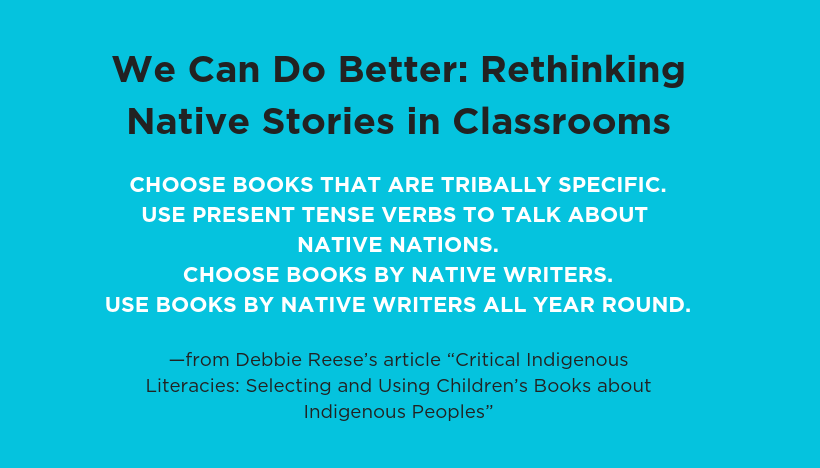
In the Best Books page here at AICL, you'll find lists that I create, and links to the pages about the Youth Literature Awards, given by the American Indian Library Association. I've also written several articles that are available online. Some are about books I recommend, and some are ones that invite you to think critically about books. Here's the links. They work right now but journals don't keep articles available this way, long term. You might have to ask your librarian for the article if a link no longer works.
Those problems range from the stereotyping of Native peoples to the pretense that peoples in conflict had a merry sit-down dinner.
Some emails are from parents who are dismayed when they visit their library and see children's books filled with those stereotypes and pretenses. These parents want their children to learn the truth. So they turn to the library for help.
Some parents tell me that, in a previous year, they had talked with librarians about the problems in the books. These parents felt hopeful that the librarians understood and would provide different kinds of programming and displays this year but that doesn't happen. Others tell me that the librarian interprets their questions as efforts to censor books. Some get lectured about censorship.
The thrust of the emails is this: what can I do?
Those of you who are writing to me have already taken the first step, which is to know there's a problem. Others have to know that, too. In order for changes to happen, more people have to understand what you already know. There is a problem. So, talking with friends and colleagues about it is a second step. Some of you already do that, which is great. Keep talking! And use social media! Though there are valid concerns about the merits of social media, I think it is why so many towns, cities, universities, schools, and states have instituted Indigenous Peoples' Day instead of Columbus Day.
With that in mind, I'm sharing a terrific resource that is available, online, at no cost.

A brief note: In 2014, Dr. Roxanne Dunbar-Ortiz's An Indigenous Peoples' History of the United States was released by Beacon Press. Teachers asked for a version that they could use with teens. Beacon asked if I would do it; I invited my friend and colleague, Dr. Jean Mendoza, to do it with me, and it was released in 2019, with "For Young People" as part of its title.
Here's a screen capture of the lesson plan. To download it, go to Beacon's website where you can see the webpage of it and the link to download a pdf. You can ask your library to get the book, and if you have the option, see if you can schedule one of the library's meeting rooms to have a conversation with others about the holiday.

I welcome other thoughts. What strategies have you used that seemed to help?
****
Ah! Meant to include a bit more. Some people write to me asking for Thanksgiving books that I recommend they use with children. My impulse is to offer some suggestions, but I am also trying to remind them and myself that the question is, in essence, one that centers the holiday itself. It seems to recognize that stereotyped and erroneous storylines are not ok, but it still wants Native peoples at that table.
Instead of providing a list of books that can be used for this week, I am asking that you use books by Native writers, all year long. Don't limit our existence to this holiday.
In the Best Books page here at AICL, you'll find lists that I create, and links to the pages about the Youth Literature Awards, given by the American Indian Library Association. I've also written several articles that are available online. Some are about books I recommend, and some are ones that invite you to think critically about books. Here's the links. They work right now but journals don't keep articles available this way, long term. You might have to ask your librarian for the article if a link no longer works.
- Native Stories: Books for tweens and teens by and about Indigenous peoples, by Kara Stewart and Debbie Reese, at School Library Journal on August 20, 2019.
- "We Are Still Here": An Interview with Debbie Reese in English Journal, in 2016.
- Critical Indigenous Literacies: Selecting and Using Children's Books about Indigenous Peoples, by Debbie Reese in Volume 92, Number 6 of Language Arts (published in 2018).
- Twelve Picture Books that Showcase Native Voices by Debbie Reese in School Library Journal in 2018.
Subscribe to:
Posts (Atom)