Thursday, December 20, 2018

NOT RECOMMENDED: WILD BIRD by Wendelin Van Draanen

This post started out as a "Debbie--have you seen" one but turned into a Not Recommended one pretty quickly...

A reader wrote to ask if I've seen Wild Bird by Wendelin Van Draanen. It was published in 2017 by Knopf. Here's the book description:

3:47 a.m. That’s when they come for Wren Clemmens. She’s hustled out of her house and into a waiting car, then a plane, and then taken on a forced march into the desert. This is what happens to kids who’ve gone so far off the rails, their parents don’t know what to do with them anymore. This is wilderness therapy camp. Eight weeks of survivalist camping in the desert. Eight weeks to turn your life around. Yeah, right.
The Wren who arrives in the Utah desert is angry and bitter, and blaming everyone but herself. But angry can’t put up a tent. And bitter won’t start a fire. Wren’s going to have to admit she needs help if she’s going to survive.

The description has no mention of the Native content that Kirkus noted in their review and that prompted AICL's reader to write to me. Kirkus noted that content:
Traditional tales told by Mokov, an elderly Paiute who visits the camp... 

Hmm. Sounds like Wild Bird has a Native elder imparting wisdom, doesn't it? Let's look a bit more. Using the Google Books preview, I see that Mokov comes into the story in chapter 24 (it starts on page 101). My comments are marked in italics following each summary I do as I take a look at Wild Bird.

It is nighttime, Wren is in her tent, the other girls are sitting around a campfire when one of them squeals "Mokov!" Wren sees a man come out of the darkness. He's got "two long silver braids" and is wearing a leather vest, a dark green shirt, and pants and hiking boots that are just like the jailers who guard these girls in this camp. But, something about him seems different. The girls get to their feet. He greets them, and Dvorka (one of the girls at the camp) comes to get Wren for "Legend time. He's Paiute." What, Wren asks, is that?

Debbie's comments: I gotta say--girls "squealing" when he appears is kind of unsettling. And that name: Mokov. Is that a Paiute word? And his purpose? It does look like he's there to use Native stories to teach these girls.

On page 102, Dvorka tells Wren: "It's a Native American nation."

Debbie's comments: I like that Wren asks that question. It is an accurate depiction of the level of ignorance many (most?) people in the US have. If, for example, Dvorka had said "He's Native American" instead of "He's Paiute" -- Wren would know what Dvorka was talking about, but the author's "He's Paiute" is a good move. It makes Wren ask a question that is followed by very important information: the Paiutes are Native peoples of a particular nation. 

The girls offer Mokov food and drink but he says that the land has nourished him. Then he "spreads his arms" and asks the girls to sit and tell him how they've been. They talk about using rainwater to wash their hair with yucca root.

Debbie's comments: He spreads his arms?! I'm getting snarky pretty quick but that snark reflects my frustration with these kinds of representations of Native characters. Think about that movement for a minute. Who does that, for real? Remember--this is a campfire setting. In the White imagination, wise Indians do that sort of thing. You can probably recall an image or two or three, of that very thing. The one that comes to mind, for me, is Grizzly Bob! He's a good example. Grizzly Bob, of course, is not a Native character. He's just playing one at camp. (And that bit about land nourishing him plays into the stereotype of Native peoples being one-with-the-land.)


Mokov nods his approval, and then asks them about their quests. They look away, or down, telling him it isn't easy. One says she is still so angry. Mokov nods, then says (102):

Anger is a dry riverbed. You should follow it only if it leads you to the springs of forgiveness.
Debbie's comments: I feared it would go that way... along with that holding up of the arms is this wise-Indian-speak. It is not a good thing. It is a term that describes the ways that White Writers imagine Native people's speech to be. It is romantic in style, and the opposite of the "heap big" sort of thing that some writers do, but done this way, either one is stereotypical. Both are misrepresentations that get in the way of seeing Native people as people. 

Then the girls Mokov for a story. Wren wonders if the girls are serious. Dvorka says (p. 103):
"There's nothing like a story told by Mokov." Then she adds, "Traditionally, the full legends were only told in the winter or fall, but he thinks there's value in sharing shortened versions with us." She lowers her voice even further as we watch the others. "Most Native American tribes have nature-centered spiritual traditions where everything has life and the power to direct its energies. The humans and spirits in their stories often take on the forms of animals." She zeroes in on me. "Storytellers were the ones who passed along the tribe's history and beliefs. These are sacred legends, told in a traditional way. They are not to be ridiculed." 
The girls hold their breath, waiting for him to speak. "Even the fire is quiet" and "the smoke rises straight up." Then he tells the story.

Debbie's comments: Is there an author's note in this book, I wonder? Do we get a source for what Dvorka says? Is there a source for these "sacred legends" that Mokov is telling? 

Later in the book, another Native guy is the object of their adoration. This time, it is "Silver Hair." Turns out that he is Mokov's grandson. The girls, as Wren says, are definitely fawning over him. She is too, by the way, but is more subtle about it.

Debbie's comments: This White adoration of Native men is unsettling and reminds me of the too-many romance novels that have a white woman on the cover, in the embrace of a very sexualized Native man. Will Wren and Silver Hair (that name, by the way, is another problem). I know a lot of you will object to a "Not Recommended" tag when I haven't read the entire book, but come on! You see the problems, right? I hope so. Books like this one -- published by one of the Big Five publishers -- do a lot of damage. 


Wednesday, December 19, 2018

FIRST LAUGH: WELCOME, BABY! by Rose Ann Tahe

This year, Charlesbridge published First Laugh: Welcome, Baby!

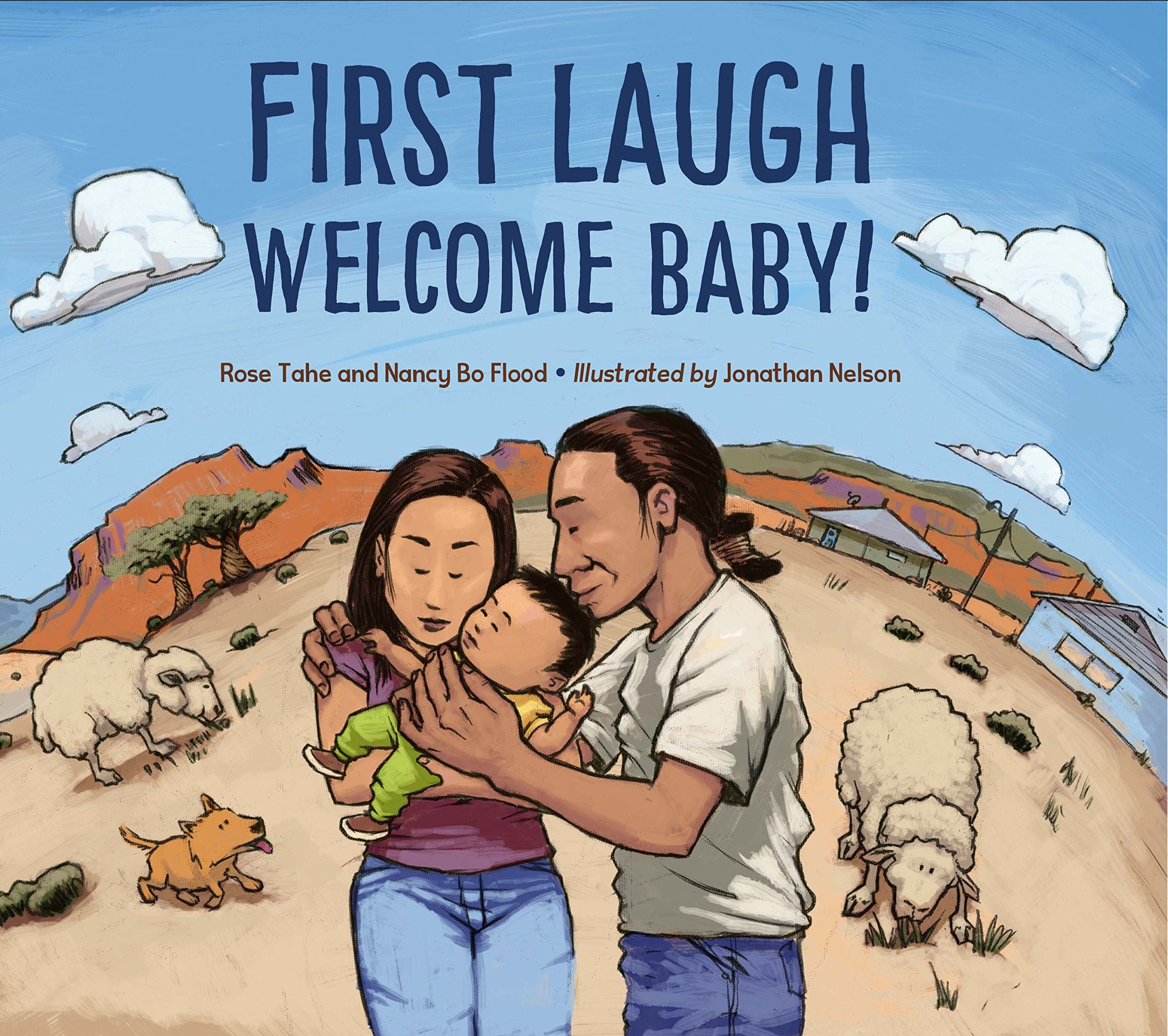
When I learned that Jonathan Nelson (illustrator of the way-cool The Wool of Jonesy) was doing the illustrations for this book, I was excited. When I got the book and saw that Nancy Bo Flood was listed as a co-author, I groaned. More on that later. For now, let's look at the art and what Nelson tells us with his art. Here's the cover:

Image result for "nelson jonathan" "first laugh"


So much to love, there, in his art! We see two adults clearly loving the child in their arms. We see a modern day house. Regular readers of AICL know that I think stories of Native people set in the present day are crucial to help non-Native people know that (and I hate saying this every single time I write or speak it) we are here, part of the present day.

When you open the book and look at the title page, you see that baby, lying in a baby bouncer, playing with a mobile... of sheep! On a blanket with sheep! See? So perfect!


From there we see babies in different places, surrounded by family members who are trying to make the baby laugh. Then, a baby smiles and laughs!


And then there's a gathering to celebrate that baby's first laugh. Take a look at it! So much joy and details to note, like the satellite dish on the house and the electric pole.


Did you know that there's a lot of writing about photographers and post card makers removing such things from photos because they wanted the Native people and places being depicted to look "authentic." Infuriating, for sure that they made decisions that if we had clocks or sewing machines or electricity or glass in our windows, we weren't "real."


Published in 1999
As I study Nelson's painting of all those folks gathered there, I am remembering Luci Tapahonso and Anthony Chee Emerson's Songs of Shiprock Fair, published in 1999 by Kiva Publishing.

I like it a lot, too, for the same reasons I like what I see in First Laugh: Welcome Baby! Set in the present day, family, crowds.

Both books provide Navajo children with mirrors of their lives and tribally specific experiences.


~~~~

Now let's look at the authors.

In the back matter, the first author's note is listed as "Author's Note from the Late Rose Ann Tahe." In first person, she tells us her English name and her Navajo name. Then, she introduces herself in the traditional way, telling us that she was born into her mother's clan, and her father's clan, and what her maternal grandparents' clan is, and her paternal ones, too. That note ends with "This is who I am and where I am from."

It is followed by an author's note from Nancy Bo Flood who tells us that "Just weeks after Rose and I completed the manuscript for this book, she contracted a sudden illness that took her life." So, Flood asked Tahe's family what they wanted to do. They agreed, Flood writes, that "their mother's wish was to have this book become real."

And so--we have First Laugh: Welcome Baby! with Flood listed as the second author. On the strength of Nelson's illustrations, I am recommending First Laugh. I think his work is terrific and I want to see more of it.  

Rather than put the concerns--including appropriation--with Nancy Bo Flood here, I'll be doing a stand-alone post (12/22/18: see William Flood and Nancy Bo Flood: A History). I'll be back to add the title and link to it, soon.

Do take time to visit Nelson's website, and of course, get a copy of The Wool of Jonesy. 

I adore that book and was delighted to see a 3D version of Jonesy at Returning the Gift last year.

He's awesome!


Tuesday, December 11, 2018

Highly Recommended! Awâsis and the World Famous Bannock, by Dallas Hunt and Amanda Strong

I settled in to do some reading last night. I reached for Dallas Hunt's Awâsis and the World Famous Bannock. Amanda Strong's illustrations drew me in as I turned the pages, following Awâsis as she sets out to take her her grandma's world-famous bannock to a relative. 


Image result for awasis and the world famous bannock


Illustrated by Amanda Strong (you absolutely must watch her stop animation videos!) and published in 2018 by Highwater Press, I'm pleased as can be to recommend it. Here's the description:
During an unfortunate mishap, young Awâsis loses Kôhkum’s freshly baked world-famous bannock. Not knowing what to do, Awâsis seeks out a variety of other-than-human relatives willing to help. What adventures are in store for Awâsis?
Like I said, I was reading along, enjoying the story. Awâsis talks to several animals on her way. Instead of the English words for them, Hunt gives us the Cree ones. When I got to her conversation with Ayîkis (frog) I smiled to see her words in bold and capital letters because Ayîkis is far away and Awâsis has to shout.  

Then, I got to the page where she comes to Ôhô (Owl), who is drifting off to sleep. Awâsis speaks softly. The font is smaller. I like that, too. Ôhô wakes up and looks at Awâsis... and then I read this sentence and sat right up!
They swiveled their head back and forth and hooted.
They?! THEY?! (Yeah, I am using bold and capital letters to convey my delight...) Here's that page:


Right away I started writing to friends in children's literature to ask if they've seen a gender neutral pronoun before in a children's picture book. The answer so far? No. This might be the first time a writer has put a gender neutral pronoun in a children's picture book. 

The one exception I've come across so far is a nonfiction picture book, They, He, She, Me: Free to Be! by Maya Christina Gonzales and Matthew Smith Gonzales, published in 2017. Are there others? If you know of one, let me know.

For now, I'm going to shout about this book to friends and colleagues in children's literature. Published in 2018 by Highwater Press, Awâsis and the World Famous Bannock by Dallas Hunt and Amanda Strong is highly recommended! 

And make sure you check out the recipe and pronunciation guide at the end of the book... and the video, too! 


Last bit of info: Hunt is a member of Wapisewsipi (Swan River First Nation) in Treaty 8 territory in Northern Alberta, and Strong is Michif out of the unceded Coast Salish territory also known as Vancouver, British Columbia. That's from the book flap. 

__________
Below, I will list other picture books that colleagues recommend. If the book is by a Native writer, I'll note that writer's nation. 

Gonzales, Maya, (2014). Call Me Tree/Llamame arbol. Children's Book Press.

Thom, Kai Cheng and Kai Yun Ching, (2017). From the Stars in the Sky to the Fish in the Sea. Arsenal Pulp Press. 


Saturday, December 08, 2018

Recommended: NEW POETS OF NATIVE NATIONS, edited by Heid E. Erdrich

There are very few books of Native poetry for teachers looking for poems to use with children and young adults. They can, however, get a copy of New Poets of Native Nations, edited by Heid E. Erdrich.


There are several poems in it that I'd use with teens. Consider, for example, Layli Long Soldier's "38." Most people, I'd be willing to bet, need help understanding the significance of that number. The opening stanza's of 38 are a comment on rules, on writing, on storytelling, on history, on expectations, on integrity of telling... terrific words that a teacher would want to spend time on. From that powerful set up, Long Soldier moves on to tell us about the 38:
You may or may not have heard about the
Dakota 38.
If this is the first time you've heard of it, you
might wonder, "What is the Dakota 38?"
The Dakota 38 refers to thirty-eight Dakota men
who were executed by hanging, under orders
from President Abraham Lincoln.
To date, this is the largest "legal" mass execution
in US history.
The hanging took place on December 26, 1862--
the day after Christmas. 
This was the same week that President Lincoln
signed the Emancipation Proclamation.

There's a lot more, after that. Long Soldier's poem is a history told with integrity and respect for the 38 and for Native people.

If you've read Eric Gansworth's young adult novels, you'll definitely want to read the poems he's got in New Poets of Native Nations. His "Speaking through Our Nations' Teeth." It opens with him asking:
When you see me
for the first time
at a powwow or social
across the circle
we dance
in which language and world view
do you form your first
impression 

In the next parts, he talks about some of the things we do in school (diagramming sentences)--which is one world view--and the other? Well... it isn't one where anybody diagrams sentences. That poem is followed by "It Goes Something Like This" which is about two children, going to Carlisle Indian School. And "Snagging the Eye from Curtis" is a brilliant critique of those sepia-toned photographs that far too many people view as authentic.

There are, in total, 21 Native poets in New Poets of Native Nations. Make sure you read Erdrich's introduction, also available online at Lit Hub. There, she talks about putting this volume together. I want to paste the entire Introduction here, but will put one paragraph, instead:

As I conceived of this book, I wanted to select and present a substantial and strong gathering of work by U.S. Native writers. I wanted to avoid the ways Native American poetry, most edited by non-Natives, has been presented—with a lot of apparatus and within binary notions of an easily digestible “American Indian” history or tradition in order to tie contemporary to past in a kind of literary anthropology. I did not want to add to the body of literature that allows “Indians” to exist in the past, or in relation to the past, but remain invisible in the world we all inhabit now.

New Poets of Native Nations. Get several copies! Give them away. Some books are described as "a gift" to readers. This one is that, for sure. Published in 2018 by Graywolf Press, I highly recommend it.

Highly Recommended! Kiss by Kiss/Ocêtôwina: A Counting Book for Families, by Richard Van Camp

You know how some things are so dear that you hold that thing close to your heart and give it a squeeze? Every year, Richard Van Camp creates books for young people that make me want to do that. This year, it is Kiss by Kiss/Ocêtôwina: A Counting Book for Families. His oh-so-perfect words in this board book were translated into Plains Cree by Mary Cardinal Collins.


It starts with "One kiss, two kiss, three kiss, four!" and so on. Facing these pages of words in English and Plains Cree are delightful, endearing photos of babies and toddlers and grown-ups, planting kisses. 

That cadence is interrupted by this photo, and, a smooch!


That smooch launches us into a series of pages where we read "Your kisses are so sweet!" and "Your kisses are so fun!" and "Your kisses are as welcome as the light from the sun!" 

I read Kiss by Kiss/Ocêtôwina after having spent a raucous hour playing with my niece's little girl. We played with a stuffed bear and a snowman, chasing each other around my mom's house. After each spree down the hall, she looked up at me with her twinkling eyes that said 'let's do that again'--and so we did. The photo on the right is the two of us, at one moment in that zany playtime!  

That 'let's do it again' look is where Kiss by Kiss ends, too. The final page is "Please can we start again at kiss number one?" It'd be fun to read this book to her (and the bear and snowman)! 

This is one of those books you'll want to give to lots of people. And--lots of people are in it! Some people might look at the photos and think the people in them don't "look like Indians" because far too many people carry stereotypical ideas of what Native people should look like. In fact, every person shown in the book could be a tribal member or citizen of a Native nation! 

In every book, Van Camp gives us so much. Native people see things others may miss, but that's ok. Those are, to use Cynthia Leitich Smith's phrase, "brushstrokes" that are subtly placed mirrors for Native readers. 

Published in 2018 by Orca, Richard Van Camp's Kiss by Kiss/Ocêtôwina is highly recommended. Get a copy. You'll see. It is a delight!

Friday, December 07, 2018

Recommended: YOUNG WATER PROTECTORS: A STORY ABOUT STANDING ROCK by Aslan and Kelly Tudor

Aslan and Kelly Tudor's Young Water Protectors: A Story About Standing Rock is a non-fiction photo-essay published by EagleSpeaker Publishing.


The "about" page tells us that the author, Aslan Tudor, was eight and nine years old during the period depicted in the book, and a citizen of the Lipan Apache Tribe of Texas. Information provided is his first-hand account of time spent at the camps when he was there in 2016.

Told from the point of view of a child, 
Young Water Protectors is a rare kind of story 
of a unique period of activism 
with Native people from so many nations 
standing together to fight a company
exploiting people and hurting earth's resources. 

There's a lot to think about, packed into this slim book. Tudor touches on the school at the camp, and what he learned there but he also notes that activity at some of the construction sites wasn't safe. It was safer for kids to stay in camp. For readers who want more information about that, adults can fill in the gaps according to what they know about the reader.


AICL's Best Books of 2018

We are starting AICL's "Best Books of 2018" today (December 7) and will update it as we read other books published in 2018. Please share this page with teachers, librarians, parents--anyone, really--who is interested in books about Native peoples. As we come across additional books published in 2018 and as we finish reading and writing up reviews, we will add them to this list. If you know of ones we might want to consider, please let us know! For now, a partial list of to-be-read books by Native writers is at the bottom. 


BY NATIVE WRITERS OR ILLUSTRATORS

Comics and Graphic Novels

  • Henry, Gordon and Elizabeth LaPensée. (2018). Not [Just] [An] Other. Makwa Enewed. United States. (review in process)

Board Books

Picture Books

For Middle Grades
  • Boney, Roy. (2018). "Tell It In Your Own Way" in We Rise, We Resist, We Raise Our Voices, edited by Cheryl and Wade Hudson. Crown Books for Young Readers. United States.
  • Quigley, Dawn. (2018). Apple in the Middle. North Dakota State University Press. United States
  • Smith, Monique Gray. (2018). Lucy & Lola. McKellar & Martin. Canada
  • Tingle, Tim. (2018). When A Ghost Talks, Listen. Roadrunner Press. United States. (review in process).
  • Tingle, Tim. (2018). Trust Your Name. 7th Generation. United States (review in process).
  • Van Camp, Richard. (2018). When We Play Our Drums, They Sing! McKellar & Martin. Canada

For High School
  • Day, Christine. (2018). "Unexpected Pursuits: Embracing My Indigeneity & Creativity" in Our Stories, Our Voices. Simon and Schuster. United States. 
  • Erdrich, Heid E., ed. (2018). New Poets of Native Nations. Graywolf Press. United States.
  • Gansworth, Eric. (2018). Give Me Some Truth. Scholastic. United States.
  • Gansworth, Eric. (2018). "Don't Pass Me By" in Fresh Ink: An Anthology edited by Lamar Giles. Random House Books. United States. (review in process)
  • Jones, Adam Garnet. (2018). Fire Song. Annick Press. Canada (review in process)
  • Smith, Cynthia Leitich. (2018). Hearts Unbroken. Candlewick. United States.
  • Wylls, Kristine. (2018) "Ballad of Weary Daughters" in Unbroken, edited by Marieke Nijkamp. 

BY WRITERS WHO ARE NOT NATIVE

Comics and Graphic Novels

Board Books

Picture Books
  • Morales, Yuyi. (2018). Dreamers. Holiday House. United States. 

For Middle Grades

For High School


BOOKS BY NATIVE WRITERS THAT ARE IN OUR TO-BE-READ STACK!
These include books intended for the adult market, but that we might think can be read by older teens. 
  • Francis, Lee and Alvitre Weshoyot, Sixkiller 
  • Hobson, Brandon. Where the Dead Sit Talking
  • Mailhot, Terese. Heart Berries: A Memoir
  • Orange, Tommy. There, There
  • Rice, Waubgeshig. Moon of the Crusted Snow
  • Robinson, Eden. Trickster Drift (book two in her Trickster trilogy)
  • Whitehead, Joshua. Jonny Appleseed


BOOKS BY NON-NATIVE WRITERS THAT ARE IN OUR TO-BE-READ STACK!
This list include books intended for the adult market, but that we might think can be read by older teens. 
  • Warner, Andrea. Buffy Sainte-Marie: The Authorized Biography