Monday, March 27, 2017

Debbie--have you seen BEAUTY OF THE BROKEN by Tawni Waters?

A reader wrote today, to ask if I've seen Beauty of the Broken by Tawni Waters. It came out in 2014 from Simon Pulse/Simon and Schuster. Here's the description:

In this lyrical, heartwrenching story about a forbidden first love, a teen seeks the courage to care for another girl despite her small town’s bigotry and her father’s violent threats.
Growing up in conservative small-town New Mexico, fifteen-year-old Mara was never given the choice to be different. Her parents—an abusive, close-minded father and a detached alcoholic mother—raised Mara to be like all the other girls in Barnaby: God-fearing, churchgoing, and straight. Mara wants nothing to do with any of it. She feels most at home with her best friend and older brother, Iggy, but Iggy hasn’t been the same since their father beat him and put him in the hospital with a concussion.
As Mara’s mother feeds her denial with bourbon and Iggy struggles with his own demons, Mara finds an escape with her classmate Xylia. A San Francisco transplant, Xylia is everything Mara dreams of being: free-spirited, open, wild. The closer Mara and Xylia become, the more Mara feels for her—even though their growing relationship is very much forbidden in Barnaby. Just as Mara begins to live a life she’s only imagined, the girls’ secret is threatened with exposure and Mara’s world is thrown into chaos.
Mara knows she can't live without Xylia, but can she live with an entire town who believes she is an abomination worse than the gravest sin?

The description doesn't mention Henry, the Native character. Here's what I see in Amazon's "look inside."

We meet Henry at the start of chapter 4:
There's a new freshman named Henry at our school. He's an Indian who moved from the reservation. His father came here to work at the prison, not as a guard, but as a janitor. Henry has no mother. No one knows why for sure. Some people say she drowned herself when he was little, right after his baby brother drowned in the tub. But I don't know if that's true. People talk a lot, and only half of it has any basis in reality.
What I do know is that Henry has long braids, black and shiny like licorice whips. Daddy said Henry's father fought the school for Henry's right to keep his braids and they agreed because they needed his tuition money. That pissed Daddy off so much, he drank all night and punched out a window. "It's a disgrace for a man to have long hair!" he bellowed. "It says right there in the first Corinthians. They call that place a Christian school? The little fucker probably worships rocks and trees and wolves and shit."
Daddy isn't alone in his convictions. All the boys at school hate Henry. Especially Elijah Winchell. I heard that in the bathrooms, they shove him up against the wall and call him gay. Also, people say he wears tighty-whities, which is weird because, apparently, most boys wear boxers these days. Not that I'd know from personal experience, but everyone seems to agree on it.
Mara feels bad for him. By the end of the chapter, she's invited him to her birthday party. He accepts her invitation. The last line in the chapter is this:
And that is how I ended up with a genuine Indian coming to my birthday.
I'll order a copy and will be back once I've read it.

Alternatives to Aaron Carapella's "Tribal Nations Map"

A few years ago, Aaron Carapella launched his Tribal Nations Maps website. At first glance, the project seemed terrific, but a close look revealed a lot of problems.

People--some who are scholars, others who are resource people for their particular nation, and some who are teachers--spotted problems and began to talk about those problems on social media. Among the problems with his maps are the sheer volume he tried to put on a fixed page. Native Nations moved and were removed over time. So--where he shows a given nation can be incomplete or wrong altogether. Another problem is that he tried to tell Native peoples the right name to use--based on his research which many told him was wrong, but he persisted and told them they are wrong. Another is that he used photographs in the public domain--much like people have used them forever--which means replicating problems in the photos themselves and how they were taken and used. An admirable project, yes, but when you get down to the product itself, problems! Nonetheless, Carapella continues to sell his maps.

Some people recommended alternatives to Carapella's maps. I'm sharing their recommendations, below. Some are maps, and some are in-depth looks at the concept of mapping. If you've got one to recommend, drop it in the comments.

Important! A first step, always, is to go right to the website of the specific nation you're interested in. See if they've got maps you can study.

The Invasion of America is a time lapse map project created by Claudio Saunt. Its interactive features provide a lot of information teachers will find useful. (Added here on 3/27/17.)

Maps are Territories is a close look at the concept of mapping. There's terrific material all through that site. If you're a teacher who asks students to make maps, study the site before you do your mapping projects. Recommended by Eric Ritskes.  (Added here on 3/27/17.)

Yuhaviatam (People of the Pines) is a map of Native peoples in southern California. Recommended by Pamela Peters. (Added here on 3/27/17.)

Yup'ik Environmental Knowledge Project Atlas is interactive and was created by elders. (Added here on 3/27/17.)

Saturday, March 25, 2017

What happened to "A Second Perspective" at All The Wonders?

Eds. note, 3/30/17: Please see updates to this post, including Matthew Winner's explanation.

First, a brief overview of what happened to my "Second Perspective" post at the All the Wonders website (more on who they are, later):

  • On Wednesday (March 22, 2017), I reviewed The Secret Project by Jonah and Jeanette Winters.
  • On Thursday morning (March 23, 2017), my review was added (with my permission) to the All the Wonders page about that book, as "A Second Perspective."
  • On Thursday evening (March 23, 2017), my review was gone.

Now, the details. 


On March 22, I wrote my review of The Secret Project, loaded it to AICL, and posted a link to the review on Facebook and Twitter. Then I looked on Twitter to see if others had reviewed it. If someone I know has reviewed a book I've also reviewed, I'll generally ask them to take a look at my review. Donalyn Miller and Jillian Heise added links to my review to their reviews on Goodreads.

I saw that The Secret Project was featured at All the Wonders. I read their interview with Jonah Winters (the author), and agree with what he said about propaganda. I felt then (and still do) that some changes to the book would make it outstanding. I wanted to listen to the podcast and read the interview with the illustrator, but had other things to do at that moment. Because I know All the Wonders is widely read by teachers and librarians, I asked them if they could add my review so that they could use information I share when they teach or read the book.


They said yes. On Thursday morning, my review was on their site as "A Second Perspective." I went back to my review and added a link to their site (and a screen cap of their introduction to my review). They wrote:
Here at All the Wonders, we strive to represent diversity and inclusion in the books we share. Debbie Reese, co-founder of American Indians in Children's Literature drew our attention to a recent review of The Secret Project she wrote where she discusses concerns over how Native Americans were represented in the story and illustrations. Specifically, the depiction of the Los Alamos Ranch School as isolated from other inhabitants to the region -- which it was not -- and the use of the phrase "nobody knows they are there" in reference to the scientists working on the bomb, which marginalizes the presence of the Native people living there. 
The story told in The Secret Project through words and illustrations is powerful, but in order to understand and appreciate more fully the context in which the even happened, it is important for readers to be aware of the Native people in and of the surrounding area.
Then, I went back to All the Wonders to read the interview with the illustrator, but it was gone. A little bit later, the interview with the author was gone, too. Why were they gone?

On Thursday night, I had an email from Matthew saying they had made a difficult decision to remove my review.

That night on Twitter, Sam Bloom of Reading While White, asked Matthew what happened to it. Here's a screen cap of his question:


Matthew replied, saying that they value "reading and being challenged by that review, but ultimately decided as a team to support the conversation in other ways". Here's a screen cap of his reply:


Early Friday morning, I replied to Matthew to acknowledge what they had done and let him know that I was about to get in my car for a day-long road trip and didn't have time to write back at length about the decision.

Just before I got in my car, I saw that the author and illustrator interviews were back on the All the Wonders page.

As I write this post, it is Saturday morning. I'm reading through what happened yesterday on Twitter.

Kathleen Horning of the Cooperative Children's Book Center  asked Matthew for an example of "other ways." He replied, saying "Such as in a conversation on an open forum such as Twitter where all stakeholders can participate in real time." And, here's the screen capture of that:


In an email sent to me yesterday, Matthew suggested I contribute a post for All the Wonders, that consists of books I recommend. He also referenced a Twitter conversation. I haven't replied to him yet. I'm conflicted. If I say yes to his invitation, I'll be able to bring visibility to Native writers.

I'm not angry at Matthew, and I hope this blog post doesn't cause him to withdraw his invitation.

Here's what I think, and some back story...


In posting my review at their site, All the Wonders found themselves mired in the politics of children's literature. Did Jonah Winters demand that his interview be removed? Did Jeanette Winters demand that her interview be removed? Did their publisher make demands of the team at All the Wonders? Did they make threats?! I know--that sounds dramatic--but there's back story to all this that prompts me to use the word "threat."

The Secret Project is published by Simon and Schuster. As one of the Big Five, it is a powerful entity. Back on March 5, 2017, the Wall Street Journal published an article titled The 'Rock Star' Librarians Who Choose What Your Kids Read. That article is how I learned about All the Wonders and Matthew Winner. He's featured in it as one of the three men characterized as rock stars (the three strongly objected to being the focus of the article and to being characterized that way. Women had also been interviewed but were not included).

The article generated a lot of discussion. Allie Jane Bruce of Reading While White did a terrific post about it. She asked some pointed questions. Are these three librarians being used by publishers as a way to get free advertising for their books? Were/are they (inadvertently) functioning as marketers for publishers? Please read the comments to the post. Among them is one from Matthew Winner. He disagreed with her remarks about advertising and marketing. He also said that he wants to increase the diversity of the podcasts at All the Wonders. In my comment to Allie's post, I recommended he add Native writers. He and I started talking, via email, about possibilities and I think one will be there, fairly soon.

I also asked him, in an email, if he might add critical content to some of the pages they do at All the Wonders. He didn't say yes or no, but I believed (and still believe) that he and his team are very interested in being more diverse with what they're doing on their site. So... last week when I saw that All the Wonders had a new page up on The Secret Project, I decided to ask them to add a link to my review and was thrilled that they did. Then, as you know, they removed it.

So, what happened to "A Second Perspective" at All the Wonders?


Did Simon and Schuster put pressure on the All the Wonders team to remove my review? If Simon and Schuster gives All the Wonders books, did they threaten to withhold future books? If Simon and Schuster controls access to its authors and illustrators, did they threaten to withhold access to their authors and illustrators? Did they say "get rid of Debbie's review, or else"?

I don't know if the All the Wonders team was pressured to remove my review, and I'm not going to ask Matthew that question.

It seems to me that the team at All the Wonders was put into a difficult position. They want to offer critical content of books along with podcasts and interviews, but their effort to do so with my review didn't succeed.

I've got lot of questions. Do publishers wield that much power over sites like All the Wonders? If so, that's not good, at all, for anyone. If not, then.... what happened to my review? Right now, several people are wondering what happened.

Update (3/30/17) -- A Response from Matthew Winner


A few days after loading this post, I went back to School Library Journal to read "Rock Star Librarians" Article Hits Sour Note. Written by Addie Matteson and Matthew Winner, it addressed a major concern with the article in the Wall Street Journal that featured three male librarians. This paragraph stood out to me:
The fact that diverse voices weren’t heard, valued, or represented in the WSJ article made us look more closely at the people we look to as leaders, the authors and role models we invite to our schools, the books we choose to read, review, and purchase. We need to do more, and we need to be better. If we want our students to see themselves on our bookshelves and in our programming, we need to actively work toward that goal. How can we expect the world (or the Wall Street Journal) to see school libraries as places where diversity is honored and celebrated if we are not working to make them that way?

Winner's decision to use my review of The Secret Project was evidence of his wish to "do more" and "be better." But, with those words as context, his decision to delete it made the decision to use it in the first place even worse.

I shared that excerpt on Twitter yesterday morning (3/29/17), again asking why my review was taken down. Kate Messner, Laurie Halse Anderson, and Justine Larbaleister retweeted it and asked the question, too.

At 8:14 PM, Winner replied to Kate Messner and Laurie Halse Anderson, saying he would respond. Here's a screencap of his tweet to Laurie:


At 8:41 Winner submitted a response, using the blog's comment form. I saw it in this morning's email and am pasting it here:

Hi everyone. I want to apologize publicly here to anyone who was offended by our decision to include Debbie’s review of The Secret Project in our feature at All Wonders and then retract it later that day.
We feature one book each month in addition to our regular content, and the selected book is one that our team believes stands above the rest. We think of our features as an award from our team, and we honor the chosen book by compiling various forms of content that celebrate it. We even describe the feature to the artists involved as "a week-long celebration of your book." These words, we believe, enter us into a verbal agreement that we will shine a positive light on their work, and it is based upon this agreement that the publisher grants us permission to license their images, words, and behind-the-scenes content. I made a misstep, then, by surprising Jonah and Jeanette Winter and their publisher, Simon & Schuster, with a critique, and introducing an element of debate into the feature. After careful reconsideration of these factors, we decided to pull the post. 
I know now that this series of events confused and offended a number of individuals. I am sorry for that. We (myself along with the team) had the best intentions, which was to offer a “second perspective” post from Debbie, who saw something that we did not see in our reads through the book. We consider critically all of the books that we include on our site, and we welcome discussions about how they are serving readers, but our features in particular are not designed for that purpose. They are designed to give children multiple entry points into what we believe to be special books. 
Once we came to the decision to pull Debbie’s post, we immediately communicated to her via email that we would be removing her post for these reasons and gave her an open invitation to address American Indian representation in children’s books on our site or in the form of a Twitter chat. Though we are still waiting for an official response from Debbie, it is our sincere hope that she will choose to work with us in the future to raise awareness about misrepresentations of American Indians in children’s literature.
Our goal at All the Wonders is not to silence, but to raise the voices of authors, artists, bloggers, and critics in service of readers. I regret the way these events have unfolded, but I consider this an opportunity to learn from our mistakes and a renewal of our mission to build positive relationships with all of our colleagues. 
Sincerely,
Matthew C. WinnerAll The Wonders co-founder 


Matthew did, as he wrote above, email me to say they were removing my post. Specifically, he wrote:
 [We] dd not feel that the piece added to the focus of the feature and that the conversation it beckons would be better served in other contexts throughout the site. We felt that the topic begs for discussion, and that is not something that the feature is suited for or capable of.
That line was particularly ambiguous (to me). He went on to say that they wanted me to write about Native writers and be a guest on a Twitter chat they host.

That invitation is fine, but it is a far cry from what a Second Perspective on books can do for teachers and librarians. When they added my review as A Second Perspective, I thought of all the other books they had featured and that could use A Second Perspective. One, for example, is Laura Jimenez's perspective on Telgemeier's Ghosts. Frankly, I was excited at the possibilities.

Do I want to contribute a post about Native writers to All the Wonders? I'm not sure.

I still think that their decision not to proceed with A Second Perspective is a mistake. A week-long celebration of a book is a mistake if there are concerns about that book's representations of marginalized people.

Winner and the team at All the Wonders were right when they said this, to introduce my review as A Second Perspective at their site:
The story told in The Secret Project through words and illustrations is powerful, but in order to understand and appreciate more fully the context in which the even happened, it is important for readers to be aware of the Native people in and of the surrounding area.
Saying that, they recognized Pueblo children as readers. Indeed, they recognized all children who live in that area who know more about the history and cultures of the area than Jonah and Jeanette Winters told them in The Secret Project. 

As Winner's response says, their decision to add A Second Perspective surprised Jonah and Jeanette Winters, and Simon and Schuster, too, because of his verbal agreement to shine a positive light on their work. That, I believe, explains why their interviews disappeared from the site when A Second Perspective was published. Once that second perspective was removed, their interviews went back up.

Those two people and their publisher set the terms under which Matthew Winner and the team at All the Wonders will speak about their books.

That's not surprising, but Winner is a librarian by training and profession. From that position as a librarian, he is providing a huge service to teachers and librarians who read All the Wonders.

But is it a service to his profession? I think it is a service to publishers. With that as a fact, his words in the SLJ article ring hollow. Doing better doesn't mean just talking up the good. Books get better when we talk about the problems in them, too.

Update, March 31, 2017

Yesterday, Kate Messner asked Matthew Winner for a clarification:
To clarify...were you asked by S&S to remove the original images/words/content after you'd added Debbie's Second Perspective?
He replied saying:
S&S expressed their regret, but we as @_AllTheWonders maintain full autonomy over what we create and what we share on our site. 
and
S&S was very specific about saying they would not pressure us to take down the post. 

Wednesday, March 22, 2017

Not recommended: VIVIAN AND THE LEGEND OF THE HOODOOS by Jennings and Saroff

A reader wrote to ask me about Vivian and the Legend of the Hoodoos, written by Terry Catasus Jennings and illustrated by Phyllis V. Saroff. Published by Arbordale Publishing, it came out in 2017.

Here's the synopsis:
Long ago, the Old Ones were bad. They drank all the water, ate all the pine nuts, and left nothing for the other creatures. Sinawav the coyote punished them by turning them into rocky hoodoos. Now when children misbehave, their Paiute elders remind them that they too could be turned into stone columns! Vivian has heard the stories, but this year as she and her grandmother climb the mesa to pick pine nuts, Vivian has something more important on her mind: basketball tryouts. When Vivian is disrespectful to the trees and the land, her grandmother must remind Vivian of the legend of the hoodoos and how nature has made it possible for her people to live.
My thoughts:

I specifically look for books set in the present day, in which a Native child and his parents or grandparents are doing something together, whether it is specific to their nation or not. I like to see traditional story brought into that story, in a natural way, with the characters speaking, in a natural way. 

And so, I like that Vivian and the Legend of the Hoodoos is set in the present day. If it was well done, it could have been a mirror for Paiute children who pick pine nuts with their families. If it was well done, it could have been a window for non-Paiute children to learn a little about Paiute people.

But, I don't think it is well done, for several reasons.

As the synopsis says, Vivian is out with her grandmother. They're going to pick pine nuts. As they set out, her grandmother reminds her that they should leave some for others. Vivian remembers a legend her grandma had told her, about "the Old Ones" who took everything. Others asked "the god" named Sinawav, or coyote, for help. 

Using "the god" to describe coyote bothers me. Do the Paiute's think of coyote as a god? 

In the story, Sinawav invites the old ones to a banquet, and then punished them by turning them into "rocky hoodoos." When Vivian was a little girl and out with her grandma, that story of misbehaving always made Vivian obey. But now that she's older, she knows it is erosion that formed the rocks that way, and not Sinawav. Here's that part of the story:


That bothers me, too. If the hoodoos are, in fact, amongst the stories the Paiute people tell about how their land came to be the way it is, would that story be spoken of that way? It is possible, of course, but I wonder. Would we see something similar in a story with a Christian grandmother and her grandchild about something important to how the Christian world came to be?

Vivian is impatient. Her grandmother reminds her to ask the trees' permission to pick their fruits, but she replies that she'd done that last year. Her grandmother harrumphed, and asked the trees' permission herself, and they got started picking the nuts.

At one point she starts treating the pine cones like basketballs, shooting them into her bucket. That makes her grandmother angry. She grabs Vivian's hand and takes her to a place where "the Old Ones had lived." This place, however, is different from others she's been to. At this one, Vivian nearly steps on a pottery shard. She picks it up and admires it. Her grandmother took it from her and put it back on the ground, saying
"Things from long ago are sacred. You shouldn't remove them."
Some things from long ago are sacred. Some pots from long ago might be sacred. Sacred or not doesn't matter. When you're on a reservation or at a national park or lands held by the US government, it is against the law to remove such things. For centuries, people have taken things like that. Some ended up in museums. Today, there is a federal law by which such things are returned to the tribal nations they were taken from. And, people who take them, today, are arrested and prosecuted for doing it.

Next, Vivian's grandmother tells her:
"Our legends say we have always been here."
That doesn't sound the way a grandma would speak to her grandchild in a natural, one-on-one conversation, and it doesn't fit with what Vivian already knows (the story about the hoodoos). I also don't think a grandma would use the word "legends" either, to refer to their stories. I can imagine a grandmother speaking that way to an audience of non-Native people in a storytelling format, but again, I don't think she'd say "legends." It is possible, of course, but it feels very much an outsider trying to speak as an insider, but not getting a strong sense of how we talk to each other. 

Vivian's grandmother goes on to tell her a story about "those who had lived on that mesa." Again--this doesn't feel right. Vivian knows that hoodoo story but not any of this cultural information about pine nuts, songs, drying meat, sewing skins, and making bows and arrows? As the two walk in the runs they find many of the things from the story Vivian's grandmother has just told her about (like an awl made of bone and a metate).

They return to picking nuts, but before she does, Vivian asks the trees' permission, and when she leaves, she thanks them for their fruit.

That's the end of the story but not the end of the book. One of its selling points is the four pages of information about Paiute culture and history, how water shapes rocks, and one about hoodoos. That last one is also a puzzle. If kids put a set of four paragraphs in proper order, they will learn "the name of the modern Paiute tribe." That is an oh-oh right away, because there's more than one Paiute tribal nation today. Do a search using "Paiute" at the list of federally recognized nations and you'll see what I mean. You'll get 37 hits, but about 20 (if I counted right) distinct tribal nations with Paiute in their name. Nonetheless (before doing that search), I tried to figure it out, and failed. So... I cheated. I looked at the answer, and thought, "that's not right! No wonder I couldn't do it." Take a look:


Did you figure it out? The answer is Paiute Indian Tribe of Utah. See why "the name" isn't quite right? The puzzle ought to be something like "an acronym for the Paiute bands in Utah."

In the book, Glenn Rogers and Clarence John, of the Shivwits Band of the Paiute Indian Tribe of Utah, are thanked for verifying the accuracy of the information about Paiute culture and history. The problems in Vivian and the Legend of the Hoodoos are not about accuracy. They're about bias and voice. As such, I do not recommend it.

Not Recommended: THE SECRET PROJECT by Jonah Winter and Jeanette Winter

Eds. Note on Oct 19, 2017: For a more in-depth review than the one below, see Still Not Recommended: The Secret Project. 

Eds. Note on 3/27/17: This review (below) was posted on a popular children's literature website but removed. For details, see What Happened to A Second Perspective at All the Wonders?


A reader wrote to ask if I've seen The Secret Project by Jonah Winter and Jeanette Winter. 

It was going into my "Debbie--have you seen series" but when I looked it up, I got a copy right away. Why? Because it has several starred reviews, and because its setting is so close to Nambe Pueblo (my tribal nation, and where I grew up is about 30 miles away).


The Secret Project came out in February of 2017 from Beach Lane Books, which is part of Simon and Schuster. It is a picture book for kids in grades K-3. 


Here's the synopsis:

Mother-son team Jonah and Jeanette Winter bring to life one of the most secretive scientific projects in history—the creation of the atomic bomb—in this powerful and moving picture book.
At a former boy’s school in the remote desert of New Mexico, the world’s greatest scientists have gathered to work on the “Gadget,” an invention so dangerous and classified they cannot even call it by its real name. They work hard, surrounded by top security and sworn to secrecy, until finally they take their creation far out into the desert to test it, and afterward the world will never be the same.
The Secret Project is getting a lot of starred reviews for its content and illustrations. Of course, I'm reading it from a Native point of view. Or, to be more specific, the point of view of a Pueblo Indian woman whose ancestors have been in that "remote desert of New Mexico" for thousands of years. 

The opening pages depict a boys school, all alone in the middle of a "desert mountain landscape":


That school was the Los Alamos Ranch School. The boys shown are definitely not from the communities of northern New Mexico at that time. In the Author's Note, the school is described as being an elite private academy (elsewhere, I read that William Borrough's went there). It was, and its history is interesting, too. What bothers me about those two pages, however, is that they suggest there was nothing there at all. It is like the text in Wilder's Little House on the Prairie. All through that area, there are ancestral homes of Pueblo Indians. Depicting the school that way adds to the idea that the site where the bomb would be developed was isolated, but depicting it that way also erases Native people. 


The government wanted the school and that area to do research, so the boys school had to close. The scientists moved in. We read that "nobody knows they are there." Who is nobody? It was, as the Winter's tell us, a secret project. But people who lived in the area knew it was there. They may not have known what was going on, but they knew it was there. If, by "nobody," we are meant to think "citizens of the world minus those who lived there" then yes, nobody knew (but again, nobody is relevant, even to them). 


We read that in "the faraway nearby" places, people didn't know the scientists were there. 


Artists, specifically, don't know they are there. The first image is meant to represent Georgia O'Keefe who lived in Abiquiu, which is about 50 miles away. It--I guess--is a "nearby" place. 


Then, there's this page:


The text on that page reads "Outside the laboratory, in the faraway nearby, Hopi Indians are carving beautiful dolls out of wood as they have done for centuries."


Hopi? That's over 300 miles away in Arizona. Technically, it could be the "faraway" place the Winter's are talking about, but why go all the way there? San Ildefonso Pueblo is 17 miles away from Los Alamos. Why, I wonder, did the Winter's choose Hopi? I wonder, too, what the take-away is for people who read the word "dolls" on that page? On the next page, one of those dolls is shown hovering over the lodge where scientists are working all night. What will readers make of that? 


On an ensuing page, we see the scientists take a break by going to "the nearby town" on what looks like a dirt road. That town is meant to be Santa Fe, and that particular illustration is meant to depict the plaza where Native artists sell their work (there's a Native woman shown, holding a piece of pottery). It wasn't a dirt road, though. By then, Santa Fe had paved roads. Showing it as a dirt road contributes to the isolated nature of where the scientists were doing their work, but it isn't accurate. 


Like many reviewers, I think the ending is provocative. The Secret Project ends with the test of the atomic bomb, at the Trinity site. As the bomb explodes, the scientists watch from a bunker, far away. The bomb's explosion fills the last page. That's it. No more story. I think some readers will think "AWESOME" and others will think it horrible. The author's note is next. It has information about the radiation that explosion left behind, how long it will be there, and that now, studies of the cancer it caused in citizens near there, are being done. 


I think children should have books about subjects like the development of the bombs that destroyed Hiroshima and Nagasaki, but they ought to be inclusive of -- in this case -- Native peoples who lived and live in and around Los Alamos. As is, the book yanks those readers out of the book. And, it misleads readers who don't know the area or its history. 


I suspect that people will defend it, telling me or others that "it is important that kids know about the bomb" and that my concern over its misrepresentations are of less importance than knowing about the bomb. With that defense, however, it will be among the ever-growing pile of books in which this or that topic is more important than Native people. 


The irony, of course, is that this universe of books is one in which books are written and published by people who are occupying Native homelands. 


Published in 2017 by Beach Lane Books/Simon and Schuster, I do not recommend Jonah and Jeanette Winter's The Secret Project. 

Update, March 22 2017, 1:45 PM

Back to insert comments from Dr. Jeff Berglund, a friend and colleague who teaches at Northern Arizona University. He said, in part (read his entire comment below):


"I have another issue with the Hopi panel: the majority of Hopi men during the 19th and through the mid-20th century had cut hair with bangs, quite distinct and different from the carver depicted. This is a simplistic stereotypical rendering of a Native man."
Update, March 22 2017, 3:30 PM

Another colleague--actually, she's more of a member of my family--wrote to tell me about a 2015 Walking Tour document of Los Alamos. Take a look. Here's an enlarged piece of the document, showing item 9:


I looked around a bit and found this photo of it from a running and travel blog, whose post says it is right behind Fuller Lodge:


Update, March 23, 2017

The folks at All the Wonders asked if they could put my review on their page about The Secret Project as a "Second Perspective." That's a terrific idea! Readers there can listen to the podcast review, read interviews with the author and his mother--and read my critical review, too. Here's a peek. Go there and see it, and thanks, All the Wonders for adding it.


Update, March 25, 2017

My review is no longer at the All the Wonders website. For details, see What Happened to "A Second Perspective" at All the Wonders? 

Saturday, March 18, 2017

Librarians Noting Problems in Nonfiction Series: First Peoples of North America, by Cassie Lawton

One of the more gratifying kind of emails I get is from librarians who are bringing a critical lens to nonfiction.

Recently I had an email from a librarian in Oklahoma who was looking over Cassie Lawton's First Peoples of North America. That seroes came out in 2016 from Cavendish Square Publishing.

The librarian noted problems that every librarian can keep an eye on as they look over nonfiction books.

One is tense. Are all, or most of the verbs past tense? If so, that's a problem.

Another is words used. This series has "costume" for the clothing the people in the books are wearing. Better words are regalia, or traditional clothing.

A third one this librarian noticed is about the photographs. She wonders if the photos match the particular tribal nation the photograph is supposed to be about.

I haven't seen the series. Given their price, I don't plan to buy them. If they turn up in a local library, I'll review one. I did look them up on the publisher's website and winced at the covers. Those old sepia-colored photos on the covers generate a nostalgic response in so many people that moves them to talk about "plight" and hold us safely in mind as a problem of the past, not present. It is a lot like how people view mascots.

Anyway. If you're a writer, or if you're an editor... no matter what kind of book you're doing: stay away from those sepia covers! Please!

Friday, March 17, 2017

Jokes and Riddles in Books for Kids

This morning on Twitter, I saw a tweet from a Native parent that included an image from a joke book her child was reading last night. The book is from their local library. I've asked her for more details, but in the meantime, it was easy to find at least one book with the "joke" in it:


That's from Biggest Riddle Book in the World, by Joseph Rosenbloom. Published in 1976 by Sterling Publishing Company, the copy at Google Books shows that it was reprinted at least 11 times:


A quick search of the book, using "Indian" as the search term, shows this "joke" is in it, too:


Rosenbloom's book doesn't have illustrations for those two "jokes," so that's not the one in question.

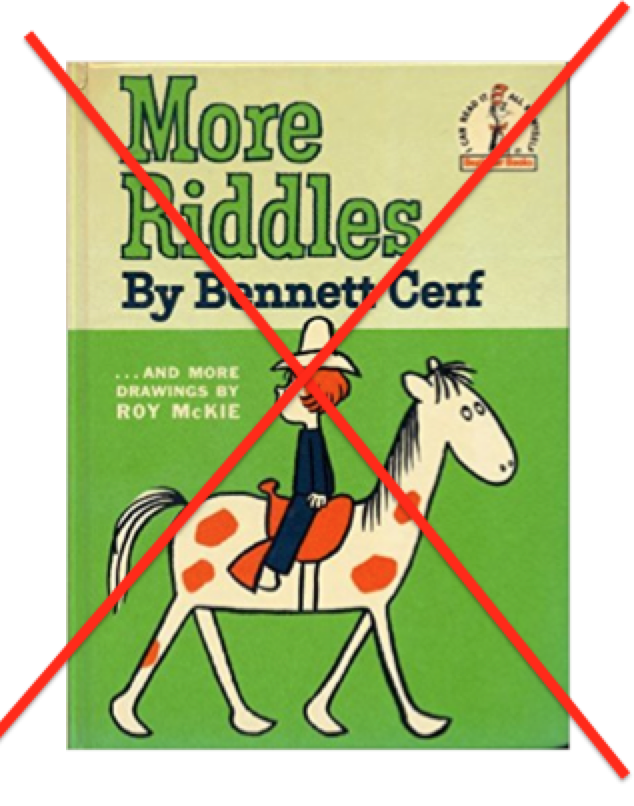
Based on the style of the illustration that was tweeted out, I think the book is Bennett Cerf's More Riddles, published in 1961. Here's the cover. I put the big red X there, with the hope that next time you see that book, you'll remember that red X, and remember that it has a racist "joke" in it.


And here's the image (adding it at 11:40 AM on March 17, with permission of the parent):


In American Indian Stereotypes in the World of Children: A Reader and Bibliography, there's a passage about that book:
Cerf’s More Riddles (1961) contains an image and verse that epitomize the detached nature of “Indian” imagery from the reality of Native people. “What has . . . Two legs like an Indian? Two eyes like an Indian? Two hands like an Indian? Looks just like an Indian? But is not an Indian?” The questions are accompanied by a headdressed, buckskinned, dancing caricatured “Indian.” The answer to the riddle, on the next page, is “A picture of an Indian,” and is illustrated with a child holding a picture of the same caricature. The “Indian” image in this and other books has no reality except as a white-created caricature of Native people, true only unto itself, and the answer to this riddle unwittingly reflects that fact.
Cerf's book is old, but is popular, which is why it is still in that library. There are other joke and riddle books with that sort of "joke" in them. I noted Rosenbloom's book, above, but I recommend you get a copy of American Indian Stereotypes in the World of Children: A Reader and Bibliography. I've got a hard copy of the first edition (published in 1982), but get the second one, which came out in 1991 (I have a hard copy and electronic copy of that one). The publisher is Scarecrow Press, and the book is edited by Arlene Hirschfelder, Paulette Molin, and Yvonne Wakim. Inside are chapters by them, and other writers, too. Here's screen captures of the Table of Contents for part one (part two is the bibliography):


I think American Indian Stereotypes in the World of Children can be used as a collection development tool. As the Table of Contents shows, it has chapters about books, textbooks, toys, films, holidays... It is amongst the books I read early in graduate school, and that I use as a resource, now.

If the Native parent gives me permission to use the image she shared last night, I'll be back to insert it and the title of the book her child was reading. Obviously, these "jokes" aren't funny to those who are the subject of the joke.