Back in January, a reader wrote to ask me about Emily Henry's The Love that Split the World. I've now gotten a copy, read it, and am working on an in-depth review of it. Due out in 2016, it is being published by Razorbill (Penguin).
However! Last week I learned it was being picked up by Lionsgate. If all goes according to plan, it will be a movie. That troubled me deeply because of the errors I found in the book.
I started tweeting about it, and got some pretty fierce pushback from people who are friends of the writer.
If you're interested in the tweets and my response to the pushback, I created two Storify's about them (Storify is a way to capture a series of tweets in a single place.) I've also got them available as pdf's--let me know by email if you want a copy of the pdf.
Here's the first one (note on March 31 2023: Spotify went down years ago, but the saved stories I did using their page are available at the Wayback Machine):
- Home
- About AICL
- Contact
- Search
- Best Books
- Native Nonfiction
- Historical Fiction
- Subscribe
- "Not Recommended" books
- Who links to AICL?
- Are we "people of color"?
- Beta Readers
- Timeline: Foul Among the Good
- Photo Gallery: Native Writers & Illustrators
- Problematic Phrases
- Mexican American Studies
- Lecture/Workshop Fees
- Revised and Withdrawn
- Books that Reference Racist Classics
- The Red X on Book Covers
- Tips for Teachers: Developing Instructional Materials about American Indians
- Native? Or, not? A Resource List
- Resources: Boarding and Residential Schools
- Milestones: Indigenous Peoples in Children's Literature
- Banning of Native Voices/Books
- Debbie on Social Media
- 2024 American Indian Literature Award Medal Acceptance Speeches
- Native Removals in 2025 by US Government
Sunday, March 20, 2016
Wednesday, March 16, 2016
Beverly Slapin's Review of Bruchac's THE HUNTER'S PROMISE: AN ABENAKI TALE
Editor's note on Sep 30, 2023: I (Debbie Reese) can no longer recommend Bruchac's work. For details see Is Joseph Bruchac truly Abenaki?
Debbie Reese to Host IndigenousXca from March 17 through March 24
Sharing some great news! Chelsea Vowell of apihtawikosisan asked me to host IndigenousXca from March 17 through March 24. If you're not tapped into Native networks on Twitter, you're probably wondering what IndigenousXca is...
Back in 2012, Luke Pearson started IndigenousX in Australia as a way to provide Indigenous people a way to reach a broader audience than those who follow the individual's Twitter account. Inspired by it, Chelsea launched IndigenousXca on October 30, 2014. Hosts are primarily First Nations, but the reality? The line between the US and Canada is a blurry one when you center Indigenous Peoples as the peoples of North America.
Each week, an Indigenous person is invited to tweet using the IndigenousXca account. The subject of the tweets is up to the host.
IndigenousXca's first host was Paul Seesequasis. Since then, there have been over 60 hosts. Right now (March 10-17), Dale Turner (he's a professor at Dartmouth) is the host.
People who follow my Twitter account (@debreese) know that I generally tweet about representations of Native peoples in children's and young adult books, but that I also tweet items I've read and want to promote. Some of those are specific to Native people, but some aren't.
During my week as a host of IndigenousXca, I'll stick to tweets about my area of research and expertise (representations of Native peoples in children's and young adult books). That includes sharing books I've reviewed here on AICL as well as items other Native people are writing about--including their responses to J.K. Rowling's Magic in North America series. Those tweets will be sent out using the @IndigenousXca account. If you're on Twitter, I hope you'll check out, and then follow that account. There's some excellent content shared via that account.
Tuesday, March 15, 2016
Did JK Rowling Change the Images on her Magic In North America Series at the Pottermore Site?
If you're following the response of Native people to JK Rowling for her "History of Magic in North America" stories that are short backgrounds for the next movie, Fantastic Beasts and Where to Find Them, I think you'll be interested in this bit of info.
Last Thursday (March 10, 2016) I began compiling a list of blog posts and threaded tweets by Native people who were responding to JK Rowling's "History of Magic in North America" series. I included a screen cap from the Pottermore site that had a flying eagle as the image for the story. Seeing that eagle struck me as odd, because the day of my first tweet (March 8, 2016) I had seen a different image on the Pottermore site--the one of an Indian standing on a cliff.
This morning (Tuesday, March 2016) I read an article at Hypable that describes a person's search to figure out who the founding group of Ilvermorny would be (in the movie, Fantastic Beasts and Where to Find Them) that is due out later this year. (There's a lot to say about the Hypable article but that's for another post.) The article is by Andrew Sims. I looked him up on Twitter, found him, and found an interesting tweet from him, dated March 10 at 8:34 AM. Here's a screen cap:
Using the Internet WayBack Machine, I figured out that the image changed sometime between March 9 at 8:10:58 PM and March 10 at 5:17:17 AM.
Here's the image time stamped March 9 at 8:10:58 PM:
And here's the image time stamped March 10 at 5:17:17 AM:
As far as I know, JK Rowling has not responded to any of the criticisms Native people began putting forth on March 8th. Someone did make a change to the site. I suspect it was Rowling.
Will we hear more from her? Because she has tweeted in support of various marginalized groups before, her lack of response to us is troubling. As they say on TV "stay tuned" to AICL for updates.
The info?
Evidence (maybe) that someone (Rowling, maybe?!)
is, in fact, doing some tinkering with the
problematic content on the
Pottermore website.
Last Thursday (March 10, 2016) I began compiling a list of blog posts and threaded tweets by Native people who were responding to JK Rowling's "History of Magic in North America" series. I included a screen cap from the Pottermore site that had a flying eagle as the image for the story. Seeing that eagle struck me as odd, because the day of my first tweet (March 8, 2016) I had seen a different image on the Pottermore site--the one of an Indian standing on a cliff.
This morning (Tuesday, March 2016) I read an article at Hypable that describes a person's search to figure out who the founding group of Ilvermorny would be (in the movie, Fantastic Beasts and Where to Find Them) that is due out later this year. (There's a lot to say about the Hypable article but that's for another post.) The article is by Andrew Sims. I looked him up on Twitter, found him, and found an interesting tweet from him, dated March 10 at 8:34 AM. Here's a screen cap:
Using the Internet WayBack Machine, I figured out that the image changed sometime between March 9 at 8:10:58 PM and March 10 at 5:17:17 AM.
Here's the image time stamped March 9 at 8:10:58 PM:
And here's the image time stamped March 10 at 5:17:17 AM:
As far as I know, JK Rowling has not responded to any of the criticisms Native people began putting forth on March 8th. Someone did make a change to the site. I suspect it was Rowling.
Will we hear more from her? Because she has tweeted in support of various marginalized groups before, her lack of response to us is troubling. As they say on TV "stay tuned" to AICL for updates.
Thursday, March 10, 2016
Native People Respond to Rowling
Eds. note on June 30, 2016: Scroll down to see curated list of items that Native writers have written in response to Rowling.
As fans of Harry Potter know, there are (at least) two distinct responses to J.K. Rowling's "History of Magic in North America" stories.
The first story, "Fourteenth Century - Seventeenth Century," was released on Monday, March 8, 2016. Fans were delighted to have more of her writing to read.
Native people--those who are fans of her books, and those of us who study or write about representations of Native peoples in popular culture and children's literature--had a different response.
When I (Debbie Reese) read the first story in Rowling's series, I'd been deeply immersed in a study of a handful of best selling children's books. I was appalled to read "also called redskins for their custom of smearing red earth over their entire bodies" in the popular Geronimo Stilton's The Wild, Wild West:
And I'd just read Rick Riordan's The Lost Hero where a main character's dad is Cherokee, making her half Cherokee. She's taunted by other characters who ask her if her dad is an alcoholic and if she'll do a rain dance. Riordan had those words come from what we might characterize as "mean girls." I assume he did that to, in that way, show them to be inappropriate things to say, but far too many people won't pick up on that nuance. I worry that, without a direct push-back on those taunts, people will view them as an affirmation of existing stereotypical ideas, and use those same taunts themselves.
With The Wild Wild West and The Lost Hero as my immediate context for reading Rowling's story, I was furious. I used the f-bomb in a tweet at her. Use of the word wasn't necessary, but the emotion it expressed was real. As I read tweets by Native people, I saw a range of emotion. Anger. And hurt, too. Native people who are my daughter's age grew up reading Harry Potter. This particular group are adults now, in their 20s. She--and they--were huge fans of every book in the series.
But this short story? Their reaction to it is different. They read the first line, with its monolithic "The Native Americans" as bad, but each paragraph of that short story was laden with troubling misrepresentations of Native peoples.
Those who are following the news on this story know that major media is reporting on it, excerpting a few words from a stream of tweets, or, from a blog post. Below are links to items by Native writers. Please read and share them. I'll be adding others as I find them, arranging them chronologically by the date on which I add them. If you see others, please let me know in a comment.
Items added on March 10, 2016
March 7, 2016: "Magic in North America": The Harry Potter franchise veers too close to home by Adrienne Keene of Native Appropriations
March 7, 2016: #MagicInNorthAmerica smh as an Otoe Missouria & Choctaw woman... (series of tweets) by Johnnie Jae
March 7, 2016: So @jkrowling chose to appropriate... (series of tweets) by Aaron Paquette
March 8, 2016: Yo, @jkrowling, my ancestors... (series of tweets) by Brian Young
March 8, 2016: Obviously, I'm heated over this whole #MagicInNorthAmerica... (series of tweets) by Johnnie Jae
March 8, 2016: JK Rowling is... (series of tweets) by Native Beauty
March 9, 2016: When we say... (series by tweets) by Johnnie Jae
March 9, 2016: Magic & Marginalization: Et tu, JK? by Tate Walker on Righting Red
March 9, 2016: Why it's more than fiction by Mari Kurisato
March 9, 2016: In last 30 hours or so... (series of tweets) by Debbie Reese of American Indians in Children's Literature
March 9, 2016: J.K. Rowling on Native American Wizards - Called Skin Walkers on Pottermore Website by Vincent Shilling at Indian Country Today
March 9, 2016: J.K. Rowling Has Got Nothing on US History Textbook Fiction by Simon Moya-Smith at Indian Country Today
March 9, 2016: J.K. Rowling Gets a Howler by Robert Saxton at Robert Saxton Books
March 9, 2016: William Apess (Pequot) on Depictions of Native People in Stories by Debbie Reese of American Indians in Children's Literature
March 9, 2016: Navajo skinwalker slams JK Rowlings 'Magic in North America' series, a satirical response at Tlo'chi'iin News
March 9, 2016: When I was little... (series of tweets) by Megan Red Shirt-Shaw
March 9, 2016: My Navajo family... (series of tweets) by Jacqueline Keeler
March 10, 2016: Why it burns me by Mari Kurisato
March 10, 2016: This week in #SettlerNonsense: Fantastical Natives and Where to Find them, or, WHY JK ROWLING, WHY?! WHYYYYYYY! by Cutcha Risling Baldy
March 10, 2016: From Sandy Littletree on Facebook, comments about Navajo people and skinwalkers.
Many Native people on Twitter sent out individual, unlinked tweets. Start with the one I link to and read through the TL to find their other Rowling tweets.
March 8, 2016: Yes, it's fiction... by Martie Simmons
March 9, 2016: Skinwalkers? Really? by Jourdan B-B
March 10, 2016: My grandfather is a #MedicineMan by Pamela J. Peters
Here, I'll list media stories that, in my view, are listening to Native voices:
March 10, 2016: JK Rowling is criticised for writing web post about Native American wizards at BBC Newsbeat/Entertainment
March 10, 2016: It's Not Only a Story: Why it Matters How JK Rowling Depicts Native American History by Elizabeth Minkel in New Statesman.
Items added on March 11, 2016
March 9, 2016: We Aren't Magic, We Are Real by Fox Spears at Robohontas
March 11, 2016: I think I'm finally ready... (series of tweets) by Dia Lacina
March 11, 20016: So, I read the 4th installment... (series of tweets) by Johnnie Jae
Items added on March 13, 2016
March 9, 2016: Hey Indigenous authors... (series of tweets) by Aaron Paquette
March 9, 2016: My family fought an 8-year battle... (series of tweets by Darcie Little Badger)
March 11, 2016: Adrienne Keene calls J.K. Rowling's new series a slap in the face Interview at Rosanna Deerchild's Unreserved on CBC Radio
March 11, 2016: #NotNorthAmericanMagic hashtag started by Sheena Roetman @sheenalouise
March 13, 2016: Exactly why Rowling... (series of tweets) by Adrienne Keene
Items added on March 14, 2016
March 13, 2016: Indigenous stories and non-Indigenous writers: some reflections on respect and process by Ambelin Kwaymullina at ALPHA reader
March 14, 2016: JK Rowling Lifts Indigenous Traditions But Ignores History by Aaron Paquette at Ottawa Citizen
Items added on March 15, 2016
March 15, 2016: Did JK Rowling Change the Images on her Magic in North America page at Pottermore? by Debbie Reese at American Indians in Children's Literature.
March 15, 2016: On Native America Calling, Native People Respond to Jason Aaron's Scalped and JK Rowling's Magic in North America
March 15, 2016: It's Like Muggles Writing About Wizards audio recording from Native America Calling with guests, Lee Francis and Tate Walker.
Items added on March 16, 2016
March 14, 2016: Harry Potter and the Magic Indians by Marty Two Bulls at Indian Country Today.
Items added on March 17, 2016
March 9, 2016: Pottermore is just more disappointment by Rebecca Roanhorse at Writing While Indigenous/Writing While Black
March 16, 2016: Dear J.K. Rowling: Wakanyeja Video Response to History of #MagicInNorthAmerica by Tate Walker and her daughter, Mimi, at Righting Red.
Items added on March 31, 2016
March 18, 2016: What JK Rowling's New Story Can Teach Us about Cultural Appropriation at Huffington Post
March 20, 2016: Imagine Otherwise, a Storify by Daniel Heath Justice
March 21, 2016: Pro tips for SF/Fantasy Writers Interested in "Native" Themes..., a Storify by Daniel Heath Justice
March 22, 2016: The Stream - Reimagining Native Americans in the Arts (video) featuring Adrienne Keene, Stephen Graham Jones, Skawennati, and Elizabeth LaPensée.
Items added on July 3, 2016
Wednesday, June 29, 2016: "No surprise that Warren, who made false claims to Native identity, want in on Rowling's new story." (series of tweets) by Debbie Reese on Twitter.
Friday, July 1, 2016: Pottermore problems: Scholars and writers call on J.K. Rowling's North American magic by Paula Young Lee at Salon.
Friday, July 1, 2016: Dear JK Rowling: We're Still Here by Loralee Sepsey at Natives in America.
Items added on July 11, 2016
July 8, 2016: J.K. Rowling's Ilvermorny School draws criticism from Indigenous fans by Stephanie Cram at CBC News Aboriginal, includes cites Loralee Sepsey and Adrienne Keene.
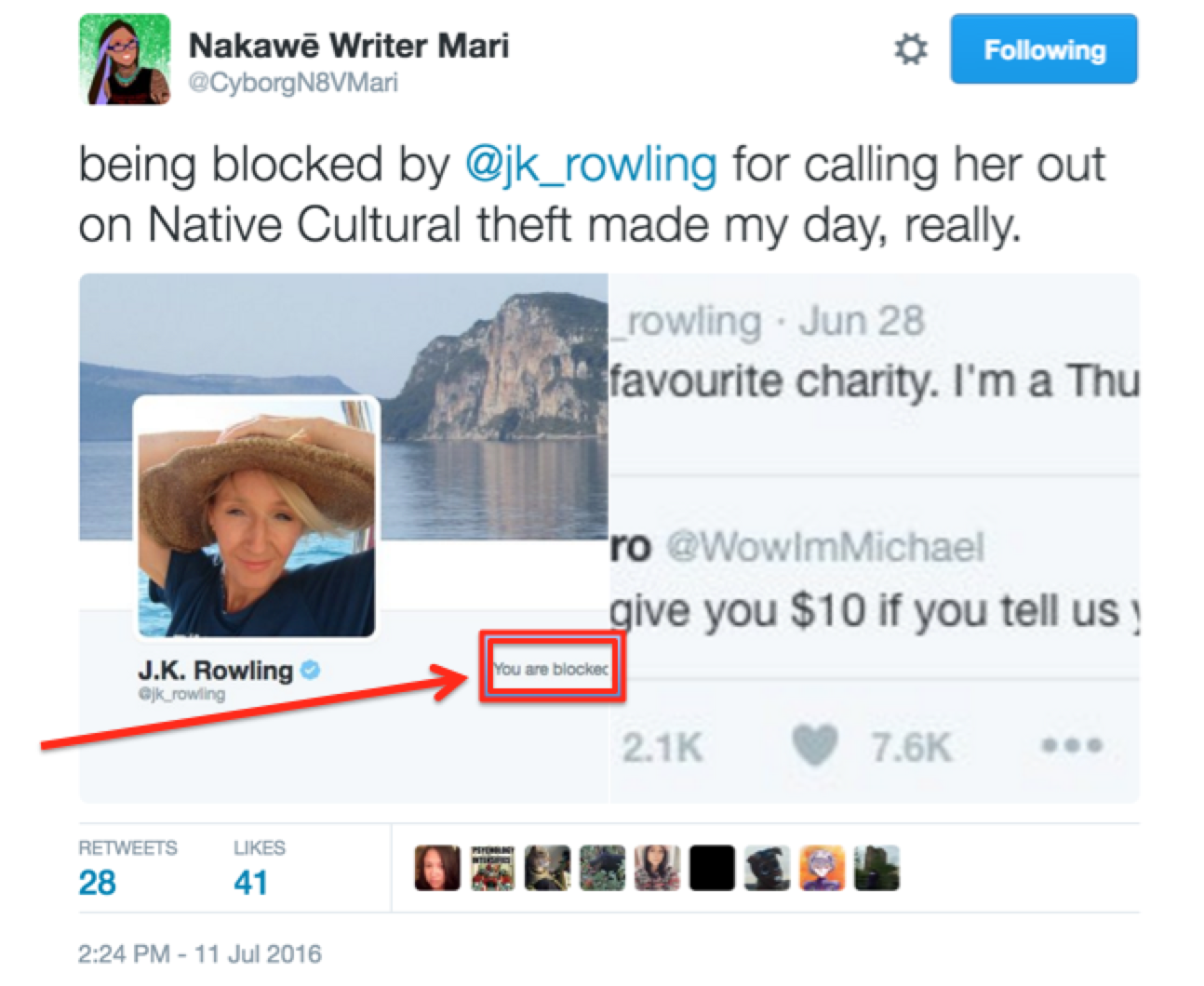
July 11, 2016: A Native writer who tweets from @CyborgN8VMari has been blocked by JK Rowling (I've used a red arrow and box to highlight the blocked notice):
Items added on October 16, 2016
October 14, 2016: Taté Walker's JK Rowling's Anti-Native 'Magic' Racism - And How Authors Can Do Diversity Better, at Everyday Feminism
_______________
![]() |
| Screen cap added 3/10/16 |
The first story, "Fourteenth Century - Seventeenth Century," was released on Monday, March 8, 2016. Fans were delighted to have more of her writing to read.
Native people--those who are fans of her books, and those of us who study or write about representations of Native peoples in popular culture and children's literature--had a different response.
~~~~~
When I (Debbie Reese) read the first story in Rowling's series, I'd been deeply immersed in a study of a handful of best selling children's books. I was appalled to read "also called redskins for their custom of smearing red earth over their entire bodies" in the popular Geronimo Stilton's The Wild, Wild West:
And I'd just read Rick Riordan's The Lost Hero where a main character's dad is Cherokee, making her half Cherokee. She's taunted by other characters who ask her if her dad is an alcoholic and if she'll do a rain dance. Riordan had those words come from what we might characterize as "mean girls." I assume he did that to, in that way, show them to be inappropriate things to say, but far too many people won't pick up on that nuance. I worry that, without a direct push-back on those taunts, people will view them as an affirmation of existing stereotypical ideas, and use those same taunts themselves.
Update: March 13: 2016
Rick Riordan submitted a comment. Thank you, Mr. Riordan, for your comment. I'm pasting it here, and will include it in my full review of your book:
Rick Riordan has left a new comment on your post "Native People Respond to Rowling":
Hi Debbie, I hadn't read this article expecting to be referenced, but thank you for your concerns. Yes, of course, I intended the insults hurled at Piper in The Lost Hero to be viewed as what they are: racist stereotyping and bullying, as something Piper had to deal with, just as Samirah in Sword of Summer has to deal with school bullies asking if she is a terrorist because she is Muslim. I hope that my readers will understand the inappropriateness of this bullying in context, especially as Piper's reality as presented in the book is so far from what those bullies say. Piper's dad is a great father and a multimillionaire movie star. The character with the alcoholic parent is in fact Piper's white boyfriend Jason, and as the son of alcoholic parents, Jason's struggle is something I can speak to. I try to do my homework and be respectful while representing the struggles each of my characters face, but of course I don't always get it right, and I value your feedback.
With The Wild Wild West and The Lost Hero as my immediate context for reading Rowling's story, I was furious. I used the f-bomb in a tweet at her. Use of the word wasn't necessary, but the emotion it expressed was real. As I read tweets by Native people, I saw a range of emotion. Anger. And hurt, too. Native people who are my daughter's age grew up reading Harry Potter. This particular group are adults now, in their 20s. She--and they--were huge fans of every book in the series.
But this short story? Their reaction to it is different. They read the first line, with its monolithic "The Native Americans" as bad, but each paragraph of that short story was laden with troubling misrepresentations of Native peoples.
Those who are following the news on this story know that major media is reporting on it, excerpting a few words from a stream of tweets, or, from a blog post. Below are links to items by Native writers. Please read and share them. I'll be adding others as I find them, arranging them chronologically by the date on which I add them. If you see others, please let me know in a comment.
Items added on March 10, 2016
March 7, 2016: "Magic in North America": The Harry Potter franchise veers too close to home by Adrienne Keene of Native Appropriations
March 7, 2016: #MagicInNorthAmerica smh as an Otoe Missouria & Choctaw woman... (series of tweets) by Johnnie Jae
March 7, 2016: So @jkrowling chose to appropriate... (series of tweets) by Aaron Paquette
March 8, 2016: Yo, @jkrowling, my ancestors... (series of tweets) by Brian Young
March 8, 2016: Obviously, I'm heated over this whole #MagicInNorthAmerica... (series of tweets) by Johnnie Jae
March 8, 2016: JK Rowling is... (series of tweets) by Native Beauty
March 9, 2016: When we say... (series by tweets) by Johnnie Jae
March 9, 2016: Magic & Marginalization: Et tu, JK? by Tate Walker on Righting Red
March 9, 2016: Why it's more than fiction by Mari Kurisato
March 9, 2016: In last 30 hours or so... (series of tweets) by Debbie Reese of American Indians in Children's Literature
March 9, 2016: J.K. Rowling on Native American Wizards - Called Skin Walkers on Pottermore Website by Vincent Shilling at Indian Country Today
March 9, 2016: J.K. Rowling Has Got Nothing on US History Textbook Fiction by Simon Moya-Smith at Indian Country Today
March 9, 2016: J.K. Rowling Gets a Howler by Robert Saxton at Robert Saxton Books
March 9, 2016: William Apess (Pequot) on Depictions of Native People in Stories by Debbie Reese of American Indians in Children's Literature
March 9, 2016: Navajo skinwalker slams JK Rowlings 'Magic in North America' series, a satirical response at Tlo'chi'iin News
March 9, 2016: When I was little... (series of tweets) by Megan Red Shirt-Shaw
March 9, 2016: My Navajo family... (series of tweets) by Jacqueline Keeler
March 10, 2016: Why it burns me by Mari Kurisato
March 10, 2016: This week in #SettlerNonsense: Fantastical Natives and Where to Find them, or, WHY JK ROWLING, WHY?! WHYYYYYYY! by Cutcha Risling Baldy
March 10, 2016: From Sandy Littletree on Facebook, comments about Navajo people and skinwalkers.
Many Native people on Twitter sent out individual, unlinked tweets. Start with the one I link to and read through the TL to find their other Rowling tweets.
March 8, 2016: Yes, it's fiction... by Martie Simmons
March 9, 2016: Skinwalkers? Really? by Jourdan B-B
March 10, 2016: My grandfather is a #MedicineMan by Pamela J. Peters
Here, I'll list media stories that, in my view, are listening to Native voices:
March 10, 2016: JK Rowling is criticised for writing web post about Native American wizards at BBC Newsbeat/Entertainment
March 10, 2016: It's Not Only a Story: Why it Matters How JK Rowling Depicts Native American History by Elizabeth Minkel in New Statesman.
Items added on March 11, 2016
March 9, 2016: We Aren't Magic, We Are Real by Fox Spears at Robohontas
March 11, 2016: I think I'm finally ready... (series of tweets) by Dia Lacina
March 11, 20016: So, I read the 4th installment... (series of tweets) by Johnnie Jae
Items added on March 13, 2016
March 9, 2016: Hey Indigenous authors... (series of tweets) by Aaron Paquette
March 9, 2016: My family fought an 8-year battle... (series of tweets by Darcie Little Badger)
March 11, 2016: Adrienne Keene calls J.K. Rowling's new series a slap in the face Interview at Rosanna Deerchild's Unreserved on CBC Radio
March 11, 2016: #NotNorthAmericanMagic hashtag started by Sheena Roetman @sheenalouise
March 13, 2016: Exactly why Rowling... (series of tweets) by Adrienne Keene
Items added on March 14, 2016
March 13, 2016: Indigenous stories and non-Indigenous writers: some reflections on respect and process by Ambelin Kwaymullina at ALPHA reader
March 14, 2016: JK Rowling Lifts Indigenous Traditions But Ignores History by Aaron Paquette at Ottawa Citizen
Items added on March 15, 2016
March 15, 2016: Did JK Rowling Change the Images on her Magic in North America page at Pottermore? by Debbie Reese at American Indians in Children's Literature.
March 15, 2016: On Native America Calling, Native People Respond to Jason Aaron's Scalped and JK Rowling's Magic in North America
March 15, 2016: It's Like Muggles Writing About Wizards audio recording from Native America Calling with guests, Lee Francis and Tate Walker.
Items added on March 16, 2016
March 14, 2016: Harry Potter and the Magic Indians by Marty Two Bulls at Indian Country Today.
Items added on March 17, 2016
March 9, 2016: Pottermore is just more disappointment by Rebecca Roanhorse at Writing While Indigenous/Writing While Black
March 16, 2016: Dear J.K. Rowling: Wakanyeja Video Response to History of #MagicInNorthAmerica by Tate Walker and her daughter, Mimi, at Righting Red.
Items added on March 31, 2016
March 18, 2016: What JK Rowling's New Story Can Teach Us about Cultural Appropriation at Huffington Post
March 20, 2016: Imagine Otherwise, a Storify by Daniel Heath Justice
March 21, 2016: Pro tips for SF/Fantasy Writers Interested in "Native" Themes..., a Storify by Daniel Heath Justice
March 22, 2016: The Stream - Reimagining Native Americans in the Arts (video) featuring Adrienne Keene, Stephen Graham Jones, Skawennati, and Elizabeth LaPensée.
Items added on July 3, 2016
Wednesday, June 29, 2016: "No surprise that Warren, who made false claims to Native identity, want in on Rowling's new story." (series of tweets) by Debbie Reese on Twitter.
Friday, July 1, 2016: Pottermore problems: Scholars and writers call on J.K. Rowling's North American magic by Paula Young Lee at Salon.
Friday, July 1, 2016: Dear JK Rowling: We're Still Here by Loralee Sepsey at Natives in America.
Items added on July 11, 2016
July 8, 2016: J.K. Rowling's Ilvermorny School draws criticism from Indigenous fans by Stephanie Cram at CBC News Aboriginal, includes cites Loralee Sepsey and Adrienne Keene.
July 11, 2016: A Native writer who tweets from @CyborgN8VMari has been blocked by JK Rowling (I've used a red arrow and box to highlight the blocked notice):
October 14, 2016: Taté Walker's JK Rowling's Anti-Native 'Magic' Racism - And How Authors Can Do Diversity Better, at Everyday Feminism
Wednesday, March 09, 2016
William Apess (Pequot) on Depictions of Native People in Stories
Over at Reading While White, Megan Schliesman's The Long Haul notes that we're in the year 2016, and that people have been objecting to problems in children's literature for a long time. She lists twelve people and invites readers to add to her list. I'm on that list, and so are Doris Seale and Beverly Slapin. My post, today, is my response to Megan's invitation.
For Native people who wrote about depictions of Native peoples in story, we can go all the way back to 1829 and William Apes.
William Apes was a Pequot activist and author. In the 1830s, he helped the Mashpee Wampanoags regain control of their lands. In 1829, his autobiographical A Son of the Forest was published. Apes was mixed blood. His paternal grandfather was a white man who married a Pequot woman. His father married a Pequot woman. Apes and his siblings were born, and they all lived with their mother's family. At some point his parents split up and left, and the kids remained with their maternal grandparents. Through all this they were very poor and his grandmother was especially cruel.
He writes about how his grandmother was out drinking amongst white people. She returned home, intoxicated, and asked him if he hated her. He answered yes because he didn't realize that "yes" was the wrong answer. She beat him again and again, breaking his arm. He was four years old when that happened. His uncle took him away, to Mr. Furman, a white man who sometimes gave them milk. Apes was subsequently placed in Mr. Furman's home where he was well-cared for. It was a stark contrast to his life with his grandparents, but, in his autobiography, Apes takes care to tell readers that they ought not judge, without context, the causes of his grandmother's behaviors. He specifically mentions alcohol, wrongful taking of Native peoples possessions and land, "violence of the most revolting kid upon the persons of female portion of the tribe" (p. 15) -- which we are correct to interpret as rape.
When he was six, he went to school and embraced what he was taught, such that he became distant from his own identity as a Native person (p. 21):
Obviously, misrepresenting who we are was wrong in 1829, and it is wrong now.
What J.K. Rowling did yesterday (March 8, 2016) in the first story of her "History of Magic in North America" is the most recent example of white people misrepresenting Native people. Her misrepresentations are harmful. And yet, countless people are cheering what Rowling did, and dismissing our objections. That, too, is not ok.
It is, as Megan wrote, a long haul. And in that long haul, people are being hurt by those who cry "it is only fiction." It isn't only fiction. Stories do work. They socialize. They educate. Or--I should say, they mis-educate. Do your part. Join us in pushing back on misrepresentation. It has been a long haul. Let's bring that to an end, together.
For Native people who wrote about depictions of Native peoples in story, we can go all the way back to 1829 and William Apes.
William Apes was a Pequot activist and author. In the 1830s, he helped the Mashpee Wampanoags regain control of their lands. In 1829, his autobiographical A Son of the Forest was published. Apes was mixed blood. His paternal grandfather was a white man who married a Pequot woman. His father married a Pequot woman. Apes and his siblings were born, and they all lived with their mother's family. At some point his parents split up and left, and the kids remained with their maternal grandparents. Through all this they were very poor and his grandmother was especially cruel.
He writes about how his grandmother was out drinking amongst white people. She returned home, intoxicated, and asked him if he hated her. He answered yes because he didn't realize that "yes" was the wrong answer. She beat him again and again, breaking his arm. He was four years old when that happened. His uncle took him away, to Mr. Furman, a white man who sometimes gave them milk. Apes was subsequently placed in Mr. Furman's home where he was well-cared for. It was a stark contrast to his life with his grandparents, but, in his autobiography, Apes takes care to tell readers that they ought not judge, without context, the causes of his grandmother's behaviors. He specifically mentions alcohol, wrongful taking of Native peoples possessions and land, "violence of the most revolting kid upon the persons of female portion of the tribe" (p. 15) -- which we are correct to interpret as rape.
When he was six, he went to school and embraced what he was taught, such that he became distant from his own identity as a Native person (p. 21):
...so completely was I weaned from the interest and affections of my brethren that a mere threat of being sent away among the Indians into the dreary woods had a much better effect in making me obedient to the commands of my superiors than any corporal punishment that they ever inflicted.He recounts setting out with his family a couple of years later, to pick berries. While in the woods, they came upon a group of white girls who were also out picking berries, but their complexion, he wrote, was dark and made him think about Indians. Scared, he ran home. When he got there, Mr. Furman asked him what had happened. Writing about that incident as an adult, Apes wrote (p. 23):
It may be proper here to remark that the great fear I entertained of my brethren was occasioned by the many stories I had heard of their cruelty toward the whites--how they were in the habit of killing and scalping men, women, and children. But the whites did not tell me that they were in a great majority of instances the aggressors--that they had imbrued their hands in the lifeblood of my brethren, driven them from their once peaceful and happy homes--that they had introduced among them the fatal and exterminating diseases of civilized life. If the whites had told me how cruel they had been to the "poor Indian," I should have apprehended as much harm from them.It is what Apes wrote there, in that paragraph, that matters to me in my work as a Native scholar who, 187 years later, is doing the same thing that Apes did in 1829. Through story, he learned mistaken ideas about his own people such that he was afraid of them.
Obviously, misrepresenting who we are was wrong in 1829, and it is wrong now.
What J.K. Rowling did yesterday (March 8, 2016) in the first story of her "History of Magic in North America" is the most recent example of white people misrepresenting Native people. Her misrepresentations are harmful. And yet, countless people are cheering what Rowling did, and dismissing our objections. That, too, is not ok.
It is, as Megan wrote, a long haul. And in that long haul, people are being hurt by those who cry "it is only fiction." It isn't only fiction. Stories do work. They socialize. They educate. Or--I should say, they mis-educate. Do your part. Join us in pushing back on misrepresentation. It has been a long haul. Let's bring that to an end, together.
Monday, March 07, 2016
Debbie Reese at Northern New Mexico College on March 9, 2016
I'm looking forward to time I'll spend with students in the P'Ă´e Project at Northern New Mexico College. If you're nearby, I hope you'll come! My goal in this lecture is to talk about what children are taught in schools. In textbooks and in children's literature, we tend to see the same problems: factual errors, bias, erasures, and missed opportunities, too.
Take, for example, a very popular series called Geronimo Stilton. One of them is in Scholastic's Arrow (4th-6th grade) flyer for February 2016. The book is Geronimo Stilton's Race Across America. It is a good example of erasure.
In it, Geronimo visits Arizona. Those of you with knowledge of Native people know there are a lot of Native people in Arizona, but there aren't any in Race Across America.
I understand that it might have not fit with the story to include Navajo people for Geronimo to interact with when he's on Navajo lands, but throughout the book, there are pages that provide information that doesn't have much to do with the story. In Race Across America, Geronimo and his bike racing team fly to the West Coast aboard a large plane. In that part of the story, there's a page about exercises anyone can do to stretch their limbs when flying. You see these exercises in the airline magazines. They're the kind people should do to avoid thrombosis.
So--why not include something about the Navajo Nation and sovereignty rather than pages about Westerns that were filmed in Monument Valley?
I'll be doing a review of Race Across America later.
Scholastic publishes the series. It also provides teachers with lesson plans to use with the books. Here's a screen capture of one:
Take, for example, a very popular series called Geronimo Stilton. One of them is in Scholastic's Arrow (4th-6th grade) flyer for February 2016. The book is Geronimo Stilton's Race Across America. It is a good example of erasure.
In it, Geronimo visits Arizona. Those of you with knowledge of Native people know there are a lot of Native people in Arizona, but there aren't any in Race Across America.
I understand that it might have not fit with the story to include Navajo people for Geronimo to interact with when he's on Navajo lands, but throughout the book, there are pages that provide information that doesn't have much to do with the story. In Race Across America, Geronimo and his bike racing team fly to the West Coast aboard a large plane. In that part of the story, there's a page about exercises anyone can do to stretch their limbs when flying. You see these exercises in the airline magazines. They're the kind people should do to avoid thrombosis.
So--why not include something about the Navajo Nation and sovereignty rather than pages about Westerns that were filmed in Monument Valley?
I'll be doing a review of Race Across America later.
Scholastic publishes the series. It also provides teachers with lesson plans to use with the books. Here's a screen capture of one:
Books like this are popular, but what are they teaching Native and non-Native kids? And, what can we--whether we are parents or teachers--do about this? My lecture includes a what-to-do component that includes the #StepUpScholastic campaign. Some publishers listen. I think Scholastic is one that does. If you're in Northern New Mexico Wednesday evening, please join us!
Subscribe to:
Posts (Atom)