Friday, December 05, 2014

"True Blood Brothers" in NBC's production of Peter Pan

In an earlier post, I wrote about how NBC had hired a Chickasaw man to rework the "Ugg-A-Wugg" song, replacing that phrase with a word used by the Wyandott people. Other musical changes were made, too, he said. That song was replaced with a new one, called True Blood Brothers. NBC's live production of Peter Pan aired last night (December 4, 2014).

So how did it turn out?

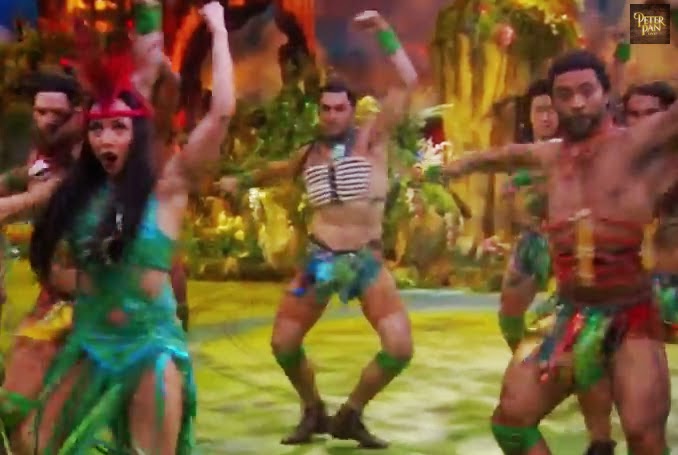
As Tiger Lily stands before Peter Pan for this song, she says something like "O a hay" instead of Ugg a wugg. The music that plays during this song? Classic Hollywood fakery. Below are some screen captures from the video available on YouTube. At the very bottom is the video itself.

Tiger Lily steps back from Peter and crosses her arms in front of her:


Tiger Lily and her tribe begin to dance. Note their attire:


Here, they sing "Beat on a drum!" And I will come and save our brave noble warrior." With their hands, Tiger Lily and Peter Pan 'play' the drum (the backs of the men on whom they stand). Because they're both singing, I guess Tiger Lily is saying Peter is a brave noble warrior, and he is saying it of her, too:


Everyone dances to that Hollywood Indian music, and then John and Michael start singing "Hickory Dickory Dock" (rather than O-a-hay o-a-hay o-a-hay). They're pretending to be Indians at that point. See that blue feather? And that loin-cloth-thingy?


More Hollywood Indian music, more dancing, a dummy meant to be Captain Hook, and the number ends with Tiger Lily and Peter Pan singing they'll be blood brothers to the end.

As I watched the clip, I didn't see any Indian women. Just Tiger Lily. All the rest of her "tribe" are men.

The take away? Lot of stereotyping:

Indians with crossed arms: check
Scantily clad Indians: check
Playing drum with hands: check
Kids playing Indian: check
Hollywood Indian music: check
Overrepresentation of men: check

So--a question.

"O-a-hey" is supposed to be a Wyandotte word. Does that make this all better? No. Not at all.

I wonder how many kids are at school today singing "o-a-hey o-a-hey o-a-hey" as they prance about with their arms crossed? I wonder about the Native kids at school today. Are they looking at their peers doing this silly song and dance?

Here's the video:


Did you tune in? It is getting slammed by reviewers this morning. What do you think about it?

Update, 4:00 PM
As requested by Rebecca (in comment section to this post), I'll add critiques of the Native content.

#NotYourTigerLily: Nine Months Later and they Still Don't Get the Point by Johnnie Jae at Native Max Magazine

Why Fix Tiger Lily? Why Can't We Just Let Her Go? by Adrienne Keene at Indian Country Today

Thursday, December 04, 2014

Thumbs up for Cynthia Leitich Smith's FERAL CURSE

The protagonist of Cynthia Leitich Smith's Feral Curse is named Kayla. Her parents are white. She is black. She was adopted. From Ethiopia.

Intrigued?

There's more. Lots more. And though it might seem like a lot for any story to take on, Smith pulls it off.

Kayla is a senior in high school. She is dating a guy named Ben. He's white, and deeply religious.

A bit more about Kayla. She's a werecat. A shapeshifter. For those who might be weirded out by that, Smith bats it down, making space for the existence of shapeshifters, with this:
Shifters aren't magical or demonic. Many of the Lord's creatures can transform. Frogs can change their gender. Snakes can change their skins. So what if we can change on the cellular level? Creation is ever the more glorious for its variety. Ever more miraculous.
Isn't that cool? People in the world Kayla lives in know about shapeshifters. She's going to meet other shapeshifters in this story. That's cool, too. Some people don't like them. Others don't know what to do about them. And others don't care. But that's changing, and not in a good way for the shapeshifters.

Early on in the story, Kayla decides to reveal her shifter self to Ben. He is glad for her having trusted him enough to do that but he's also unsettled by it and tells her that he will help her find a cure for her condition. They argue. He takes off. The things he does next unleash the story. That carousel you see on the cover? Woah! I'll leave you to read it yourself to get why I said 'woah.'

Among Kayla's friends is a girl named Jess Bigheart. Jess is Osage. The two girls were best friends for awhile. Kayla went to powwows with Jess and her family, had sleepovers, all that good stuff. That was before Kayla knew she was a shapeshifter. She was thirteen when she first experienced a shift in her body. It scared her and she withdrew from friendships, becoming somewhat of a loner. Jess, though, remains a steadfast friend. That's going to matter. A lot.

Reviews note that the end of the book is a cliffhanger. It is. And it makes me want to read the next one right away, but I'll have to wait. I will say this about that ending. I like anything--well-written, of course--that takes me to Indian Country, because it reflects a segment of society that isn't often seen out there in the land of children's and young adult books.  

Published in 2014 by Candlewick Press, Feral Curse is the second book in Smith's "Feral" series. Here's the cover of the first one. I wonder what the third will be?! Can't wait!


Tuesday, December 02, 2014

Roy Boney's WE SPEAK IN SECRET

Roy Boney's We Speak in Secret is one of many stories that will be in Tales of the Mighty Code Talkers: Volume 1, to be published by the Indigenous Narratives Collective (INC Comics). Boney's story was released in November and is available for $1.99. Here's the first page. The symbols at top are in the Cherokee syllabery, developed by Sequoyah. Development of that syllabery is included in We Speak in Secret: 


Some months back, I recommended Arigon Starr's comic about the Choctaw Code Talkers. Both Starr and Boney tell us a lot about the servicemen Americans know as the Code Talkers. Hopefully, readers of AICL have seen recent media coverage of code talkers.

In their respective comics, Starr and Boney, tell us who the code talkers were, as young people in the wars in which they served.

The first page of Boney's story tells us a lot about his character. His name, written using the Cherokee syllabary is ᎠᏟᏐᎢ.* Mr. Boney told me it is pronounced ah-thlee-so-ee. ᎠᏟᏐᎢ thinks about his childhood, playing with his friends. He wants to soak his feet in the creek where he caught crawdads. He tells us his name in Cherokee, and that it means "I habitually run."  Some fellow soldiers call him Runabout Smoke. He talks about stereotypes and how they shape the way some soldiers interact with him. One calls him "chief" and tells him that they won't be using "smoke signals" on the battlefield. For the most part, they call him Runny. He isn't keen on that name either, but in the midst of a war, he let such things slide off his back in order to stay alive. In his group is a Cherokee from North Carolina who is going by the name of Moses Mouse. He, too, speaks Cherokee.

Boney uses a sepia tone on some pages, to show us his character's childhood. On one, he's a six-year-old in Indian Territory, listening to his dad and uncle talk about how their mother, a full blood Cherokee, was declared incompetent, thereby making it possible for land grabs to take place. These land grabs were part of the US government efforts to dissolve Native Nations through the Dawes Act. His uncle says "Allotment. Fancy word for stealin'."

The heart of We Speak in Secret is about how the Cherokee language came to be used for transmissions. The Germans were intercepting communications and able to figure out where to direct their bombs. At one point, Runny's group is hit pretty hard. He looks for Moses, calling to him in Cherokee. Moses responds, also in Cherokee. Dauber, their sergeant, is already digging Moses out of the debris and hears the two men speaking in Cherokee to each other. Of course, he doesn't understand them. The two Cherokee men realize that they can use Cherokee for transmissions. Thereafter, "Using our language proved to be a winning strategy. We confounded the enemy."

Boney's story concludes by telling readers that "U.S. Public Law 110-420 states that the Code Talkers, first reported in use October 17, 1918, deserve immediate recognition for their dedication and valor." On November 30, 2013, the U.S. Congress honored Code Talkers with the Congressional Gold Medal. The Cherokee Phoenix (the Cherokee Nation's newspaper) has an article about it that includes an image of the medal the Cherokee Nation made, in collaboration with the US Mint. It, too, uses the Cherokee syllabary.

In twelve short pages, Boney conveys a lot of history. I enjoyed every word, and highly recommend his story. A curator at the Heard Museum Library purchased and printed it right away. He, too, found it exceptional. He catalogued it and put it on World Cat.

If We Speak in Secret is an indicator of what we'll see in Tales of the Mighty Code Talkers: Volume I, we're all in for a magnificent treat.

A bit more info about Roy Boney. He's a citizen of the Cherokee Nation. He does terrific work, much of it described on his website.

Order and download your copy today from the INC website.

*Post updated to include the character's name, written using the Cherokee syllabary, and the way it is pronounced.

Wednesday, November 26, 2014

Debbie Reese (me!) on CUNY's INDEPENDENT SOURCES

Finally had a chance to watch the segment that CUNY's Independent Sources asked me to do with them about children's books and Thanksgiving. My belly is always in knots when I do something like this. But! The people I worked with there are terrific. Thanks, Nicole and Zyphus! I think it turned out great and hope AICL's readers will take a few minutes to watch/share it, and of course, get the books I recommend!

Scroll down to see the video. Here's some screen captures of it. I'm sharing them because THEY LOOK SO COOL!


And here's the video:


How 'bout we all pan NBC's PETER PAN and Warner Bros PAN, too.

Over the weekend, Heather (a reader of AICL) wrote to ask if I'd seen a Salon article about changes made to music and lyrics in the version of Peter Pan that NBC is going to air in December. Though I knew about the production, I didn't know about these changes. Thanks, Heather, for letting me know.

In a nutshell, NBC hired Jerod Tate, artistic director of the Chickasaw Chamber Music Festival. He's Chickasaw but I don't know anything else about him other than what his bio (linked with his name) says.

With his assistance, the song "Ugg-a-Wugg" was changed.

Ugg-a-Wugg is a duet sung by Peter Pan and Tiger Lily. If either one is in trouble, they'll call on the other for help. The code word they'll use as a signal is ugg-a-wugg. If Tiger Lily needs help, she'll use that code word and Peter will come to save "the brave noble redskin." And if Peter Pan needs help, Tiger Lily will help him. They will be "blood brothers to the end." I think it was/is ludicrous but people love it. Do you remember it? Here. Take a look:
 (Update, Dec 6, 2014: The video was taken down. You may find other videos of the song online, but my guess is that they'll be taken down, too. Perhaps your library has a video you can borrow if you want to see how that song was performed.)


Enter Jerod Tate. Here's what he said, in the Salon article, about that song: 
And then the really big thing that we worked on was the replacement of [the lyrics] “ugg-a-wugg.” Just a little background: In general, what we all know is that the Indian tribe that’s represented in Peter Pan was influenced by knowledge of Northeast Indians of the United States. So we’re talking Iroquois, Huron, Wyandotte, Algonquin, these kinds of cultural regions. So what I did was I set out to find a replacement word for “ugg-a-wugg” that was literally a Wyandotte word.
Tate won't say what the word is, but he does say it means "come here." The interviewer asked him if he also worked on the costumes, but he said he only worked on the music and lyrics for the songs. He thinks the change is great, because the phrase is accurate. I disagree. The show and story will always be one in which the point of view is of Indians as exotic and detribalized. In chapter ten of Barrie's book, the Indians prostrate themselves in front of Peter Pan, calling him "the Great White Father." That point of view is the foundation for Barrie's story.

Now let's look at the new film from Warner Brothers.

The trailer for the new movie due out next year has a scene where Pan is on the floor, spears aimed at him. It looks like he's about to be killed, but an older man (which I imagine the script says is an elder or maybe Tiger Lily's dad) stops them. In his hand is a necklace of some sort that Peter was wearing. The man says:
"The little one. He wears the pan."
Here's a screen capture of that scene in the trailer:


The trailer cuts to Tiger Lily, played by Rooney Mara, who says:
"The Pan is our tribe's bravest warrior." 
Here she is in that moment: 


Her line (Pan is our tribe's greatest warrior) points right at the foundation for Barrie's film. Indians who worship whites. That's not ok. It was't ok then, and it isn't ok to give that racist garbage to kids today. Right?

Some of you know that there was a lot of discussion when Rooney was selected as the actress for the part. Many people said that a Native actress ought to be cast instead of Rooney. I disagree with that idea, too. 

Fixing the words in the song, and/or casting a Native person in that role does not change the point of view(s) on which the story rests. These are, through and through, "the white man's Indian." There is no fixing this story or any production of it so that the Native content is authentic. 

Attempts to do so remind me of the many schools that sought/seek to make their Indian mascots more "authentic" so that they could keep objectifying Native people, using their ideas of who Native people are for their own purposes. 

Can we just let that stuff go? 

Wouldn't we all be better off with a major studio production of a story written by a Native person? One that shows us as-we-are (or were if it is in the past), as human beings who do not say things about how we worship a "great white father" or a white guy who is our "greatest warrior"?  

By remaking this story, and/or by staging it in schools and theaters, we're just recycling problematic, stereotypic, racist images. Why do it?! 

Here's an irony. NBC released a promo featuring Allison Williams talking about the production. There's a part near the end where Williams is singing "it never never ends" as Tiger Lily drops to the stage:  


I want it to end. Don't you?

Friday, November 21, 2014

TEEN SPIRIT by Francesca Lia Block

I'll start with this: I think Francesca Lia Block likes Indians.

I'm just not sure what she knows about us. I kinda think she doesn't know a Native person.

By that, I mean one who is on-the-ground Native, as in living on the reservation, or hanging with the Native community in whatever city or suburb they're in, or, if they're in a part of the country where there is not a Native community, then, one who goes home to that community and/or talks to people from there a lot.

That on-the-ground identity is in stark contrast to the person who has a family story where a great great ancestor was Native. This group tends to romanticize who Native people are, and it comes out in dreadful ways. Case in point: mystical Indians. With powers.

Let's talk about Francesca Lia Block's Teen Spirit, published by HarperCollins. I'll start with the synopsis (pasted here from Amazon):

Francesca Lia Block, critically acclaimed author of Weetzie Bat, brings this eerie and redemptive ghost story to life with her signature, poetic prose. It's perfect for fans of supernatural stories with a touch of romance like the Beautiful Creatures series by Kami Garcia and Margaret Stohl.

After Julie's grandmother passes away, she is forced to move across town to the not-so-fancy end of Beverly Hills and start over at a new school. The only silver lining to the perpetual dark cloud that seems to be following her? Clark—a die-hard fan ofBuffy and all things Joss Whedon, who is just as awkward and damaged as she is. Her kindred spirit.

When the two try to contact Julie's grandmother with a Ouija board, they make contact with a different spirit altogether. The real kind. And this ghost will do whatever it takes to come back to the world of the living.

Francesca Lia Block's latest young adult novel is a haunting work about family, loss, love, and redemption.

Block has tons of fans. You can go to Goodreads and read all the things people like about her book. I'm giving you my view on what she does with Native content.

In the first chapter, Julie is with her grandma. First clue that you gotta pay attention to is that her grandma is wearing "Native American turquoise" (p. 13). That's fine. I hope it was the real thing, though, made by a Native person.

Hitting the pause button: did you know it is against the law to sell something as though it is Native if it isn't? Go read the text of the Indian Arts and Crafts Act of 1990. My best guess, given what Block did in the Weetzie Bat books and in Teen Spirit, is that she doesn't know about that law because she doesn't know much about us at all. Somehow, I think that she has some image in her head, some super cool image of who she thinks we are, and that is what shapes what she does when she writes us into her books.

Back to Teen Spirit.

Julie is living with her grandma and her mom. But, alas, Julie's grandma dies suddenly. Right there in front of her. As she is dying, she tells Julie she has something to tell her but doesn't get it out. Looking at her lifeless body, Julie sees "a pale lavender radiance" (p. 14) hovering over her body and she hears some "baroque and strange, otherworldly" music playing, too. She doesn't tell her mom about it. With grandma dead, there's other things to worry about.

As that chapter closes, we learn about Julie's dad. She never met him. Julie was an in vitro baby. All her mom told her about him is (p. 18):
"that he was over six feet tall, full-blooded Cherokee, and had a master's degree in psychology."
And that he was a sperm donor.

Let's hit that pause button again. That bit of info raised all kinds of questions for me that I kinda doubt even occurred to Block. I went to a donor site online to see what I might learn. I wondered, for example, how they know a person is "full blooded Cherokee" or "Blackfoot." On one site, a chat window popped up immediately. I asked my "how do you know" question and they answer was that it is self-reported. I asked about tribal ID and learned they don't ask for it. Those questions matter, in light of another law (that I'm guessing Block doesn't know about): the Indian Child Welfare Act. It was passed in 1978, to keep Native children within Native communities. I could do some research to see if there have been any cases in which a sperm donor sought information about his child and how that would play out in a courtroom. But, I'll set that aside and get back to Teen Spirit. 

Why did Block go with a "full blooded Cherokee" sperm donor? Asking that question makes me think that maybe she knows that claiming a great great Cherokee grandma wouldn't cut it. If she has Julie's dad be Cherokee, for real, does that mean we're to believe that Julie's ability to see those lights around her grandma are legitimized by the sperm donor? Scary thought! Scary because it isn't any better. It is STILL mystical Indian stuff that does not work.

In the next chapters, Julie and her mom move across town, she gets a job in a dress shop that sells vintage clothes, and she meets a guy named Clark (his aura is green) at her new school. She also finds a Ouija board in the dresser drawer in her new room. She is intrigued by it, wondering if she can use it to talk with her grandma. Clark is freaked by it. Later, she meets another guy. His name is Grant (his aura is red), and though he tells her he is Clark's twin, we're going to learn that Grant IS Clark's twin, but that he died a year ago and that his spirit has entered Clark and takes over Clark's body from time to time.

So. Julie finds a card that a lady at an occult store had given her, to a place in Chinatown called Black Jade. Julie and Clark go there and learn from the lady there that Julie is "an intuitive" and that she probably got that gift from her dad. She gives them some treatments and tells them to see Tatiana Gonzales to get rose petals they need for a tea she wants them to use.

They call Tatiana Gonzales and then go to her house. There, they see milagros embedded in the outer adobe walls of her house. Tatiana greets them (her aura is indigo). She has powers, too (of course). She's petite, black curls "adorned with fresh gardenias and cascading to her minuscule waist" (p. 151). She tells Julia that her ability to see auras can be developed with practice.

Back at her house, Julia picks up a book with a poem by Emily Dickinson. She'd been reading aloud from it to her grandmother when she died. A piece of paper falls out of it. It is an advertisement for a store called Ed Rainwater Designs. It sells figures carved of bone, dream catchers, jewelry, and sage. Since sage is one of the things that they need, Julie and Clark go to that store (p. 166):
When we walk in we see an extravagantly tall man in sunglasses, sitting on a stool behind a counter. At his side was a three-legged dog that resembled a coyote. Both of them shone with almost blinding white light in spit of the dimness of the room.
They tell him they need sage for a ritual. He asks them (p. 167):
"Looking for some kicks? Some native enlightenment?"
Julie replies:
"No, sir," I said. "With all respect, we take this seriously. And even though I don't know anything about it, I'm half Cherokee."
Ed looks them over and then takes them out back. He gives them some special sage he grows and tells her to burn it, and that she'll know when the time to do that is right. Like the others, he tells her to develop her skills. Clark asks if he means the ability to see the auras, and Ed replies:
"More than that. Your friend has a gift that can magnetize certain spirits."
Enter another character! Amrita (her aura is metallic gold). She has very long black hair, wears a bunch of gold bracelets, and looks (p. 70):
"like a Hindu goddess statue. I wouldn't have have been surprised if she was hiding a few extra arms behind her back."
A Hindu goddess. Are you groaning? Or shaking your head? Or your fist, perhaps?! Ed and Amrita invite Julie and Clark to stay for dinner. Amrita teaches Julie how to meditate and then it is time for a sweat.

Pause button! I gotta get up and walk around a bit. Shake off some of this nonsense.

.....

Back.

Inside, Ed pours water on rocks that are on top of coals. They sweat. Ed prays. They come out feeling great (sigh).

Things eventually get resolved for both, Julie and Clark. And of course, they figure out that Ed is her father. She thinks she'll go visit him sometime. For now, she's gonna explore her relationship with Clark.

THE END

I hope that is the end. I hope Block isn't going to go from this to a book where Julie's "powers" are more developed. My overall sense is that Block is really taken with "other." She likes not-white peoples. She's put them in this book and in Weetzie Bat, too. People obviously love her writing. I wish she'd stay away from this kind of writing, though.

In a twitter exchange earlier this month, she apologized for the problems I described in Weetzie Bat. I thought it was a sincere apology, but she didn't say a word about Teen Spirit. I wish she would. Without addressing it, her apology rings very hollow. Very hollow, indeed.

Thursday, November 20, 2014

Francesca Lia Block apologized for Native stereotyping in WEETZIE BAT (but see update)

Editor's note: I added "but see update" to the title of this post because after reading Block's Teen Spirit the apology rang hollow.

On November 11, 2014, the We Need Diverse Books campaign hosted a twitter chat about LGBTQ literature. During that chat, Emily Campbell (@Ms_Librarian) tweeted that Francesca Lia Block's book, Baby Bebop, was important to her. She included Block in the tweet. I replied, saying "The Native content in her bks is stereotyping 101." Here's a screencap:


Campbell asked for more information, and I sent her a link to my analysis of Weetzie Bat. The next day, November 12, Block replied to me and Campbell, saying "No offense meant. My apologies. All respect for all." Here's that screencap:


I thanked her, saying "Most ppl mean well but lack awareness, esp of Native ppl & how culture is used/misused." Here's the screencap of that; I don't know why its font is larger than the others:


She replied again, saying "I would like to learn and grow, until I am no longer alive." And I thanked her again, saying "Your voice as ally pushing back on broad/deep misrepresentations of Native ppl is important." Here's the screencap of that exchange:


I don't know what, if anything, Francesca Lia Block has said or done about this since then. Most authors who respond to my critiques of their work are defensive. Her response was different, and I appreciate that, but I wonder if she's said anything more about my critique, elsewhere, to friends, perhaps?

Block's apology came up this morning in a tweet exchange I had with a colleague about Daniel Handler, the author of Lemony Snicket books who made several racist remarks last night (November 19) at the National Book Awards. He called them "ill conceived humor" in an apology he tweeted today (November 20). His remarks weren't "ill conceived." They were racist.

Block and Handler are key figures in children's and young adult literature. They are authors of best selling books. They could change a lot of hearts and minds if they'd say more than either has said so far.

Update, November 20

There I was (above) thinking well of Block and that exchange, feeling optimistic about her response and the possibilities for change. But then I heard from a colleague about her new book. It came out this year. The title, Teen Spirit. And the spirit? Cherokee.

How to interpret her apology, now?