Thursday, May 29, 2014

WHERE'S WALDO being added to The Foul Among the Good

Last week, Sharon H. Chang tweeted a couple of images from a 1987 copy of Where's Waldo (by Martin Handford, published by Little, Brown) that I am adding to AICL's page, The Foul Among the Good. Here they are:


My response?

May 29, 2014

Dear Waldo,

Yes, in fact, I've seen that a lot in children's picture books and in dog photos created by people who apparently don't know much about Native peoples. For us, feathers are not playthings. They are sacred. I am guessing you know that eagles are protected in the United States. I'm guessing that you do not know that there are also laws that recognize that eagle feathers have religious significance to Native people. If you want to know a bit more about it, the New York Times ran a story about this in 2011

I'd also like to note, Waldo, that your depiction of "Indian" people is stereotypical. You drew a tipi, the fringed clothing, and what I think you meant to be a "peace pipe." There are over 500 federally recognized Native Nations in the U.S. Rather than anything meaningful, you're giving your readers monolithic imagery that doesn't do anyone any good. 

I'm hoping that line in your post card, the dog, and the tipi are gone from later editions of your book. 

Sincerely,
Debbie Reese
American Indians in Children's Literature
    

Tuesday, May 27, 2014

COPPER MAGIC by Julia Mary Gibson, or, an emphatic "Cut it out!" from AICL

In Copper Magic, twelve-year-old Violet Blake is digging by a stream near her house in Michigan and finds a "talisman" -- a copper hand that she comes to call "the Hand." Violet feels that this hand has some kind of power. She thinks she can use it to make wishes come true. Course, her first wish (for a new dress) does come true (actually she gets TWO new dresses), so she's thinking about how she'll use it to get her mom and little brother back home. Her mother is half Odawa.

Well, it turns out there was more than just that copper hand in the spot where Violet was digging. There's also a skeleton there that is dug up (another kid finds it), reassembled, and displayed as a curiosity in a local hotel.

Cue some fake Hollywood Indian music...

Can't be messing around in them Indian burial grounds, right?! We've seen THAT enough times in movies and TV shows to know that messing with bones and artifacts means bad things are gonna happen. And of course, bad things happen to the people in Copper Magic. Lots of bad things. A wicked storm. Lake water behaving in odd ways. Death. Before all that happens, Mercy (Violet's new friend) talks about how there might be a curse on the grave... Violet and her mother (remember--her mom is half Odawa) have special powers, too. They can see things other people can't.

"Cut!"

Cut that fake Hollywood Indian music, that is, and an emphatic "Cut it out!" as my parents would say when I was doing something wrong.

Cut it out, Julia Mary Gibson! 
Cut it out, Susan Cooper! 
Cut it out, Rosanne Parry!


"Cut what?" you may wonder... Quit writing about Native spirituality! You mean well, but you don't know what you're doing. From a place of ignorance, you're adding to an already-too-tall pile of garbage that gets circulated as information about Native people.

A good many writers have a moment in their life that touched them in such a way that they feel they must write about Native people. Gibson's moment is described in her Afterword. When she was eleven years old, she and her family found some bones near their summer cottage in Michigan. "[A]n expert" said they were "most likely American Indian but not old enough to be archeologically significant" (p. 329), so her grandfather "pieced together a skeleton and mounted it on plywood." Her "superstitious" grandma didn't like it and insisted the bones be reburied. This took place in the late 1960s or early 1970s (my guess, based on Gibson's bio at Macmillan that says she was born "in the time of Freedom Rides and the Vietnam War").

Gibson goes on to say that her grandfather didn't know better.

In Copper Magic, Violet is Gibson. The person who puts the skeleton on display is Mr. Dell, a hotel owner intent on increasing his business. The superstitious person who wants the bones reburied? Well, that is Mrs. Agosa, an Odawa woman who tells Violet to "Watch out for ghosts out by you" because "mad ghosts can throw out curses" (p. 134).

Gibson, Cooper, Parry and many other writers poke around a bit and pack their stories with bits of info that make it sound like they know a lot about American Indians. Gibson does that in Copper Magic when she has some of her characters talk about grave robbing and why it is wrong. She also does that when she has Mrs. Agosa talk about the hotel owner burning her people's village and orchards because he wanted their land. In the Afterword, Gibson tells us that part of the story is true (p. 330):
"The real people of the Chaboiganing Band were yanked from their houses by a crooked land grabber and the local sheriff, who flung kerosene over homes and orchards and burned down the whole village, just as Mrs. Agosa tells it."
The burning of that village is important information. It is what major publishers like Macmillan (publisher of Copper Magic) ought to make known. I wish Gibson had made it the heart of her story. Instead, she chose to tell a story about grave robbing, curses, and mystical Indians. There's more to the "mystical Indians" theme... Interspersed throughout Copper Magic are pages about two ancient women: Crooked Woman and Greenstone. Those parts of Gibson's novel are presented in italics. They feed the mainstream monster of stereotypical expectations--where people love to read about "mystical Indians" and our tragic history.

In Copper Magic, Violet's dad is a steady voice saying that Indian graves deserve respect and ought to be left alone. Violet parrots some of what he says but doesn't really understand. Ironically, Gibson is more like Violet than she realizes. Her understanding is superficial. Violet wants to use the hand to get what she wants. Gibson uses the childhood story to do what she wants.

As you may have guessed by now, I don't like what Gibson has done in Copper Magic. And of course, I do not recommend it. Copper Magic is another FAIL from a major publisher (published in 2014 by Starscape, which is in Macmillan's Tor/Forge line.)

Wednesday, May 21, 2014

Arigon Starr's SUPER INDIAN

If you're Kickapoo author/illustrator Arigon Starr, you gotta be dancing every time you pick up Super Indian and read what Charlie Hill, one of the best Native comedians ever (sadly, he passed away a few weeks ago), had to say about Super Indian:
"Great Scott! The long awaited indigenous super hero has arrived."
If you never saw Charlie Hill perform, those words probably don't move you the way they do me. His humor was perfect. His voice as he told jokes and stories? Perfect.

In Super Indian, Starr's own wit shines. From minute details in the art to the words on the page, I found a lot to like about Super Indian.

Starr opens with a jab at those who create The White Man's Indian. By that, I mean prose riddled with "ancient" and "proud" and "noble" and "fierce" and "sacred quest" and "mystical knowledge." Those words and more are on the very first page, but they're there to tell you that you will not find that guy in Super Indian. Instead, we have Hubert Logan who, as a boy, "attended a birthday party for the local bully, Derek Thunder." At that party, the boys "consumed mass quantities of commodity cheese tainted with "Rezium," an experimental element developed by Government Research Scientist Dr. Eaton Crowe."

My guess is that most readers of AICL are going "huh?" because they don't know what commodity cheese is, but I guarantee that Native people on reservations know exactly what that is, and they're laughing (like I was) as I read that part of the intro.

Cheese aside, Hubert is kind of like Clark Kent: a studious guy in glasses and braids. He works at the Leanin Oak Bingo Hall. "Leanin Oak" is another joke, by the way! It is a poke at a line of over-the-top greeting cards with bogus Native proverbs and the like. Hubert's alter ego is Super Indian. He's got some side kicks, and a dog, too that lends his own thread to the stories in volume one.

Volume one has three different stories in it. After introducing us to the characters we'll meet as we read Super Indian, we begin with "Here Comes the Anthro." It is a perfect opening. The art shows a scary looking anthropologist on the cover, about to grab Super Indian.

Yep--that title is another jab. This one is at the discipline that has been causing Native people headaches (to say the least) for a very long time. I gotta pause here, and drop in Floyd Crow Westerman's song, "Here Come the Anthros" so that you get a full sense of what anthropologists mean to Native people:


Starr's anthropologist is German. I think him being German is a jab at Karl May, a German writer who wrote a bunch of novels about Native people. Goofy ones, that is, that--unfortunately--people don't see as goofy. Starr clearly had a good time writing Super Indian. If you're Native or well-versed in Native life as-it-is (not as outsiders imagine it to be), you'll like Super Indian. One of the characters is a blogger! How cool is that?

Back in 2012, Indian Country Today published an interview with Starr. Check it out. It has good background info. Go to the Super Indian website. Order a copy of Super Indian, and if you're a fan of comics, keep an eye on the Indigenous Narratives Collective of Native American comic book writers and artists. Good stuff.

Published by Wacky Productions Unlimited in 2012.

Tuesday, May 20, 2014

SWEETEST KULU by Celina Kalluk

Sweet! Sometimes, that exclamation (Sweet!) means something is endearing, and sometimes, it means something is way cool. Both meanings apply to Sweetest Kulu by Celina Kalluk, illustrated by Alexandria Neonakis.

Kulu is an Inuktitut term of endearment. The babe who is the sweetest kulu in this book is Inuit (Inuktitut is one of the languages spoken by Inuit people). I got it yesterday. The sense of peace and promise in Kalluk's book was just what I needed on a particularly trying day. See the cover?


Kalluk's words and Neonakis's art work beautifully together as we learn Inuit values in which people and animals coexist as caretakers of the land. In Kalluk's hands, this is not the stereotypical one-with-the-animals story that we see all too often.

This is a terrific book for those who have a newborn in the house... And for those of us who just need a book that rights the world for us, that reminds us of that world in all its richness.

Sweetest Kulu is another great book from Inhabit Media. By the way! If you're interested in Native music, you ought to add Kalluk to your playlist. She is a throat singer. Check out this video. She was performing in New York with a cousin. You MUST ALSO watch the set of short videos here.

Note (added May 27, 2014): Sweetest Kulu will be available in October. I reviewed it from a bound galley.

Monday, May 19, 2014

Dear First Book: Step Up Your Game!

Editor's note, May 22, 2014: In response to concerns I raised about the information on First Book's Native American Heritage Month page, First Book removed the page. I look forward to one with accurate information about Native people. Thanks, First Book!
_____________________________________________

May 19, 2014

Dear First Book,

I've been tweeting at you over the last week or so, especially in the last 24 hours. Some might think I'm being unfair to an organization that is doing good work.

First...

I agree that you are doing some pretty good work. The list of books you have on your "Native Interest" page? For the most part, it is an impressive list. It includes a good many Native authors. That, in and of itself, is unusual. So, I am very glad to see it. It isn't perfect, though, and I'd really like to see some books come off that list, including:

Island of the Blue Dolphins --- Yeah, I know. It won the Newbery and is on umpteen lists of favorite books. It isn't on my list of favorites. Far from it! It has stereotypes, bias, and misinformation. I'm sure Scott O'Dell meant well, but he goofed. Given its ubiquity in American society, I am concerned that teachers, parents, librarians---whomever it is that orders books from your site---will see it and spend their precious dollars on it because they recognize the title. They may have fond memories of it that prompt feelings of nostalgia. But! I think it ought to be set aside in favor of books that do a far better job of providing children--via fiction--information about Native peoples.

Starfish --- I was astounded when I read that new book. The stereotypes and sensationalism in it are evidence, I think, of how powerful stereotypes of Native peoples are within the minds of writers (like Crowley) and editors at big publishers (like Hyperion).

You, First Read, are a non-profit. You're not trying to make money, right? You're trying to give kids good books, and you're especially interested in diversity. Seems logical to me that you'd stay away from books like Island of the Blue Dolphins and Starfish. 

Second...

Your page on Native American Heritage Month needs some work. You link to New Age music. Not cool. You feature Pocahontas: Princess of the New World. She was not a princess! The whole idea of royalty is European. Promoting that book, you promote misinformation! There are far better choices, many of which you actually have on your Native Interest list! Jingle Dancer by Cynthia Leitich Smith, or Kunu's Basket are both excellent.

That page links to New Age music rather than Native music. In a tweet, I suggested you use the Black Lodge Singers instead. Their kid pow wow songs are terrific!

Third...

Your CEO, Kyle Zimmer, gave an interview to NPR this weekend. Zimmer noted that the We Need Diverse Books is the most recent effort to call attention to what some of us call 'the all white world of children's books.'

I wish that Zimmer had named the men and women who created this latest effort. Most of them are people of color. (For the record, I'm not one of the creators of WNDB.)

In an earlier blog post and in a twitter chat with First Book, I advocated for Native writers/illustrators because I think the identity of an author/illustrator makes a difference. It presents a child with a possible-self, which is a phrase used in psychology. It means 'what I imagine as being possible for myself as an adult.' That idea is more commonly known as a role model.

Imagine what a boost it would be for the children of the We Need Diverse Books campaign, if they'd heard the name of their mom or dad on the radio! White kids hear the names of people that look like them all the time. They get that in books, too. All the time. Lot of possible selves.

That is not the case for children of color. You can do that, First Book. You can offer lots and lots of possible selves.

I want First Book to use their power and influence to do precisely that. Feature and promote writers and illustrators who are outside what we call 'the mainstream' or 'the norm.'

As reported on your website, First Book, you are making a difference. Step up your game. You have nothing to lose and the entire country as everything to gain by such a move.

First Book! Step up your game!

Sincerely,

Debbie Reese
American Indians in Children's Literature

Saturday, May 17, 2014

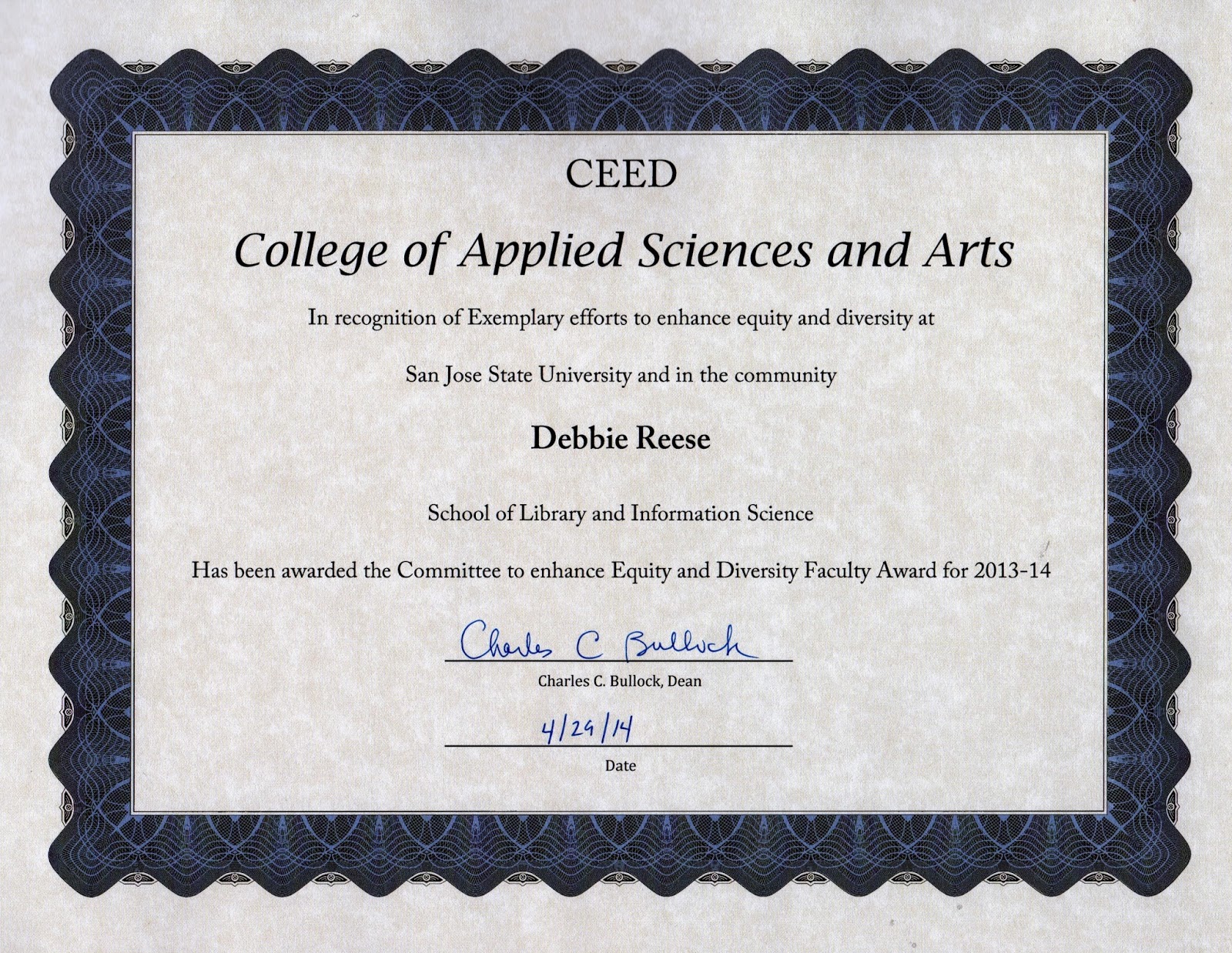
San Jose State University, College of Applied Sciences, School of Library and Information Science, recognizes Debbie Reese for Exemplary efforts to enhance equity and diversity


"According to her nomination form, she was the recipient of the 2013 Virginia Matthews Scholarship Award for her “sustained involvement in the American Indian community and her sustained commitment to American Indian concerns and initiatives.” Her award-winning blog, American Indians in Children’s Literature, shined the spotlight on the Arizona law that led to the recent shutdown of the Mexican American Studies Program in the Tucson Unified School District. According to the American Indian Library Association, Reese not only works with the Nambe community and “she strives to inform the dominant culture about issues facing Indian people today.” --Melissa Anderson, SJSU


Thursday, May 15, 2014

Another 'thank you' to Cynthia Leitich Smith

A few hours ago, my daughter called to tell me she'd finished her last exam of the semester. With joy and enthusiasm, she said she was finished with Year One of law school.

I was happy to hear her voice as she described that last exam and reflected on the year. I carried her joy through my day. And then, a hour ago, I was on Twitter when a colleague tweeted a photo from Cynthia Leitich Smith's Jingle Dancer. If you're a regular reader of AICL, you know that I talk about that book more than any other. It is the one I wish I'd had when my daughter was a three year old and dancing for the first time at home. Our dance, by the way, is like prayer. Not entertainment, and not performance. Prayer. Everyone helps get ready for that first dance. Smith depicts that in Jingle Dancer. 

But the particular page that I'm thinking of right now is this one:


That is Jenna on the left. On the right is Jenna's cousin, Elizabeth. At that point in Smith's story, Jenna is visiting Elizabeth. Elizabeth can't be with Jenna on that special day. She's got a big case she's working on. You see, Elizabeth is a lawyer.

Need I say more about why that page is special to me today? Your book continues to give to me, Cyn. Thank you.