Saturday, December 07, 2013

"Mom, when Jesus was born, where were all the women?" Marcie Rendon's response is HANNAH: THE MIDWIFE WHO DELIVERED JESUS

Bookmark and Share


Marcie Rendon's daughters were raised in a matriarchal home. On Christmas Eve, 1990, one of her daughters asked her "Mom, when Jesus was born, where were all the women?" When I read that question, I thought to myself 'Oh yeah! There's only one female in that story!'

Marcie's response to her daughter's question is this e-book, Hannah: The Midwife Who Delivered Jesus. 

As I read the story Marcie created, I felt such warmth and goodness radiating from Hannah, and from that scene in the stable, and from the newborn babe, too. It is a deeply satisfying story. In addition to Hannah, you'll meet the innkeeper's daughter. It isn't graphic and it isn't anti-male in any way. It's just a beautiful story. I highly recommend it. 

Hannah: The Midwife Who Delivered Jesus is one of those books that you can't pin to a particular grade level. If you're not afraid of talking with students/patrons or your own elementary-aged kids about how babies are born, you can read this aloud to them. Older kids can read it on their own.

I had to create an account with SMASHWORDS to download it, but that was simple enough to do. The book itself is priced at $4.99. 

Thursday, December 05, 2013

2013 Virginia Mathews Scholarship Awarded to Debbie Reese

In today's email, I received the Fall 2013 newsletter of the American Indian Library Association. In it is an announcement that I was selected as the recipient of the 2013 Virginia Mathews Scholarship Award.

Receiving the scholarship means a lot to me. There are a lot of terrific Native people in library school. Within that context, I'm humbled and honored to be recognized by the scholarship committee.

Here's a screen capture of the newsletter page. For your convenience, I'm including the full text below the screen capture.


The purpose of the Virginia Mathews Memorial Scholarship is to provide tuition to an American Indian individual who lives and works in an American Indian community, and who is enrolled, or has been accepted and will enroll, in a master's degree program at a university with a library and/or information sciences program accredited by the American Library Association for the 2013-2014 academic school year. The scholarship has been named to honor Virginia Mathews, one of the original founders of AILA. 

Further details and scholarship criteria are available at http://ailanet.org/awards/scholarships/. 

The American Indian Library Association is pleased to announce that its 2013 Virginia Mathews Memorial Scholarship has been awarded to Debbie Reese. Debbie is an enrolled member of Nambe Pueblo and is pursuing her Master of Library and Information Science at San Jose State University School of Library and Information Science. 

Debbie exemplifies the scholarship criteria of “sustained involvement in the American Indian community and sustained commitment to American Indian concerns and initiatives,” and she has specific intentions and vision for returning to her community as a librarian. She has a track record of making an impact on the community and the profession. As one committee member stated, “Her blog, American Indians in Children's Literature, is one of the best resources available for discussions, book reviews, etc. In addition, her publications are hard-hitting truths on what libraries should and should not have in their collections concerning Indigenous literature, and she lectures extensively on the issues. Not only does she work with the Nambe community, but she also strives to inform the dominant culture about issues facing Indian people today.” 

In 2012, the American Library Association published a press release about the scholarship. It reads, in part:

In 1971, Virginia Mathews, Lotsee Patterson and Charles Townley formed a Task Force on American Indians within the Social Responsibilities Round Table of the American Library Association. She was a member of the first OLOS Subcommittee on Library Service for American Indian People, which led to the founding of the American Indian Library Association in 1979. She was involved with the Library Project at the National Indian Education Association, which supported three demonstration library projects — Akwesasne Library and Cultural Center, the Rough Rock Demonstration School and the Standing Rock Tribal Library—and all three served as models for the early development of tribal libraries on reservations. She worked tirelessly with the National Council of Library and Information Services to create the first White House Pre-Conference on Indian Library Services in 1978 whose delegates attended the 1979 White House Conference on Libraries and Information Services. She was responsible for inclusion of Title IV for tribal libraries in the Library Services and Construction Act Reauthorization in 1984. This special status and funding for tribal libraries is retained in current Library Services and Technology Act legislation. She was the first American Indian to seek candidacy for the ALA presidency and was a proud member of the Osage Nation.
While I never knew Ms. Mathews, I do know Lotsee Patterson and the work they did in the 1970s. Lotsee's work, in particular, touched my life through the librarianship programs she provided to the Pueblos. My aunt was one of her students. 

Kundawho'haa (thank you) AILA committee members, for your confidence in what I strive to do in my professional work. 

Wednesday, December 04, 2013

Online Video: INJUNUITY - TWO SPIRIT

Have you heard of the INJUNUITY project? It consists of a series of short videos about Indigenous people. The one I'm pointing you today is called Two Spirit. Here's some screen captures that convey the visual power of the videos.

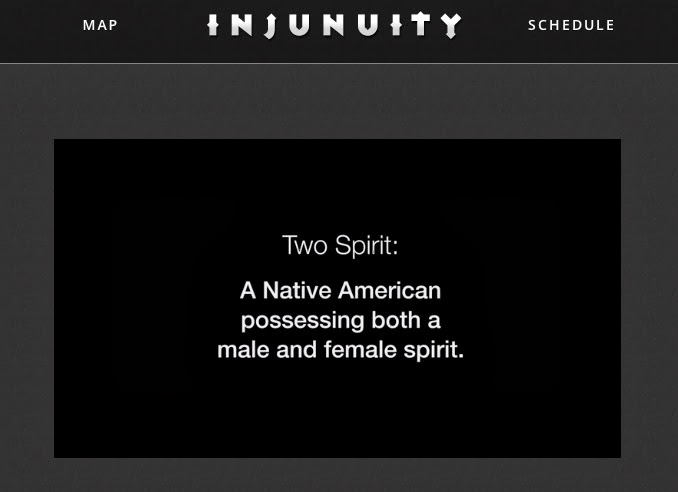
Two Spirit starts without any music. We're shown a graphic of the title, and then we see a definition:


As the video unfolds, we meet several people who recount their experiences coming out. We start with a woman who is shown as a string puppet. She's transformed, though, and we see the string puppet dissolve into pieces. All the while she's talking, words slowly drift down the sides of the viewing window. They add an aesthetic dimension to the video:


There's a bit of history in Two Spirit. Prior to colonization, two spirit people were revered within Native Nations. That changed with the overwhelming force of Christianity:


Native resiliency and sovereignty are pushing back and embracing Two Spirit people. The stories shared in the Two Spirit video are evidence of personal resilience, and actions taken by some Native Nations to grant marriage licenses to individuals--regardless of gender--who are enrolled in a federally recognized tribe demonstrate the exercise of a tribal nations sovereignty.

I talked at length with Irvin Harrison, a close friend, about the Two Spirit video. I asked him if he could provide a comment about the film. He is the Director of the Native American Student Center at California State Polytechnic University in Pomona. Irvin is a smart and nurturing individual. Students at Cal Poly Pomona are fortunate to have him there. Here's what he said:

"I really enjoyed the use of visuals to create meaning to the words. I can directly relate to each person's perspective. For myself, I use the terms - gay, two spirit, nádleehé - interchangeably depending on with whom I have a conversation. I did not become fully open of who I am until I moved out of my family home. I learned the two spirit history from readings and articles. It was my "professional" family who were the first to acknowledge and appreciate me and my partner's relationship. However, it was when both of our parents came to accept that being who we are, as gay, two spirit, or nádleehé couple, that it came full circle." 

I highly recommend Two Spirit. It is beautiful and empowering and makes an additional point about where Native peoples live and what we aspire to:


I also recommend the other films at the INJUNUITY site and look forward to ones in development, too. They're ideal for use in high school classrooms. To read more about the project, check out their About page.

I'll also point you to a resource Irvin directed me to... It is called the Indigenous Ways of Knowing (IWOK) Tribal Equity Toolkit. Here's the description:

The Native American Program of Legal Aid Services of Oregon, the Indigenous Ways of Knowing Program at Lewis & Clark Graduate School of Education and Counseling, the Western States Center, the Pride Foundation and Basic Rights Oregon collaborated on the nation’s first guide for Two Spirit and LGBT equity in Indian Country.
It, too, is evidence that Native peoples are moving in positive directions with regard to Two Spirit and LGBT people.

Tuesday, December 03, 2013

Art Coulson's THE CREATOR'S GAME: A STORY OF BAAGA'ADOWE/LACROSSE

Note from Debbie on Nov 28, 2023: Due to my concerns over Art Coulson's claim of being Cherokee, I am no longer recommending his books.  


Coulson has a way with words. English ones, and Ojibwe ones, too, as he tells this story about Travis, a sixth grade Ojibwe boy who is starting out playing lacrosse.

Set in the present day, Travis lives with his mom and grandmother. He's struggling with the game and bummed each day after practice. But his grandma has confidence in him.

So does his grandfather, who passed away some time back, but comes to Travis each night. His grandfather was a strong and swift lacrosse player that everyone called Hummingbird.

There's a terrific blend here. Coulson's storytelling delivers nuggets of info about the ways that Ojibwe people play lacrosse, and, the way that Cherokee's play it.

Oh yeah--Neil Gaiman's The Sandman: Dream Country figures in the story, too.

Perfectly paced, The Creator's Game is a terrific book. I think I'll give my copy to the Pima boys around the corner. I suspect they'll like it, and I'm going to send a librarian a link to this review. Just a few days ago, she wrote to me, asking for recommendations for a 4th grade reluctant reader. I suggested Joe Bruchac's Children of the Longhouse, which coincidentally, Coulson includes in his list of books for further reading.

Illustrated by Robert DesJarlait, The Creator's Game is published by the Minnesota Historical Society Press. You can get a copy from Birchbark Books. And check out Indian Country Today's interview with Coulson.


Friday, November 22, 2013

Taylor (5th grader): "Do you mean all those Thanksgiving worksheets we had to color every year with all those smiling Indians were wrong?"

This morning I received an email from a teacher who wrote to share what Taylor, a fifth grader, wrote in response to having studied a speech written by a Wampanoag man, Wamsutta (Frank B.) James.

Some context: Back in 1970, James was invited to an event in Plymouth, Massachusetts that was designed to celebrate "The First Thanksgiving." He was asked to submit his remarks ahead of time to the planners. When they read what he planned to say, the invitation was withdrawn. His speech is now titled "The Suppressed Speech of Wamsutta (Frank B.) James, Wampanoag" and is associated with an event that takes place in Plymouth. That event is "Thanksgiving: A National Day of Mourning."

Upon reading the speech that James intended to read, one of Taylor's initial responses was this:
"Do you mean all those Thanksgiving worksheets we had to color every year with all those smiling Indians were wrong?" 
Struck by the fact that history was more complicated than she'd been taught, Taylor chose to skip recess and begin her assignment. Here it is, published with permission from Taylor, her teacher, and her mother.


My Response to “Thanksgiving: A National Day of Mourning”  
By Taylor M., Grade 5

Frank James, also known as Wamsutta, was correct in writing a protest speech on Thanksgiving in 1970. For James, Thanksgiving was a sad day, and this is true for many Native Americans even in the present day. The Pilgrims made the Native people into slaves. James wrote, “Even before the Pilgrims landed it was common practice for explorers to capture Indians and sell them for slaves.” The Pilgrims sometimes tortured the Indians. James reported, “Sometimes an Indian was pressed between stone slabs and hanged as any other ‘witch’.” The Pilgrims punished the Indians if they didn’t believe in the Christian religion. James wrote in his speech, “If the Native Americans didn’t believe in [the Pilgrim’s] religion, [the Pilgrims] would dig up the ground and release the great epidemic again.” In conclusion, Frank James was correct to write his protest speech so people would look at Thanksgiving from his point of view. He illustrated how badly the European settlers mistreated his people, the Wampanoag and why Thanksgiving, for his people, is a day of mourning and reflection.

And here is a note Taylor wrote to me:

When I started this assignment in school about Pilgrims and Indians, I learned a lot at first, but then I read Frank James’ protest speech and to be honest, I was speechless. The way the Pilgrims punished the Indians was gruesome and I felt sorry for them. For a second, I had to put the packet down it was so horrible. I mean, the way my book and the speech were written it sounded like in the beginning that the relationship between the Pilgrims and the Wampanoag people started off well. But, when it started to get deeper into the story, the more Pilgrims started to spread out across the U.S.A, the more the Native American people realized that they were in harm and in danger, and that they were being kicked out of their land. The sad part for me was how the Pilgrims thought the Native Americans were savages just because they didn’t believe in the Pilgrims’ religion. 

I thought about all the way back to Kindergarten, right before Thanksgiving break we would always get these coloring worksheets of the happy little Pilgrims and Indians giving each other things. Up until now, I didn’t really realize that that’s not how it happened. Showing the happy little cartoon Indian was a lie. I think Kindergarteners and young children should know what actually happened, not with gruesome details, but they should know more of the truth. 

The way I felt after I read my book about Thanksgiving and Wamsutta’s speech, I was sad, angry, and heartbroken for the Indians. We should teach Americans not just to be happy for the Pilgrim’s survival, but we should also be respectful, reflective, sad, and even upset for the Wampanoag tribe and other Native American tribes.

I think it is fair to say that this experience was a life-changing moment for Taylor. She uses strong language ("the happy little cartoon Indian was a lie") and I think she is starting down a road where she will always question what she reads. Questioning is a good thing to do. I think she's going to love Howard Zinn's A People's History of the United States. I think she'll like what she finds on the Zinn Education Project website. And, I think she'll also like the PBS series, We Shall Remain. I hope her school or public library has a copy of it. 

Reading her words gives me great hope. We need more Taylor's and we need more teachers who design lessons that encourage critical thinking. With that in mind, I'll point readers to an excellent piece that ran in Indian Country Today last year. Titled "What Really Happened at the First Thanksgiving," it is an interview with Ramona Peters, the Mashpee Wampanoag Tribe's Tribal Historic Preservation Officer.  

Thank you, Taylor, for sharing your response with me and my readers! I'd love to hear more from you. 

Thursday, November 21, 2013

ORIGINAL LOCAL: INDIGENOUS FOODS, STORIES, AND RECIPES FROM THE UPPER MIDWEST, by Heid E. Erdrich

Bookmark and Share


Heid Erdrich's Original Local: Indigenous Foods, Stories, and Recipes from the Upper Midwest is a treat! I mean that literally (reading the recipes makes my mouth water!) and spiritually, too.

The stories she tells in the book take me to my childhood and time spent gathering plants with my grandmother, or, helping her with her garden. To do this gardening, Gram would wear old work shirts that belonged to my grandfather. They kept the sun off her arms, but there was another reason to wear them.... Gophers! See, she irrigated her garden with water from the 'high land' ditch. We'd walk up to the high land, 'turn down the water,' and walk back down to the garden, waiting for the water to meander down the bone dry bed of the ditch to her rows of corn and beans and squash and peas and cucumbers.

Sometimes, the water didn't get to the garden. When the water didn't arrive, we'd walk alongside the ditch till we got to the gopher hole that we knew we'd find. She'd rip pieces off of her shirt and stuff them, along with rocks and sticks, into the gopher hole. It was annoying as heck to her, but remembering those times gardening with my grandmother gives me cause to smile, and to--in effect--nourish my soul in the ways that Erdrich's stories do, too.

"A recipe is a story."

 "A recipe" Erdrich tells us, "is a story" (p. 12). That line perfectly captures what you'll find in her book.  Some of the stories in Erdrich's book are specific to gatherings with her family and friends. I especially like "The First Hunt and the Last" on page 84 and 85. On page 85 is her brother's recipe for venison stew. Some stories are traditional ones, and still others are about activism. Winona LaDuke, well known for her activism, has a piece in the book about gathering wild rice. She ends her piece by pointing to a company in California that has recently patented wild rice, which essentially put the Ojibwe people in a battle over who owns foods and medicines. For more on that, see LaDuke's "Ricekeepers: A Struggle to Protect Biodiversity and a Native American Way of Life" in the July/August 2007 issue of Orion Magazine. 

As you turn the pages of Original Local, there are lot of names you'll recognize if you read the work of Native writers and scholars. Louise Erdrich, for example. One of her recipes is in the book. Brenda Child is here, too. The recipes and photographs and stories make this cookbook an absolute delight. You can get an autographed copy from Birchbark Books

Friday, November 08, 2013

Marcie Rendon's POWWOW SUMMER: A FAMILY CELEBRATES THE CIRCLE OF LIFE (2013)

Bookmark and Share


Back in the 1990s when I started graduate school, I read Marcie Rendon's Powwow Summer: A Family Celebrates the Circle of Life. Originally published by Carolrhoda Books in 1996, I'm delighted to see that it is back in print. This time, it is a paperback published by the Minnesota Historical Society Press. Here's the cover:


Isn't it gorgeous? Powwow Summer is full of solid information about Native people of today. Its text and photographs are what captivated me when I first read it. It wasn't another book about long-ago-and-far-away-tribeless-stereotypical-Indians. As I turned each page, I learned a lot.

See, I'm tribally enrolled at Nambe Pueblo, in northern New Mexico. I grew up there. From my parents, grandparents, and elders, I learned about us and how we do things. That means the material things we do (cooking traditional foods) and the spiritual things we do, too (our dances are a form of prayer). My photo albums have photos of Nambe kids playing outside, helping their grandma's cook, and, photos of them in traditional clothing. I know a lot about who we are.

Marcie's book taught me about her people, which are the Anishinaabe (I met Marcie several years ago. See my review of her play, "SongCatcher: A Native Interpretation of the Story of Frances Densmore"). The text and photographs in Powwow Summer provide a depth of information that is tribally specific.

Marcie asks questions that help the reader frame the information within their own family context (p. 3):
Does your family have a ritual of going to church or synagogue every weekend? Does someone in your family play a sport, and do the rest of you attend to cheer that person on?
If you're looking for top notch books to add to your shelves this month (November is Native American Month), include this one. (Note: Back in 1996 when I launched American Indians in Children's Literature, one of the first books I wrote about was Powwow Summer.) 

The details:
Title: Powwow Summer
Author: Marcie Rendon
Illustrator: Cheryl Walsh Bellville
Publisher: Minnesota Historical Society Press
Year: 2013