Tuesday, September 25, 2012

Dear Elizabeth Warren: I know kids who would ask their parents for proof of their identity

Yesterday (September 24, 2012), Elizabeth Warren responded to Scott Brown's attack on her heritage by putting out an ad in which she rhetorically asks "What kid would?" ask her parents for documentation of her Native heritage.

Ms. Warren? Here's my answer. A Native kid who is part of her Nation would, that's who!

From her childhood, my kid knew what it meant to be Native, not in a "family lore" way like Elizabeth Warren, but in a day-in-and-day-out way where being a member or citizen of Nambe carries a responsibility to the Native community.

Several hundred years ago, our ancestors fought for our rights as nations. They prevailed in the face of enormous onslaughts of military might, but, they prevailed.

Our responsibility is to continue that fight.

Will you join us in that fight? Right now, your statements undermine our sovereignty.

And, by the way, since you have no idea what it means to be a citizen of a Native Nation, your outrage at Scott Brown's staff for their war whoops and tomahawk chops is superficial.

I'm a Democrat who makes phone calls and knocks on doors. I supported you until I learned of your claims. No more, Ms. Warren. My strongest allegiance is to my ancestors and the status of Native Nations. There are things you could do to regain my support and maybe the support of other Native people who have questioned what you are doing. And you know what sucks (pardon my use of that word)? Democrats need you to win your race so that things we care about are more attainable.

Scott Brown? You're as ignorant and racist as they come. You don't know what Native Americans look like.

_____

Update, 6:41 PM, September 25, 2012:

A few people asked what Warren could do. I made some suggestions when this story first broke in May. For your convenience, I'm pasting them and my thoughts on why this matters here:

Instead of asking voters to move on, she could say that: 
  1. She was raised to believe that that she is part Native American, and based on that belief, she claimed Cherokee identity at various times in order to meet people like her. She knows, now, that...
  2. There is a Cherokee Nation that has policies in place that determine who its citizens are, and, she is not a citizen of the Cherokee Nation.
  3. There are a lot of people like her who believe they have Cherokee ancestors and they, like her, proudly assert that ancestry. 
  4. The hard reality is that she doesn't know what it means to be a Cherokee, and that her heartfelt pride is based on romantic ideas and stereotypes. That she embraced that identity uncritically because schools in the U.S. don't teach children that, in addition to the federal and state government, there are tribal governments with inherent powers to determine who its citizens are. She could point out that, instead of an education about tribal governments, students learn about Indians at the First Thanksgiving, and how they did cool things like using every part of the buffalo, and that it is sad that Indians are all gone, now.
  5. In other words, she'd be saying she is ignorant, and that America's collective ignorance can't go on unchecked because it gets in the way of being able to see American Indians in today's society for who we are. Instead of knowing American Indians as we should, Americans choose to know and love them in an abstract stereotypical way that does more harm than good.

Why this should matter to you 

I think Warren ought to use her status as a candidate for a national office to educate the public. Her claim is especially problematic because of her prior work on protecting the consumer. Does she know, for example, that there is a federal law that was written to protect the consumer interested in buying American Indian art? Here's some info about that law:
The Indian Arts and Crafts Act of 1990 (P.L. 101-644) is a truth-in-advertising law that prohibits misrepresentation in marketing of Indian arts and crafts products within the United States. It is illegal to offer or display for sale, or sell any art or craft product in a manner that falsely suggests it is Indian produced, an Indian product, or the product of a particular Indian or Indian Tribe or Indian arts and crafts organization, resident within the United States. For a first time violation of the Act, an individual can face civil or criminal penalties up to a $250,000 fine or a 5-year prison term, or both. If a business violates the Act, it can face civil penalties or can be prosecuted and fined up to $1,000,000.

Under the Act, an Indian is defined as a member of any federally or State recognized Indian Tribe, or an individual certified as an Indian artisan by an Indian Tribe.

The law covers all Indian and Indian-style traditional and contemporary arts and crafts produced after 1935. The Act broadly applies to the marketing of arts and crafts by any person in the United States. Some traditional items frequently copied by non-Indians include Indian-style jewelry, pottery, baskets, carved stone fetishes, woven rugs, kachina dolls, and clothing.

All products must be marketed truthfully regarding the Indian heritage and tribal affiliation of the producers, so as not to mislead the consumer. It is illegal to market an art or craft item using the name of a tribe if a member, or certified Indian artisan, of that tribe did not actually create the art or craft item.
Of course, she is not a product, but I hope you see why this claim by her is especially egregious. I hasten to add that the law excludes Native artists who cannot be enrolled with a tribe because they don't meet the tribe's criteria for enrollment. For example, someone could have four full blood grandparents from four different tribes, making them 1/4 of each one, but if each one requires more than 1/4 blood quantum to be enrolled, that person could not be enrolled in any of them. There's a lot more to say about enrollment and blood quantum, but lets stick with the current discussion of Elizabeth Warren.

A more informed public 

America could emerge from this moment as more-educated about American Indians. And, maybe we'd even have the courage to reject all those disgusting headlines wherein people skewer Warren by playing with racist language and ideas like the Fox News personality who said the first thing she'd say to Warren (if she agreed to an interview) would be "How!"

Warren could do a lot of educating if she had the courage to do so. It would help us (teachers and librarians) do a better job of selecting literature, and it would give us the information we need when a person or group is being brought in to our schools to do Native American workshops or performances. 


Monday, September 24, 2012

Trailer: THE LESSER BLESSED

Watch:


Did you watch it? If not, do it now.

I'm not easily given to profuse out-loud exclamations like OMG or WOW, but this trailer prompted me to do just that. THIS IS AMAZING!

The film is based on Richard Van Camp's outstanding YA novel, The Lesser Blessed. For some years now, I knew it was going to be made into a movie, and.... well, I'm at a loss for words. I wish I could see it TODAY. It was screened at the Toronto International Film Festival earlier this month.

Film critic and columnist Kim Voynar said The Lesser Blessed is a "must see coming-of-age story about an aboriginal teen struggling to stand up against a golden-boy bully." Movie critic Peter Howell of The Toronto Star said it is one of the films in this year's festival in which a "rebel spirit" is seen in which Canadian filmmakers seem to be intent on "breaking as many rules as possible."

Want to know more about the film? Go to its website: The Lesser Blessed.

..............................

Haven't read The Lesser Blessed
Do it today. 
..............................

And you best read the book (if you haven't yet)! I've written about it several times, including listing it in a Focus On column I wrote for School Library Journal in 2008.

If you're teaching his novel, see how a university professor works with it in Teaching Van Camp's The Lesser Blessed

Waiting... for my chance to see The Lesser Blessed...  Will be hard.

Saturday, September 22, 2012

Library of Congress: "52 Great Reads"

With the National Book Festival happening this weekend in DC, I was looking over their webpages. On the "Educator's Share" page is this: 


Every year, a list of books representing the literary heritage of the 50 states, the District of Columbia and the U.S. Virgin Islands is distributed by the Library of Congress's Center for the Book during the National Book Festival. Why not read the book suggested for your state or district and then learn, through these books, about the other places that interest you?

I downloaded the page and am happy to see Debby Dahl Edwardson's outstanding My Name Is Not Easy, a finalist for the National Book Award, on the Alaska list:


Here's a larger image of the cover:


States submit several titles, but only one is listed on the "52 Great Reads" list that you can download. If, however, you click on the map on that page, you can see additional books. If you click on Minnesota, this is what you see:


The book on the bottom is Awesiinyensag. Here's a larger image of it:


Available from Birchbark Books, Awesiiyensag is written entirely in Anishinaabemowin, which is the language spoken by the Ojibwe people. It is a big hit in Minnesota and was featured last year at the National Book Festival. 

Congratulations, Debby, and Wiigwaas Press! I'm glad to see your work featured in DC.


Friday, September 21, 2012

Dear Scott Brown: Do you know what Native Americans look like?

At the end of May, I wrote about Elizabeth Warren (running for US Senate against incumbent Scott Brown) and her family story about how they are part Cherokee.

Last night was the first debate between Warren and Brown. The first thing Scott Brown brought up was Warren's identity. He said "Professor Warren claimed she was a Native American, a person of color. And as you can see, she's not."

Scott Brown's ignorance is showing!

__________

Brown's remark suggests that a blue-eyed blonde could not be American Indian. He is wrong about that. 
__________

Being a tribally enrolled member or citizen of a federally recognized tribe is what matters (and yes, there is a lot of debate about federal recognition and state recognition). Is Native identity determined by skin color? Nope. Hair color? Nope. Obviously, his idea of what an American Indian should look like is based on stereotypes!

The Cherokee Nation has several videos about being a citizen of the Cherokee Nation. Here's one:


As the video demonstrates, Cherokee's "look" lots of different ways with regard to hair and skin color.

Scott Brown ought to watch that video!

And maybe he should read Cynthia Leitich Smith's short story, "A Real-Live Blond Cherokee and His Equally Annoyed Soul Mate" in Moccasin Thunder, edited by Lori Marie Carlson.

There's a lot of ignorance in America (around the world, in fact) about who American Indians are, but there are a lot of outstanding children's and young adult books that can unseat that ignorance. Moccasin Thunder has short stories by several leading Native writers: Joy Harjo, Sherman Alexie, Richard Van Camp, Linda Hogan, Joseph Bruchac Update on Sep 30 2023: I (Debbie Reese) no longer recommend Bruchac's work. For details see Is Joseph Bruchac truly Abenaki? Greg Sarris, Lee Francis, and Susan Power. Pick it up today. Elizabeth Warren and Scott Brown could learn a lot by reading it.

Thursday, September 20, 2012

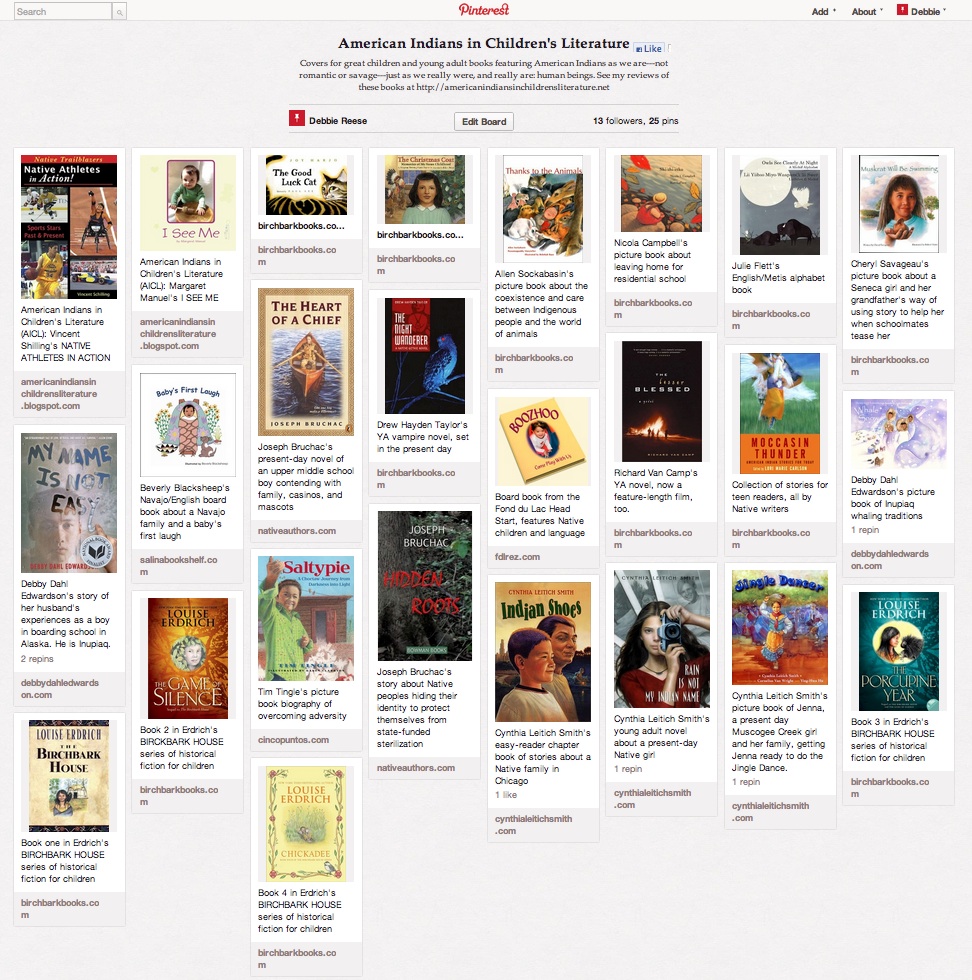
AICL on Pinterest

Recently, I created a Pinterest account for the purpose of promoting selected literature by and about American Indians. Here's a screen shot of what I've loaded so far:


Pretty cool, huh? It allows me to visually provide people with books that I find outstanding. They're tribally specific! They're award winning books! And of course, there are no stereotypes in these books! Wanna follow me on Pinterest? Here's the link:
American Indians in Children's Literature on Pinterest

Barbara Cooney's MISS RUMPHIUS: Take Two


Editor's Note: Back in 2009, I wrote up a short note about Barbara Cooney's Miss Rumphius. Because the book is on the We Give Books site, I decided to revisit that short post, add to it, and repost a cleaned up version of it here, today:


Barbara Cooney's Miss Rumphius

Though it is much loved and winner of an American Book Award, every time I think of Barbara Cooney's Miss Rumphius, the image that I recall is not the lovely lupines she walks amongst or the landscapes people adore. Instead, I remember this page:


(Source for image: http://theartofchildrenspicturebooks.blogspot.com/2011/03/miss-rumphius.html)

Here's the text for that page:

Now he worked in the shop at the bottom of the house, making figureheads for the prows of ships, and carving Indians out of wood to put in front of cigar stores.

"He" is Cooney's great grandfather. He's the one who carved cigar store Indians. So... what is wrong with that page?


Source: Oklahoma Historical Society

Noted Creek writer, Alexander Lawrence Poseysaid that the cigar store Indians "are the product of a white mans's factory, and bear no resemblance to the real article." Posey died in 1908.

Is Cooney wrong for including this information in her book? It is factual as Cooney wrote it--carvers of that time period did carve figureheads for ships and wooden Indians, too--but given that Miss Rumphius was published in 1982 and the information about these carvings being stereotypical is quite old, perhaps she could have inserted "stereotypical" in front of "Indians."

If she had done that, the text on that page would be:

"Now he worked in the shop at the bottom of the house, making figureheads for the prows of ships and carving stereotypical Indians out of wood to put in front of cigar stores."

Course, if Cooney did that, the story wouldn't be as charming as it is, but it would be more accurate, and it could prompt teachers, parents, and librarians to address stereotypes whenever they read the book to children. What do you think?

Saturday, September 15, 2012

Horn Book interviews Louise Erdrich


Head over to Horn Book to read Martha Parravano's interview with Louise Erdrich!


Martha asked her about the two men who kidnap Chickadee (the protagonist in Chickadee). Though the two are kidnappers, they are also the comic relief in the story. They're goofy as can be! Erdrich talks a little about them in the interview, and she also talks about the next book in the Birchbark House series...

LE: The next book, a twin to Chickadee, is titled Makoons. That book is going to be very personal for me because for the first time I will be writing from the living memory of my relatives. I was fortunate enough as a child to remember my great-grandfather, The Kingfisher, who lived into his nineties and had been part of some of the last buffalo hunts along the Milk River in Montana. So what I will be describing has incredible resonance for me.

Makoons will be the fifth book. Chickadee just came out, and it is outstanding. Have you read it yet? And have you ordered it for your library? I hope your answer is "yes" and "I ordered several copies!"

(Photo credit: http://www.boston.com/ae/books/articles/2009/01/25/movable_feats/)