Tuesday, April 03, 2012

Sean Arce, Director of Mexican American Studies Department in Tucson Unified School District, receives prestigious award

[Editor's Note: A chronological list of AICL's coverage of the shut-down of the Mexican American Studies classes at Tucson Unified School District is here.]
 

The Zinn Education Project Honors 

Sean Arce


Identifying Sean Arce as the co-founder of "one of the most significant and successful public school initatives on the teaching of history in the United States," the Zinn Education Project released a statement yesterday, naming Sean Arce as the recipient of the 2012 Myles Horton Education Award for Teaching People's History. Here's the announcement:


Washington, D.C. (April 2, 2012) – The Zinn Education Project announced the recipient of the 2012 Myles Horton Education Award for Teaching People’s History. The award is named for Myles Horton, one of the most influential educators in the 20th century. Myles Horton was co-founder of Highlander Folk School in Tennessee, famous for its pivotal role in desegregation efforts, and a tireless advocate for education and civil rights. In 1961, segregationists attempted to close Highlander on trumped-up charges, to which Horton replied: “A school is an idea, and you can’t padlock an idea.”

This award honors those who promote democracy through education by ensuring that students have the knowledge and skills to be informed and active participants in their communities, country, and the world.

The 2012 Myles Horton Award for Teaching People’s History honoree is Sean Arce, co-founder and director of the Mexican American Studies program in Tucson, Ariz. The Zinn Education Project is delighted to honor Sean Arce for his instrumental role in nurturing one of the most significant and successful public school initiatives on the teaching of history in the United States.

“Tucson’s Mexican American Studies program gets it absolutely right: Ground the curriculum in students’ lives, teach about what matters in the world, respect students as intellectuals, and help students imagine themselves as promoters of justice,” explains Zinn Education Project co-director Bill Bigelow. “I’m thrilled that the Zinn Education Project is able to honor the work of Sean Arce by recognizing him with the first Myles Horton Award for Teaching People’s History. Mr. Arce has begun work that we hope will be emulated by school districts throughout the United States.”

The Zinn Education Project is joined by many educators, writers, and policy makers in our respect for the invaluable achievements of Sean Arce.

 “At a time when students, particularly students of color, are accused of being apathetic about education, Sean Arce, a teacher and director of the Ethnic Studies program of the Tucson Unified School District, refutes this claim loudly and beautifully. Given the widespread mean-spirited and false attacks on the program from right-wing politicians who have resisted even visiting the program, Sean Arce stands out as an educator who speaks truth to power. He has inspired young people to love, to pursue their dreams, and to work for the betterment and uplift of their communities. As one young man in the film Precious Knowledge so beautifully said, ‘This space saved me.’ Sean Arce’s work is a welcome antidote to the cynicism about young people and a testament to the power of education.” —Sonia Nieto, Professor Emerita, Language, Literacy, and Culture, School of Education, University of Massachusetts, Amherst

“Sean Arce has been a steadfast pillar of an outstanding program that was unlike what he had access to as a student. Under his co-leadership, more than 6,000 students, the majority being Latino, have been served by a program producing a consistent graduation rate of more than 90 percent, at a time and in a state in which Latino students complete school at a much lower rate. His work and accomplishments on behalf of social justice for Arizona’s youth merit the highest tribute.” —Christine Sleeter, President, National Association for Multicultural Education

“The Mexican American Studies program in TUSD has been a resounding academic success and affirmation of the diversity of our nation and our community. Sean Arce, as a teacher and as director of MAS, has been key to the success of the program and to the very necessary ongoing effort to save it. He has helped lead the program to a standard of excellence that we all continue to admire, and he will help lead it back to that same standard when these politically motivated attacks on students and education are just a bad memory.” —U.S. Rep. Raúl M. Grijalva  (AZ-07)

“As co-founder and director of the MAS program, Sean Arce developed a culturally relevant program that speaks to students who have felt unseen and marginalized and inspired and motivated them in their education, to know their own history, engage actively in their own learning, and connect in meaningful ways to the larger community. I applaud the Zinn Education Project for honoring this dedicated educator committed to promoting the study and understanding of issues of social justice.” —Myla Kabat-Zinn, daughter of Howard Zinn

“Over the past decade, Sean Arce, the esteemed director and co-founder of the district’s Mexican American Studies program, has created and instituted a nationally acclaimed curriculum with a host of other scholars that has reversed troubling dropout rates among Latino students, and overseen one of the most successful academic programs in the state. When the White House Hispanic Community Action Summit came to Tucson two weeks ago, in fact, Arce emerged as one of the most esteemed voices—as a respected parent, beloved educator, and trusted community member—at the gathering. In a family that traces its roots back to the city’s 18th-century founders, Arce’s longtime involvement and commitment have not gone unnoticed by thousands of students, parents, and community leaders.” —Jeff Biggers, author/journalist

“Sean Arce is a hero and a viral educator.” —Luis Alberto Urrea, 2005 finalist for the nonfiction Pulitzer Prize.

The Myles Horton Education Award will be presented at a special ceremony at Busboys and Poets in Washington, D.C., at the beginning of the 2012–13 school year. Busboys and Poets owner Andy Shallal explained, “In these days when so few education reform efforts demonstrate real impact, the Ethnic Studies program that was headed by Mr. Sean Arce hit a bull’s-eye with a 93 percent success rate. We are delighted to honor the founder and host the award ceremony.”

Background on Sean Arce

Sean Arce’s father was a glazier and ironworker whose union struggles gave Sean his first taste for social justice. His mother worked as a translator, giving voice to those unable to speak English as they navigated the U.S. legal and financial worlds. Both instilled in him a sense of service to others.

After playing football at San Jose State, Arce came to the University of Arizona. At his wife’s suggestion he began to take Mexican American studies classes, and his world changed. “It was highly engaging for me,” he says. “I began to make connections and to establish a greater understanding of my history. It really inspired me.”

Arce worked with others to create the Ethnic Studies program at the Tucson USD at the K-12 levels. “The actual planning took place with university students and community folks,” he notes. “We created this understanding of why it’s so important to have culturally and historically relevant education in Tucson. We understood the dropout rate, and the abysmal history of Mexican American education. I heard stories from my parents about their Americanization. Students’ names were Anglicized, they were hit for speaking Spanish, and there was a tracking system [a practice where children of color are put in classes that are not college bound, such as industrial arts], so they didn’t have the same educational opportunities I had.”

At its essence it was a grassroots effort accompanied by a solid academic plan. Arce and the framers of the program did the research as to how to make the material age appropriate and meaningful for the students. Since Arce started in 1999, the program grew from a single American History Mexican American Perspective class to some 44 high school-level classes throughout TUSD, and more at the elementary level.

The Mexican American Studies program, documented in the film Precious Knowledge, has been under attack from the state legislature and from the state superintendent of schools. Arce has played a central role in the public, legal, and political campaigns to reinstitute this invaluable program.

About the Zinn Education Project

The Zinn Education Project promotes and supports the use of Howard Zinn’s best-selling book A People’s History of the United States and other materials for teaching a people’s history in middle and high school classrooms across the country. Founded with the support of Howard Zinn, the project is coordinated by two nonprofit organizations, Rethinking Schools and Teaching for Change. Close to 20,000 teachers from every state are registered for the project, 25,000 teachers visit the website each month, and more than 75,000 teachers receive the project news.

The project’s goal is to introduce students to a more accurate, complex, and engaging understanding of U.S. history than is found in traditional textbooks and curricula. Zinn’s A People’s History of the United States and Voices of a People’s History of the United States emphasize the role of working people, women, people of color, and organized social movements in shaping history. Students learn that history is made not by a few heroic individuals, but instead by people’s choices and actions, thereby also learning that their own choices and actions matter.

We believe that through taking a more engaging and more honest look at the past, we can help equip students with the analytical tools to make sense of—and improve—the world today.

Friday, March 30, 2012

TUSD Announces New English/Language Arts Curriculum

 [Editor's Note: Are you looking for information about the shut-down of the Mexican American Studies classes at Tucson Unified School District? A chronological list of links to AICL's coverage of the shut-down is here.]
 

On its homepage, Tucson Unified School District posts 'Announcements' on the lower right side of the page. Yesterday, I saw "TUSD Adopts New Curriculum" and clicked on the link. I wonder if TUSD admin realizes that the new curriculum includes "I Am Offering this Poem to You" by Jimmy Santiago Baca? The poem is in his Immigrants in Our Own Land & Selected Early Poems.

The announcement itself doesn't have a date. The only date for the page is a "last updated" notice at the bottom indicating the page was last updated on March 28th, 2012 at 11:53 AM. Here's the introductory paragraph:
The TUSD Governing Board has adopted new mathematics and English language arts curriculum for the district. The new curriculum is based on the Arizona Common Core State Standards and is designed to assist teachers in teaching those standards. The curriculum is in a rollout phase and will be fully implemented in the 2013-2014 school year. 
Beneath it are links to the curriculum at each grade level.  I downloaded "Grade 11-12 English Language Arts Curriculum" and started reading. On page five:
Competent readers recognize that:
  • Effective authors make specific language choices (emotive, evocative, formal, impersonal) and use specific organizational strategies to position readers to accept representations of people, events, ideas and information in particular ways.
  • An author's perspective and global cultural experiences impact choices made about the text, such as what to include or not include as well as considering the point of view from which the narrative is told.
  • Reflection on the nuanced meanings of words and phrases in texts is a tool by which readers discover the meaning, tone and theme of a text.
That is precisely what the Mexican American Studies program was doing! The MAS teachers designed a curriculum that taught readers to recognize that an author's perspective impacts choices made. And, they taught students to recognize point of view!

According to Horne (he wrote the bill to ban ethnic studies) and Huppenthal (he enforced the bill) and Stegeman (he is the president of the governing board and voted to shut down the classes), however, there are limits on point of view. To them, thinking critically about the Founding Fathers is not ok.

On the first page of the document, there are pdfs teachers can go to for further information. Among them is "Appendix B: Text Exemplars and Sample Performance Tasks."  Exemplary texts. Ok... what constitutes exemplary? I clicked on the link and started reading Appendix B. I learned that the list of items (books, essays, speeches) are guideposts and "expressly do not represent a partial or complete reading list" (p. 2).


There's a lot to say about the Common Core Standards and the idea of a "Common Core" list of books, but for now, I wonder if TUSD administrators are aware that Appendix B has books on it by Latino/a authors? Several of them wrote books or stories that are on the list of over 50 books that can no longer be taught by teachers who taught courses in the Mexican American Studies department, and some of them were purchased by the MAS department and are in resource rooms in TUSD.

Here's books from Appendix B:

K-1
Family Pictures by Carmen Lomas Garza
Tomas and the Library Lady by Pat Mora

Grades 2-3
Eating While Reading by Gary Soto

Grades 4-5
Words Free as Confetti by Pat Mora

Grades 6-8
"Eleven" by Sandra Cisneros

Grades 9-10
"I am Offering this Poem to You" by Jimmy Santiago Baca

Grade 11
"The Latin Dell: An Ars Poetica" by Judith Ortiz Cofer
"Take the Tortillas Out of Your Poetry" by Rudolfo Anaya

Curtis Acosta taught "Eleven" in his Social Justice/Latino Literature course. But, because he was a Mexican American Studies teacher, that course doesn't exist anymore, and he's not supposed to teach the way he used to. What will he do? What can he do?

Note: I don't think this "new curriculum" is related to the district's claims that they're going to rewrite their core curriculum so that it is more inclusive. According to Stegeman, that work won't begin until summer 2012.


Friday, March 16, 2012

Donna Jo Napoli's THE CROSSING: LEWIS & CLARK'S HISTORIC JOURNEY SEEN THROUGH A BRAND-NEW PAIR OF EYES

Donna Jo Napoli's book, The Crossing, is subtitled "Lewis & Clark's historic journey seen through a brand-new pair of eyes".  That "brand-new pair of eyes" belongs to Sacagawea's baby, Jean Baptist.

The Crossing - NOT RECOMMENDED
On the first page, we see a tiny baby in a cradleboard on his mother's back. His mother and two men (and a grizzly bear) all look to the right (west). The accompanying text is:
Rolled in rabbit hide,
I am tucked snug
in a cradle pack
in the whipping cold
of new spring
Cradle pack? In the author's note on the last page, Napoli tells us that Jean Baptiste was in a cradle board (commonly written as one word). Why did Napoli use "cradle pack" in the text? It is likely that other Native readers (like me) and readers who know "cradleboard" is the right word, will ask that question, and those without that knowledge will "learn" something inaccurate about what that item is called.

On the next page, she writes:
Wind catches the sail,
swing and woop!
Over we go, Bia' and Ape' and me--
Mother and Father and Babe--
splash, shiver.
There are five men shown on that page. Presumably, one of them is the baby's father, Toussaint Charbonneau, a French-Canadian trader and trapper. "Bia'" is Shoshone for mother, and "Ape'" is Shoshone for father. We see Bia' and Ape' a couple of times. It suggests a lovely nuclear family. On most pages however, Madsen (the illustrator) shows us mother and child and two men. Those two men are likely meant to be Lewis and Clark.


Alongside the author's note is the Acknowledgement section, where the author notes that she consulted two different websites of English/Shoshone language. That is where I learned that Bia' means mother and Ape' means father. I also entered "cradleboard" and found that "gohno" is the Shoshone word. I wonder how the author decided when to (and when not to) use Shoshone words.


Did the baby learn Shoshone? Did he call his parents Bia' and Ape'?

It is nice that Napoli introduces her readers to two Shoshone words, but she could have given us more of that language.

I have many questions. On one page, Napoli writes:
The old chief speaks Chinook
to the prisoner, who speaks Shoshoni
to Bia', who speaks Hidatsa
to Ape', who speaks French
to his friend, who speaks English.
There was need, during that journey, for communication to occur in a chain like that, but I'm caught up wondering about that prisoner. Who is that? The previous pages in the book provide no context for having a prisoner.

Later, we read that:
Summer heat tires us.
Horses get stolen overnight and no one saw a thing.
The illustration shows Indian men walking away from a camp. Did Indians steal horses from Lewis and Clark's expedition? If yes, why? And, what was taken from them and all the other Native Nations at that time and in years prior to that?

Chronologically, events are out of order.

Overall, The Crossing is disappointing. In the acknowledgements, Napoli thanks Brenda Bowen for suggesting that Napoli write about the child on Sacagawea's back. The Crossing is not about that child. The child is a vehicle for telling the same glorified and romantic Lewis and Clark story.   


Monday, March 12, 2012

The Librotraficante Caravan on its way to Tucson

 [Editor's Note:  A chronological list of links to AICL's coverage of the shut-down of the Mexican American Studies classes is here.]

_________________________________

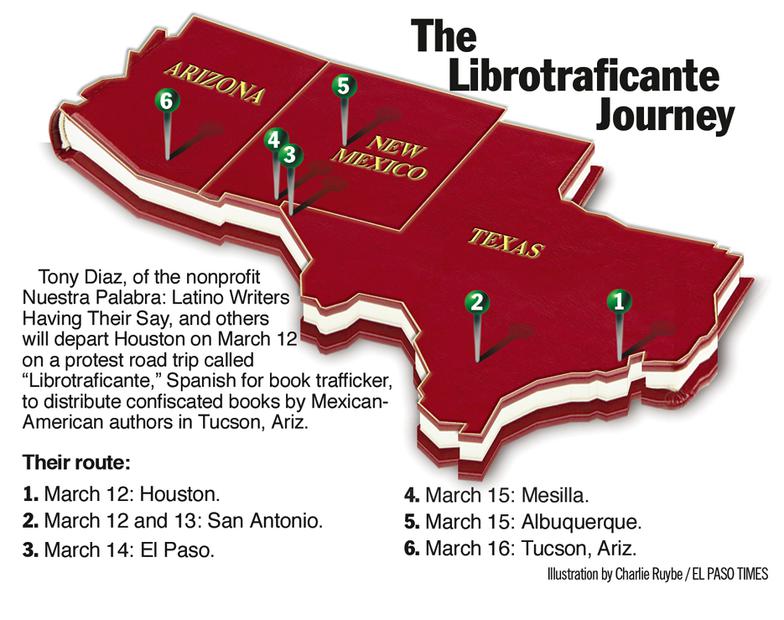
In a few hours, Tony Diaz's Librotraficante Caravan will be on its way to Tucson. The caravan consists of carloads of banned books Diaz calls "wetbooks" that his caravan is "smuggling" into Tucson for use by students who were in the Mexican American Studies courses that were shut down in January. Authors of the banned books are supporting the caravan by donating money and books.

In January when Diaz learned of the shut-down of the classes, he created the video below, describing the caravan. Since then, it has picked up steam and media attention. He was on Democracy Now! last week and the New York Times featured the caravan on its page of "interesting things to do this week" in Texas.


The Caravan will end in Tucson with a celebration. Along the way, there are terrific events planned where authors will participate in Teach-Ins. Below is a map of the journey. You can see the detailed schedule here.

Source: Librotraficante website

Sandra Cisneros will be at several events, and so will Benjamin Alire Saenz, author of the outstanding A Gift From Papa Diego that Jean Mendoza and I wrote about in Examining Multicultural Picture Books for the Early Childhood Classroom: Possibilities and Pitfalls.

Follow the caravan on Twitter using #Librotraficante.

Note (added on March 12, 10:20 AM):
You can support the teachers, students, and their on-going efforts to get the program reinstated by donating to Save Ethnic Studies.  
 
You can donate to Librotraficante's work. Though the caravan itself will end on the 17th, Librotraficante will continue its work at providing books to "Underground Libraries". 
 

Sunday, March 11, 2012

Former Student in TUSD's Mexican American Studies classes: "Everything has been taken away..."

 [Editor's Note: Are you looking for information about the shut-down of the Mexican American Studies classes at Tucson Unified School District? A chronological list of links to AICL's coverage of the shut-down is here.]

_________________________________
 
Last month, students from California State University, Northridge (CSUN) traveled to Tucson in support of students and teachers in the now-banned Mexican American Studies classes that were shut down in January, 2012 by the Tucson Unified School District's (TUSD) board. For background on their visit, see the article in the CSUN student newspaper.
 
David Morales, who blogs at Three Sonorans, filmed students talking about how things have changed. Their day-to-day lives are ones in which they are followed and their assignments are collected by administrators:


Curtis Acosta is a teacher in TUSD. He taught in the now-banned classes and has been providing updates:
You can support the teachers, students, and their on-going efforts to get the program reinstated by donating to Save Ethnic Studies
 

Thursday, March 08, 2012

Curtis Acosta, March 7 2012 Update from Tucson Unified School District

 [Editor's Note: Are you looking for information about the shut-down of the Mexican American Studies classes at Tucson Unified School District? A chronological list of links to AICL's coverage of the shut-down is here.]

_________________________________

Below is Curtis Acosta's March 7th update regarding the now-banned Mexican American Studies program in Tucson Unified School District.

March 8, 2012
To the nation and network of love and support,

From all of the students and teachers of Mexican American Studies and Save Ethnic Studies in Tucson, Arizona, we are humbled and moved by the Teacher Activist Groups, the Education for Liberation Network, and each one of you that participated in "No History Is Illegal." It is difficult to fully express how important your words, actions, and hard work have meant to us. As I sit in my classroom each day I am faced with an overwhelming feeling of loss. Regardless of the resiliency of our students and my own resolve not to let the dismantling of our curriculum, classes and pedagogy alter my own commitment to serving the youth of my community, it is impossible not to be affected. That is why all your testimonies and actions have been so important. Each time we have a fleeting moment of defeat, we are able to be embraced by your words and stories from the "No History Is Illegal" campaign. Stories from Rhode Island, Colorado, Minnesota, California, and Oregon amongst many others have brought smiles, pride, and even tears of joy to my students and fellow colleagues.

When I asked my students to contribute to this email, one of our student leaders, Nico Dominguez, wanted to express his appreciation and his words follow: 

After all that has happened in regards to the loss of Mexican American Studies, there are many moments in time that are able to lift my spirits back up. I will definitely say that seeing/experiencing out of Tucson, support for our movement (classes) is a great way of lifting up my spirit. I remember the first time I experienced out of Tucson support for our classes. Seeing different people speak and perform passionately about our classes was a great experience the day of the teach-in at the Casino Ballroom on January 24th. I had not experienced any of that previous to the teach-in.  It was definitely an experience that I will carry with myself from here on.

Since that day, there has been a massive amount of support which is overwhelming. Students from all over the country have done something for M.A.S., including Oakland, Chicago, Northridge, New York, and on. All of these experiences I take to my heart. The feelings that  I get when I remember all of these people who have in some way involved us into their lives is overwhelming and just a true sign of the humanity that exists. As these experiences continue, I am reminded of the vastness of the world that I live in and that I must learn to live in harmony with it.
--Nicolas Dominguez
Nico's words help me stay strong and remind me why we continue to fight for our students' rights to study their own history, literature and culture and we will never give up!

In that spirit, I would ask you all to send more love our way as our lawsuit moves forward to repeal this hateful law. There are big court dates ahead and you can stay apprised of the latest news through Save Ethnic Studies where you can also donate to our legal effort.

Next week the Librotraficante Caravan will depart from Houston for Tucson with "Banned Books" to be distributed in San Antonio, Albuquerque and Tucson. Chican@ writers and supporters will be hosting workshops, performances, and readings. Please checkout their website for more details.

In the next few weeks I will have a major announcement about a television appearance about our issue, but I'm still sworn to secrecy. Stay tuned for that one.

Lastly, a 50 minute version of Precious Knowledge will be shown on the national PBS show Independent Lens on May 17th. We are hoping to coordinate a national event for that night so I will write more as those details become clearer.

Again, thank you to everyone and we are hopeful of better news and better days ahead. You all have helped our optimism and belief that justice will prevail.

In Lak Ech,
Curtis Acosta


Modern Language Association: Statement on Tucson Mexican American Studies

[Editor's Note: Are you looking for information about the shut-down of the Mexican American Studies classes at Tucson Unified School District? A chronological list of links to AICL's coverage of the shut-down is here.]

_________________________________


Modern Language Association's Statement on Tucson Mexican American Studies Program

Recent legislative and policy initiatives in the Tucson Unified School District concern us deeply as teachers and scholars of language and literature.

In 2010, the Arizona state legislature passed HB 2281, which was signed by Governor Jan Brewer. The bill forbade any school district to include in “its program of instruction any courses or classes . . . that promote resentment toward a race or class of people[,] . . . are designed primarily for pupils of a particular ethnic group[,] . . . [or] advocate ethnic solidarity instead of the treatment of pupils as individuals.” State Superintendent of Public Instruction John Huppenthal declared in January 2011 that Tucson’s widely admired Mexican American studies program was in violation of HB 2281. The board of the Tucson Unified School District appealed that ruling in June 2011. In December 2011, Judge Lewis Kowal affirmed Huppenthal’s decision, saying that the Mexican American studies program had “one or more classes designed primarily for one ethnic group, promoting racial resentment, and advocating ethnic solidarity” and was thus in violation of state law. Penalties for noncompliance established in HB 2281 would have cost the Tucson Unified School District millions of dollars in state aid.

As a result, the district’s school board voted 4-1 to shut down the Mexican American studies program. The school board president, Mark Stegeman, took several measures to bring that termination about, the most publicized of which involved the removal of several books from ethnic studies classrooms in Tucson and their sequestration in a storage facility.

That removal, in addition to being objectionable, followed from a series of discriminatory acts by Arizona officials, all of which run against principles that the MLA considers vital. Although Arizona HB 2281 was ostensibly passed to ensure that students would be taught as individuals, we see the law as part of an attack on Mexican American citizens and cultures—including, but not limited to, undocumented immigrants. We are unaware of any similar argument or policy initiative aimed at, for instance, Americans of Irish or Polish descent; no one argues that Irish American or Polish American children who learn about their ethnic heritages in school are promoting racial resentment or ethnic solidarity, even though the history of Irish and Polish immigration in the United States is not free of instances of ethnic discrimination. Furthermore, we contend that the law has been discriminatory in effect, insofar as the superintendent’s ruling, the judge’s decision, and the school board president’s order applied it to target and shut down only Mexican American studies programs. We note that programs in Native American and African American studies seem not to have triggered fears and anxieties among the supporters and enforcers of HB 2281.

We believe that teaching Mexican American children about Mexican American history and heritage is teaching them as individuals—indeed, precisely as the individuals they are. But more important, we believe in teaching all American children about Mexican American history and heritage. We therefore reject the reasoning behind HB 2281 and behind the decisions made by Superintendent Huppenthal, Judge Kowal, and President Stegeman, on two counts. First, we reject the idea that Mexican American studies is a subject “designed primarily for pupils of a particular ethnic group.” Throughout the United States, and especially in the Southwest, Mexican American studies is an integral part of the study of American identity and history; ideally, every schoolchild should be acquainted with that fact. Second, we reject the idea that Mexican American studies promotes “resentment toward a race or class of people” or advocates “ethnic solidarity.” Mexican American studies is a field of inquiry, not a form of propaganda. It is designed to lead to a greater understanding of the histories and cultures of the peoples of the United States, not to any partisan political outcome.

Our beliefs about ethnic studies and about curricular reform generally have been formed by forty years of scholarly research, informed debate, and open-ended discussion. As an organization devoted to the study of language and literature, the MLA is allied with primary and secondary school educators who teach in this field and who participate in the long project of questioning and undoing the biases of the traditional curriculum, which for many years ignored or demeaned the histories and cultures of people deemed “ethnic.” We see that project as central to the mission of American education at all levels. As former MLA President Sidonie Smith wrote in her 2010 letter to Governor Brewer, “ethnic studies curricula have provided important gateways for students to learn about the diversity of heritages in the United States, a key educational goal of the liberal arts education that is the bedrock of American higher education. . . . Policies that curtail this vision will weaken the quality of education.”

Finally, we see in these actions a threat to academic freedom and intellectual inquiry. To pursue scholarly inquiries into the histories and cultures of the United States, teachers must be free from legislative and judicial interference. Allowing state officials to declare legitimate branches of history and culture out of bounds—to the point of seizing and sequestering books—is inimical to the principles on which the United States was founded. And to students in the Tucson Unified School District, such actions send a far more chilling message than anything they might find in the books that have been removed from their classrooms.

We urge all relevant Arizona officials—Governor Brewer, Superintendent Huppenthal, Judge Kowal, and President Stegeman—to reconsider these rulings, reverse these decisions, and reaffirm the freedom of inquiry on which an open society must depend.

__________________________________

(AICL Editor's Note: Though not dated on their website, the statement was posted to the MLA website on March 6, 2012).