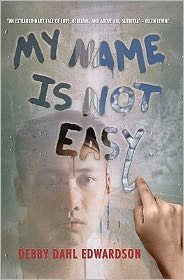
Yesterday I read Debby Dahl Edwardson's My Name Is Not Easy. It is a powerful novel, moving me in the same ways that Joseph Bruchac's Hidden Roots did. Powerful governmental institutions did some really horrible things to Indigenous people.
My Name Is Not Easy is one of those novels that brings those horrible events to a wide audience. Joe wrote about sterilization in his novel; Debby writes about using Alaska Native children in boarding schools to conduct experiments involving radioactive iodine. I didn't know about those tests.
There's more, too. A child being taken from his family, abuse at the hands of a Catholic priest...
Because of the story itself, and the power and grace and beauty of Debby's writing as she recounts this family story, I highly recommend My Name Is Not Easy, and it will be one of the books I discuss when I do workshops and talks with teachers and librarians.
Read Debby's blog to see where she'll be speaking about the book. There, you'll also find contact information. Invite her to speak at your school. She lives in Alaska, but does Skype visits, too.
See a video of Debby's husband at a post from October of 2011.
- Home
- About AICL
- Contact
- Search
- Best Books
- Native Nonfiction
- Historical Fiction
- Subscribe
- "Not Recommended" books
- Who links to AICL?
- Are we "people of color"?
- Beta Readers
- Timeline: Foul Among the Good
- Photo Gallery: Native Writers & Illustrators
- Problematic Phrases
- Mexican American Studies
- Lecture/Workshop Fees
- Revised and Withdrawn
- Books that Reference Racist Classics
- The Red X on Book Covers
- Tips for Teachers: Developing Instructional Materials about American Indians
- Native? Or, not? A Resource List
- Resources: Boarding and Residential Schools
- Milestones: Indigenous Peoples in Children's Literature
- Banning of Native Voices/Books
- Debbie on Social Media
- 2024 American Indian Literature Award Medal Acceptance Speeches
- Native Removals in 2025 by US Government
Friday, October 07, 2011
Tuesday, September 27, 2011
The Horn Book Magazine, 1959
I'm in Santa Fe at the state library doing homework for one of my MLIS courses. Setting that work aside for a few minutes to peruse the shelves, I've come across The Horn Book Magazine. On the open shelves, they've got issues going waaaaaaay back, so, I pulled out the issue for the month and year of my birth. A bit egocentric, I admit.... Here's what I see:
To the right is the cover for the April issue. The illustration is used on all covers (1959 and 1960) in the box I pulled. And here's the short list of articles in the February issue:
A New Look at Heroes of the Southwest, by Camilla Campbell
Theodore Roosevelt and Children's Books, by Peggy Sullivan
A Children's Literary Tour of Great Britain, by Joan H. Bodger
Course, given the topic of AICL, I'm intrigued by the first article. Heroes of the Southwest? Heroes for who, I wonder? Turning the page, I see an illustration at the of the title page. It shows three men on horses. The horses are drinking from a river. The men are wearing uniforms. The table of contents tells me that it is a drawing by Harve Stein for Coronado and His Captains. That book was written by Camilla Campbell, the author of the article, A New Look at Heroes of the Southwest. I'll get to the article in a minute, but for now, I'll keep on with my page-by-page study of the issue.
The Hunt Breakfast on page 2 tells me that Campbell was born and raised in Texas. Her article is an edited version of a talk she gave at the Texas Library Association on March 29th, 1958. Coronado and His Captains is reviewed in this issue.
Page 6 is an ad for the World Book Encyclopedia. At the top of the page is an illustration that includes a totem pole, a newspaper, an airplane, an oil derrick, a lake... I wonder what the encyclopedia entry for totem pole says?
Page 7 has an ad for Thomas Nelson & Sons. It includes:
Page 8 is about Macmillan Books for Boys and Girls, Spring, 1959. It includes:
Page 13 is the ad page for The World Publishing Company. They feature Indians written and illlustrated by Edwin Tunis. In it, he "re-creates the everyday life of the American Indian before the arrival of the white man. A treasure house of a book which presents every aspect of Indian life in lively text and more than 230 drawings." Wow! Sounds comprehensive. I wonder if Tunis distinguishes one tribal nation from another?
On page 16 is another illustration by Stein for Coronado and his Captains. It shows Coronado's route from Mexico city and up into Arizona, New Mexico, Texas, Oklahoma, and Kansas. Campbell's article starts on page 17. I'll study and write about it later.
The "Late Winter Booklist" of recommended (and reviewed) books starts on page 31. "Spanish Heroes in the New World" starts on page 38. That is where Coronado and his Captains and Protector of the Indians are reviewed. So is Maud Hart Lovelace's What Cabrillo Found (he "found" California).
On page 74 is information about the Lewis Carroll Shelf Award, a new award given by the University of Wisconsin School of Education and state organizations in Wisconsin. Publishers submit titles and a committee of librarians, teachers, parents, and writers selected 16 books. Among them is Laura Ingalls Wilder's Little House in the Big Woods. I've written about that book before... it is the one in which Pa, as a child, played at hunting Indians. On page 53, Wilder wrote:
Finishing my page-by-page study of the February issue, I see more ads on the closing pages. Julian Messner's list includes a book by David C. Cooke, called Tecumseh: Destiny's Warrior, and Robin McKown's Painter of the Wild West: Frederick Remington. Hastings House offered Red Eagle by Shannon Garst, illustrated by Hubert Buel. The ad says it is a "true-to-life story of how a Plains Indian boy overcomes his handicaps and becomes a brave. Based on actual facts about the Sioux." Farrar, Straus & Cudahy were pushing Kit Carson of the Old West by Mark Boesch, illustrated by Joshua Tolford. It is a "sparkling" biography about Kit Carson's career, which included "Indian scout."
That's it for now... I've gotta run to the copy machine to copy Campbell's article. The library closes in 25 minutes. Sorry for typos, lack of clarity, etc. in my rush to load this post.
To the right is the cover for the April issue. The illustration is used on all covers (1959 and 1960) in the box I pulled. And here's the short list of articles in the February issue:
A New Look at Heroes of the Southwest, by Camilla Campbell
Theodore Roosevelt and Children's Books, by Peggy Sullivan
A Children's Literary Tour of Great Britain, by Joan H. Bodger
Course, given the topic of AICL, I'm intrigued by the first article. Heroes of the Southwest? Heroes for who, I wonder? Turning the page, I see an illustration at the of the title page. It shows three men on horses. The horses are drinking from a river. The men are wearing uniforms. The table of contents tells me that it is a drawing by Harve Stein for Coronado and His Captains. That book was written by Camilla Campbell, the author of the article, A New Look at Heroes of the Southwest. I'll get to the article in a minute, but for now, I'll keep on with my page-by-page study of the issue.
The Hunt Breakfast on page 2 tells me that Campbell was born and raised in Texas. Her article is an edited version of a talk she gave at the Texas Library Association on March 29th, 1958. Coronado and His Captains is reviewed in this issue.
Page 6 is an ad for the World Book Encyclopedia. At the top of the page is an illustration that includes a totem pole, a newspaper, an airplane, an oil derrick, a lake... I wonder what the encyclopedia entry for totem pole says?
Page 7 has an ad for Thomas Nelson & Sons. It includes:
- Painted Pony Runs Away written and illustrated by Jessie Brewer McGaw. It is "an exciting story about a runaway pony told in authentic Indian pictographs."
- Protector of the Indians by Evan Jones. Illustrated by George Fulton, it is an "absorbing biography of the Indian's first friend, Bartolome de Las Casas.
Page 8 is about Macmillan Books for Boys and Girls, Spring, 1959. It includes:
- Xingu by Violette and John Viertel. Illustrated by Karla Kuskin, "this touching story of a little Indian boy and his animal friends has the universal appeal of a children's classic."
- The Mystery of the Aztec Idol by Harriett H. Carr is about an American boy who visits Mexico and "discovers a valuable relic eagerly sought by many people."
Page 13 is the ad page for The World Publishing Company. They feature Indians written and illlustrated by Edwin Tunis. In it, he "re-creates the everyday life of the American Indian before the arrival of the white man. A treasure house of a book which presents every aspect of Indian life in lively text and more than 230 drawings." Wow! Sounds comprehensive. I wonder if Tunis distinguishes one tribal nation from another?
On page 16 is another illustration by Stein for Coronado and his Captains. It shows Coronado's route from Mexico city and up into Arizona, New Mexico, Texas, Oklahoma, and Kansas. Campbell's article starts on page 17. I'll study and write about it later.
The "Late Winter Booklist" of recommended (and reviewed) books starts on page 31. "Spanish Heroes in the New World" starts on page 38. That is where Coronado and his Captains and Protector of the Indians are reviewed. So is Maud Hart Lovelace's What Cabrillo Found (he "found" California).
On page 74 is information about the Lewis Carroll Shelf Award, a new award given by the University of Wisconsin School of Education and state organizations in Wisconsin. Publishers submit titles and a committee of librarians, teachers, parents, and writers selected 16 books. Among them is Laura Ingalls Wilder's Little House in the Big Woods. I've written about that book before... it is the one in which Pa, as a child, played at hunting Indians. On page 53, Wilder wrote:
I began to play I was a mighty hunter, stalking the wild animals and the Indians.I don't think K.T. Horning at CCBC would select that book today.
Finishing my page-by-page study of the February issue, I see more ads on the closing pages. Julian Messner's list includes a book by David C. Cooke, called Tecumseh: Destiny's Warrior, and Robin McKown's Painter of the Wild West: Frederick Remington. Hastings House offered Red Eagle by Shannon Garst, illustrated by Hubert Buel. The ad says it is a "true-to-life story of how a Plains Indian boy overcomes his handicaps and becomes a brave. Based on actual facts about the Sioux." Farrar, Straus & Cudahy were pushing Kit Carson of the Old West by Mark Boesch, illustrated by Joshua Tolford. It is a "sparkling" biography about Kit Carson's career, which included "Indian scout."
That's it for now... I've gotta run to the copy machine to copy Campbell's article. The library closes in 25 minutes. Sorry for typos, lack of clarity, etc. in my rush to load this post.
Labels:
CCBC,
Horn Book Magazine
Friday, September 23, 2011
Another pair of eyeglasses...
I am enjoying my courses as a student San Jose State's School of Library and Information Science. Prior to this, I felt proficient using a handful of databases, but I'm learning just how much I do not know about databases... From ones I've never used to learning how to develop one... At times it is overwhelming, and my blog posts are definitely impacted by my need to study and get homework done.
Today, I'm sitting at the Pueblo of Pojoaque Public Library, using their computers for some surfing. Next week I'll deliver an online lecture to Minjie Chin's class at UIUC's Graduate School of Library and Information Science. I enter both spaces as a person with more knowledge about libraries than I had prior to beginning my coursework. You might say I've added another pair of eyeglasses that I'll be using from now on.
That said, I highly recommend Mitali Perkin's How to Write Fiction Without The "Right" Ethnic Credentials. She's speaking directly to writers but much of what she says can be used by anyone who is thinking about books and American Indians. Reading her essay, and AICL, can give you another pair of eyeglasses, too, to use as you work with children's and young adult literature.
Today, I'm sitting at the Pueblo of Pojoaque Public Library, using their computers for some surfing. Next week I'll deliver an online lecture to Minjie Chin's class at UIUC's Graduate School of Library and Information Science. I enter both spaces as a person with more knowledge about libraries than I had prior to beginning my coursework. You might say I've added another pair of eyeglasses that I'll be using from now on.
That said, I highly recommend Mitali Perkin's How to Write Fiction Without The "Right" Ethnic Credentials. She's speaking directly to writers but much of what she says can be used by anyone who is thinking about books and American Indians. Reading her essay, and AICL, can give you another pair of eyeglasses, too, to use as you work with children's and young adult literature.
Wednesday, September 07, 2011
AWESIINYENSAG, Wiigwaas Press, and the Minnesota's Best Read for 2011
This is terrific news! Awesiinyensag, a book published by Heid and Louise Erdrich's Wiigwaas Press, was selected as Minnesota's Best Read for 2011. That means the book will represent the state of Minnesota at the National Book Festival in Washington D.C.
As you might glean from reading the title, the text is not in English. Here's the blurb:
The book will provide a challenge to those of us who do not speak Anishinaabemowin, but if you've got students in your classrooms or school who do speak that language, it will be a treasure. Or, if you've got students who loved the language they found in Erdrich's Birchbark House, you could get Awesiinyensag for them. Get it at Birchbark Books. Among the authors included are Nancy Jones, Eugene Stillday, Rose Tainter, Anna Gibbs, Marlene Stately, Anton Treuer, Keller Paap, Lisa LaRonge, Michael Sullivan, John Nichols, Lucia Bonacci, and Heather Fairbanks.
An aside: On her Facebook page, Heid Erdrich noted that when you search Google using Awesiinyensag, Google asks "Did you mean: Awesomeness." For a lot of us, AWESOME perfectly captures the book and the press, too.
As you might glean from reading the title, the text is not in English. Here's the blurb:
Awesiinyensag presents original stories, written in Anishinaabemowin, that delight readers and language learners with the antics of animals who playfully deal with situations familiar to children in all cultures. Suitable for all ages, this book can be read aloud, assigned to classes, shared at language tables, gifted to elders, and enjoyed by those curious about the language and all who love Anishinaabemowin.
Authored by a team of twelve and richly illustrated by Ojibwe artist Wesley Ballinger, Awesiinyensag will be the first in a series created to encourage learning Anishinaabemowin, the language of Ojibwe people.
The book will provide a challenge to those of us who do not speak Anishinaabemowin, but if you've got students in your classrooms or school who do speak that language, it will be a treasure. Or, if you've got students who loved the language they found in Erdrich's Birchbark House, you could get Awesiinyensag for them. Get it at Birchbark Books. Among the authors included are Nancy Jones, Eugene Stillday, Rose Tainter, Anna Gibbs, Marlene Stately, Anton Treuer, Keller Paap, Lisa LaRonge, Michael Sullivan, John Nichols, Lucia Bonacci, and Heather Fairbanks.
An aside: On her Facebook page, Heid Erdrich noted that when you search Google using Awesiinyensag, Google asks "Did you mean: Awesomeness." For a lot of us, AWESOME perfectly captures the book and the press, too.
Monday, September 05, 2011
Julie Luecke on Nora Raleigh Baskin's THE SUMMER BEFORE BOYS
Julie Luecke, an Associate Professor of Education at Edgewood College in Madison, Wisconsin, wrote to tell me about Nora Raleigh Baskin's The Summer Before Boys. I'm ordered a copy of the book and will write about it as soon as I can. In the meantime, here's what Julie said:
-------------
Update, Tuesday, Sept 6, 8:32 AM:
Baskin submitted two comments in response to Leucke. She submitted the first one as herself, and the second one came in as "Anonymous" but was signed by her. I am pasting both of them below (with time stamps affixed when her comments were submitted). As Baskin notes, she is going to see if she can make changes in the paperback. If the publisher agrees to the changes, I hope that a page-of-explanation is also included in the book, explaining how and why the changes were made. Given her publishing record, Ms. Baskin is quite influential and can therefore effect a lot of change in others if she is able to get the changes done and the page-of-explanation included. I imagine it may be something she will share in one-on-one interactions and gatherings with fellow authors. In my view, she joins Garth Nix as a thoughtful writer who gets it.
Update, Thursday, Jan 25, 2018:
Baskin submitted a new comment (pasted here), indicating changes have been made to her book. My response is below her comment.
January 25, 2018
Dear Ms. Baskin,
Thank you for what you said in your comment. The change is important, and it is great to hear that you talk about this with students. It is important to them and to other writers, to know that we can admit mistakes and talk about those mistakes with others. That's an educational response that we need to see more and more so that the mistakes decrease, overall.
I doubt that anyone likes being spoken to by someone who is angry about something they've done. Anger is a genuine emotion. It embodies not just the moment that invokes it, but the many ones that came before it. I understand that writers are uncomfortable with anger, but I ask that they step outside of their own space and think of their readers and how many times they've been uncomfortable and hurt by the things writers and others write or say about them.
Debbie
Another profound disappointment - The Summer Before Boys, the newest book by Nora Raleigh Baskin. Baskin has written insightfully in other books about the Jewish-American experience (The Truth About My Bat Mitzvah) and Autism (Anything but Typical, which won the Schneider Family Book Award), but here she disappoints. The story is set at the "Mohawk Mountain Lodge." Early in the novel there is a reference to reading the Little House books, and then at several points as friends Julia and Eliza pretend to be characters from the past, they imagine sneaking through the mountains to avoid being captured or scalped by "Indians." Sorry, I didn't keep track of page numbers. It's stunning to me that an author of this caliber and her editor/publisher, etc think this is appropriate in 2011.Some will argue that Baskin is giving readers an accurate portrayal of her characters. Some might say that they see themselves in Baskin's twelve-year-old protagonists, Julia and Eliza. Are you someone who, at age 12, pretended you were Laura, afraid of being scalped?
-------------
Update, Tuesday, Sept 6, 8:32 AM:
Baskin submitted two comments in response to Leucke. She submitted the first one as herself, and the second one came in as "Anonymous" but was signed by her. I am pasting both of them below (with time stamps affixed when her comments were submitted). As Baskin notes, she is going to see if she can make changes in the paperback. If the publisher agrees to the changes, I hope that a page-of-explanation is also included in the book, explaining how and why the changes were made. Given her publishing record, Ms. Baskin is quite influential and can therefore effect a lot of change in others if she is able to get the changes done and the page-of-explanation included. I imagine it may be something she will share in one-on-one interactions and gatherings with fellow authors. In my view, she joins Garth Nix as a thoughtful writer who gets it.
Baskin's comment on Monday, September 5, 6:45 PM: you are right..and I feel so confused and bad about this. I am very very conscious of the Native American vs Indian terminology. It is also ironic given how I feel about the treatment of native americans in our country ..then and now.
My editor and I did discuss it..and sometimes a decision is made NOT as the author or publisher but as the character in the book. .in terms of the symbolism and authentic voice, and other considerations. But hearing your review deeply affects me. ..I wish there were something I could do. Perhaps I can.
very sincerely,
nora raleigh baskin
Baskin's comment on Tuesday, September 6, 8:01 AM:. .I was up all night with this blog on my mind, tossing and turning. All I can say is that I've had my eyes opened..And those being eyes I thought were already opened!
I know if I were to read something (even IN character) about Jews or the holocaust that cast a negative or stereotypical slant..I would take it deeply personally.
so, again..you are right. It is a tricky line..character realism vs what I as a human being want to put out into the world.
I am going to see what i can do about the paperback..if someone can perhaps contact me privately ..so I can get it right. I do care very much..
thank you
nora
Update, Thursday, Jan 25, 2018:
Baskin submitted a new comment (pasted here), indicating changes have been made to her book. My response is below her comment.
Baskin's comment on Thursday, Jan 25, 2018: Not sure if better late than never applies here..but hopefully it does.. . A reprint is scheduled and the changes have been made to repair the offensive and hurtful reference in my book. As well, I have been sharing my tone-deafness and my journey to repairing it with students I speak to. It's not easy but I think it's important for them to hear and understand.
I am not a fan of the angry, vitriolic call-out culture (to put it mildly) but I am more than grateful and appreciative of thoughtful criticism.
Thank you..
nora raleigh baskin
January 25, 2018
Dear Ms. Baskin,
Thank you for what you said in your comment. The change is important, and it is great to hear that you talk about this with students. It is important to them and to other writers, to know that we can admit mistakes and talk about those mistakes with others. That's an educational response that we need to see more and more so that the mistakes decrease, overall.
I doubt that anyone likes being spoken to by someone who is angry about something they've done. Anger is a genuine emotion. It embodies not just the moment that invokes it, but the many ones that came before it. I understand that writers are uncomfortable with anger, but I ask that they step outside of their own space and think of their readers and how many times they've been uncomfortable and hurt by the things writers and others write or say about them.
Debbie
Saturday, September 03, 2011
Gertrude Doederlein's LIVING WITH OUR CHILDREN
Scarlett wrote to tell me about a blog post at Awful Library Books in which Holly Hibler (the blogger) wrote about Gertrude Doederlein's Living With Our Children. Part of Hibler's post is about playing Indian. Published in 1941, the book is old. I wish it reflects a past and practice that no longer occurs, but readers of American Indians in Children's Literature know the practice is still with us today...
Mercer Meyer's JUST ME AND MY MOM
Bummer! (Using that word dates me, eh?!)
Susan Santee-Buenger at the University of Wisconsin-Eau Claire wrote to tell me about this page in Mercer Meyer's Just Me and My Mom. When my daughter was little, we had--and enjoyed--several of the Little Critter books.
In this part of the book, Little Critter and his mom are at a natural history museum. Meyer is not alone in putting American Indians in natural history museums... He does, in fact, reflect a reality. Putting us there is a problem! American Indians are often found in natural history museums with the dinosaurs and the bears... Remember this page from Danny and the Dinosaur?
Placing us in natural history museums is a problem! Placing us alongside dinosaurs suggests that is the proper time frame for us to be presented. It isn't. It suggests we are extinct. We are not. It suggests we are primitive. We are not. And, placing us alongside animals suggests we are animal-like, and we are not.
Course, maybe authors could interrupt that problem by having characters challenge the status quo. It would be way cool to have Little Critter or his mom say "Why are American Indians here with dinosaurs and animals instead of in a museum with other peoples?" instead of having Little Critter dress up that way... Or, to have Little Critter ask a docent "what tribe is this supposed to be?!" Is that too much to ask for? Is it too didactic?
Susan Santee-Buenger at the University of Wisconsin-Eau Claire wrote to tell me about this page in Mercer Meyer's Just Me and My Mom. When my daughter was little, we had--and enjoyed--several of the Little Critter books.
In this part of the book, Little Critter and his mom are at a natural history museum. Meyer is not alone in putting American Indians in natural history museums... He does, in fact, reflect a reality. Putting us there is a problem! American Indians are often found in natural history museums with the dinosaurs and the bears... Remember this page from Danny and the Dinosaur?
Placing us in natural history museums is a problem! Placing us alongside dinosaurs suggests that is the proper time frame for us to be presented. It isn't. It suggests we are extinct. We are not. It suggests we are primitive. We are not. And, placing us alongside animals suggests we are animal-like, and we are not.
Course, maybe authors could interrupt that problem by having characters challenge the status quo. It would be way cool to have Little Critter or his mom say "Why are American Indians here with dinosaurs and animals instead of in a museum with other peoples?" instead of having Little Critter dress up that way... Or, to have Little Critter ask a docent "what tribe is this supposed to be?!" Is that too much to ask for? Is it too didactic?
Labels:
Just Me and My Mom,
Mercer Mayer
Subscribe to:
Posts (Atom)


