It's hard to authentically tell stories from the POV of children and youth trying to keep family and self together in the face of parental loss, dysfunction, abuse, or neglect (or institutional abuse). One Native writer who has done that exceptionally well is Vickie L. Sears (Cherokee). Her devastating, often-anthologized "Grace" should be required reading for professionals who work with foster children or other young ones pushed too early into the role of looking out for themselves and their siblings.
"Ballad of Weary Daughters" by Kristine Wyllys (Eastern Band Cherokee) is another insightful story of young people carrying family survival on their shoulders. It's part of an anthology "starring disabled teens" in Unbroken (Farrar Strauss Giroux, 2018, edited by Marieke Nijkamp). We're reviewing it on AICL because of several references to the Tsalagi people and language.
"Ballad" is told in the voice of contemporary high schooler River Smith. River is the daughter of a Tsalagi mother and a white Christian pastor who has recently abandoned his congregation and his family to run off with another woman. River's mother manages to keep putting one foot in front of the other, working long hours to keep food on the table. River steps into the caretaker role for her younger siblings, who are all showing signs of severe stress. It doesn't help that River has a mental illness and her doctors have had trouble getting her medications right.
River and her beloved friend, Lucy, are the "weary daughters" of the story's title. They both feel the stress of barely holding on, and they recognize that their relationship is what gets them through each difficult day. In teaching and social services, when we hear about "resilience factors," this is one of the factors they're talking about: friends who go beyond the typical expectations and serve as literal lifelines for the ones who are struggling. You can't imagine how either River or Lucy could get by without the other's sustaining presence. There is no one else to help them, no support services.
I've read other fiction about teens that feels like a circa-2005 Ruby Payne anecdote catalog of poverty-related dysfunction and catastrophe, where an author just won't stop dumping on the main character. But "Ballad" works for me because Wyllys shows us a family in what could be called a slow-moving emergency -- one that ravels over time. In real life, those aren't the kind that tend to qualify for substantial official help for a family, but the burden on a teen can still be nearly unbearable. River and her family have lived through one emergency -- the days and weeks after the father's departure. Another may be brewing with one of River's sisters, and River's mental health could become more fragile.
The story ended with me loving both River and Lucy. I wanted more for them -- and more about them. I hope Kristine Wyllys will let us hear from them again.
The Cherokee (Tsalagi) content feels matter-of-fact; Wyllys is not teaching readers; she is saying "This is River's life, in which family conversations contain some Tsalagi words, absent Tsalagi family members are important, and the children are aware that their father's congregation views them as Other because they are not white."
I strongly recommend this story. Other entries in Unbroken are also definitely worth reading.

Established in 2006 by Dr. Debbie Reese of Nambé Pueblo, American Indians in Children's Literature (AICL) provides critical analysis of Indigenous peoples in children's and young adult books. Dr. Jean Mendoza joined AICL as a co-editor in 2016. (Site redesign on January 8, 2025)
Sunday, December 01, 2019


Sunday, November 24, 2019
Not Recommended: THE SACRIFICE by Diane Matcheck
A reader wrote to ask if we've seen The Sacrifice by Diane Matcheck. It was published in 2016 by Farrar, Straus and Giroux (Macmillan). Based on what I have read about the book, I am changing the title of this blog post from a "have you seen" to "Not Recommended."

One of the things I (Debbie) do when I get questions about a book is to read the description of the book. Over at Barnes and Noble's website, I saw this:
On the website for the Crow Tribe of Indians, you'll find "Apsaalooke."

I wondered if the sources Matcheck used might have been from older books when the word ended with an 'a' instead of an 'e'. I did a search in Google Books and was surprised to see Paulette Fairbanks Molin's critique of The Sacrifice in her book, American Indian Themes in Young Adult Literature. Molin's book came out in 2005.
From the reader's question, I had assumed--incorrectly--that Matcheck's The Sacrifice is a new book. It isn't. As I showed above, the first year of publication for this book is 1998.
Obviously, people at Macmillan did not read Molin's critique. Were there any changes from the 1998 edition to the 2016 one? I doubt it, based on reviews I read of the 2016 edition.
Through agreements with review journals, Barnes and Noble is able to post the full review of a book on their website page for a given book. I am able to see, for example, the reviews of The Sacrifice from BookList, Publisher's Weekly, and School Library Journal. The first two reviews are unsigned. The one from School Library Journal, however, is signed--by Dr. Loriene Roy who is enrolled at the White Earth Reservation. She's a former president of the American Library Association.
All three reviews begin with similar content (descriptions of what happens in the book). The first two unsigned reviews praise the book in their closing sentences, but Roy does not. Here's what she wrote:
I opened the "Look Inside" option on Amazon to read what I could of The Sacrifice. Just prior to chapter one is a passage from the Bible. That doesn't bode well, at all. In fact, it shouts White Man's Indian (for those who don't know, a "White Man's Indian" is a white depiction of a Native person; for more info see Robert F. Berkhofer's The White Man's Indian, published in 1979). The Bible passage is this one:
On page 4, the author's description of the main character is rife with stereotypes. Her eyes smolder, "like a wildcat's eyes at night from within its den." She's got high cheekbones and a "fine, straight nose." Her hair is black but is "snarled in a grimy black nest" down her back. The very first sentence of the book is "The girl clawed the wind-whipped hair out of her eyes with bloody hands, and listened" (page 3). Her hands are bloody because she's killed three buffalo; the carcass of one is beside her. She imagines everyone praising her and giving her a new name, "the Great One" instead of the name she carries, "Weak-one-who-does-not-last." That desire to be known as "the Great One" is what Roy's critique is describing. Her father approaches her. Matcheck introduces him by talking about his speech, and his teeth. "His talk was stubby-sounding and full of whistles, because all but one of his front teeth were snapped off jagged or gone completely" (p. 6-7).
The passage from the Bible, the author's depiction of the main character and her father, and Roy's critique are enough for me to give The Sacrifice a Not Recommended tag.
Macmillan republished it (with a new cover) because it must be making money for them. That means people are buying it. Money drives book publishing. How about--if you bought it--you take it back to your bookstore and ask for a refund? If you're on Twitter, what if you ask Macmillan why they published it? In other words, I'm asking people to speak up about publishers reissuing old books. Don't be complicit with Macmillan's anti-Native nonsense! Speak up!

One of the things I (Debbie) do when I get questions about a book is to read the description of the book. Over at Barnes and Noble's website, I saw this:
An Apsaalooka (Crow) Indian girl has lived her life as a despised loner, overshadowed by her dead twin brother, who, it was prophesied at their birth, would become a "Great One" among his people. One night, she sets off on a forbidden journey to prove to her village, and her brother's spirit, that she is the one destined to become the true Great One. Her trek over the plains and into the mysterious region of modern-day Yellowstone National Park is a disaster, culminating in her eventual capture by a tribe of Pawnee. Strangely, these foreigners treat her with an unfamiliar respect, and the girl starts to let down her guard. But when it is suddenly revealed that she has been kept alive in order to be killed in a ritual harvest-season sacrifice, the girl is thrown back into her desperate battle for survival...in Diane Matcheck's The Sacrifice.The words in that description prompted a lot of questions. First is the use of "Apsaalooka" (that word, spelled that way, is in the description and throughout the book). I'm glad to see writers using a tribal nation's own name for itself, in their language, but it is important to get it spelled right. When I put "Apsaalooka" in the Google search window, Google asked "Did you mean Apsaalooke"?
On the website for the Crow Tribe of Indians, you'll find "Apsaalooke."

I wondered if the sources Matcheck used might have been from older books when the word ended with an 'a' instead of an 'e'. I did a search in Google Books and was surprised to see Paulette Fairbanks Molin's critique of The Sacrifice in her book, American Indian Themes in Young Adult Literature. Molin's book came out in 2005.
From the reader's question, I had assumed--incorrectly--that Matcheck's The Sacrifice is a new book. It isn't. As I showed above, the first year of publication for this book is 1998.
Obviously, people at Macmillan did not read Molin's critique. Were there any changes from the 1998 edition to the 2016 one? I doubt it, based on reviews I read of the 2016 edition.
Through agreements with review journals, Barnes and Noble is able to post the full review of a book on their website page for a given book. I am able to see, for example, the reviews of The Sacrifice from BookList, Publisher's Weekly, and School Library Journal. The first two reviews are unsigned. The one from School Library Journal, however, is signed--by Dr. Loriene Roy who is enrolled at the White Earth Reservation. She's a former president of the American Library Association.
All three reviews begin with similar content (descriptions of what happens in the book). The first two unsigned reviews praise the book in their closing sentences, but Roy does not. Here's what she wrote:
Weakness lies in the characterization. The young woman appears to have a modern belief in independence and personal achievement and a defiance of the more Native perspectives of respect for elders and thanksgiving for the gifts of nature. Also questionable is the recounting of tribal religious practice, an act of cultural misappropriation.Roy's last two sentences are important. It seems to me that Matcheck's Native character is one with White sensibilities. That's not ok, at all. And I'm glad to see Roy calling out the appropriations she saw in the book.
I opened the "Look Inside" option on Amazon to read what I could of The Sacrifice. Just prior to chapter one is a passage from the Bible. That doesn't bode well, at all. In fact, it shouts White Man's Indian (for those who don't know, a "White Man's Indian" is a white depiction of a Native person; for more info see Robert F. Berkhofer's The White Man's Indian, published in 1979). The Bible passage is this one:
For what is a man profited,
if he shall gain the whole world,
and lose his own soul?
or what shall a man give in exchange for his soul?
--MATTHEW 16:26
On page 4, the author's description of the main character is rife with stereotypes. Her eyes smolder, "like a wildcat's eyes at night from within its den." She's got high cheekbones and a "fine, straight nose." Her hair is black but is "snarled in a grimy black nest" down her back. The very first sentence of the book is "The girl clawed the wind-whipped hair out of her eyes with bloody hands, and listened" (page 3). Her hands are bloody because she's killed three buffalo; the carcass of one is beside her. She imagines everyone praising her and giving her a new name, "the Great One" instead of the name she carries, "Weak-one-who-does-not-last." That desire to be known as "the Great One" is what Roy's critique is describing. Her father approaches her. Matcheck introduces him by talking about his speech, and his teeth. "His talk was stubby-sounding and full of whistles, because all but one of his front teeth were snapped off jagged or gone completely" (p. 6-7).
The passage from the Bible, the author's depiction of the main character and her father, and Roy's critique are enough for me to give The Sacrifice a Not Recommended tag.
Macmillan republished it (with a new cover) because it must be making money for them. That means people are buying it. Money drives book publishing. How about--if you bought it--you take it back to your bookstore and ask for a refund? If you're on Twitter, what if you ask Macmillan why they published it? In other words, I'm asking people to speak up about publishers reissuing old books. Don't be complicit with Macmillan's anti-Native nonsense! Speak up!
Tuesday, November 19, 2019
Mark this day... there's a Native Imprint from a Major Publisher!

Way back when I started graduate school in the mid 1990s, I wanted to see so much more being published by Native writers... and here, in 2019, is the very best news that I could hope for...
Congratulations to Cynthia Leitich Smith (Muscogee) for making it happen!
Thank you, to Rosemary Brosnan and HarperCollins, for your commitment to Heartdrum, to Cyn, and to Native writers and illustrators.
And thank you, Ellen Oh!
And Rainey--the logo... perfect!
[This news was first published by Publishers Weekly.]
Recommended: The Case of the Missing Auntie

How often have you read a middle grade mystery novel that had you in tears just a few pages after making you laugh? That's what happened when I spent yesterday with an ARC of Michael Hutchinson's new Mighty Muskrats Mystery, The Case of the Missing Auntie (Second Story Press, 2019).

Chickadee looks forward to the Exhibition (the Ex), but she's also on a mission. Their Grandpa has told her about his younger sister who was taken from a boarding school decades ago, and lost in "The Scoop" The family hasn't seen or heard from her since, and he wants very much to find her. "The Scoop" is the informal name for a set of Canadian policies that resulted in many First Nations children disappearing, forever separated from their families. Chickadee is determined to find out what happened to Auntie Charlotte, even if that means she has to guilt-trip her cousins into helping her. And even if she has to navigate the city transit system alone while Atim, Samuel, and Otter try to find a ticket for Otter to a sold-out concert by their favorite Indigenous band.
Hutchinson's storytelling is engaging. The kids find some good allies and face some unexpected challenges, even dangers. To say more about the plot lines might give something away. So.
Windy Lake featured some standout prose, and Hutchinson's way with words is evident in Missing Auntie as well. Here are a couple of examples.
a) Chickadee and her older cousin Harold are talking at breakfast about the contrasts between the Windy Lake reserve and the city. Harold says, "City people don't seem to know there is a different life out there. It's like the city mouse killed the country mouse and forgot he ever existed. Our people can get lost in the city." That sly reference to one of Aesop's fables made me smile and think, "Funny!" and "Yikes!" at the same time.
b) And here's part of the description of an arcade and pool hall the Muskrats enter during their effort to get that concert ticket for Otter: "The Crystal Palace was a mixture of deep shadows, colorful neon, and arcade lights. It smelled like the ghosts of greasy burgers and spilled pop....A palisade of pool sticks lined the outside walls. A scattering of players focused on their games. The smack and click of pool balls colliding kept a random tempo."
But you don't get the impression that Hutchinson is bashing urban life -- the Muskrats meet some good people, people of subtle courage and outright heroism, along with racists, criminals, and people who have lost themselves. It's clear that the city can be a combination of the strange, the unfriendly, the wondrous, and the ordinary. And the characters of the Muskrats are developing, too, in ways that are easy to appreciate. These are good-hearted, caring, smart young people, but they're all individuals.
Hutchinson also weaves in factual information as the kids sort out what happened to their Grandpa's little sister. Occasionally that can seem like a lot of exposition, but some readers won't know otherwise about the boarding schools and the Scoop, about present-day bureaucracy, about Canada's Truth and Reconciliation Commission, and about how the old racist policies continue to affect First Nations families today.
I found the ending to be realistic and satisfying, even though it unfolded in a way I didn't expect. Overall, Missing Auntie is a good read, with an emotional "punch," and I can hardly wait for the Mighty Muskrats to take their next case. But Missing Auntie won't be out until spring 2020. Preorder your copy now from Second Story Press!
Recommended! THE RELUCTANT STORYTELLER by Art Coulson; illustrated by Hvresse Christie Blair Tiger
Note from Debbie on Nov 28, 2023: Due to my concerns over Art Coulson's claim of being Cherokee, I am no longer recommending his books.
But!
Don't look away! Benchmark Education offers books that I know--without a doubt--that Native children will be happy to read! One of my favorite books--ever--is Where'd You Get Your Moccasins by Bernelda Wheeler. When I was teaching children's literature way back in grad school in the 1990s, it was on the required list of books I asked pre-service teachers to buy. Some would look at the stapled spine and think less of it without reading the words in the book that made, and makes, my heart soar! They had to learn to set aside elite notions of what a book should be like, and think about the content and what that content could do for readers in their classrooms.

I ask that same thing for The Reluctant Storyteller. The things I look for in a book are all here. It is set in the present day, it is tribally specific, it is written and illustrated by Native people, and it rings true! Coulson knows what he's talking about. The family at the heart of this story is filled with storytellers who adore being out and about, telling Native stories. They're from Oklahoma, but live in the Twin Cities. They do visit, a lot, and a trip is coming up. Chooch, the main character in Coulson's book doesn't want to go. He's rather stay in Minneapolis for the Lacrosse tournament.
Chooch doesn't tell stories and can't imagine himself as a storyteller. His dream? To be a chef. But, nobody knows that he wants to be a chef. He enjoys cooking with his mom and grandma, making up recipes. Things he makes are tasty!
On the way to their Oklahoma, Chooch's uncle tells him a story about a Tsula, a fox who wishes he had a coat of feathers, like Totsuhwa, the redbird that he sees flying about in the trees, so that he could fly, too. One day he runs and runs and runs, so fast, that his feet are off the ground. Day moves into night and, well, he started flying. He's no longer Tsula, the fox. Now, he's Tlameha, the bat. People who read AICL regularly know that I'm careful about traditional stories and how a writer works with them, uses them, bringing them into a book. This story is one that the Cherokee people tell. Coulson is Cherokee. I trust that he's sharing a story that can be shared. And--I love the way he brought it to Chooch.
They get to Oklahoma, and Chooch is drawn to the cooking area of a Native gathering. By the time we get to the final pages of The Reluctant Storyteller, Chooch understands himself in ways he did not before the trip. He's learned that there are many ways to be storytellers.
And, there are many ways to tell stories--to bring stories to children and teens! That's what I mean, up top, where I say there's a specialness to this book. There's layers of truth in it. Layers of Native life, too...
So, don't turn away from leveled readers. If you open the Benchmark catalog, you'll see other writers there, too. Like Ibi Zoboi! And David Bowles! And Jane Yolen! Jerry Craft, and, Virginia Driving Hawk Sneve! These are names teachers and librarians are familiar with. Look at the catalog! You'll see others, too.
I like The Reluctant Storyteller very much and recommend that you get it... but I think the books are hard to get. I got my copy from Art Coulson's website.
Recommended: JOHNNY'S PHEASANT written by Cheryl Minnema, pictures by Julie Flett
Johnny's Pheasant is written by Cheryl Minnema (Mille Lacs Band of Ojibwe) and illustrated by Julie Flett (Cree-Métis). New in 2019, it is a picture book I am pleased to recommend.

Grandma's are special, aren't they? Mine was, and I know my mom is special to my daughter and all her other grandchildren. In some families, grandma's make things. When I was a kid, I hung out with my grandma, a lot. I have such fond memories of those times, helping and watching her make things.
Back in the 1960s when the US government was putting a blacktop road on our reservation, they also strung barbed wire fencing to keep livestock off the road. That barbed wire came on wire spools that are about the size of a 5 gallon bucket. The end parts of the spool looked like flower petals. Here's a photo that sort of looks like what I have in my memory:

I walked with my grandmother for miles and miles, gathering up empty, cast off spools. At home, she bound them together in an array that she attached to a wood frame. These then became charming gates to the porch, and to the garden. She also worked with feathers. She especially liked peacock feathers. She'd trim them and attach them to fabric wall hangings. They were so pretty!
In Johnny's Pheasant, we see a grandma and grandson, out and about. Johnny spies something in the grass. Turns out, it is a pheasant! Grandma thinks it is dead and that she can use its feathers in her craft work. But Johnny thinks the pheasant is ok. He's right!
The pheasant comes to from its seemingly-dead state, and flies about the house, at one point, landing on Grandma's head! Johnny thinks the pheasant, lying there in Grandma's house, had heard his grandma say she was going to use its feathers--and her words roused it!
From grandma's head, the pheasant flies out the open door. Johnny and his grandma go outside and watch it fly away. But, a single feather flutters to the ground. When Johnny hands it to his grandma, she exclaims "Howah."
Howah is an Ojibwe expression meaning 'oh my!' I enjoyed reading this story, but when I read "Howah," I paused. Ojibwe kids are gonna love that! Johnny's Pheasant is a delight on many levels. Published by the University of Minnesota Press in 2019, I recommend it for every family, Native or not, who tells stories about grandma's. Its quite a heartwarming story!

Back in the 1960s when the US government was putting a blacktop road on our reservation, they also strung barbed wire fencing to keep livestock off the road. That barbed wire came on wire spools that are about the size of a 5 gallon bucket. The end parts of the spool looked like flower petals. Here's a photo that sort of looks like what I have in my memory:
I walked with my grandmother for miles and miles, gathering up empty, cast off spools. At home, she bound them together in an array that she attached to a wood frame. These then became charming gates to the porch, and to the garden. She also worked with feathers. She especially liked peacock feathers. She'd trim them and attach them to fabric wall hangings. They were so pretty!
In Johnny's Pheasant, we see a grandma and grandson, out and about. Johnny spies something in the grass. Turns out, it is a pheasant! Grandma thinks it is dead and that she can use its feathers in her craft work. But Johnny thinks the pheasant is ok. He's right!
The pheasant comes to from its seemingly-dead state, and flies about the house, at one point, landing on Grandma's head! Johnny thinks the pheasant, lying there in Grandma's house, had heard his grandma say she was going to use its feathers--and her words roused it!
From grandma's head, the pheasant flies out the open door. Johnny and his grandma go outside and watch it fly away. But, a single feather flutters to the ground. When Johnny hands it to his grandma, she exclaims "Howah."
Howah is an Ojibwe expression meaning 'oh my!' I enjoyed reading this story, but when I read "Howah," I paused. Ojibwe kids are gonna love that! Johnny's Pheasant is a delight on many levels. Published by the University of Minnesota Press in 2019, I recommend it for every family, Native or not, who tells stories about grandma's. Its quite a heartwarming story!
Sunday, November 17, 2019
Dear _____: I got your letter about Thanksgiving
Today's blog post has an unusual title. It is my effort to reply, in one response, to the range of queries I get by email. These are emails that give me hope. They embody a growing understanding that Thanksgiving, as observed in the U.S., is fraught with problems.
Those problems range from the stereotyping of Native peoples to the pretense that peoples in conflict had a merry sit-down dinner.
Some emails are from parents who are dismayed when they visit their library and see children's books filled with those stereotypes and pretenses. These parents want their children to learn the truth. So they turn to the library for help.
Some parents tell me that, in a previous year, they had talked with librarians about the problems in the books. These parents felt hopeful that the librarians understood and would provide different kinds of programming and displays this year but that doesn't happen. Others tell me that the librarian interprets their questions as efforts to censor books. Some get lectured about censorship.
The thrust of the emails is this: what can I do?
Those of you who are writing to me have already taken the first step, which is to know there's a problem. Others have to know that, too. In order for changes to happen, more people have to understand what you already know. There is a problem. So, talking with friends and colleagues about it is a second step. Some of you already do that, which is great. Keep talking! And use social media! Though there are valid concerns about the merits of social media, I think it is why so many towns, cities, universities, schools, and states have instituted Indigenous Peoples' Day instead of Columbus Day.
With that in mind, I'm sharing a terrific resource that is available, online, at no cost.
 Titled "Origin Narrative: Thanksgiving," it is a free teacher's guide to be used by people who have bought a copy of An Indigenous Peoples' History of the United States for Young People but I think people can use it without the book.
A brief note: In 2014, Dr. Roxanne Dunbar-Ortiz's An Indigenous Peoples' History of the United States was released by Beacon Press. Teachers asked for a version that they could use with teens. Beacon asked if I would do it; I invited my friend and colleague, Dr. Jean Mendoza, to do it with me, and it was released in 2019, with "For Young People" as part of its title.
Here's a screen capture of the lesson plan. To download it, go to Beacon's website where you can see the webpage of it and the link to download a pdf. You can ask your library to get the book, and if you have the option, see if you can schedule one of the library's meeting rooms to have a conversation with others about the holiday.

I welcome other thoughts. What strategies have you used that seemed to help?
Ah! Meant to include a bit more. Some people write to me asking for Thanksgiving books that I recommend they use with children. My impulse is to offer some suggestions, but I am also trying to remind them and myself that the question is, in essence, one that centers the holiday itself. It seems to recognize that stereotyped and erroneous storylines are not ok, but it still wants Native peoples at that table.
Instead of providing a list of books that can be used for this week, I am asking that you use books by Native writers, all year long. Don't limit our existence to this holiday.
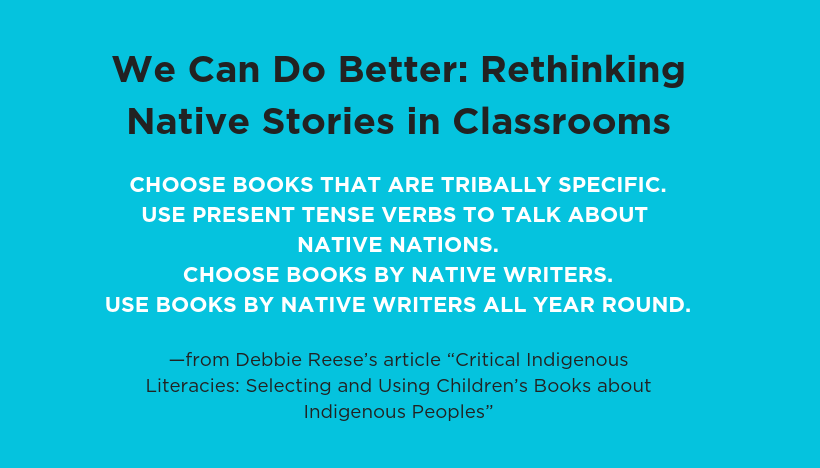
In the Best Books page here at AICL, you'll find lists that I create, and links to the pages about the Youth Literature Awards, given by the American Indian Library Association. I've also written several articles that are available online. Some are about books I recommend, and some are ones that invite you to think critically about books. Here's the links. They work right now but journals don't keep articles available this way, long term. You might have to ask your librarian for the article if a link no longer works.
Those problems range from the stereotyping of Native peoples to the pretense that peoples in conflict had a merry sit-down dinner.
Some emails are from parents who are dismayed when they visit their library and see children's books filled with those stereotypes and pretenses. These parents want their children to learn the truth. So they turn to the library for help.
Some parents tell me that, in a previous year, they had talked with librarians about the problems in the books. These parents felt hopeful that the librarians understood and would provide different kinds of programming and displays this year but that doesn't happen. Others tell me that the librarian interprets their questions as efforts to censor books. Some get lectured about censorship.
The thrust of the emails is this: what can I do?
Those of you who are writing to me have already taken the first step, which is to know there's a problem. Others have to know that, too. In order for changes to happen, more people have to understand what you already know. There is a problem. So, talking with friends and colleagues about it is a second step. Some of you already do that, which is great. Keep talking! And use social media! Though there are valid concerns about the merits of social media, I think it is why so many towns, cities, universities, schools, and states have instituted Indigenous Peoples' Day instead of Columbus Day.
With that in mind, I'm sharing a terrific resource that is available, online, at no cost.

A brief note: In 2014, Dr. Roxanne Dunbar-Ortiz's An Indigenous Peoples' History of the United States was released by Beacon Press. Teachers asked for a version that they could use with teens. Beacon asked if I would do it; I invited my friend and colleague, Dr. Jean Mendoza, to do it with me, and it was released in 2019, with "For Young People" as part of its title.
Here's a screen capture of the lesson plan. To download it, go to Beacon's website where you can see the webpage of it and the link to download a pdf. You can ask your library to get the book, and if you have the option, see if you can schedule one of the library's meeting rooms to have a conversation with others about the holiday.

I welcome other thoughts. What strategies have you used that seemed to help?
****
Ah! Meant to include a bit more. Some people write to me asking for Thanksgiving books that I recommend they use with children. My impulse is to offer some suggestions, but I am also trying to remind them and myself that the question is, in essence, one that centers the holiday itself. It seems to recognize that stereotyped and erroneous storylines are not ok, but it still wants Native peoples at that table.
Instead of providing a list of books that can be used for this week, I am asking that you use books by Native writers, all year long. Don't limit our existence to this holiday.
In the Best Books page here at AICL, you'll find lists that I create, and links to the pages about the Youth Literature Awards, given by the American Indian Library Association. I've also written several articles that are available online. Some are about books I recommend, and some are ones that invite you to think critically about books. Here's the links. They work right now but journals don't keep articles available this way, long term. You might have to ask your librarian for the article if a link no longer works.
- Native Stories: Books for tweens and teens by and about Indigenous peoples, by Kara Stewart and Debbie Reese, at School Library Journal on August 20, 2019.
- "We Are Still Here": An Interview with Debbie Reese in English Journal, in 2016.
- Critical Indigenous Literacies: Selecting and Using Children's Books about Indigenous Peoples, by Debbie Reese in Volume 92, Number 6 of Language Arts (published in 2018).
- Twelve Picture Books that Showcase Native Voices by Debbie Reese in School Library Journal in 2018.
Friday, November 15, 2019
Recommended! STRANGELANDS written by Magdalene Visaggio and Darcie Little Badger; art by Guillermo Sanna; Cover by Dan Panosian
Native teens! Go to the Humanoids site and get copies of the comic series, Strangelands. They're written by Magdalene Visaggio and Darcie Little Badger. The art is by Guillermo Sanna, and Dan Panosian did the cover.
I've read the first three...

.... and definitely recommend that you add them to your comic and graphic novel collection.
Here's info about the series:
Right now in the series they're at a lodge in Colorado where they can rid themselves of these powers. Adam doesn't like the decor of the "Wild Saints" lodge. In this passage, he's glaring at a dreamcatcher, and says:
And of course, get this new series, Strangelands.
I've read the first three...

.... and definitely recommend that you add them to your comic and graphic novel collection.
Here's info about the series:
Two strangers find themselves inextricably tied together by inexplicable superpowers. Fighting their connection could mean destroying the world.
Opposites attract? Elakshi and Adam Land aren’t married. In fact, a month ago, they were perfect strangers, dwelling in lands foreign to one another. But now, they’re forced to remain by one another’s side, for their separation could mean the planet’s demise. Their greatest challenge is to stay together — even if they have to tear the world apart to do so.See that? Elakshi and Adam's last name is Land. A hint, maybe, about who they are and how and why they have the powers they have--and don't want? I'm intrigued!
Right now in the series they're at a lodge in Colorado where they can rid themselves of these powers. Adam doesn't like the decor of the "Wild Saints" lodge. In this passage, he's glaring at a dreamcatcher, and says:
... all this Indian kitsch brings back terrible memories of paper teepees and chicken feather headdresses. Trust me. You do not want to be the only Apache kid at summer camp.From that passage, we know that Adam is Apache. One of the writers, Darcy Little Badger, is Lipan Apache. I think the first writing of hers that I read was in 2016 when I read "Né le," her space travel story in Love Beyond Body, Space and Time. (If you don't have that book, get it!).
And of course, get this new series, Strangelands.
Thursday, November 07, 2019
Not Recommended: SQUANTO'S JOURNEY: THE STORY OF THE FIRST THANKSGIVING

One of the questions I (Debbie) get around this time of the year is whether or not I recommend Joseph Bruchac's picture book, Squanto's Journey: The Story of the First Thanksgiving. The book was published in 2000 by Harcourt Brace. Illustrations are by Greg Shed.
I do not recommend Squanto's Journey because I view it as a feel-good story that is a lot like other books about Thanksgiving. This line is one example:
"Perhaps these men can share our land as friends."See the red question mark on the book cover? I'm using that today to pose some questions. In Squanto's Journey, Bruchac speaks as if he is Squanto. The first sentence in the book is:
My story is both strange and true.See? First person. As far as I've been able to determine, there are no records of anything that Squanto said to anyone. I'm going to keep looking, and if you find something, let me know.
My general position about creating speech and thoughts for a person who actually lived, hundreds of years ago, is that it is not appropriate. I usually say--for example--that a white woman imagining what a Native man said and thought hundreds of years ago is making huge leaps from her own existence to that Native man's time, place, culture, and language. If there are no written records to draw from, I think it ought not be done. To me, it doesn't matter if the work being created is fiction. If it is a person who actually lived, and for whom there are records a writer can draw from to quote the writings or speech of that person, then, ok. I think that can work. But otherwise, no. (The exception I make is when the book in question is written by someone of the subject's own nation who can draw from stories they tell about that person.)
So, a question: are there any documents or writings that quote the man we know as Squanto (more on that in a moment)?
Towards the end of the first paragraph, the text reads:
My name is Squanto.Though many people call him that, other sources say his name was Tisquantum and that "Squanto" was more like a nickname.
So, another question: What did that man actually say his name was?
I have more questions about the history told in Bruchac's book, but for now want to look at Squanto (Bruchac) learning that his wife, children, parents, and others who were close to him had died. Squanto says he will speak to them again when he walks on the "Road of Stars" to greet them. In the glossary, Bruchac says:
Road of Stars: The Milky Way, which is seen as a trail to reach the afterlife walked by those who have died.Is there evidence that Squanto and his people used that phrase? Regular readers of AICL know that I'm critical of white folks who make up things like that... I wonder what Bruchac's source for that is?
Update: a reader replied right away, saying "Isn't Bruchac Abenaki? This sounds like you're saying he's white." My answer: for most of the time that I've been studying children's books, I understood that Bruchac is Abenaki. More recently, he has said he is "Nulhegen Abenaki" which is a state recognized tribal nation. And even more recently, I have been reading Dr. Darryl Leroux's research that calls into question claims made to Métis identity/nationhood and, relevant to Bruchac, the four Abenaki tribes that the state of Vermont has recognized (Nulhegan Abenaki is in Vermont). So, I am not saying Bruchac is White, but I've definitely got questions about the Nulhegan Abenaki, now, given the research Leroux has done. Get his book, Distorted Descent: White Claims to Indigenous Identity" and see what you think. Respected Native scholars are sharing and recommending his book. I know that the responses to this update will be intense. Some will question my reference to Leroux's work. Some will be indignant that I am citing it, but I think it is important work that has bearing on my own work in children's literature.On another page, Squanto (Bruchac) uses the word "sachem." That word, as defined in the glossary, is supposed to mean "a leader of the people." Is that the word that Squanto would have used? What are the roots of that word?
Those are a few questions, for now. I might be back when I have more time, with additional questions (and maybe some answers). They're examples of the kinds of questions that I want teachers to ask when they read children's books, and to teach students to ask, too.
Wednesday, October 23, 2019
Thoughts on Patricia MacLachlan's THE HUNDRED-YEAR BARN (and my conclusion: Not Recommended)

Though the reader did not say why they were asking me about The Hundred-Year Barn, my hunch is that they read my article, An Indigenous Critique of Whiteness in Children's Literature (write to me and I'll send you a copy of it). The article is a published account of the remarks I made when I gave the 2019 May Hill Arbuthnot Lecture in Madison, WI.
In that lecture, I talked about the 2018 Caldecott Award winner, Hello Lighthouse (by Sophie Blackall) which I view as the epitome of Whiteness and the embodiment of the nostalgia we hear when we read the news ("Make America Great Again"). I said:
I have no doubt that people think books like Hello Lighthouse are "neutral" or "apolitical." That's Whiteness at work. From my perspective, the politics in Hello Lighthouse are front and center. Its nostalgia for times past is palpable. In Blackall's book, the life of a white family is affirmed and the lighthouse that they live in is on what used to be Native lands. There's no neutrality there. In fact, if we think about it, every children's book for which the setting is this continent, is set on what used to be Native lands. If we could all hold that fact front and center every time we pick up a children's book set on this continent, how might that change how we view children's literature? How might that shape the literature as we move into the future?
People did not (and do not) like me saying that about Blackall's book. That is, however, my sincere appraisal of it and my questions are sincere, too. What if we did think about the land every time we pick up a children's book like The Hundred-Year Barn?
Here's the description of The Hundred-Year Barn from the HarperCollins website:
One hundred years ago, a little boy watched his family and community come together to build a grand red barn. This barn become his refuge and home—a place to play with friends and farm animals alike.
As seasons passed, the barn weathered many storms. The boy left and returned a young man, to help on the farm and to care for the barn again. The barn has stood for one hundred years, and it will stand for a hundred more: a symbol of peace, stability, caring and community.
In this joyful celebration generations of family and their tender connection to the barn, Newbery Medal–winning author Patricia MacLachlan and award-winning artist Kenard Pak spin a tender and timeless story about the simple moments that make up a lifetime.
This beautiful picture book is perfect for young children who are curious about history and farm life.
The barn was built in 1919. We aren't told where (geographically), but Lachlan's dedication to her grandparents suggests that she may have had North Dakota prairies in mind when she wrote this story. But, she was born in Wyoming and said that she carries a bag of prairie dirt with her, so it could be Wyoming rather than North Dakota. What was going on in those states in the early 1900s? North Dakota became a state of the US in 1889. Wyoming became a state in 1890.
I'll say this, just to be obvious: all that land belonged to Native Nations.
I wanted to read The Hundred-Year Barn to see if there was any mention of Native people. I wondered if there was an author's note that said a bit more about that land, that barn, that family. In short: no. I've got the book in front of me today and it is simply a white family and community. Not a single mention of Native people or communities. Its history starts in 1919 with a white family.
Now--I know some of you are saying "MacLachlan's book isn't about Native people!" and "Don't judge it for what it doesn't have in it." But those are thin arguments, aren't they? If we think back to children's books that, for decades, showed women in narrow ways, critics asked questions, right? Asking questions about the contents of books is one mechanism to drive change.
I'm pretty sure that, in 1919, Native people were watching White people building barns on what was once Native homeland. And that, in that hundred-year period, Native people watched more and more White people move on to Native homelands and build things.
I'd bet, as a matter of face, that there were lawsuits in federal courts, through which Native Nations were trying to get the US to honor treaties it made with them.
The Hundred-Year Barn is--to some--a lovely story. To a Native person--to me--it is one like so many others that erase Native people from existence. It denies truths to children. And it feeds a nostalgia for a time that never really was like what you see when you read MacLachlan's book. The Hundred-Year Barn is not a good that I would recommend, to anyone. All kids deserve better than that.
Tuesday, October 22, 2019
Highly Recommended: FRY BREAD: A NATIVE AMERICAN FAMILY STORY
Update from Debbie, Oct 26, 2019: Unfortunately, the endpapers include some state recognized groups (I won't call them tribes or nations) whose website information makes me cringe. I hope the team who put the endpapers for Fry Bread together can make edits immediately. I am in the process of looking at them carefully and am considering creating a post that tells you how/why I am saying I would not personally call them tribes or nations.
All across social media, friends and colleagues are saying "Happy Book Birthday!" to Kevin Maillard and Juana Martinez-Neal. That's because their book, Fry Bread: A Native American Family Story is officially available, today, October 22, 2019.
There's a lot inside the covers of Fry Bread! What you find when you turn the pages is why I highly recommend it.

I wish I had slick video and video-editing skills so I could offer you a short and compelling film about the book. I don't have those skills, so... here's what I have:
Here's a screen capture (from my kindle copy of the book) of the last page I showed you in the video:

See those adults pointing out names of Native Nations? That's so wonderful! Mine--Nambé--is there, too. Here's my finger, pointing to it:

Those of you who follow AICL know that we emphasize the importance of sovereignty... Of knowing that Native Nations pre-date the United States. So many names inside this book! It will be empowering to so many readers!
There's more, though, to say about Fry Bread.
A few weeks ago, I gave a talk at the Santa Fe Indian Center, in Santa Fe, NM. I talked about the names of nations but I also talked about the range of hair color and skin tone in the book. See?

After the lecture, a family approached me to say how deeply moved they are by seeing a child with lighter skin and hair. Fry Bread pushes back on the expectation that Native people look the same (black hair, dark skin, high cheekbones etc.). That expectation means that adults don't hesitate to tell a Native child like the girl holding the cat that they are "not really an Indian" (or some variant of that phrase). That's such a damaging statement! When you hear an adult say that to anybody--but especially a child--stop them.
The final pages of Fry Bread can help you interrupt that kind of harmful statement. There, Maillard wrote that:
Update: October 23, 2019
In a comment, I was asked if the book has information about the history of fry bread and its impact on health of Native people. It does--and that is yet another aspect of what makes this book stand out.
One double paged spread shows Native people in shadow. The woman on the cover is telling kids about the long walk. The text is:
Fry bread is history
The long walk, the stolen land
Strangers in our own world
With unknown food
We made new recipes
From what we had
In the Author's Note, Maillard provides teachers and parents and librarians who do not know this history, with information they can use to prepare to use the book with kids. It is an exquisite author's note! It spans eight pages that correspond with the illustrated pages that are the heart of Fry Bread. And--they're footnoted! I don't recall seeing footnotes in an Author's Note before.
Maillard writes that people think the Navajo (Diné) were the first to make fry bread. He talks about how, across the country, Native people and our ways are resilient and here, today, in spite of efforts to weaken and destroy our nations and communities.
He writes that there are some Natives who are pushing back on the making and eating of fry bread. He wrote:
As noted above, the Author's Note is exquisite for the depth of information it provides. I quoted that one sentence, but will also note that the sentence has a footnote! It goes to Devon Mihesuah's article, "Indigenous Health Initiatives, Frybread, and the Marketing of Nontraditional 'Traditional' American Indian Foods." In his Author's Note, Maillard provides 15 footnotes! Like I said... exquisite. And--I think--groundbreaking.
All across social media, friends and colleagues are saying "Happy Book Birthday!" to Kevin Maillard and Juana Martinez-Neal. That's because their book, Fry Bread: A Native American Family Story is officially available, today, October 22, 2019.
There's a lot inside the covers of Fry Bread! What you find when you turn the pages is why I highly recommend it.

I wish I had slick video and video-editing skills so I could offer you a short and compelling film about the book. I don't have those skills, so... here's what I have:
Here's a screen capture (from my kindle copy of the book) of the last page I showed you in the video:

See those adults pointing out names of Native Nations? That's so wonderful! Mine--Nambé--is there, too. Here's my finger, pointing to it:

Those of you who follow AICL know that we emphasize the importance of sovereignty... Of knowing that Native Nations pre-date the United States. So many names inside this book! It will be empowering to so many readers!
There's more, though, to say about Fry Bread.
A few weeks ago, I gave a talk at the Santa Fe Indian Center, in Santa Fe, NM. I talked about the names of nations but I also talked about the range of hair color and skin tone in the book. See?

After the lecture, a family approached me to say how deeply moved they are by seeing a child with lighter skin and hair. Fry Bread pushes back on the expectation that Native people look the same (black hair, dark skin, high cheekbones etc.). That expectation means that adults don't hesitate to tell a Native child like the girl holding the cat that they are "not really an Indian" (or some variant of that phrase). That's such a damaging statement! When you hear an adult say that to anybody--but especially a child--stop them.
The final pages of Fry Bread can help you interrupt that kind of harmful statement. There, Maillard wrote that:
Most people think Native Americans always have brown skin and black hair. But there is an enormous range of hair textures and skin colors. Just like the characters I this book, Native people may have blonde hair or black skin, tight cornrows or a loose braid. This wide variety of faces reflects a history of intermingling between tribes and also with people of European, African, and Asian descent.It is quite the challenge to impart substantive information in an engaging way, but Maillard and Martinez-Neal have done it, beautifully, in Fry Bread. I highly recommend it! Published by Roaring Book Press (Macmillan) in 2019, I hope you'll order several copies for your bookshelves, and to give to Native families, too.
Update: October 23, 2019
In a comment, I was asked if the book has information about the history of fry bread and its impact on health of Native people. It does--and that is yet another aspect of what makes this book stand out.
One double paged spread shows Native people in shadow. The woman on the cover is telling kids about the long walk. The text is:
Fry bread is history
The long walk, the stolen land
Strangers in our own world
With unknown food
We made new recipes
From what we had
In the Author's Note, Maillard provides teachers and parents and librarians who do not know this history, with information they can use to prepare to use the book with kids. It is an exquisite author's note! It spans eight pages that correspond with the illustrated pages that are the heart of Fry Bread. And--they're footnoted! I don't recall seeing footnotes in an Author's Note before.
Maillard writes that people think the Navajo (Diné) were the first to make fry bread. He talks about how, across the country, Native people and our ways are resilient and here, today, in spite of efforts to weaken and destroy our nations and communities.
He writes that there are some Natives who are pushing back on the making and eating of fry bread. He wrote:
For these critics, fry bread is an easy target for a much larger problem of being forced to deviate from a traditional Indigenous diet.The larger problem, he writes, is a reality many Native communities face. There are no fresh food markets nearby, fast food is more readily available, and access to health care (like markets) is difficult. We know that fast food is unhealthy when eaten every day. Maillard makes that point about fry bread, too. Eating it everyday will lead to health problems.
As noted above, the Author's Note is exquisite for the depth of information it provides. I quoted that one sentence, but will also note that the sentence has a footnote! It goes to Devon Mihesuah's article, "Indigenous Health Initiatives, Frybread, and the Marketing of Nontraditional 'Traditional' American Indian Foods." In his Author's Note, Maillard provides 15 footnotes! Like I said... exquisite. And--I think--groundbreaking.
Monday, October 21, 2019
A First Look at Roanhorse's RACE TO THE SUN
In July of 2019, I received an ARC (advanced reader copy) of Rebecca Roanhorse's Race to the Sun. I did a short twitter thread as I looked it over. Below is that thread, with some light editing to the original tweets, for clarity. I assume that Roanhorse and Riordan, too, read my thread and that edits to the ARC will be made before the final printing of Race to the Sun. The book is due out in 2020.
Indigenous peoples weren't "Original Americans."
They weren't "First Americans" either.
They were people of their own unique nations, all of which pre-date the United States.
How are readers going to know which parts are fantasy and which are not?
I am currently reading Race to the Sun, making notes as I do. So far, I've met the main character. She is a Diné girl named Nizhoni who can see monsters. Because of that power, the monster she sees in the opening chapters tells her that it has to kill her.
But, a small stuffed horned toad on her shelf speaks to her, telling her she has to slay that monster. To do that she has to go to the Glittering World where she will meet the Sun, who is also known as The Merciless One, and who will give her the tools she needs to kill that monster.
Clearly, Roanhorse is using Navajo stories to create the characters in Race to the Sun. As such, people in the Diné Writers Collective will see this as appropriation. Would the Diné Writers view these characters as caricatures?
When I finish reading and thinking about the book, I will be back with a link to the review.
****
I have an ARC of Roanhorse's RACE TO THE SUN.
I was wrong to recommend her TRAIL OF LIGHTNING. Details: Concerns about Roanhorse's TRAIL OF LIGHTNING.
I was wrong to recommend her TRAIL OF LIGHTNING. Details: Concerns about Roanhorse's TRAIL OF LIGHTNING.
RACE TO THE SUN is in Rick Riordan's "Rick Riordan Presents" series. His use of his fame to launch writers of color is terrific. I haven't read the other book in Riordan's series.
His intro for RACE TO THE SUN is titled "The Original American Gods." That's a problem, for sure. His problematic intro looks like this:
His intro for RACE TO THE SUN is titled "The Original American Gods." That's a problem, for sure. His problematic intro looks like this:
THE ORIGINAL AMERICAN GODSDo you see why that's not ok? "Original American" erases the fact that the Diné people pre-date America.
Changing Woman. Rock Crystal Boy. The Glittering World. The Hero Twins.
Indigenous peoples weren't "Original Americans."
They weren't "First Americans" either.
They were people of their own unique nations, all of which pre-date the United States.
Moving from Riordan's intro to the book itself, I am pretty sure the Diné Writers Collective would say no to it, immediately. In their Open Letter, they state that Roanhorse appropriated Diné culture when she wrote TRAIL OF LIGHTNING. But they are also concerned with the content. They write that
Roanhorse often mischaracterizes and misrepresents Diné spiritual beliefs.and,
Roanhorse turns deities into caricatures.
They reference others who have appropriated and misrepresented Diné beliefs, including Tony Hillerman, Oliver LaFarge, and Scott O'Dell.
And they write that
We are concerned that this book attempts to convert our true ancestral teachings into myth and legend.
Upthread, I linked to the Diné Writers Collective letter. I hope you go read the entire letter.
It is signed by Esther Belin, Sherwin Bitsui, Chee Brossy, Dr. Jennifer Denetdale, Tina Deschenie, Jacqueline Keeler, Dr. Lloyd Lee, Manny Loley, Jaclyn Roessel, Roanna Shebala, Jake Skeets, Dr. Laura Tohe, Luci Tapahonso, and Orlando White.
It is signed by Esther Belin, Sherwin Bitsui, Chee Brossy, Dr. Jennifer Denetdale, Tina Deschenie, Jacqueline Keeler, Dr. Lloyd Lee, Manny Loley, Jaclyn Roessel, Roanna Shebala, Jake Skeets, Dr. Laura Tohe, Luci Tapahonso, and Orlando White.
In her Author's Note for RACE TO THE SUN, Roanhorse writes
I am just a writer of fantasy, not a culture keeper or scholar. This book should not be taken for a cultural text.
That is an icky, not-my-fault disclaimer because it echoes what Whiteness says (by "Whiteness" I mean white writers who argue that what they do in fiction doesn't have to be accurate because everybody knows that fiction isn't real. That is a disingenuous defense, no matter who says it.)
In that note, she also thanks Riordan for allowing her to:
...share some of what I know of the beauty of the Navajo culture with Navajo readers and the rest of the world.That kind of clashes with what she said, earlier (about the book not being a cultural text). First she says not to read the book as a cultural text, but then she says she's glad to share what she knows about Navajo culture.
How are readers going to know which parts are fantasy and which are not?
****
But, a small stuffed horned toad on her shelf speaks to her, telling her she has to slay that monster. To do that she has to go to the Glittering World where she will meet the Sun, who is also known as The Merciless One, and who will give her the tools she needs to kill that monster.
Clearly, Roanhorse is using Navajo stories to create the characters in Race to the Sun. As such, people in the Diné Writers Collective will see this as appropriation. Would the Diné Writers view these characters as caricatures?
When I finish reading and thinking about the book, I will be back with a link to the review.
National Parks, in AN INDIGENOUS PEOPLES' HISTORY OF THE US, FOR YOUNG PEOPLE
In the last few months, I (Debbie) have received a few emails about the National Parks. I have replied by directing individuals to An Indigenous Peoples' History of the United States, for Young People.
When Jean and I adapted Roxanne Dunbar-Ortiz's book into one that teachers could more readily use on their own or with students, we made choices on what to modify, keep, leave out, or expand.
Knowing that some families visit National Parks, we decided to expand a bit on that topic.
In Chapter 9, "The Persistence of Sovereignty," we wrote about the Yellowstone Park Act in a segment we titled "Pushing Back Against Legalized Land Theft." In that section we talk about several instances in which a tribal nation fought to have land taken from them to create a national park or forest, returned. One example is Blue Lake, taken from Taos Pueblo when President Roosevelt created Carson National Forest in 1906. For decades, they fought to have it returned.

As you can see from the screen cap of my Kindle copy of that page, we also have a "Did You Know" textbox about a legal term: reserved rights. That was deliberate on our part because we knew there was a case before the Supreme Court, about whether or not Clayvin Herrera, a member of the Crow Nation, had rights to hunt in the Bighorn National Forest.
When teachers introduce information about the National Park system, we hope our adaptation will help them provide students with a more critical look at how those lands came to be "national" parks.
And we hope they'll draw connections from history to the present day. They can do that, for example, by studying and talking about Clayvin B. Herrera v. State of Wyoming. It cited the reserved rights doctrine. The court, by the way, ruled in favor of Herrera.
When Jean and I adapted Roxanne Dunbar-Ortiz's book into one that teachers could more readily use on their own or with students, we made choices on what to modify, keep, leave out, or expand.
Knowing that some families visit National Parks, we decided to expand a bit on that topic.
In Chapter 9, "The Persistence of Sovereignty," we wrote about the Yellowstone Park Act in a segment we titled "Pushing Back Against Legalized Land Theft." In that section we talk about several instances in which a tribal nation fought to have land taken from them to create a national park or forest, returned. One example is Blue Lake, taken from Taos Pueblo when President Roosevelt created Carson National Forest in 1906. For decades, they fought to have it returned.

As you can see from the screen cap of my Kindle copy of that page, we also have a "Did You Know" textbox about a legal term: reserved rights. That was deliberate on our part because we knew there was a case before the Supreme Court, about whether or not Clayvin Herrera, a member of the Crow Nation, had rights to hunt in the Bighorn National Forest.
When teachers introduce information about the National Park system, we hope our adaptation will help them provide students with a more critical look at how those lands came to be "national" parks.
And we hope they'll draw connections from history to the present day. They can do that, for example, by studying and talking about Clayvin B. Herrera v. State of Wyoming. It cited the reserved rights doctrine. The court, by the way, ruled in favor of Herrera.
Subscribe to:
Posts (Atom)