Tuesday, January 11, 2022

A Second Look at PebbleGo Next


On December 2, 2016, I took a look at "PebbleGo Next" (an educational website for early childhood) because AICL readers had been writing to ask me about it. Based on what I saw on the Pueblo pages, I decided I could not recommend PebbleGo Next. My major concerns were that the site did not use "nation" and that the site's content was presented using past tense verbs which contributes to the idea that we no longer exist.

One of my concerns was that they had used the word "cultures" in their categories. For example, the site said "Southwest Cultural Area." Categorizing Native peoples as cultures or cultural groups is a typical error. We are--of course--people with distinct languages, stories, religions, housing, clothing, but the single most important fact about us is this: we are sovereign nations. No other cultural groups in the U.S. have political status. No other cultural groups have treaties with the U.S. government (some tribal nations had treaties with European governments, too. See for example, the Gäsweñta’ (Two Row Wampum) information about the Haudenosaunee and the Dutch.)

Instead of "cultures," the best word to use is "nations" (or nation when the focus is on a single tribal nation). Editors at PebbleGo read my review and made some changes--but they are superficial. Let me explain by walking you through some of what I see today (January, 2022). 

Instead of "Southwest Cultural Area" the category is now "Southwest Tribal Nations." When you click on it, this is what you'll see:


Clicking on "Southwest Tribal Nations" in the array (it may look different on your screen depending on how wide your browser window is), you'll get an overview grouped in these sections: Introduction, History, Geography, Communities, Cultural Characteristics, Housing, and Food. 

In the Introduction, there are two paragraphs. They both start out with "Southwest culture area." The introduction says that the area "is home to several American Indian groups" and it says they include Navajo, Apache, Pueblo, Hopi, Zuni, Tohono O'odham, Akimel O'odham, Upland Yumans, and River Yumans. There is no mention of them as nations. That's what I mean about superficial changes. Substituting the word on the category page is easy to do. That's a cut and paste task. Making substantive change is harder to do--but necessary! 

In the History section, there are four paragraphs. I don't see the word nation anywhere there. "Groups" is PebbleGo's word of choice in this section. Some information is incorrect. It says that the U.S. government forced all of the Southwest Indian peoples onto reservations, but in fact, some of us are living on the same homelands that we were living on prior to European invasions. Reservations were established and removals did happen, but overly broad information like what I see here mis-educates children. 

In the Communities section, I finally see the words nation/nations, but it is used in an inconsistent way.  This section uses "Akimel O'odham nation" and "Apache" and "Chiricahua and the Mescalero" and "the Hopi nation." Why not use it with Apache, Chiricahua, and Mescalero? In the third paragraph of this section, I see
The Hopi nation is made up of many different villages. Hopi people identify closely with their own village. Their own village is much more important to them than the Hopi nation as a whole." 
Kudos for using nation, but when the word appears with a specific nation, a capital letter is necessary. Style guides and scholars use a capitol N. It should therefore be "Hopi Nation."  The last sentence in that excerpt is also a problem. I wonder about the source for it? I think the Pebble go editors mean to say that people have a strong affinity for the place they live. Some of you reading this review have strong feelings about your hometown and might not have the same warmth for your state.  As written, that sentence is a problem because it undermines the significance of the Hopi Nation's sovereign status. Why include that sentence in the first place? I don't think the editors mean to undermine nationhood, but I think that sentence does that very thing. 

There are two paragraphs in the Cultural Characteristics section. Both are about languages. The opening sentence is "Southwest Indians spoke many different languages." Use of "spoke" rather than "speak" suggests the languages are no longer spoken--and while language loss is an issue--many do speak their language and/or are involved in language projects to teach it to others. For the most part, those two paragraphs use present tense verbs. 

In the Housing section, all four paragraphs use past tense verbs. In fact, Pueblo people--today--build our homes using adobe bricks. Over the course of his life, my dad made thousands of adobes. I've got a wonderful photo of him doing that with his parents when he was a kid, and I've got a photo of my daughter doing it with him, when she was a kid. He built four adobe homes. 

In the Food section, all the paragraphs are in the past tense. We still farm. Navajo people still raise sheep. Though most of us buy meat at the local grocery store, some of us continue to hunt deer, rabbit, and antelope.  

The last observation I have about the overview page is with regard to the illustrations. There are seven. Five show Native people, but they are all shown in a past tense setting. Captions are also in past tense, and the placement of the illustrations doesn't make sense. Here is a screen capture from the Communities section that helps make my point:
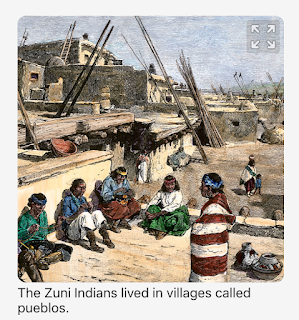


Why is it there? The content of that particular section does not mention the Zuni people. A better choice would be an illustration of a Hopi village of the present day. 

When I did my first look at the PebbleGo site, people there wrote to me, nothing the significance of my review and that they were making changes. As noted above, I think the changes are superficial. One thing that I do recommend at their site is the "American Indians Today" page that you can see when you click on the American Indian History page. It is the one on the top left, below:
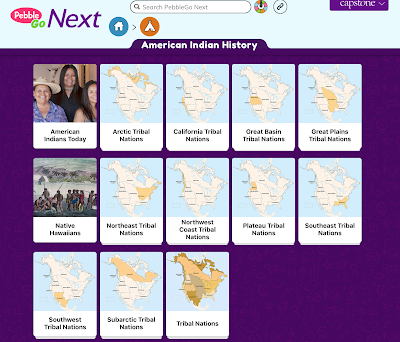


Clicking to that page you'll read terrific information written by Dr. Karina Phillips. She is a professor at Macalester College in St. Paul, Minnesota, and a member of the Red Cliff Band of Lake Superior Ojibwe. Her knowledge and identity make that page exceptionally useful. If PebbleGo wants to improve what they offer, every page must be written by someone like her. The "American Indians Today" page that she wrote is divided into several sections. Over and over, she uses present tense verbs. the illustrations on the page are eight full color photographs of Native people in the present day, like this one in the Government section that shows the Navajo Nation's Council Chamber:


The page created by Dr. Phillips demonstrates that you--PebbleGo--can do better, but you must step up and DO better, on ALL your pages. Until you do, I cannot recommend your site.

--Debbie Reese, January 11, 2022


Tuesday, January 04, 2022

Indigenous Nations in Nonfiction

In 2021, the National Council of Teachers of English published Reading and Teaching with Diverse Nonfiction Children's Books: Representations and Possibilities. Edited by Thomas Crisp, Suzanne M. Knezek, and Roberta Price Gardner, it includes a chapter I wrote with Betsy McEntarffer that draws heavily from Simon Ortiz's The People Shall Continue. 


Betsy is a retired white librarian. I met her years ago, online, before she retired. I don't remember how, exactly, but she was doing terrific work on her library's efforts to be mindful of diversity in the collection. And so, we talked by email for years. When I was invited to write a chapter for nonfiction book, I asked her to work with me on it. The book came out in November of 2021. 

In 2016, Simon Ortiz (Acoma) invited me to give a talk in his lecture series at Arizona State University. I met him a long time ago and had been talking about his children's book The People Shall Continue in talks I gave here and there. He has been a source of strength and guidance for Native people -- through his writings but also with his advocacy. I was deeply honored by his invitation.  He follows what I do in children's literature. 

What he writes about in The People Shall Continue is the heart of the chapter Betsy and I wrote. Our chapter is "Indigenous Nations in Nonfiction." We came up with a set of guidelines that we call An Indigenous Peoples' Framework for Evaluating Nonfiction. One of the challenges for us all is a lack of time. Often we want a quick answer to a question but when we are trying to expand what we know about a people unlike ourselves, quick answers are not enough. In our chapter we provide some background information that helps you strengthen your critical lens. 

A mainstream default is to think of Native peoples as a cultural group. That is true, but the vital difference is that we are the original peoples of this land currently called North America. We are not "the first Americans." This land was called something else before it was called "America." When Europeans came here, there was conflict but they also engaged in treaties with us. 

Treaties don't happen between cultural groups. They happen between nations. Or, more specifically, between leaders of those nations. That, for me, is a starting place to understanding who we are. And so, I emphasize that we are nations. Sovereign nations. It is far more complicated that that but I think it is important to start with that idea. The word, nation, is in The People Shall Continue. As far as I know, it is the first time a children's book has that word in it. 

The word "people" is in the book title. Some of you may not notice it and to some of you it might seem unimportant---but it is deeply significant! Think about books you've read about us. Do you remember "people" in it? Or do you remember "Indian" or a similar word (Native American, etc.). Now--what image comes to your mind when you think about "people" and when you think "Indian." Different, right? The "Indian" is likely a stereotypical image and it is also likely an adult male or a group of adult males attacking some white pioneers that are depicted as courageous for venturing out onto "the frontier" or "the wilderness." I believe Simon used the word "people" to help you see us--not as aggressors but as mothers, fathers, aunts, uncles, grandparents, etc. The word "people" shifts the lens, significantly. 

With The People Shall Continue as our guide, our framework uses Simon's words to help you develop understandings that will help you evaluate a work of non-fiction. I think the content of our framework applies to fiction, too. In addition to the words "people" and "nation" there are nine additional points that we invite you to consider. I hope you're able to get a copy of Reading and Teaching with Diverse Nonfiction Children's Books: Representations and Possibilities. Request one at your library. I think you'll see that the book has many other excellent chapters, and perhaps, you may buy a copy for yourself. 

Update: Jan 5, 2022, 6:30 AM


Monday, January 03, 2022

Debbie Reese in THE WEEK, JUNIOR

A personal and professional high point of 2021 that I haven't noted yet on AICL is this one:


On July 2, 2021, an interview of me was published in The Week, Junior. I was thrilled that they knew about AICL, and that they wanted to tell their readers about my work. In June, I think, I started getting notes from friends and colleagues who subscribe to it, sharing their delight in seeing me on one of the pages. It was a terrific high for me! 

AICL has been around since 2006, pointing out bias and misrepresentation of Native peoples, and shining a bright light on excellent books by Native writers. A heartfelt kú'daa to those who read and share what we publish here on AICL. 

Tuesday, December 28, 2021

Highly Recommended: THE FIRE by Thomas Peacock


The Fire
Written by Thomas Peacock (Fond du Lac Band of Lake Superior Ojibwe)
Illustrations by Anna Granholm
Published by Black Bears & Blueberries
Published in 2021
Reviewer: Jean Mendoza
Review Status: Highly Recommended

I'm very happy to add a title to our 2021 Recommended Books list: Thomas Peacock's The Fire. This is my "short and sweet" review. As you may remember, "short and sweet" reviews are not in-depth; they cover four reasons for our decision about a particular book. 

Here's how the publisher, Black Bears & Blueberries, describes The Fire.
This story is a fictionalized account of the Great Fire of 1918 based on an interview of Elizabeth (Betty) Gurno, a Fond du Lac Reservation elder. Betty was a little girl when the fire swept the area. The Fire of 1918 destroyed the city of Cloquet, Minnesota and surrounding communities, including the Fond du Lac Reservation, and resulted in the loss of many lives.

Author Thomas Peacock frames Betty's telling of the story within a later-day classroom scene in Minnesota. Betty has come to her grandchild's classroom to share her memories of the fire. 

First reason to recommend The Fire: It focuses on Indigenous people's experience during a catastrophic event, and joins a fairly small pool of exciting and moving historical fiction picture books told from an Indigenous perspective. In The Fire, Ojibwe oral history is at the center. The author uses some words in Ojibwemowin and refers to Ojibwe traditions (such as offering asemaa, tobacco, to an elder who shares wisdom). 

Second reason: It's timely. Wildland fires have affected communities around the country in recent years. Children are wondering how such fires can happen, how people survive them, and what happens afterward. Young readers may want to do further research about the Great Fire of 1918, using sources like the National Weather Service article and a dedicated page on the Library of Congress Web site. 

Third reason: The illustrations amplify the storytelling. There's plenty of drama in the pictures. Burning boards fly through the air; dozens of animals join the people in the river as the fire rages. But there are also some important, more subtle touches. Look closely at the page that shows Betty's grandparents warning her family about the fire. The hazy trees and yellowish sky behind the horse and buggy aren't just meant to be pretty. That's the smoke, already drifting into Fond du Lac, a silent warning. 

Fourth reason: The story manages to locate modest, honest hope and affirmation in the aftermath of the disaster. Readers learn that no Ojibwe people died, but "more than four hundred fifty of our non-Native neighbors were lost in the fire," and several non-Native towns burned to the ground. (For comparison, I checked the estimated death toll of the Chicago Fire of 1871 -- around 300.) Grandma Betty recounts that her grandmother's home escaped the fire, and she shared what food she had with other Fond du Lac families, most of whom had lost everything. I love the final words of Grandma Betty's storytelling: "We help each other. That is what we do." (It reminds me of the values behind Richard Van Camp's little board book, May We Have Enough to Share.)

I also love that when Betty ends her storytelling, the children line up to hug her. Maybe that's a classroom custom. But I think it also shows that the children are moved by this elder's story of the trauma she and their community endured, and they are caring for her in their way, years afterward.

The Fire is a valuable book to have on your shelves, and to share with children you know.


Monday, December 20, 2021

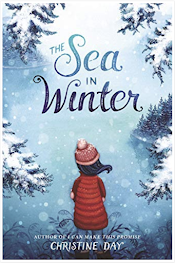
HIGHLY RECOMMENDED: THE SEA IN WINTER


The Sea in Winter
By Christine Day (Upper Skagit)
Published by Heartdrum
Published in 2021
Reviewed by Jean Mendoza
Review Status: Highly Recommended

Back in September 2020, Debbie blogged about her positive reaction to reading the ARC of Christine Day's second novel for young people -- The Sea in Winter. Since then, the book has gotten positive critical attention, including a Kirkus starred review and School Library Journal "Best Book". Here, finally, is my "short and sweet" AICL review. 

The publisher, Heartdrum, says this about The Sea in Winter:

It’s been a hard year for Maisie Cannon, ever since she hurt her leg and could not keep up with her ballet training and auditions. Her blended family is loving and supportive, but Maisie knows that they just can’t understand how hopeless she feels.... Maisie is not excited for their family midwinter road trip along the coast, near the Makah community where her mother grew up. But soon, Maisie’s anxieties and dark moods start to hurt as much as the pain in her knee. How can she keep pretending to be strong when on the inside she feels as roiling and cold as the ocean?

Reason One to recommend The Sea in Winter: The sense of place. 

The author writes from the heart when she describes the story's setting. It's good to have a book about a contemporary middle schooler, that celebrates geoduck clams and the removal of the Elwha River dam. It's set in much the same part of the continent as a certain popular vampire-and-werewolf series, but Day's storytelling is noticeably more attuned to the landforms, the weather, the animals, the sea. 

Reason Two: Respect for advocacy and activism. 

Advocacy for social and environmental justice, and for Indigenous rights, are natural parts of family life in Maisie's world. For example, readers learn that her family has been directly affected by treaty rights to harvest shellfish, and removal of dams that kept salmon from spawning in local rivers. And conflict around the 1999 Makah whale hunt (the tribe's first effort to hold its traditional hunt in 70 years) forced an important decision for some of Maisie's Makah relatives. 

Reason Three: The protagonist's unique perspective. 

The Sea in Winter offers the young reader a window on the experience of a child with an unusual level of ambition. Most children Maisie's age haven't discovered an activity that inspires the kind of commitment she has to ballet. What is it like, at age 12, to have your entire life, including peer friendships, revolve around ballet, because you love it that much? Who else understands such dedication? And how do you cope, at age 12, when you face the loss of your beautiful dream? Is that what depression feels like?

Reason Four: Maisie's solid, loving Native family. 

Leo Tolstoy famously, or infamously, wrote, "All happy families are alike; every unhappy family is unhappy in its own way." Though Maisie's family faces some challenges, including Maisie's depression, they are fundamentally "happy" together -- affectionate, thoughtful, supportive, respectful of boundaries, and knowledgeable about their Native identities. But they're by no means ordinary, stereotypical, or indistinguishable from other fictional families that are doing essentially okay. The author makes them interesting, not merely quirky or weird, as individuals and as a unit. 


In short, I add my voice to the chorus of recommendations: Read and share The Sea in Winter with young people in your life!

Wednesday, December 01, 2021

AICL's Best Books of 2021

A Sample of AICL's Best Books of 2021

Those who study and write about children's books will mark 2021 as a significant year because it is the year that Heartdrum (an imprint of HarperCollins) released several books written and illustrated by Native people. Heartdrum's first book, The Sea In Winter by Christine Day (enrolled, Upper Skagit), is outstanding. We read an advanced copy of it in 2020 and highly recommended it. You will find it below, along with several books we read from Heartdrum. What Heartdrum represents is important. Cynthia Leitich Smith (Muscogee Creek) brought it into existence. For all that she has done, she was named as the recipient of the 2021 NSK Neustadt Prize for Children's Literature. Three of her books were republished this year. In our articles, book chapters, and presentations, we usually include one or more of her books. We're pleased to see the new updated versions and you'll find them listed below. 

The persistence of Native peoples who write, speak, and challenge the status quo in other ways is significant. Those who support Native people in that work matter, too. An example is Arthur A. Levine, who launched Levine Querido in 2019. They published Anton Treuer's Everything You Wanted to Know about Indians But Were Afraid to Ask: Young Reader's Edition in April. Last year, they published Apple (Skin to the Core) by Eric Gansworth (Onondaga), which is on the National Book Award Longlist for 2020. It is joined this year at Levine Quierido by A Snake Falls to Earth by Darcie Little Badger (Lipan Apache). 


In an effort to keep track of accomplishments of Native people working in children's literature, we started Milestones: Indigenous Peoples in Children's Literature. We invite you to look it over, and share with others. And of course, we invite you to visit and share our page of Best Books

Two topics generated a great deal of conversation in 2021. We mention each one, briefly. First is pretendians, or, race shifting. The identity of writers we have previously recommended has come under question. We are considering how and when we might write about these questions. In the meantime, you can visit our page of resources, Native? Or Not? A Resource List. The second topic is a growing awareness amongst non-Native people of Native children who died at residential and boarding schools in Canada and the U.S. In June of 2021, reports of hundreds of unmarked graves on the grounds (or nearby) of the schools appeared in news media in Canada, and Interior Secretary Haaland announced an investigation in the U.S. We compiled a list of recommended materials that includes children's books, nonfiction for high school and adult readers, websites, and videos: Resources: Boarding and Residential Schools. We update those two pages when we find additional resources.

As was the case last year, we are not able to read and write a review of every book we've read. We try! If there is something you want us to take a look at, let us know. Over time we'll be revisiting and adding to the list we share today. As we look over it, we are pleased to see biographies of women of modern times! Though our books are listed below in distinct categories, we encourage you to use picture books with all readers--including adults--and hope that everyone who works with children or books will read all the books. Doing so can help you become better able to know who we are, and that knowledge can help you see stereotyping and misrepresentations. 

We hope you order these books for your classroom or school or home library.

--Debbie and Jean


Books Written or Illustrated by Native People

Comics and Graphic Novels 

Vermette, Katherena (Red River Metis). A Girl Called Echo, Vol. 4: Road Allowance Era, illustrated by Scott B. Henderson; Colors by Donovan Yaciuk. Highwater Press, Canada.

Board Books

Vickers, Roy Henry (Tsimshian, Haida and Heiltsuk) and Robert Budd, A Is For Anemone: A First West Coast Alphabet, illustrated by Roy Henry Vickers. Harbour Publishing, Canada. 

Picture Books 

Coulson, Art (Cherokee), Look, Grandma! Ni, Elisi! illustrated by Madelyn Goodnight (Chickasaw Nation). Charlesbridge, US.

Davids, Sharice (Ho-Chunk) with Nancy Mays (not Native). Sharice's Big Voice: A Native Kid Becomes a Congresswoman, illustrated by Joshua Mangeshig Pawis-Steckley (member of Wasauksing, First Nation). Harper Collins, US.

Gyetsxw Hetx'wms (Brett D. Huson) (Gitxsan). The Wolf Mother, illustrated by Natasha Donovan (Metis). Portage & Main Press, Canada.

Gyetsxw Hetx'wms (Brett D. Huson) (Gitxsan). The Frog Mother, illustrated by Natasha Donovan (Metis). Portage & Main Press, Canada.

Lajimodiere, Denise (Citizen, Turtle Mountain Band of Chippewa), Josie Dances, illustrated by Angela Erdrich (Citizen, Turtle Mountain Band of Chippewa). Minnesota Historical Society Press, US.

Luby, Brittany (Anishinaabe descent), Mii maanda ezhi gkendmaanh (This Is How I Know), illustrated by Joshua Mangeshig Pawis-Steckle(member of Wasauksing First Nation), translated by Alvin Ted Corbiere and Alan Corbiere (Anishinaabe from M'chigeeng First Nation). Groundwood Books, Canada.

Peacock, Thomas (Fond du Lac Band of Lake Superior Ojibwe). The Fire, illustrated by Anna Granholm. Black Bears and Blueberries, US.
 
Robertson, David A. (Member, Norway House Cree Nation), On the Trapline, illustrated by Julie Flett (Cree-Métis). Tundra Books, Canada.

Smith, Cynthia Leitich (Muscogee Nation), Jingle Dancer illustrated by Cornelius Van Wright and Ying-Hwa Hu, Heartdrum, 2021.

Sorell, Traci (Cherokee), Classified: The Secret Career of Mary Golda Ross, Cherokee Aerospace Engineer, illustrated by Natasha Donovan (Métis). Millbrook Press, U.S.

Spillett-Sumner, Tasha (Inninewak (Cree) and Trinidadian), I Sang You Down from the Stars, illustrated by Michaela Goade (enrolled member of the Tlingit & Haida Indian Tribes of Alaska). Little Brown Books for Young Readers, US.

Weatherford, Carole Boston (not Native). Unspeakable: The Tulsa Race Massacre, illustrated by Floyd Cooper (Black and Muscogee). Carolrhoda Books, US.

Early Chapter Books

Quigley, Dawn (Citizen, Turtle Mountain Band of Ojibwe), Jo Jo Makoons, The Used-to-Be Best Friend, illustrated by Tara Audibert (Wolastoqey). Heartdrum, US.

Smith, Cynthia Leitich (Muscogee Nation), Indian Shoes illustrated by MaryBeth Timothy (Cherokee). Heartdrum, US.

For Middle Grades 

Cutright, Patricia (Enrolled member, Cheyenne River Sioux). Native Women Changing Their Worlds. 7th Generation, US. 

Engelking, Jessica (White Earth Band of Ojibwe descent). Peggy Flanagan: Omigaakwe, Lieutenant Governor, illustrated by Tashia Hart (Red Lake Anishinaabe). Minnesota Humanities Center, US.

Ferris, Kade (Turtle Mountain Chippewa and Canadian Metis descent), Charles Albert Bender: National Hall of Fame Pitcher, illustrated by Tashia Hart (Red Lake Anishinaabe). Minnesota Humanities Center, US.

Hutchinson, Michael (Misipawistik Cree Nation), The Case of the Burgled Bundle: A Mighty Muskrats Mystery. Second Story Press, Canada. 

Smith, Cynthia Leitich (Muscogee Nation). Sisters of the Neversea, cover by Floyd Cooper (Black and Muscogee Nation). Heartdrum, US.

Wilson, Diane (Dakota). Ella Cara Deloria: Dakota Language Protector, illustrated by Tashia Hart (Red Lake Anishinaabe). Minnesota Humanities Center, US.

Young, Brian (Navajo). Healer of the Water Monster, illustrated by Shonto Begay (Navajo). Heartdrum, US.

For High School

Belin, Esther, Jeff Berglund, Connie A. Jacobs, and Anthony K. Webster (editors). The Diné Reader: An Anthology of Navajo Literature. University of Arizona Press, US.

Boulley, Angeline (Sault Ste. Marie Tribe of Chippewa Indians), Firekeeper's Daughter, cover by Moses Lunham, Ojibwe. Henry Holt (Macmillan), US.

Campbell, Nicola I. (Nłeʔkepmx, Syilx, and Métis). Spílexm: A Weaving of Recovery, Resilience, and Resurgence. Highwater Press, Canada.

Smith, Cynthia Leitich (Muscogee Nation). Rain Is Not My Indian Name, cover illustration by Natasha Donovan (Métis), Heartdrum, US.

Treuer, Anton (Ojibwe). Everything You Wanted to Know About Indians But Were Afraid to Ask (Young Reader's Edition). Levine Querido, US.

Cross-Over Books (written for adults; appeal to young adults) 

Harjo, Joy and Howe, LeAnne (eds.) When the Light of the World Was Subdued, Our Songs Came Through: A Norton Anthology of Native Nations Poetry, cover by Emmi Whitehorse (Navajo), WW. Norton and Company, US.

Peacock, Thomas D. (Ojibwe). Walking Softly. Dovetailed Press, US.


Books Written or Illustrated by non-Native People

Picture Books

Hannah-Jones, Nikole and Renée Watson, Born on the Water: The 1619 Project, illustrated by Nikkolas Smith. Kokila, US. 

For High School

Johnson, George M. All Boys Aren't Blue: A Memoir Manifesto. Cover art by Charly Palmer. Farrar Straus Giroux, US.

Kiely, Brendan. the OTHER talk: reckoning with our my white privilege. Simon & Schuster, US.

Tuesday, November 30, 2021

RECOMMENDED: NENABOOZHOO AND THE ELK'S HEAD


 Nenaboozhoo and the Elk's Head
Nenaboozhoo miinawaa Adik Odishtigwaan
Written by Dr. Giniwgiizhig (enrolled, White Earth) and Niizhobines (Ojibwe)
Illustrated by Anna Granholm
Published by Black Bears and Blueberries
Published in 2021
Reviewer: Jean Mendoza
Status: Highly Recommended

Nenaboozhoo is a prominent figure in the Anishinaabe traditional stories that have been published over the years. He appears in several picture books published in the past couple of years. I hope to review all of them eventually, but today I'm taking a "short and sweet" look at just one: Nenaboozhoo and the Elks's Head/Nenaboozhoo miinawaa Adik Odishtigwaan

Here's my quick summary of the story:

Nenaboozhoo tricks an elk into lending him a beautiful bow and arrow, and then kills the elk for food. The trees that witness this treachery let their displeasure be known, but Nenaboozhoo is quite pleased with himself. Before long, though, he gets his comeuppance, as he often does, showing listeners how NOT to act. 

I'd recommend this story for upper elementary age children, and older. 

First reason to recommend this book: Native people are involved at all levels of its publication. It's an Ojibwe traditional story retold in a collaboration between Dr. Giniwgiishig (a school principal) and Niizhobines, an Ojibwe elder and storyteller. It's bilingual, in English and Ojibwemowin. And the publisher is the Native-owned non-profit Black Bears and Blueberries. 

Second reason:  The book has a mission. Initially the story was part of the Indian Education Curriculum for Red Lake (MN) School District #38. The front matter includes this dedication:

This endeavor is for our children so that they will know who they are and where they come from and to learn our language so they will be strong and proud that they are Anishinaabe and stand up and lead and succeed.

There's another statement in the front matter of this book and several of the others mentioned under my Reason 4, below: "The stories in these books are told only when snow is on the ground and a tobacco offering is made." This tells the reader that even though this story and others like it are engaging, the sharing of them is important enough that there's a protocol for doing so. They were never intended just for amusement.  

Third reason: Kids who aren't Anishinaabe can engage with and learn from the book, too. Just seeing Ojibwemowin in print can affirm for them that specific Indigenous languages exist and have value -- Native people don't just "talk Indian". Like many traditional stories, this one is an opportunity for considering how to treat others, and how a person's self-centered actions can have uncomfortable consequences.  

Fourth reason to recommend Nenaboozhoo and the Elk's Head: It's just one of several bilingual English-Ojibwemowin books published by Black Bears and Blueberries that belong in classroom libraries. They include:

  • by Dr. Giniwgiishig and Niizhobines -- Why the Bear Has a Short Tail; How the Boy and the Rabbit Helped Each Other; Nenaboozhoo Steals Fire; and When the Boy Was Made into a Whirlwind.  
  • by Liz Granholm -- Rabbit and Otter; Rabbit and Otter go Sugarbushing
  • by Tara Perron -- Animals of Nimaamaa-Aki (Dakota version is Animals of Kheya Wita)

You can find out more about the bilingual books put out by Black Bears and Blueberries on their Web site. 


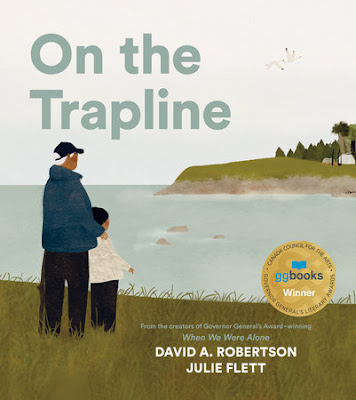
Highly Recommended: ON THE TRAPLINE by David A. Robertson and Julie Flett


On the Trapline
Written by David A. Robertson (Member, Norway House Cree Nation)
Illustrated by Julie Flett (Cree-Métis)
Published by Tundra Books
Published in 2021
Reviewer: Debbie Reese
Status: Highly Recommended

****

When most kids visit or travel with a grandparent to a special place, they drive or fly on a commercial airplane. For this trip, this grandfather and grandson start out on a small propeller airplane. 

On the Trapline is based on Robertson's visit--with his father--to his father's trapline. In the book launch he talked about going to that trapline. His father had not been to it since his childhood. Robertson had never seen it. For that father and son, then, it was a special moment when they would be walking, together, on homelands known to the father but not to the son. When his father stepped onto that homeland, Robertson said (in the book launch) that his dad seemed younger. Many of you may have had an experience like that with someone you love. I have. There is a joy that radiates from within. For me, and for Robertson, there is also a quiet to it all. Filled with so much! 

The visit that Robertson and his father took to the trapline became the exquisite picture book, On the Trapline. On the way to the trapline, the grandson asks questions about things he sees, and about things his grandfather talks about. Readers learn, for example, about the school Moshom went to where "all of us had to talk about learn in English." The grandson asks "Did you still get to speak Cree?" and his grandfather replies, "My friends and I snuck into the bush so we could speak our language." That language is on most pages of the book. On the page about Moshom's school, you'll find this sentence:
Ininimowin means "Cree language."
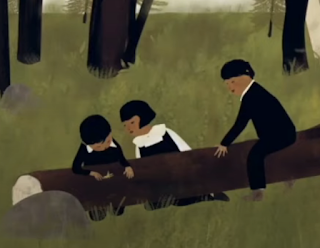
That is a deceptively simple set of words. They seem straightforward, and yet, they are filled with meaning! Here's a bit of the art that Julie Flett created for that page:


See? Children, in the bush. They look like they are playing. I imagine they are--but as they do--they speak to each other in Cree. 

When they get to the trapline, "Moshom's eyes light up." He points and says "That's my trapline." Then, there's more and more and more for this young Cree boy to learn about his grandfather's life on the trapline. 

Robertson and Flett's book received starred reviews from the major review journals. This occurred before, when they worked together on When We Were Alone. As was the case then, I highly recommend you get a copy of On the Trapline. 


Monday, November 29, 2021

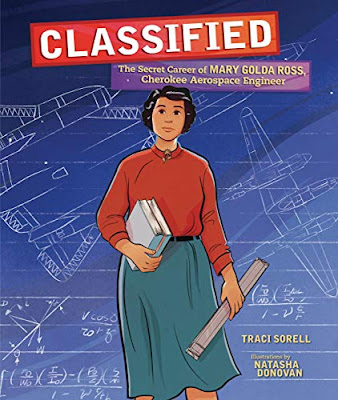
Highly Recommended! CLASSIFIED:THE SECRET CAREER OF MARY GOLDA ROSS, CHEROKEE AEROSPACE ENGINEER, by Traci Sorell and Natasha Donovan


Classified: The Secret Career of Mary Golda Ross, Cherokee Aerospace Engineer
Written by Traci Sorell (Cherokee)
Illustrated by Natasha Donovan (Métis)
Published by Millbrook Press
Published in 2021
Reviewer: Debbie Reese
Review Status: Highly Recommended

****

Sorell's Classified: The Secret Career of Mary Golda, Cherokee Aerospace Engineer is receiving starred reviews from the major children's literature review journals. And, I'll add, with good reason! Sorell is Cherokee. The book, focusing on a Cherokee aerospace engineer, is tribally specific. And people interested in STEM will love what they'll find in this picture book. You can read it aloud, and you can watch the video format where DeLanna Studi provides the narration. Like Sorell, she is Cherokee. 

Back when I was a kid, I liked biographies and I would have liked this biography of Mary Golda Ross. Some things beckon to me in a personal sense. She worked at Santa Fe Indian School as a girls advisor. My parents and grandparents went there, and I taught there for awhile. I didn't know about her, then. From what I can tell, she worked at SFIS after my grandmother was there, and before my parents attended the school. The timeline in the back of the book says she was there to advise female students. These advisors played significant roles! I remember both my parents talking fondly about their advisors.  

The word "classified" is part of the title because Ross was part of the Skunk Works division, which was a top-secret group working on planes that could fly beyond Earth. Hence, "aerospace" is also part of the title. One page of the book says that "She designed concepts for space travel to Venus and Mars" and her work helped send astronauts to the moon! That is, to use a Cherokee word, osdadv! 

I thoroughly enjoyed reading about her, and studying the illustrations Natasha Donovan did for the book. Teachers will love all the materials Sorell has on her webpage for the book. Scroll down to find the Teaching Guide, a Resource Toolkit, and a classroom poster. Scroll down even further to find audio files for Cherokee words. 


Sunday, November 28, 2021

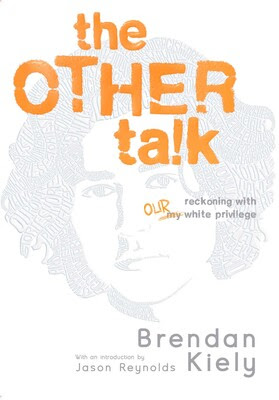
Highly Recommended: THE OTHER TALK: RECKONING WITH OUR WHITE PRIVILEGE by Brendan Kiely


the OTHER talk: reckoning with OUR my white privilege*
by Brendan Kiely, with an introduction by Jason Reynolds
Published by Simon & Schuster
Publication in 2021
Reviewer: Debbie Reese
Review Status: Highly Recommended

****

In the last few years, the word "reckoning" has appeared a lot. In meaning, it has to do with facing up to truths. Way back in the 1990s when I started graduate school, I read White Privilege: Unpacking the Invisible Knapsack by Peggy McIntosh. She was learning whites are taught not to recognize white privilege. It was, she wrote, unacknowledged privilege. It was vivid writing that stuck with me.

As I read Brendan Kiely's the OTHER talk: reckoning with OUR my white privilege, I thought back to McIntosh's essay. It was published in 1989. In a way, what Kiely offers to us, 32 years later, is a more in-depth reckoning. I'm sure McIntosh got push back for what she wrote, and I wonder what sorts of pushback Kiely is getting for his book. We are in a very heated period in society. Social media has been a great tool for social justice but it has also been used in harmful ways. I don't want to go on about that, so I'll turn back to the book.

Those of you who pay attention to visibility or invisibility of groups of people in the US know that one report after another leaves Native people off, or uses an asterisk that says data on us is statistically insignificant, so none is provided. In chapter 15 of the OTHER talk, Kiely writes about an anti-racist training he went to, where Native people were not included in an exercise the group was doing. He and others there did not notice that omission, but then, he writes (p. 154):
The facilitators were about to move on to their next exercise when a Native American woman in the audience stood up. She wanted to know why the racetrack model, why the entire workshop, did not include or allude to, in any way, Indigenous people in the United States. "This," she went on to explain, "is the kind of erasure we face every day." 
Kiely writes that he was floored. The facilitators had not realized what they were doing, and neither had he or other participants. It seems to me that one wave of realization was washing over him when another one struck. What made it all worse, he says, is that the workshop was taking place in Albuquerque, New Mexico, and part of the focus was to acknowledge local Indigenous cultures. Each day, the conference started with a welcome from the Navajo, Apache, or Pueblo Nations. He recounts all that, and more, on those pages. 

There's more to that experience in chapter 15 than what I shared above, but I'm sitting with that particular part of it. It happens to Native people all the time. We're here, right here beside you, and still so unseen, on lands that were/are homelands to Native people. The welcome to the workshop (provided by Native people) feels to me a lot like land acknowledgements. Something is said, and then forgotten.  Kiely's book starts with praise for the book, offered by a wide range of people. I assume his publisher sought out people to write those paragraphs of praise. I can't help but notice there is not a Native person amongst them. That, I think, is unfortunate but also reflects precisely what spoke to me about that passage in chapter 15 of the book. 

I deeply appreciate that Kiely shared that experience in Albuquerque.  There are other reasons why I'm highly recommending the OTHER talk but I'll leave that for you to find, on your own. 

Get a copy and talk about it with others. It is written for young people, but every adult should read it, too. As far as I know, neither Kiely or Jason Reynolds are Native. 

*I was not able to include "my" as a strike-thru on the title for this blog post. It is part of the title of the book.