Monday, June 06, 2011

A Right to Justice: Native Youth Theater Play about Police Brutality

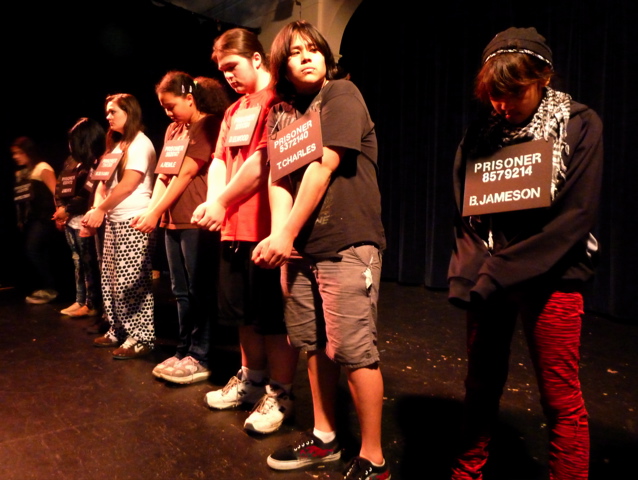
Photo credit: Charla Bear, KPLU, Seattle


The young people in this photograph are Native actors in A Right to Justice, a play being done in Seattle on June 12th, 2011 at the Rainier Valley Cultural Center. Produced by Red Eagle Soaring, it isn't the play the group had intended to do...  They wanted to do a play about basketball but the young actors couldn't get into it because they are trying to understand police brutality:
This play (written by our students and their teaching artists Drew Hobson and Hannah Franklin) explores our relationship as Natives with police and other authority figures, and touches on the haunting tragedy of Chief Leschi, whose story still evokes the sting of injustice 153 years after his hanging. 
The brutality the play is about spans a great length of time.

On a summer afternoon in August, 2010, John T. Williams, a Native woodcarver, was shot and killed by Ian Birk, a Seattle police officer. An investigation by the Seattle Police Department found the shooting was not justified.

The police officer's dash camera was on during the shooting. In it, you'll see Williams crossing the street in the crosswalk, in front of the police car. As he walks, he is carving a plank of wood. He goes out of camera view.

Birk got out of his car and called out "Hey, hey, hey! Put the knife down! Put the knife down!" He, too, goes out of camera view, and you hear gunshots. The video lasts over six minutes, during which you hear Birk say that he told Williams to put the knife down and that he was using it to carve the board.

This shooting has been featured prominently in Native news media since then. I cannot imagine what it must feel like to Seattle's Native community to see this video. Watching it, I understand how the shooting would shadow the youth in the community, and, I'm glad to see Red Eagle Soaring's efforts to help them process what happened.

Friday, June 03, 2011

TRIBES OF NATIVE AMERICA - series

This morning a librarian in New Jersey wrote to ask about the Tribes of Native America series published n 2002 by Blackbirch Press.

I don't know the series, but did a bit of searching and found a review of the Zuni volume in the series. That review is on Amazon, and it was submitted by Codi Hooee, a library media assistant at Zuni High School. She writes that she was "very disappointed" with the book. The historical information is correct, she says, but many of the captions for photographs and drawings are incorrect. And, she wrote:
What I found most offensive was the use of a photograph of our very sacred Sha'la'ko ceremony. Overall this book was poorly written, an example from the Customs section on page 25, "Among these are the June Rain Dance, held in August,..." The editors needed to be more thorough in researching the topic. 
She doesn't recommend the book.

Here's the cover for the Cahuilla volume. It is the same cover used for all the books in the series. The only thing that changes is the name of the tribal nation, at the bottom. It is a one-size-fits-all cover that suggests to me that the publisher didn't want to take the time or invest much money in developing the series. Codi's review notes that the book lists "the June Rain Dance" that is "held in August." Oops! Didn't the series have an editor who'd catch that sort of error?!

If that is the care and attention given to the entire series, it is not one I'd spend any money on...  If you're considering it for your collection, pass it up.

Thursday, June 02, 2011

Tim Tingle and Matt Dembicki at ALA

Tim Tingle, enrolled member of the Choctaw Nation of Oklahoma, and author of some of my favorite picture books, and Matt Dembicki will be at ALA this year as part of a panel that will discuss Dembicki's graphic novel, Trickster.

According to the ALA press release, a third person on the panel will be Michael Thompson, a high school English teacher in New Mexico. Thompson is a member of the Muscogee (Creek) Tribe. Forty percent of the students in his high school are Navajo.

The panel, "Trickster: Engaging Readers, Honoring Traditions" is scheduled for Sunday from 4 to 5:30 in room 284 o the Morial New Orleans Convention Center. It is sponsored by ALA's Committee on Rural, Native, and Tribal Libraries of All Kinds, the American Indian Library Association (AILA), and, ALA's Young Adult Library Services Association (YALSA).

I'm attending ALA this year and am really looking forward to hearing what they have to say!