Wednesday, February 11, 2009

Cynthia Leitich Smith's ETERNAL


Cynthia Leitich Smith's new book, Eternal, was launched yesterday. I read a copy a few weeks ago. It is a page-turner about vampires and angels and... It's quite a ride, from Austin to Chicago. I'll leave it there for you to read. If you're a fan of gothic fiction, take a look at Eternal.

As you may know, my blog is about children's books about American Indians. That's what most of the content is about.

However! I think it important that children and teens know that Native people write stories, and that not all of their stories are about Native people. Cynthia's range of books is a good case in point. If you read her YA novel, Rain Is Not My Indian Name, read her vampire novels, too. Her first one is Tantalize, Eternal is the second, and a third one is in the works.

In Tribal Secrets, Robert Warrior writes about American Indian literature and criticism. He says "producers of American Indian literature continue to push the boundaries of creativity by bringing European vampires to Navajo country..." Warrior notes that such a book "does not fit into standard definitions of Indian writing..." but he goes on to say that the increase in such books "seems more than enough justification for some fundamental reworking of scholarly understandings of American Indian literature, culture, and experience."

In essence, it is important that we be open to what is being written by Native writers. Don't pigeon hole them or their writing. Expand your expectations of what Native writers write about.

Read Native writers, whether their stories are about Native life, or vampires.

So! Eternal. Click on over to Cynsations where you'll learn a lot about the book. There's more at Smith's website including a very cool book trailer that perfectly captures the mood of the book.

Tuesday, February 10, 2009

"What Students Need to Know about America's Wars"

I'm on a listserv for the National Council of Teachers of Social Studies. Yesterday a subscriber posted information about an upcoming "History Institute for Teachers" called "What Students Need to Know about America's Wars." Curious, I checked out the webpages, looking specifically at the video of a session that was on war with Native peoples.

It was an unpleasant experience. Perhaps I should not have taken the time...

The material is developed by the Foreign Policy Research Institute. The lecturer, a man named Skarstedt, notes that there are ideological disagreements over the ways that history of American Indian/United States conflict is presented, but it is clear in his remarks where he stands in the debate.

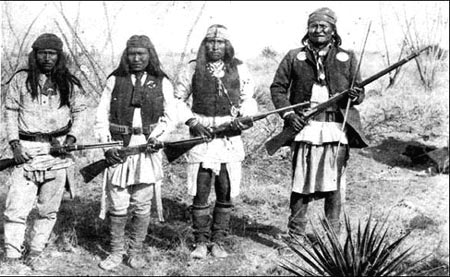
He begins by saying students wonder why they need to study the frontier wars. He tells the teachers gathered in the session why it is important, using Apaches as an example.

He shows a photograph of four Apache men. He carefully describes the weapons they hold and talks at length about how skilled they were. How they were able to blend into their surroundings, very resourceful, could survive for days with little food or water. They knew the terrain and were "tough as nails."

Then Skarstedt asks "What did the US do to get them?"

He shows the next photograph: men on horses. It is the cavalry! On horseback, he tells us, the US was able to wear down, defeat, and capture the Apaches. And here is why studying the Frontier Wars matters:  He says the US learned valuable lessons by fighting the Apaches, lessons that it uses today, in Iraq and Afghanistan. Because of wars with Indians, he says, the US developed its "special ops" teams.

Next slide?

It is a photograph of two men, with weapons, wearing masks. They're in Afghanistan or Iraq (Skarstedt doesn't specify). They, he says, are like those Indians. Tough, well-armed, fast moving, blend into the environment, lots of firepower, willing to endure great sacrifice.

His next photograph is one of soldiers, again, on horseback. They are, he tells us, the special ops unit that is pursuing fighters in Iraq and Afghanistan.

Seeing those images used that way was deeply troubling to me. Apaches and Iraq/Afghan's. Obviously he feels they were/are enemies of the US who must be taken down. Who do you think they are? What do you think they were/are doing?

He argued at the opening of his lecture, for people to recognize the complexity of conflict and how it is presented, and then he goes on to do otherwise. In making his points about war tactics, he introduces and affirms simplistic notions.

Later in the lecture he speaks about the people of Cahokia and Taos Pueblo. Both, he says, are gone. They were very advanced and peaceful, he tells us, but they are no longer around. Probably, he says, due to the warring tribes, of which he names the Apache, Comanche, and Sioux. Of course, the people of Taos are not gone. They're a thriving Native Nation!

I wonder if he's ever tried to give this lecture to an audience that includes American Indians?

______________________
Update, May 3rd, 2011: You can view the entire lecture, or see Skarstedt's slides by going here. Scroll down to the section called "The Frontier Years."

Monday, February 09, 2009

Indigenizing Children's Literature


In 2008, the Journal of Language and Literacy (JoLLE) published an article I wrote. Titled "Indigenizing Children's Literature," it is a critical look at Little House on the Prairie and Thanksgiving Day. The article is one of several published in Volume 4(2), 2008, a special issue devoted to children's literature and literacy. JoLLE is a peer-reviewed online journal. I submitted this paper there, specifically because it is an online journal, thereby making it like my blog (accessible to anyone who has an internet connection).

In the conclusion, I make some connections between images and ideology in those two books and America's wartime activity. I welcome your thoughts and comments on the article.

Sunday, February 08, 2009

Nora Naranjo-Morse


Last weekend I watched Nora Naranjo-Morse's lecture, given at the National Museum of the American Indian, in 2007. She was there that summer working on the pieces for the "Always Becoming" installation.

Her lecture was part of the Vine Deloria, Jr. Native Writers Series. It is archived on the NMAI website and is about an hour long. She read several poems, including one that especially struck me--for its imagery, for its emotion, for its power. It is called "A Telegram." Prior to reading it, she talked about writing that poem when she was a teenager, and finishing it last year.

"A Telegram" is about learning that her brother had been wounded in Vietnam. The poem she read at NMAI has not yet been published, but an earlier version of it is in Hirschfelder and Singer's Rising Voices: Writing of Young Native Americans, published in 1992.

Nora is working on a documentary about Always Becoming. She is blogging about it, too. You can follow the project at her blog, also called Always Becoming. She's a poet, a sculptor, a filmmaker. Studying her work, in an art, lit, or film class, would be an incredibly rich experience.

Her book, Mud Woman, is available from Oyate.

Thursday, February 05, 2009

SLJ Column: "A DIRTY LITTLE SECRET"

Over at School Library Journal's website, there's a column about self-censorship that is worth a look. It's provocative title is "A Dirty Little Secret."

The bulk of the column is about what does not get bought by librarians. The columnist, Whelen (a senior editor at SLJ), writes about their fears and anxieties. Fear of parents, school boards, community members, and students who will object to books with sexual content and gay themes. To avoid confrontation, they do not buy the books.

Rather than provide students with books that reflect reality, then, librarians play it safe. In effect, the librarians are choosing to let the gay students suffer. Is it really that simple? Preserve ones self and well-being, one's job? It's easy to rationalize the decision... "If I avoid that book, I avoid trouble and keep my job, and I can work subtly on this topic in other ways..."

The article also includes a brief mention of a writer who wrote a book about the Trail of Tears. Her publisher asked her to "...tone down her criticism of Andrew Jackson and his treatment of Native Americans..." I don't know the book at all, so can't comment on it one way or another. It is called The Trail of Tears: An American Tragedy, by Tracy Barrett. Rather than change what she wrote, Barrett went with another publisher.

Tone it down? Right! Let's not tell anyone, especially children, that our presidents did terrible things!

The SLJ column calls this decision not to buy a book "self-censorship." In education circles, this is akin to "the selective tradition" or "the hidden curriculum."

Whatever label we use, it is more than just fear and anxiety at work, it is the affirmation of the status quo, an unspoken, and generally unaware desire to perpetuate and preserve a certain image of America. A certain false image that hurts us all as individuals, as members of our communities, and as citizens of the United States.

How long will we deceive ourselves?

Sunday, February 01, 2009

3rd post: Capaldi bio on Montezuma

From the archives, I found a copy of the letter from Holmes to Montezuma. Dated August 31, 1905, it reads:


My Dear Sir:
I am very desirous of procuring a brief biographical sketch of yourself for incorporation in the “Handbook of the Indians” to be published by this Bureau, and shall be greatly obliged if you will furnish the necessary data for this purpose. As the first part of the work is now being put in type, I shall appreciate any effort you may make to furnish the sketch at your earliest opportunity.
Very truly yours,
H. W. Holmes
Chief

When Montezuma wrote back to Holmes on October 7th, 1905, this is how he started:

My dear Friend:-
I am sorry that I delayed your request of August 31st.

In her presentation of Montezuma's letter, dated October 7, 1905, Capaldi starts with this:

My dear friend,
I know that you are gathering information on me and what befell my people. I am, therefore, delighted to answer your questions. I hope that what I write will add knowledge, acceptance and understanding for all.

In comparing her presentation of the letter to the letters exchanged between Holmes and Montezuma, I don't like what she did. I wish Capaldi had not used this technique, pulling Montezuma's words from several documents that span many years, weaving them (she says "I interwove") into the original letter to, she says "more fully present" his life. She says "I have made every effort to be true to the original sources and have only added brief phrases to make the text flow smoothly."

I'm really uncomfortable with Capaldi putting words in Montezuma's mouth. She tells us in her notes that she has done this, but that doesn't work for me.

I wish Capaldi had written this book more like the books in the Diaries, Letters, and Memoirs series published by Capstone Press, where the primary material is clearly set apart from additional information that does what Capaldi wanted (more fully present the person's life).


Wednesday, January 28, 2009

2nd post: Capaldi's biography of Carlos Montezuma

A few days ago I wrote my initial thoughts about Gina Capaldi's picture book biography, A Boy Named Beckoning: The True Story of Dr. Carlos Montezuma, Native American Hero. The phrase "true story" leaped out at me, as did Capaldi's note, in which she said she drew from various documents written by Montezuma.

Today, I'll lay out comparisons between Montezuma's letter (I found a copy yesterday) and Capaldi's presentation of that letter.

The opening paragraphs...

The first paragraphs of Montezuma's letter:

My dear Friend: -

I am sorry that I delayed your request of August 31st.

I am a full-blooded Apache Indian, born about the year 1866 or '67 some where [sic] near the Four Peaks, Arizona Territory.

The Apache tribe roamed at will the country covering Ft. McDowell, Camp Date Creek, Prescott, Canon of Colorado, Ft. Defiance, Ft. Apache, San Carlos andSuperstition [sic] Mountains, for the Indians whom I have found at these places over thirty four years ago on my way east spoke the same dialect as I did. Since then the Apaches have been divided into various tribes.

My distant relatives are known as the Mohave Apaches;but [sic] the real Mohave Indians have a didtinct [sic] language of their own and were enemies to the Apaches.

For five years I lived in a most primitive state with my people-a band of about one hundred and fifty souls. Fortunately I was captured by the Pima Indians in the month of October, 1871 from the plateau known as Iron Peak, 10 or 12 miles north-west of the great Silver King mine;about [sic] 60 or 70 miles north-east of Florence and about 40 or 50 miles west of Globe in the Superstition range of mountains.


Page 4 of Capaldi's book includes an illustration of the letter she created as the framework to write the biography. Her presentation of this letter reads:

My dear friend,

I know that you are gathering information on me and what befell my people. I am, therefore, delighted to answer your questions. I hope that what I write will add knowledge, acceptance and understanding for all.

I am a full-blooded American* Indian, born in 1866 near Fish Canyon Creek in the Arizona Territory. Until the time I was five years old I was called Wassaja which means "beckoning." My people, a band of about one hundred and fifty souls, roamed the red earth plateaus. We searched for food and lived in small grass huts called oo-wahs.

Life was safe and simple in my grandfather's day. It was deadly and dangerous in mine, for we had many enemies...

Debbie's thoughts/observations:

  1. In Montezuma's letter, he does not use the word "oo-wahs" anywhere.
  2. On page three of his letter, he says that his Indian name is "Was-sa-jah" and that it means "Beckoning."
  3. Capaldi substituted "Apache" for "American Indian." The information the asterisk references is on the same page of her book. It says "When Dr. Montezuma wrote this letter to Professor Holmes, he stated that he was an Apache. Years later, he came to learn that he was not Apache but Yavapai." First, I don't think she should have made that substitution. Putting words in someone's mouth, especially about how they self-identify, is pretty egregious and presumptive. Second, why choose "American Indian" instead of "Yavapai"? Did she reason that her readers would know what "American Indian" means but be confused by "Yavapai"? Countless times, Native people have stated that they prefer the name of their tribal nation over the generic "American Indian" or "Native American." Using one of the latter obscures the diversity within those terms.
As Capaldi said in her author's note, she pulled from various documents Montezuma wrote. What she presents in the book as a letter is actually drawn from several places and times. Below are some specific comparisons. Somewhere, I may find that Montezuma actually wrote the words Capaldi brings into her presentation of the 1905 letter. Finding out where those words actually are, in document and in chronological time, requires more research. I'll do more of that research later today. For now, I'll look at the information in the opening pages:

Date of his capture:
  • Montezuma's letter says "...I was captured by the Pima Indians in the month of October, 1871..."
  • Capaldi's presentation of this point of his life is on page 6. The first line is "The Awful Night at Iron Peak Plateau; the second line is "October 1871" and the text reads: "In the month when the shadows run long..."
My thoughts? Did he say, somewhere, "when the shadows run long..." or is this Capaldi's creative hand at work?


Details of his capture:
  • Montezuma's letter says "...our camp was raided at midnight. Thirty or more were killed and about 16 or 18 children taken captive. I was one of that number and with the others was taken down into the valley and carried off.
  • Capaldi's presentation says "When it turned midnight, we were awakened by the sound of gunshots. There were screams everywhere. My mother and sisters ran for their lives. I scrambled under a clump of bushes and waited for the terror to end. But the full moon rose over the peaks, and its bright light revealed my hiding place. A strange man spotted me. He snatched me up by the arm and bound me with rope. I stood terrified and watched my village burn. Before that horrible night, I had never seen a horse. Nor had I ever seen a dead person. That night I saw both. that night I cried."

There's a lot of detail in Capaldi's presentation. I hope to find those details as I continue my research of his writing.


Where was his father during this capture?
  • Montezuma says "During the raid all the braves of the village were at San Pedro on a mission for a Peace treaty, and as my father was on his way back he received, from an Indian runner, the sad news of the massacre of his little band by the Pimas. "
  • Capaldi tells us "...my father and the other men rode away toward the rising sun to make peace with the U. S. Army." She places these words right before her description of the chapter, right after the words "when the shadows run long,".

A "Peace treaty," he says. Capaldi tells us "make peace with the U. S. Army." That phrase "make peace" is pretty common, or at least quite familiar to me. Sort of, that is, because I think I remember it a little different... It is "make peace with the Indians" --- not the U.S. Army. I'll check into Native use of the phrase in historical writings.


Immediately after his capture
  • Montezuma's letter says: "Two days travel over the hot desert brought me to what is known as Black Water Camp, twenty-five miiles above the present site of Sacston [sic].
  • On page 8, Capaldi presents "The Trek over the Hot Desert" again dated "October 1871." She says:
A Pima warrior lifted me upon a horse, and we rode for two days over the hot Arizona desert. When we reached their village, I was given pumpkin, corn, and horsemeat to eat, but I could not stomach these. Perhaps it was because I had never tasted these foods before. Perhaps it was because I was too scared.

There were close to four hundred men, women, and children in the village. I was afraid they might kill me and therefore resolved to do whatever I could to please them. During this time, the Pima were very kind to me.

On the third day of my captivity, I saw several Pima pointing at me. Some laughed. Others looked sad when my eyes met theirs. My captors painted their faces and began their war dance. The whole village danced around me. The men threatened me with spears and war clubs. The women threw dirty rags, and the children spat. An enemy captive was quite a prize--even if it was a mere sobbing child.

Everyone I knew and loved was gone. The Pima gave me a new name, Hejelweiikan, which means, "left alone."

Debbie's comments: Nowhere in his letter is there anything like what she describes. No face painting or war dance, and no spitting. It is possible he wrote something like this, perhaps, in Red Man. Capaldi cites Red Man in her bibliography. It was published at Carlisle Indian Industrial School. Though many read and use them as-is, scholars have shown that the Indian Helper, in particular, was heavily dictated and edited by teachers to portray the school as a happy place with happy students.

_________________________________

That's all for now..... Back to the archives.

__________________________________

Note, 3:35 PM, Jan 28, 2009:

I've spent the day in the archives. On the Bibliography page of her book, Capaldi says "I reconstructed the accounts of Montezuma's early life mainly from an interview he gave in 1921 to writer, N. M. Clark." I found that interview. It is called "Dr. Montezuma, Apache: Warrior in Two Worlds" and appeared in Montana: The Magazine of Western History, in volume 23, no. 2 (April, 1973). The interviewer, Neil M. Clark, prefaced the actual interview with this (excerpt from p. 57):

Late in the year 1921, I sat down with Dr. Montezuma in the front room of his home on the south side of Chicago. He was a man of medium height, solidly built, with eyes that were black and sometimes mystical. His hair was black and straight, his features unmistakably those of a pureblood Indian. There was nothing unusual about the room where we first sat down. But we had not been there long when Dr. Montezuma rose.

"Come with me, he said, "it is too civilized here." He led the way to his study. Here we might have been in a miniature museum. The walls were covered with pictures of the people and scenes of his race and his friends. On strings across the ceiling hung moccasins, skins, ears of corn, and a host of trinkets.

"This," Montezuma smiled, "is the medicine man's workroom!"


The interview corresponds pretty close to the episodes Capaldi relates. As she said in her note, she drew from this interview to present Montezuma's early life. Clark says that Montezuma stood and closed his eyes to tell this part of his story (excerpt from p. 58-59):

I, little WASSAJA, was asleep in our grass hut. I woke to the sound of war cries, the echoes of guns, and the crackle of fires. I ran for my life, and soon overtook my two sisters, the older one carrying the younger on her back. I passed them, but presently stumbled and fell. Too frightened to go on, I crawled under a bush, small than myself, and curled up, hardly daring to breath. I might have been safe there, but at that moment the moon rose above the rim of Iron Peak and revealed my hiding-place as if it had been mid-day. I caught sight of someone stealing toward me -- a stranger, I knew, for he had a queer high hat on his head, and a cape around his shoulders. I had never seen anybody clothed, and I could think of nothing but this was some god coming after me. The figure came close, put out a swift hand and seized my arm."


Here's another excerpt (p. 59):

Alone, friendless, frightened, I sat there and cried with all my might. Occasionally a warrior would make a motion at me with a tomahawk or a spear, and I would scream. The women kicked sand in my face and threw their dirty rags at me. The children spat on me. Their dance around the captive of the feared and hated Apaches, though the captive was only a small boy, lasted for an hour.


As I continue reading the Clark interview alongside the Capaldi book, in the context of what I know about Native voice, Native history, appropriation and interpretation of voice, I can't help wondering about this interview. The prefatory material about Montezuma characterizing his front room as "too civilized" and taking Clark to a room filled with "moccasins, skins" and other things does not match what I know about Montezuma and his thinking about American Indians and what he thinks progress would look like. Clark seems to portray a tragic Indian who cherishes an Indian existence. That does not sound like Montezuma, but I'm still reading, still studying.

Still working, still thinking....

Tuesday, January 27, 2009

Univ of North Carolina students share their thoughts...

Susan Gardner teaches "American Indians in Children's Literature" at the University of North Carolina. Over the course of the semester (Spring 2009), her students will use this space to post comments about what they're reading, learning and doing. Some of their comments may be in reference to things they've read on this blog. I've not hosted another professor's course before. I'm not sure how it will work, but we're going to give it a try and see what we learn. By "we" I mean me, Susan, her students, and readers of this blog.

Monday, January 26, 2009

Meyer's BREAKING DAWN...

Meyer's BREAKING DAWN...


... is CRACKING ME UP and GROSSING ME OUT.


I'm halfway through, laughing out loud in some parts. Is this a comedy?! A bad one, if that!!! It is stunning in its ludicrous dialogue and gratuitously bloody scenes.

I'm making notes on the parts about the Quileute's and the "treaty" between the vampires and the Quileute's --- there's interesting things to note about that, but my gosh!!! It is so..... STUPID.

Stop reading this if you're worried about spoilers.

During the birth, Bella vomits a fountain of blood. Jacob's nickname for the "little monster" is Nessie. Bella is furious that he nicknamed her after the Loch Ness Monster.

I am so glad I did not pay full price for this book. It's a joke! I know her readers were disappointed. I'll have to see why once I finish the book.