Did you know...
the phrase "the only good Indian is a dead Indian"
appears in the acclaimed Little House on the Prairie three times?
Could you/would you hand that book to a Native child?
Could you/should you hand that book to a non-Native child?
How would you/could you/should you use that book?
.

Established in 2006 by Dr. Debbie Reese of Nambé Pueblo, American Indians in Children's Literature (AICL) provides critical analysis of Indigenous peoples in children's and young adult books. Dr. Jean Mendoza joined AICL as a co-editor in 2016. (Site redesign on January 8, 2025)
Tuesday, October 16, 2007


Monday, October 15, 2007
Thanksgiving Lesson Plans
With November approaching, teachers across the country are getting ready to teach about Thanksgiving and the "Indians."
In some classes, students will dress up to reenact the "First Thanksgiving." But... What "Indians" will they dress like? What will they "wear" for this reenactment? Will they emulate stereotypical "Indians" or, is the teacher among those who know how crucial it is to be specific----to identify a tribe, to make certain anything taught is correct with respect to that tribe's location, history, clothing, food, politics, etc.
Teachers have good intentions, but with respect to the ways they were trained and socialized to think about American Indian, their good intentions are actually contributing to misperceptions about who we are. I wrote about a flawed lesson plan last year. Click here to read that post.
My colleagues at Oyate prepared some excellent resources on "Thanksgiving." The resources are on-line. Please download them. Read and think. If you're a teacher, there is still time to revise your lesson plans. If you're a parent, give the materials to your child's teachers and librarian.
To find the materials, click here.
Look, especially at the "Books to Avoid" page on Thanksgiving... You will be dismayed to see how many there are, and further dismayed to realize that you have those books on your shelves right now.
To order books that counter those on the "Books to Avoid" list, to help all children learn about American Indians, look through Oyate's catalog. Order books from Oyate. It is the best source for these materials, and it is a not-for-profit organization, too.
In some classes, students will dress up to reenact the "First Thanksgiving." But... What "Indians" will they dress like? What will they "wear" for this reenactment? Will they emulate stereotypical "Indians" or, is the teacher among those who know how crucial it is to be specific----to identify a tribe, to make certain anything taught is correct with respect to that tribe's location, history, clothing, food, politics, etc.
Teachers have good intentions, but with respect to the ways they were trained and socialized to think about American Indian, their good intentions are actually contributing to misperceptions about who we are. I wrote about a flawed lesson plan last year. Click here to read that post.
My colleagues at Oyate prepared some excellent resources on "Thanksgiving." The resources are on-line. Please download them. Read and think. If you're a teacher, there is still time to revise your lesson plans. If you're a parent, give the materials to your child's teachers and librarian.
To find the materials, click here.
Look, especially at the "Books to Avoid" page on Thanksgiving... You will be dismayed to see how many there are, and further dismayed to realize that you have those books on your shelves right now.
To order books that counter those on the "Books to Avoid" list, to help all children learn about American Indians, look through Oyate's catalog. Order books from Oyate. It is the best source for these materials, and it is a not-for-profit organization, too.
Saturday, October 13, 2007
Alexie's YA Novel Nominated for National Book Award
Editors Note on Feb 25, 2018: Please see my apology about promoting Alexie's work. --Debbie
~~~~
Beverly Slapin's review of the book was posted here on Wed, April 15, 2007. Click here to read her review.I posted links to newspaper articles on September 16, 2007. Click here to go to the list.Roger Sutton, editor at Horn Book, reviewed the book in September. Read his review here.
Friday, October 12, 2007
DO ALL INDIANS LIVE IN TIPIS?

Are you a teacher wondering if all Indians live in tipis? If so, order a copy of the book Do All Indians Live in Tipis?: Questions and Answers from the National Museum of the American Indian. It isn't a children's book, per se, but its content is certainly accessible to upper elementary readers, and, it will prove useful to teachers developing lesson plans about American Indians.
In the foreword, founding director Rick West (Southern Cheyenne and member of the Cheyenne and Arapaho Tribes of Oklahoma) writes:
Before I became the founding director of the National Museum of the American Indian, I was a practicing attorney, and sometimes, when I hear the odd--and even offensive--questions that almost every Indian must bear, I want to rise up and shout, "I object!"
The introduction is by Wilma Mankiller (Cherokee). She writes:
In 1963 President John F. Kennedy said, "for a subject worked and reworked so often in novels, motion pictures, and television, American Indians are the least understood and the most misunderstood of us all." Regrettably, this statement is as true today as it was more than forty years ago. Many negative stereotypes persist.
She goes on to say that summer visitors to the Cherokee Nation include tourists who wanted to know "Where are all the Indians?" To which she'd reply "They are probably at Wal-Mart!"
West and Mankiller's words set the state quite nicely for a volume consisting of about 100 questions, grouped into these categories:
- Identity
- Origins and Histories
- Popular Myths
- Clothing, Housing, Food, and Health
- Ceremony and Ritual
- Sovereignty
- Animals and Land
- Language and Education
- Love and Marriage
- Art, Music, Dance, and Sports
Here's a sample of the questions:
- Why was the Navajo language chosen for military code in World War II? Were all Indian "code talkers" Navajo?
- Did all tribes have totem poles? Does anyone still carve them?
- How many Indians lived in the Western Hemisphere when Columbus arrived?
- Why is the word Eskimo sometimes offensive?
Published by the Smithsonian's National Museum of the American Indian and HarperCollins, I paid $14.95 for the book at Pages for All Ages, our local independent bookstore. With "Native American Month" approaching in November, you will find it a useful volume.
And, as always, consider moving your lesson plans about American Indians OUT of November; teaching about American Indians only during that month contributes to the mistaken idea that we are only a people of the past, long vanished. That is not the case. We are still here.
Get your copy at the National Museum of the American Indian giftshop, or, from Louise Erdrich's independent bookstore, Birchbark Books.
Thursday, October 11, 2007
Chiori Santiago's HOME TO MEDICINE MOUNTAIN

On Saturday, October 20th, 2007, I will be in Monticello, Illinois, at the train depot, working as a volunteer for "Artrain USA." It is an art exhibit in train cars. This year, the art is by top American Indian artists whose art is contemporary in style. The exhibit itself is called "Native Views: Influences of Modern Culture."
Among the artists whose work is in the train cars is Judith Lowry, who did the illustrations for Chiori Santiago's picture book, Home to Medicine Mountain. The story is about Lowry's father and uncle, and their experience at boarding school in the 1930s.
In those schools, Native children were taken far from their homes by the US government. They could not return home unless their families had money to pay for their travel. That meant that a lot of kids were stuck at those schools for the entire school year, and many spent many years at them before they could go home. Many kids ran away. Many died as they tried to get home.
Home to Medicine Mountain is about two boys and their efforts to go home. The book concludes with a photograph of the two boys as men.
It is, for me, a unique moment. The boys went home on a train, as you can see in the cover illustration. On Saturday, I will view Judith Lowry's art, in a train car exhibit.
If you're in Central Illinois (or if you're up for a weekend drive to central Illinois), this exhibit is a rare opportunity to see exquisite Native art. To see this sort of collection, you'd have to travel to Washington, or Phoenix, or Oklahoma... And it'll be right here in central Illinois.
The Artrain website includes an educational packet that I encourage you to download and use, whether or not you go to the exhibit.
From here, it will go to Clarksdale, Mississippi; Meridian, Mississippi; Washington DC; Springfield, Missouri; Oklahoma City, and the last stop is in Norman, Oklahoma at the end of November.
The Artrain will be in Monticello for two days (Saturday October 20 and Sunday October 21st). If you do visit, please find me and introduce yourself!
.
Sunday, October 07, 2007
Laura Tohe's NO PAROLE TODAY

[This review used with permission of its author, Beverly Slapin, and may not be published elsewhere without her written permission.]
-----------------
Tohe, Laura (Diné), No Parole Today.
The first words in Laura Tohe’s book are those of Richard Henry Pratt, the founder of the Indian boarding school system that devastated Indian lives throughout
In Indian civilization I am a Baptist, because I believe in immersing the Indians in our civilization, and when we get them under holding them there until they are thoroughly soaked.
Tohe’s great-grandfather was one of the first Diné students to attend Pratt’s
In an opening piece, a response to Pratt, Tohe writes,
A hundred years after you made your statement to the Baptists, we are still here. We have not vanished, gone away quietly into the sunset, or assimilated into the mainstream culture the way you envisioned….[W]e continue to survive with the strength of the spirit of our ancestors. Our grandmothers and grandfathers taught us to hold to our beliefs, religions, and languages. That is the way of survival for us….I voice this letter to you now because I speak for me, no longer invisible, and no longer relegated to the quiet margins of American culture, my tongue silenced….To write is powerful and even dangerous. To have no stories is to be an empty person. Writing is a way for me to claim my voice, my heritage, my stories, my culture, my people, and my history.
In first grade, the children received their first “Dick and Jane” books, in which they were introduced to white society in the form of Father, Mother, Dick and Jane and Sally, who drove around in cars and said “oh, oh, oh” a lot. In “Dick and Jane Subdue the Diné,” Tohe describes how the schools made the taking away of language a priority:
See Father.
See Mother.
See Dick run.
See Jane and Sally laugh.
oh, oh, oh
See Spot jump.
oh, oh, oh
See
See Juanita answer him.
oh, oh, oh
See teacher frown.
uh oh, uh oh
See
oh, oh, oh
See
oh, oh, oh
See Juanita stand in corner, see tears fall down face.
oh, oh, oh
Oh see us draw pictures
of brown horses under blue clouds.
We color eyes black, hair black.
We draw ears and leave out mouth.
Oh see, see, see.
While most of Tohe’s writing focuses on her coming of age in this hostile alien environment, her later pieces are written from her perspective as an adult, and her final poem, “At Mexican Springs,” is a thing of beauty and hope:
It is here among the sunset in
every plant
every rock
every shadow
every movement
every thing
I relive visions of ancient stories
First Woman and First Man
their children stretched across
these eternal sandstones
a deep breath
she brings me sustenance
life
and I will live to tell my children these things.
For everyone who has survived the Indian boarding schools, and for everyone who never knew of their existence, No Parole Today is a gift. Laura Tohe’s writing is spare and honest, with no polemic; proof of the government’s utter failure to take away Indian voice.
—Beverly Slapin
Saturday, October 06, 2007
October 8th, 2007: INDIGENOUS PEOPLES DAY

Monday, October 8th, 2007, is Indigenous Peoples Day. If you've come to this site looking for Columbus Day lesson plans, please set aside the tired and untrue 'celebration' of Christopher Columbus!
Instead, provide your students and library patrons with information that makes them informed citizens of the world. Tell them that Columbus did not "discover" the lands that came to be known as "America." There were indigenous people here then, and we are still here.
I am from Nambe O'Weenge. It is a Tewa pueblo located in northern New Mexico. In the "We Are Still Here" series, published by Lerner, is a book called Children of Clay: A Family of Pueblo Potters. Books like can be very helpful because through photographs, students in your class can see that we are part of today's society. Note: I've said "we are still here" and "teach students that we are still here" many times on this blog. I feel a bit like a broken record, but, over time, enough teachers, parents, and librarians will change their lesson plans, that we can all stop saying "we are still here."
.
Subscribe to American Indians in Children's Literature

Thursday, September 27, 2007
BABAR'S WORLD TOUR
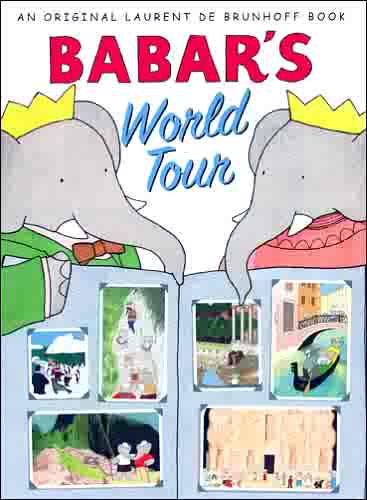

"World tour," I thought to myself. "What did dear old Babar see?"
In the first pages, Babar and his family visit Italy, Germany, Russia, India, Japan, Thailand... where they eat new foods, speak phrases in Italian, etc. At one point, Isabelle notes difference in language and asks "What's wrong with our words?" Celeste explains that "People in different places say things differently. They do things differently, too. They build different kinds of buildings." Note Celeste's reference to people of the present day. She uses present tense words like "say" and "do".
Now, I call your attention to this page from the inside of the book.

Note, specifically, the text from that page, which I've included below (bold text is mine):
When everyone was rested, they went to Angkor in Cambodia, the ancient city of the Khmers. In Mexico, they climbed a pyramid built by the Aztecs. In both places, the original settlers were gone but tourists abounded.
"Will everyone move out of Celesteville one day, too?" Pom asked.
"Never," said Babar. "But apart from us, it happens a lot, as you'll see."
The "it" that happens is being gone, moved out. The "as you'll see" refers to the places they visit next, which include "the cliff houses of the Anasazi in the high desert of the American Southwest," and "the Inca Trail, on the same stones that the Incas had walked..." and "... the remains of the city of Machu Picchu hidden in the Andes Mountains."
Speaking sarcastically.... How nice for the Babar family and other tourists, that the "original settlers" were gone! And what does "gone" mean??? Why are they gone? How does a child understand that word? And how nice that these "original settlers" moved out, leaving these wonderful places for the tourists! And how good it is of Babar to assure Pom that the inhabitants of Celesteville will never move out of Celesteville! Their own home is secure. Forever.
Reviewers of the book failed to note these passages and the messages they impart to the reader. School Library Journal's reviewer finds it lacking because it doesn't have the same adventure and excitement in Jean de Brunhoff's Travels of Babar (which has highly problematic illustrations of "cannibals"). Perhaps if they'd actually come across "savages" (aka "original settlers) the reviewer might have given it a favorable review.
The review in Booklist is more favorable: "Though children listening to the story will get only a glimpse or two of each country before moving on to the next, this colorful picture book provides an inkling of the diversity of places and cultures in the world. A pleasant excursion, recommended especially for those who already know and love Babar and his family."
Perhaps, but I wonder about children of all those "original settlers"?! Will a Pueblo child say "We're not gone as in extinct. We're still here. We're the descendants of the Cliff Dwellers."
There is a great deal wrong with this book. It is very useful for a high school or college classroom, but as a read-aloud for young children? No.
Tuesday, September 25, 2007
A Note from LeAnne Howe (author of MIKO KINGS)
 I got this note late last night, in response to yesterday's post about "The Indian Show" episode from I Love Lucy. I blogged about LeAnne's new book, Miko Kings, a few days ago. It is available from Aunt Lute Books. I've spent a lot of time with LeAnne, and have heard her use "Fred and Ethel" many times...
Debbie, I love Lucy. In fact, so much so that I often use the terms, "Fred and Ethel," my invisible friends, when I want to make a point about binaries and metaphor. My new novel's working title is: The Adventures of Fred and Ethel in the Middle East: A Choctaw Travelogue. It's all about sex and a love triangle run amuck, and of course, espionage and the CIA, and well, Indians caught in the middle of the Iraqi civil war. Thanks for posting this delicious segment. What fun.
LeAnne Howe
PS: I'm not kidding.
Subscribe to:
Posts (Atom)