Two nights ago I gave a lecture at Westfield State College. Among the books I discussed is The Matchlock Gun, by Walter D. Edmonds. Doris Seale's review of the book is at the Oyate site. I urge you to click on over there to read it. She describes the book, and notes, too, that it gained new life when it was chosen for the "We the People" bookshelf project sponsored by the National Endowment for the Humanities/American Library Association.
I'm thinking about the book today because last night I watched a film with my daughter (a sophomore in college). She's taking a film class. Screenings for this week include Drums Along the Mohawk. (I'm in New Haven, doing research in the Bienecke, and spending time with Liz, too.) As we drove to my hotel last night, she asked if I wanted to watch a film with her. She told me the title and started reading the accompanying info on the movie box. It reads "Based on the best-selling novel by Walter D. Edmonds..."
So I did spend the late evening last night watching Drums Along the Mohawk. It's came out in 1939. Very early in the film, Peter Fonda takes his bride, Lana, to his homestead. It's a stormy night, there's a lot of flies, and she's pretty unhappy. They go inside his cabin, he lights a fire, and then leaves to tend to the horse and wagon outside. While he's gone, an Indian comes into the cabin.
Lana turns away from the fireplace, sees, him, and starts screaming and races to the farthest corner. The Indian has been walking toward her, holding his gun, a blank expression on his face. Hubby comes in and tries to shake some sense into her, eventually slapping her, which stops her hysterics. He tells her that the Indian, "Blue Back" is helpful, friendly, a Christian. Blue Back calls out "Hallelujah" more than once during the film. Helpful and friendly, he warns the colonists when Indians are "on the warpath."
Doing some research on the book, I see it on a lot of book lists, especially for accelerated readers. I wonder how the book is used? With older children, books with biased presentations of Native people can be used to teach about perspective, but I wonder if its being used that way...

Established in 2006 by Dr. Debbie Reese of Nambé Pueblo, American Indians in Children's Literature (AICL) provides critical analysis of Indigenous peoples in children's and young adult books. Dr. Jean Mendoza joined AICL as a co-editor in 2016. (Site redesign on January 8, 2025)
Thursday, February 26, 2009


Wednesday, February 25, 2009
My visit to Westfield State College, MA
I spent yesterday at Westfield State College in Westfield, Massachusetts. I gave a lecture, followed by an hour or so of questions. I didn't get to answer all the questions (sorry!), and, there may be others that weren't asked, or, that came to mind later, or this morning.
If you have a comment or question, please send me an email to debreese at illinois dot edu. (I trust you know how to turn that spelled-out email address into an actual one.) Or, use the comment option below... Click on comment, a dialog box will open, type your comment/question, then the wavy letters that prove you're a person not a computer that's sending spam, and, hit submit.
I do appreciate feedback. If you disagree or object to any part of my presentation, please do share, that, too. Your feedback helps me revisit my thinking on the subject of American Indians and children's literature.
Thanks!
If you have a comment or question, please send me an email to debreese at illinois dot edu. (I trust you know how to turn that spelled-out email address into an actual one.) Or, use the comment option below... Click on comment, a dialog box will open, type your comment/question, then the wavy letters that prove you're a person not a computer that's sending spam, and, hit submit.
I do appreciate feedback. If you disagree or object to any part of my presentation, please do share, that, too. Your feedback helps me revisit my thinking on the subject of American Indians and children's literature.
Thanks!
Monday, February 23, 2009
"American Indians" in Google, some data
Passing along some data for your perusal...
I entered American Indians into Google's search window. Google automatically displays a list of popular searches that begin that way. A different set of terms appears if you stop at American Indian (singular), and you can do this with any phrase of your choice. The phrase is followed by the number of searches. Here's what came up. I'm reordering the info by number of hits:
American Indians food = 43,900,000
American Indians history = 30,900,000
American Indians names = 15,700,000
American Indians for kids = 6,570,000
American Indians today = 4,680,000
American Indians pictures = 3,960,000
American Indians culture = 3,880,000
American Indians tribes = 2,860,000
American Indians and alcohol = 2,430,000
I entered American Indians into Google's search window. Google automatically displays a list of popular searches that begin that way. A different set of terms appears if you stop at American Indian (singular), and you can do this with any phrase of your choice. The phrase is followed by the number of searches. Here's what came up. I'm reordering the info by number of hits:
American Indians food = 43,900,000
American Indians history = 30,900,000
American Indians names = 15,700,000
American Indians for kids = 6,570,000
American Indians today = 4,680,000
American Indians pictures = 3,960,000
American Indians culture = 3,880,000
American Indians tribes = 2,860,000
American Indians and alcohol = 2,430,000
Sunday, February 22, 2009
Cynthia Leitich Smith presentation on Second Life

For those of you who know how to navigate Second Life, Cynthia Leitich Smith will be there on Tuesday, Feb 24th, at 3:00 CST. She'll talk about Tantalize and Eternal. The graphic sneak-peek's Cynthia has on her site are so cool!! (I copied one here.) I created a Second Life profile last year, but couldn't grasp the skills necessary to figure out how to move around. Click on over to her site for more details.
For those of you in the area of Westfield College in Massachusetts, I'll be giving a public lecture there on Tuesday evening in Scanlon Banquet Hall. There's no charge, so please do come if you can! I'll be there at the invitation of Vanessa Diana, Associate Professor of English at Westfield State.
And a heart congratulations to Cynthia... Eternal is in its 3rd printing.
Saturday, February 21, 2009
A big thank you
I'm in Sarasota, Florida for a one-day conference at USF, Sarasota-Manatee. The theme of the conference was "Representations of Diversity." I gave a lecture about American Indians in children's literature at the invitation of Professor Thomas Crisp. I met him last summer at a children's lit conference in Normal, Illinois. He's at USF, Sarasota-Manatee, on the faculty. In his opening remarks, Tom spoke about the false perception that the election of Barack Obama means we've left racism behind. He's an eloquent speaker, and USF and its students are fortunate to have him on the faculty.
As part of the conference, books were sold---books recommended by myself and David Rice, the other keynote speaker. When I went by the book desk, I was pleased as could be to learn that all the copies of Richard Van Camp's What's the Most Beautiful Thing You Know about Horses sold out right away.
Tom introduced me to two women who he went to grad school with: Suzanne Knezek who is at the University of Michigan-Flint, and Jaqueline LaRose, Eastern Michigan University. I spent a lot of time with all three of them. Invigorating conversation, many laughs, thoughtful reflections on children and books. It's been a terrific two days, and this is a public thank you to Tom, Suzy, and Jackie.
As part of the conference, books were sold---books recommended by myself and David Rice, the other keynote speaker. When I went by the book desk, I was pleased as could be to learn that all the copies of Richard Van Camp's What's the Most Beautiful Thing You Know about Horses sold out right away.
Tom introduced me to two women who he went to grad school with: Suzanne Knezek who is at the University of Michigan-Flint, and Jaqueline LaRose, Eastern Michigan University. I spent a lot of time with all three of them. Invigorating conversation, many laughs, thoughtful reflections on children and books. It's been a terrific two days, and this is a public thank you to Tom, Suzy, and Jackie.
Thursday, February 12, 2009
Edgar Heap of Birds' Exhibit: BEYOND THE CHIEF

Earlier this week I watched as Edgar Heap of Birds, "Beyond the Chief" was being set up on our campus. All along Nevada Street are signs like the one shown here.
Click on the photo so you can read the words. The first line is "FIGHTING ILLINI" --- but it's printed backwards. The second and third lines say "TODAY YOUR HOST IS" and the bottom line has the name of a tribe.
I stood outside and watched students for awhile. Some pass right past the signs, absorbed in their thoughts or conversations, but once someone notices one, the entire group slows down, trying to make sense of the sign. One student said to her companion "Are they back?"
Another student stopped, stepped back, and lifted his sunglasses, peering at the sign. He altered his route, walking down Nevada to read some of the other signs, then resumed his route.
Here's the press release of the exhibit.
URBANA, IL -- February 10, 2009
The influential work of HOCK E AYE VI Edgar Heap of Birds, a Cheyenne-Arapaho artist, challenges viewers to re-imagine public spaces as American Indian.
In his exhibit "Beyond the Chief" on the University of Illinois at Urbana-Champaign, signs and language remind the campus community whose land they occupy: this includes the Peoria-Piankesaw-Kaskaskia-Wea Homelands. The signs are now installed along West Nevada Street.
By using media that resembles official city and state signage, Heap of Birds creates a conceptual space in a given environment that reinforces the historic and political presence of American Indian communities that live within these lands.
In this exhibit, the words "Fighting Illini" are printed backwards on each sign to provoke the viewer to reflect upon the past and to recognize a more complex history to this land. Read more about the "Beyond the Chief" exhibit, including the Artist’s Statement, on the "Features" page.
Heap of Birds’ other public interventions have included "Building Minnesota," "Day and Night" in Seattle, "Reclaim" in New York, and "Wheel" in Denver, Colorado. More of his work is available online.
Heap of Birds’ art includes multi-disciplinary forms of public art messages, large scale drawings, acrylic paintings, prints and monumental porcelain enamel on steel outdoor sculpture. He currently lives in Oklahoma City and is Professor of painting and Native American Studies at the University of Oklahoma in Norman.
An artist’s talk and opening reception is planned for Wednesday, February 18, 2009 at the Asian American Cultural Center, 1210 West Nevada Street, Urbana, at 5:30pm; a campus lecture is scheduled on Thursday, February 19 at School of Art and Design, Room 229 408 E. Peabody Drive, Champaign, at 12 noon. These events are free and open to the public. We especially encourage media to attend the opening reception Wednesday where the artist will be made available to speak about the exhibit.
The exhibit is Paid for by the Student Cultural Programming Fee and sponsored by the Native American House, American Indian Studies, African American Studies, La Casa Cultural Latina, Asian American Studies, and Asian American Cultural Center.
The exhibit will run to December 2009.
And here's our statement about the exhibit, followed by the Artist Statement and Biography.
About
"Beyond the Chief" provides an opportunity for those of us at the University of Illinois to consider the indigenous history of our campus and the state in which we live. The signs in this public art exhibit include the names of a dozen Indigenous peoples whose homelands are within the boundaries of the state of Illinois. Many of these peoples continue today with viable governments, cultures, and languages. All of them remain, even if some are only remnants of what they once were. Members of these groups live, learn, and work on campus. We at Native American House and American Indian Studies hope "Beyond the Chief" helps all of us who share our campus learn more about those whose homelands we occupy.
Artist's Statement
Of course these words ["Beyond the Chief"] speak to extending discussion beyond the campus "chief" and its insensitive history (while still hinting at the problem); yet, the title also is derived from my own Cheyenne tribe where there is a council of 44 chiefs - and from which came four principal chiefs. The first man named Heap of Birds was one of these principal chiefs.
Most non-native people think about the chief position as if he were president or executive. In fact, chiefs often sat as a council representing bands and many families; they also differed from war chiefs or headsmen of warrior societies (one of which I belong to).
In Cheyenne tradition a chief had no personal property. All that he and his family owned was offered to tribal members on request (this is sometimes a demand even today) once the chief took the position. Chiefs were selected because of their generosity. Many men did not wish to become chief because of this point. Chiefs were chosen by chiefs, but could decline.
A chief is far beyond one person and should reflect an honor and allegiance -- as well as truth, tradition, listening, openness, and good way -- to a whole people.
As we install these 12 sign panels, we walk forward on the University of Illinois campus to honor these ideals and intertribal brothers and sisters from a circular position of respect.
Biography
The art of Hock E Aye VI Edgar Heap of Birds includes public art messages, drawings, paintings, prints, works in glass, and sculpture. His work was deployed as a collateral public art project by the Smithsonian's National Museum of the American Indian for the 2007 Venice Biennale. He received his M.F.A. from Tyler School of Art, his B.F.A. from the University of Kansas, and has undertaken graduate studies at the Royal College of Art in London and awarded an Honorary Doctor of Fine Arts from the Massachusetts College of Art and Design. Heap of Birds teaches Native American Studies at the University of Oklahoma and has received grants and awards from the National Endowment for the Arts, the Rockefeller Foundation, the Lila Wallace Foundation, the Pew Charitable Trust, and the Andy Warhol Foundation.
Last, here's a link to the Facebook group, Friends of "Beyond the Chief."
As media coverage occurs or other developments unfold, I'll provide updates here.Wednesday, February 11, 2009
Cynthia Leitich Smith's ETERNAL

Cynthia Leitich Smith's new book, Eternal, was launched yesterday. I read a copy a few weeks ago. It is a page-turner about vampires and angels and... It's quite a ride, from Austin to Chicago. I'll leave it there for you to read. If you're a fan of gothic fiction, take a look at Eternal.
As you may know, my blog is about children's books about American Indians. That's what most of the content is about.
However! I think it important that children and teens know that Native people write stories, and that not all of their stories are about Native people. Cynthia's range of books is a good case in point. If you read her YA novel, Rain Is Not My Indian Name, read her vampire novels, too. Her first one is Tantalize, Eternal is the second, and a third one is in the works.
In Tribal Secrets, Robert Warrior writes about American Indian literature and criticism. He says "producers of American Indian literature continue to push the boundaries of creativity by bringing European vampires to Navajo country..." Warrior notes that such a book "does not fit into standard definitions of Indian writing..." but he goes on to say that the increase in such books "seems more than enough justification for some fundamental reworking of scholarly understandings of American Indian literature, culture, and experience."
In essence, it is important that we be open to what is being written by Native writers. Don't pigeon hole them or their writing. Expand your expectations of what Native writers write about.
Read Native writers, whether their stories are about Native life, or vampires.
So! Eternal. Click on over to Cynsations where you'll learn a lot about the book. There's more at Smith's website including a very cool book trailer that perfectly captures the mood of the book.
Tuesday, February 10, 2009
"What Students Need to Know about America's Wars"
I'm on a listserv for the National Council of Teachers of Social Studies. Yesterday a subscriber posted information about an upcoming "History Institute for Teachers" called "What Students Need to Know about America's Wars." Curious, I checked out the webpages, looking specifically at the video of a session that was on war with Native peoples.
It was an unpleasant experience. Perhaps I should not have taken the time...
The material is developed by the Foreign Policy Research Institute. The lecturer, a man named Skarstedt, notes that there are ideological disagreements over the ways that history of American Indian/United States conflict is presented, but it is clear in his remarks where he stands in the debate.
He begins by saying students wonder why they need to study the frontier wars. He tells the teachers gathered in the session why it is important, using Apaches as an example.
He shows a photograph of four Apache men. He carefully describes the weapons they hold and talks at length about how skilled they were. How they were able to blend into their surroundings, very resourceful, could survive for days with little food or water. They knew the terrain and were "tough as nails."
Then Skarstedt asks "What did the US do to get them?"
He shows the next photograph: men on horses. It is the cavalry! On horseback, he tells us, the US was able to wear down, defeat, and capture the Apaches. And here is why studying the Frontier Wars matters: He says the US learned valuable lessons by fighting the Apaches, lessons that it uses today, in Iraq and Afghanistan. Because of wars with Indians, he says, the US developed its "special ops" teams.
Next slide?
It is a photograph of two men, with weapons, wearing masks. They're in Afghanistan or Iraq (Skarstedt doesn't specify). They, he says, are like those Indians. Tough, well-armed, fast moving, blend into the environment, lots of firepower, willing to endure great sacrifice.
His next photograph is one of soldiers, again, on horseback. They are, he tells us, the special ops unit that is pursuing fighters in Iraq and Afghanistan.
Seeing those images used that way was deeply troubling to me. Apaches and Iraq/Afghan's. Obviously he feels they were/are enemies of the US who must be taken down. Who do you think they are? What do you think they were/are doing?
He argued at the opening of his lecture, for people to recognize the complexity of conflict and how it is presented, and then he goes on to do otherwise. In making his points about war tactics, he introduces and affirms simplistic notions.
Later in the lecture he speaks about the people of Cahokia and Taos Pueblo. Both, he says, are gone. They were very advanced and peaceful, he tells us, but they are no longer around. Probably, he says, due to the warring tribes, of which he names the Apache, Comanche, and Sioux. Of course, the people of Taos are not gone. They're a thriving Native Nation!
I wonder if he's ever tried to give this lecture to an audience that includes American Indians?
______________________
Update, May 3rd, 2011: You can view the entire lecture, or see Skarstedt's slides by going here. Scroll down to the section called "The Frontier Years."
It was an unpleasant experience. Perhaps I should not have taken the time...
The material is developed by the Foreign Policy Research Institute. The lecturer, a man named Skarstedt, notes that there are ideological disagreements over the ways that history of American Indian/United States conflict is presented, but it is clear in his remarks where he stands in the debate.
He begins by saying students wonder why they need to study the frontier wars. He tells the teachers gathered in the session why it is important, using Apaches as an example.
He shows a photograph of four Apache men. He carefully describes the weapons they hold and talks at length about how skilled they were. How they were able to blend into their surroundings, very resourceful, could survive for days with little food or water. They knew the terrain and were "tough as nails."
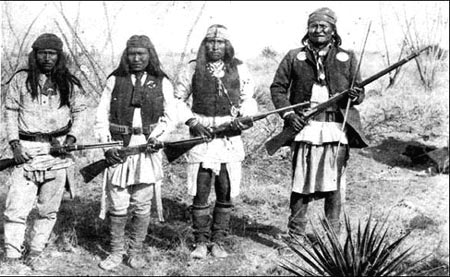
Then Skarstedt asks "What did the US do to get them?"
He shows the next photograph: men on horses. It is the cavalry! On horseback, he tells us, the US was able to wear down, defeat, and capture the Apaches. And here is why studying the Frontier Wars matters: He says the US learned valuable lessons by fighting the Apaches, lessons that it uses today, in Iraq and Afghanistan. Because of wars with Indians, he says, the US developed its "special ops" teams.
Next slide?
It is a photograph of two men, with weapons, wearing masks. They're in Afghanistan or Iraq (Skarstedt doesn't specify). They, he says, are like those Indians. Tough, well-armed, fast moving, blend into the environment, lots of firepower, willing to endure great sacrifice.
His next photograph is one of soldiers, again, on horseback. They are, he tells us, the special ops unit that is pursuing fighters in Iraq and Afghanistan.
Seeing those images used that way was deeply troubling to me. Apaches and Iraq/Afghan's. Obviously he feels they were/are enemies of the US who must be taken down. Who do you think they are? What do you think they were/are doing?
He argued at the opening of his lecture, for people to recognize the complexity of conflict and how it is presented, and then he goes on to do otherwise. In making his points about war tactics, he introduces and affirms simplistic notions.
Later in the lecture he speaks about the people of Cahokia and Taos Pueblo. Both, he says, are gone. They were very advanced and peaceful, he tells us, but they are no longer around. Probably, he says, due to the warring tribes, of which he names the Apache, Comanche, and Sioux. Of course, the people of Taos are not gone. They're a thriving Native Nation!
I wonder if he's ever tried to give this lecture to an audience that includes American Indians?
______________________
Update, May 3rd, 2011: You can view the entire lecture, or see Skarstedt's slides by going here. Scroll down to the section called "The Frontier Years."
Monday, February 09, 2009
Indigenizing Children's Literature

In 2008, the Journal of Language and Literacy (JoLLE) published an article I wrote. Titled "Indigenizing Children's Literature," it is a critical look at Little House on the Prairie and Thanksgiving Day. The article is one of several published in Volume 4(2), 2008, a special issue devoted to children's literature and literacy. JoLLE is a peer-reviewed online journal. I submitted this paper there, specifically because it is an online journal, thereby making it like my blog (accessible to anyone who has an internet connection).
In the conclusion, I make some connections between images and ideology in those two books and America's wartime activity. I welcome your thoughts and comments on the article.
Sunday, February 08, 2009
Nora Naranjo-Morse

Last weekend I watched Nora Naranjo-Morse's lecture, given at the National Museum of the American Indian, in 2007. She was there that summer working on the pieces for the "Always Becoming" installation.
Her lecture was part of the Vine Deloria, Jr. Native Writers Series. It is archived on the NMAI website and is about an hour long. She read several poems, including one that especially struck me--for its imagery, for its emotion, for its power. It is called "A Telegram." Prior to reading it, she talked about writing that poem when she was a teenager, and finishing it last year.
"A Telegram" is about learning that her brother had been wounded in Vietnam. The poem she read at NMAI has not yet been published, but an earlier version of it is in Hirschfelder and Singer's Rising Voices: Writing of Young Native Americans, published in 1992.
Nora is working on a documentary about Always Becoming. She is blogging about it, too. You can follow the project at her blog, also called Always Becoming. She's a poet, a sculptor, a filmmaker. Studying her work, in an art, lit, or film class, would be an incredibly rich experience.
Her book, Mud Woman, is available from Oyate.
Thursday, February 05, 2009
SLJ Column: "A DIRTY LITTLE SECRET"
Over at School Library Journal's website, there's a column about self-censorship that is worth a look. It's provocative title is "A Dirty Little Secret."
The bulk of the column is about what does not get bought by librarians. The columnist, Whelen (a senior editor at SLJ), writes about their fears and anxieties. Fear of parents, school boards, community members, and students who will object to books with sexual content and gay themes. To avoid confrontation, they do not buy the books.
Rather than provide students with books that reflect reality, then, librarians play it safe. In effect, the librarians are choosing to let the gay students suffer. Is it really that simple? Preserve ones self and well-being, one's job? It's easy to rationalize the decision... "If I avoid that book, I avoid trouble and keep my job, and I can work subtly on this topic in other ways..."
The article also includes a brief mention of a writer who wrote a book about the Trail of Tears. Her publisher asked her to "...tone down her criticism of Andrew Jackson and his treatment of Native Americans..." I don't know the book at all, so can't comment on it one way or another. It is called The Trail of Tears: An American Tragedy, by Tracy Barrett. Rather than change what she wrote, Barrett went with another publisher.
Tone it down? Right! Let's not tell anyone, especially children, that our presidents did terrible things!
The SLJ column calls this decision not to buy a book "self-censorship." In education circles, this is akin to "the selective tradition" or "the hidden curriculum."
Whatever label we use, it is more than just fear and anxiety at work, it is the affirmation of the status quo, an unspoken, and generally unaware desire to perpetuate and preserve a certain image of America. A certain false image that hurts us all as individuals, as members of our communities, and as citizens of the United States.
How long will we deceive ourselves?
The bulk of the column is about what does not get bought by librarians. The columnist, Whelen (a senior editor at SLJ), writes about their fears and anxieties. Fear of parents, school boards, community members, and students who will object to books with sexual content and gay themes. To avoid confrontation, they do not buy the books.
Rather than provide students with books that reflect reality, then, librarians play it safe. In effect, the librarians are choosing to let the gay students suffer. Is it really that simple? Preserve ones self and well-being, one's job? It's easy to rationalize the decision... "If I avoid that book, I avoid trouble and keep my job, and I can work subtly on this topic in other ways..."
The article also includes a brief mention of a writer who wrote a book about the Trail of Tears. Her publisher asked her to "...tone down her criticism of Andrew Jackson and his treatment of Native Americans..." I don't know the book at all, so can't comment on it one way or another. It is called The Trail of Tears: An American Tragedy, by Tracy Barrett. Rather than change what she wrote, Barrett went with another publisher.
Tone it down? Right! Let's not tell anyone, especially children, that our presidents did terrible things!
The SLJ column calls this decision not to buy a book "self-censorship." In education circles, this is akin to "the selective tradition" or "the hidden curriculum."
Whatever label we use, it is more than just fear and anxiety at work, it is the affirmation of the status quo, an unspoken, and generally unaware desire to perpetuate and preserve a certain image of America. A certain false image that hurts us all as individuals, as members of our communities, and as citizens of the United States.
How long will we deceive ourselves?
Sunday, February 01, 2009
3rd post: Capaldi bio on Montezuma
From the archives, I found a copy of the letter from Holmes to Montezuma. Dated August 31, 1905, it reads:
My Dear Sir:
I am very desirous of procuring a brief biographical sketch of yourself for incorporation in the “Handbook of the Indians” to be published by this Bureau, and shall be greatly obliged if you will furnish the necessary data for this purpose. As the first part of the work is now being put in type, I shall appreciate any effort you may make to furnish the sketch at your earliest opportunity.
Very truly yours,
H. W. Holmes
Chief
When Montezuma wrote back to Holmes on October 7th, 1905, this is how he started:
My dear Friend:-I am sorry that I delayed your request of August 31st.
In her presentation of Montezuma's letter, dated October 7, 1905, Capaldi starts with this:
My dear friend,I know that you are gathering information on me and what befell my people. I am, therefore, delighted to answer your questions. I hope that what I write will add knowledge, acceptance and understanding for all.
In comparing her presentation of the letter to the letters exchanged between Holmes and Montezuma, I don't like what she did. I wish Capaldi had not used this technique, pulling Montezuma's words from several documents that span many years, weaving them (she says "I interwove") into the original letter to, she says "more fully present" his life. She says "I have made every effort to be true to the original sources and have only added brief phrases to make the text flow smoothly."
I'm really uncomfortable with Capaldi putting words in Montezuma's mouth. She tells us in her notes that she has done this, but that doesn't work for me.
I wish Capaldi had written this book more like the books in the Diaries, Letters, and Memoirs series published by Capstone Press, where the primary material is clearly set apart from additional information that does what Capaldi wanted (more fully present the person's life).
Subscribe to:
Posts (Atom)