Tuesday, October 23, 2007

Documentary: WAY OF THE WARRIOR


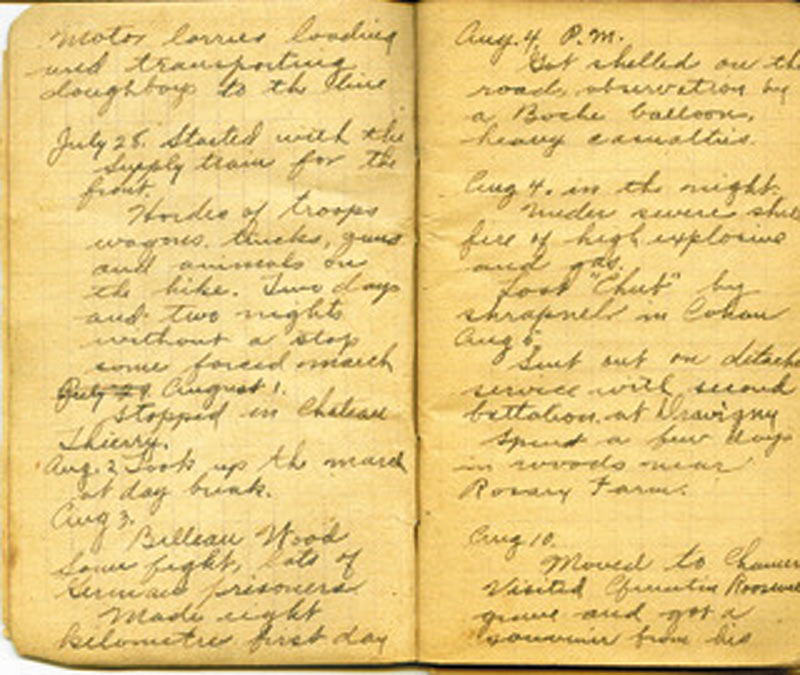
A documentary produced by Patty Loew, a colleague at the University of Wisconsin-Madison, will be broadcast in the coming weeks on PBS. Titled Way of the Warrior, the documentary is about American Indians in the armed services.

The article about the documentary includes an excerpt, and a photograph and image of a diary (shown here) kept by Loew's grandfather, Pvt. Edward DeNomie. He served in the military during a period when American Indians did not have the right to vote.

There is much to learn about American Indians in the US armed forces. I'm looking forward to viewing this film, and it seems an important one for US history teachers.

To read the article and view the excerpt, click here:
Professor's film on Native American soldiers to air on PBS.
.

Monday, October 22, 2007

The word "squaw" in SIGN OF THE BEAVER

The word "squaw" is commonly used in place of the word "woman" in historical fiction for children. I wonder if its entrance during childhood, during formative years, is what makes adults of today think it is an appropriate or acceptable word to use today?

A recent editorial in Indian Country Today describes the modern day use of the word. A small town in Maine is deeply embroiled in a struggle over the word. Insensitivity abounds. The town is near the Penobscot Nation. Tribal members attend city meetings to discuss the issue. Here's an excerpt from the editorial:

One woman, who is a teacher, asked me, "What do we call you Native American Indian women if we can't call you [squaw]?"

That question is loaded, and it prompts me to ask all of you who work with children's books---writers, teachers, librarians---what role might the use of the word in children's historical fiction play in the way that teacher responded to the Native woman?

Let's look at the award winning Sign of the Beaver. Remember---the author of the book and the perspective in the book are not Native. The main character is a white boy named Matt. He meets a Native boy named Attean. This isn't Attean's story. It is Matt's story. According to Amazon's nifty "search inside this book" option, the word 'squaw' appears on 8 pages.

The characters who use the word 'squaw' are Native.

  • In his spoken words, Attean is scornful of women and their work. That work includes care of the garden (weeding) and preparing a bear Attean has killed.

  • A Native girl also uses the word. She says "Attean think squaw girl not good for much"

I doubt that Attean would have the sentiments he has about women, especially women who are his elders. I don't think he would be scornful of them. Moreover, I don't think he would use the word "squaw" at all. If we are considering accuracy of his speech, he'd probably use the word his people would use for women in their language. If you're interested in the Penobscot language, take a look at their website.

In contrast, Matt uses the word 'woman.' The word "woman" appears on seven pages in the book, in Matt's thoughts as we read what he thinks when he sees Native women. He doesn't think "squaw" when he sees them. He thinks "woman." He does think the word 'squaw' as he does his chores, after hearing Attean use it.

Ironically, Sign of the Beaver is set in Maine.

We obviously can't say that any children's book is responsible for the views espoused by the teacher quoted in the Indian Country Today editorial, but I do think children's books and the work we do with them in the classroom setting makes a difference.

Do we affirm misrepresentation and misinformation by failing to engage students in a critical discussion of words like 'squaw' when we read books like Sign of the Beaver? If you're a regular reader of this blog, you know my answer is YES. You know that I think parents, teachers, and librarians must actively engage our children and students in these discussion.

What do you think?
.

Sunday, October 21, 2007

Halloween Costumes

With Halloween approaching, a lot of people---teachers, parents, students, children---are thinking about what they will "be" this year.

Costume shops down the street and on-line include all manner of apparel for those who want to be an "Indian Brave" or a "Sassy Squaw." It is interesting to study the photographs of the models in these costumes...

Some little boys and little girls smile at the camera, others stand with arms crossed, and still others hold one hand up in that goofy and classic "how" pose.

The women stand seductively.

I saw one that especially troubled me... It is for a little girl, it is the "Indian Princess" costume, and the selling line is "Every chiefs little dream."

The men? They stand tense, ready to spring, with tomahawk raised and a threatening scowl on their faces.

The ways in which these models are posed tell us a lot about what people think about American Indians. We are taught to think these ways from our earliest years. Images on television, and in children's books, and in the market place.... they all play a role in what Americans think they know about American Indians. Below is a post I made to the blog last year about Halloween.

I hope that you will think carefully about choosing a costume this year, and that you will choose not to dress like an "Indian."
-----------------------------------

Friday, October 13, 2006

"An Indian?" in Clifford's Halloween

Across the country, kids know who Clifford the Big Red Dog is. A long-time favorite in a series of picture books by Norman Bridwell, even more kids are meeting Clifford by way of his television program, broadcast on PBS.

In the book Clifford's Halloween, Emily Elizabeth is trying to figure out what Clifford will be for Halloween. One option is an Indian. That page shows him in a large multi-colored feathered headdress, with what Bridwell must have intended to be a peace pipe in his mouth.

Many books about Halloween have illustrations of kids dressed up as Indians, and due to society's embrace of things-Indian and playing Indian, we don't give it a second thought.

Let’s pause for a moment, though, and think about this seemingly innocent act of dressing up as an Indian for Halloween.

What else do kids dress up as at Halloween? I don’t mean animals or superheroes, but people-costumes. They can be policemen, firefighters, cowboys, doctors, nurses, pilots, astronauts, baseball players, cheerleaders, soldiers, football players, princesses, belly dancers…. All these are occupations or positions one can, in fact, be at some point, with the proper training.

Now---what about an Indian? You can’t train to be an Indian. You can’t become one. It is something you are born into.

Does that distinction matter? A lot of people would say “No. It’s all in good fun, no harm done.” So you help your child apply his/her “war paint” and put on feathers and other items that complete the costume. Can you imagine yourself painting the child’s face so he/she could be a black person? A minstrel performer, or perhaps a slave, or even Martin Luther King? I’m guessing a parent wouldn’t do that. That parent would know it was wrong. (Doing it in another context----a school play, for example, is a different context.)

Another question to consider: What sort of Indian are we encouraging children to be when we endorse an Indian costume, and what does it teach them? Are they savage Indians, the ones who, according to history books, were murderous, bloodthirsty killers? Or are they the tragic ones, heroic, last-stand, looking into the sunset, riding away despondent over loss?

In either case, the costume they wear is stereotypical. And—savage or heroic—both place Native peoples in the past, not the present, reinforcing the idea that we are an extinct people.

If the book you select for a Halloween read-aloud in storytime has characters that dress up as Indians, turn that illustration into a teachable moment with your students. And, if you’re the parent of a child who wants to dress up as an Indian, talk with your child about that choice and what it means.

In choosing NOT to think about this, are you, unwittingly, fostering the development of stereotypes?
----------------
.


--------------------------------
.

Wednesday, October 17, 2007

2008 Lacapa Spirit Prize - Call for submissions


The Lacapa Spirit Prize --- a literary prize for children's books about the peoples, cultures, and landscape of the southwest --- is accepting submissions for the 2008 prize.

For prize information and application materials, click here: Lacapa Spirit Prize. Posted there is information about last year's winners.

An excerpt from the website:

Named for Michael Lacapa, children’s book illustrator and writer who died in 2005, the award honors the legacy of his artistic vision and talent for storytelling. This prize acknowledges great books for children that best embody the spirit of the peoples, culture and natural landscape of the Southwest. Books published in the two years prior to the award are eligible for consideration.


Michael's book Less Than Half, More Than Whole, profoundly impacted me. It demonstrated---in a beautiful way---that our stories and experiences as people of today, could be portrayed in children's books.

.

Tuesday, October 16, 2007

"The only good Indian is a dead Indian"

Did you know...

the phrase "the only good Indian is a dead Indian"

appears in the acclaimed Little House on the Prairie three times?

Could you/would you hand that book to a Native child?

Could you/should you hand that book to a non-Native child?

How would you/could you/should you use that book?
.

Monday, October 15, 2007

Thanksgiving Lesson Plans

With November approaching, teachers across the country are getting ready to teach about Thanksgiving and the "Indians."

In some classes, students will dress up to reenact the "First Thanksgiving." But... What "Indians" will they dress like? What will they "wear" for this reenactment? Will they emulate stereotypical "Indians" or, is the teacher among those who know how crucial it is to be specific----to identify a tribe, to make certain anything taught is correct with respect to that tribe's location, history, clothing, food, politics, etc.

Teachers have good intentions, but with respect to the ways they were trained and socialized to think about American Indian, their good intentions are actually contributing to misperceptions about who we are. I wrote about a flawed lesson plan last year. Click here to read that post.

My colleagues at Oyate prepared some excellent resources on "Thanksgiving." The resources are on-line. Please download them. Read and think. If you're a teacher, there is still time to revise your lesson plans. If you're a parent, give the materials to your child's teachers and librarian.

To find the materials, click here.

Look, especially at the "Books to Avoid" page on Thanksgiving... You will be dismayed to see how many there are, and further dismayed to realize that you have those books on your shelves right now.

To order books that counter those on the "Books to Avoid" list, to help all children learn about American Indians, look through Oyate's catalog. Order books from Oyate. It is the best source for these materials, and it is a not-for-profit organization, too.

Saturday, October 13, 2007

Alexie's YA Novel Nominated for National Book Award


Editors Note on Feb 25, 2018: Please see my apology about promoting Alexie's work. --Debbie

~~~~


Sherman Alexie's outstanding YA novel, The Absolutely True Diary of a Part-Time Indian, was nominated for a National Book Award in the category, Young People's Literature. The finalist list was released on Wednesday.

In that category, Louise Erdrich's Birchbark House was nominated in 1999.

I think the winner will be announced mid November...

Visit Alexie's website for reviews and info, and a link to an mp3 audio excerpt of the book. Yes, he is the reader of the audio book.

The photo I uploaded is from the press page of his website. Curious... the photo on the publisher's website is a reverse image of the same photo!

Update, Sunday, October 14th:
  • Beverly Slapin's review of the book was posted here on Wed, April 15, 2007. Click here to read her review.
  • I posted links to newspaper articles on September 16, 2007. Click here to go to the list.
  • Roger Sutton, editor at Horn Book, reviewed the book in September. Read his review here.

With November approaching---the month that features and confines us (American Indians) as people of the past---Alexie's book will counter that misperception. Get your copies from Oyate.
.

Friday, October 12, 2007

DO ALL INDIANS LIVE IN TIPIS?


Are you a teacher wondering if all Indians live in tipis? If so, order a copy of the book Do All Indians Live in Tipis?: Questions and Answers from the National Museum of the American Indian. It isn't a children's book, per se, but its content is certainly accessible to upper elementary readers, and, it will prove useful to teachers developing lesson plans about American Indians.

In the foreword, founding director Rick West (Southern Cheyenne and member of the Cheyenne and Arapaho Tribes of Oklahoma) writes:

Before I became the founding director of the National Museum of the American Indian, I was a practicing attorney, and sometimes, when I hear the odd--and even offensive--questions that almost every Indian must bear, I want to rise up and shout, "I object!"


The introduction is by Wilma Mankiller (Cherokee). She writes:

In 1963 President John F. Kennedy said, "for a subject worked and reworked so often in novels, motion pictures, and television, American Indians are the least understood and the most misunderstood of us all." Regrettably, this statement is as true today as it was more than forty years ago. Many negative stereotypes persist.

She goes on to say that summer visitors to the Cherokee Nation include tourists who wanted to know "Where are all the Indians?" To which she'd reply "They are probably at Wal-Mart!"

West and Mankiller's words set the state quite nicely for a volume consisting of about 100 questions, grouped into these categories:

  • Identity
  • Origins and Histories
  • Popular Myths
  • Clothing, Housing, Food, and Health
  • Ceremony and Ritual
  • Sovereignty
  • Animals and Land
  • Language and Education
  • Love and Marriage
  • Art, Music, Dance, and Sports

Here's a sample of the questions:

  • Why was the Navajo language chosen for military code in World War II? Were all Indian "code talkers" Navajo?
  • Did all tribes have totem poles? Does anyone still carve them?
  • How many Indians lived in the Western Hemisphere when Columbus arrived?
  • Why is the word Eskimo sometimes offensive?

Published by the Smithsonian's National Museum of the American Indian and HarperCollins, I paid $14.95 for the book at Pages for All Ages, our local independent bookstore. With "Native American Month" approaching in November, you will find it a useful volume.

And, as always, consider moving your lesson plans about American Indians OUT of November; teaching about American Indians only during that month contributes to the mistaken idea that we are only a people of the past, long vanished. That is not the case. We are still here.

Get your copy at the National Museum of the American Indian giftshop, or, from Louise Erdrich's independent bookstore, Birchbark Books.

Thursday, October 11, 2007

Chiori Santiago's HOME TO MEDICINE MOUNTAIN


On Saturday, October 20th, 2007, I will be in Monticello, Illinois, at the train depot, working as a volunteer for "Artrain USA." It is an art exhibit in train cars. This year, the art is by top American Indian artists whose art is contemporary in style. The exhibit itself is called "Native Views: Influences of Modern Culture."

Among the artists whose work is in the train cars is Judith Lowry, who did the illustrations for Chiori Santiago's picture book, Home to Medicine Mountain. The story is about Lowry's father and uncle, and their experience at boarding school in the 1930s.

In those schools, Native children were taken far from their homes by the US government. They could not return home unless their families had money to pay for their travel. That meant that a lot of kids were stuck at those schools for the entire school year, and many spent many years at them before they could go home. Many kids ran away. Many died as they tried to get home.

Home to Medicine Mountain is about two boys and their efforts to go home. The book concludes with a photograph of the two boys as men.

It is, for me, a unique moment. The boys went home on a train, as you can see in the cover illustration. On Saturday, I will view Judith Lowry's art, in a train car exhibit.

If you're in Central Illinois (or if you're up for a weekend drive to central Illinois), this exhibit is a rare opportunity to see exquisite Native art. To see this sort of collection, you'd have to travel to Washington, or Phoenix, or Oklahoma... And it'll be right here in central Illinois.

The Artrain website includes an educational packet that I encourage you to download and use, whether or not you go to the exhibit.

From here, it will go to Clarksdale, Mississippi; Meridian, Mississippi; Washington DC; Springfield, Missouri; Oklahoma City, and the last stop is in Norman, Oklahoma at the end of November.

The Artrain will be in Monticello for two days (Saturday October 20 and Sunday October 21st). If you do visit, please find me and introduce yourself!

.

Sunday, October 07, 2007

Laura Tohe's NO PAROLE TODAY


[This review used with permission of its author, Beverly Slapin, and may not be published elsewhere without her written permission.]

-----------------

Tohe, Laura (Diné), No Parole Today. Albuquerque: West End Press (1999). 47 pages; grades 7-up

The first words in Laura Tohe’s book are those of Richard Henry Pratt, the founder of the Indian boarding school system that devastated Indian lives throughout North America. Addressing the World Baptist Convention in 1883, Pratt said:

In Indian civilization I am a Baptist, because I believe in immersing the Indians in our civilization, and when we get them under holding them there until they are thoroughly soaked.

Tohe’s great-grandfather was one of the first DinĂ© students to attend Pratt’s Carlisle Indian Industrial School, and she likens her own Indian school experience to serving a prison sentence. No Parole Today is Tohe’s poetry and personal narrative about this time in her life and the challenges of maintaining her identity in a system whose aim is to destroy it.

In an opening piece, a response to Pratt, Tohe writes,

A hundred years after you made your statement to the Baptists, we are still here. We have not vanished, gone away quietly into the sunset, or assimilated into the mainstream culture the way you envisioned….[W]e continue to survive with the strength of the spirit of our ancestors. Our grandmothers and grandfathers taught us to hold to our beliefs, religions, and languages. That is the way of survival for us….I voice this letter to you now because I speak for me, no longer invisible, and no longer relegated to the quiet margins of American culture, my tongue silenced….To write is powerful and even dangerous. To have no stories is to be an empty person. Writing is a way for me to claim my voice, my heritage, my stories, my culture, my people, and my history.

In first grade, the children received their first “Dick and Jane” books, in which they were introduced to white society in the form of Father, Mother, Dick and Jane and Sally, who drove around in cars and said “oh, oh, oh” a lot. In “Dick and Jane Subdue the DinĂ©,” Tohe describes how the schools made the taking away of language a priority:

See Father.

See Mother.

See Dick run.

See Jane and Sally laugh.

oh, oh, oh

See Spot jump.

oh, oh, oh

See Eugene speak Diné.

See Juanita answer him.

oh, oh, oh

See teacher frown.

uh oh, uh oh

See Eugene with red hands, shape of ruler.

oh, oh, oh

See Eugene cry.

oh, oh, oh

See Juanita stand in corner, see tears fall down face.

oh, oh, oh

Oh see us draw pictures

of brown horses under blue clouds.

We color eyes black, hair black.

We draw ears and leave out mouth.

Oh see, see, see.

While most of Tohe’s writing focuses on her coming of age in this hostile alien environment, her later pieces are written from her perspective as an adult, and her final poem, “At Mexican Springs,” is a thing of beauty and hope:

It is here among the sunset in

every plant

every rock

every shadow

every movement

every thing

I relive visions of ancient stories

First Woman and First Man

their children stretched across

these eternal sandstones

a deep breath

she brings me sustenance

life

and I will live to tell my children these things.

For everyone who has survived the Indian boarding schools, and for everyone who never knew of their existence, No Parole Today is a gift. Laura Tohe’s writing is spare and honest, with no polemic; proof of the government’s utter failure to take away Indian voice.

—Beverly Slapin

Saturday, October 06, 2007

October 8th, 2007: INDIGENOUS PEOPLES DAY


Monday, October 8th, 2007, is Indigenous Peoples Day. If you've come to this site looking for Columbus Day lesson plans, please set aside the tired and untrue 'celebration' of Christopher Columbus!


Instead, provide your students and library patrons with information that makes them informed citizens of the world. Tell them that Columbus did not "discover" the lands that came to be known as "America." There were indigenous people here then, and we are still here.


I am from Nambe O'Weenge. It is a Tewa pueblo located in northern New Mexico. In the "We Are Still Here" series, published by Lerner, is a book called Children of Clay: A Family of Pueblo Potters. Books like can be very helpful because through photographs, students in your class can see that we are part of today's society. Note: I've said "we are still here" and "teach students that we are still here" many times on this blog. I feel a bit like a broken record, but, over time, enough teachers, parents, and librarians will change their lesson plans, that we can all stop saying "we are still here."

.


Subscribe to American Indians in Children's Literature


Digg!