Sunday, December 31, 2006

"I is not for Indian"

Pointing you, today, to an article linked in my "Articles" list on the right-hand side of this blog.

In 1991, Naomi Caldwell-Wood and Lisa A. Mitten, officers of the American Indian Library Association, published "Selective Bibliography and Guide for "I" IS NOT FOR INDIAN: THE PORTRAYAL OF NATIVE AMERICANS IN BOOKS FOR YOUNG PEOPLE."

Now 15 years old, it is still one of the best articles out there for teachers, parents, librarians and others interested in learning how to look critically at children's books about American Indians.

It includes an annotated list of recommended books and books that should be avoided. It's a short article. It won't take long to read it, but will increase your understanding immeasurably. It is located on the website for the American Indian Library Association.


There's much to learn from the website. Click through the various links.

Friday, December 29, 2006

Richard Van Camp's THE LESSER BLESSED


Books for young adults are often unsettling to adults who think teens are growing up too fast. These adults are uncomfortable with novels about sex, drugs, suicide, rape. I’d be willing to bet that these same adults prefer novels about American Indians that are peopled with tragic Indians of days long past...

Richard Van Camp’s The Lesser Blessed is about Larry Sole. He’s not romantic, heroic, or savage. And he’s not the hottie you see on some of those ridiculous “Savage” bodice rippers churned out by Cassie Edwards. Unfortunately, a lot of adults who read those bodice rippers and similar novels will reject Lesser Blessed because it does not align with their stereotypical taste and fantasies.


Larry Sole is a 16 year old boy of the Dogrib (Tlicho) Nation in the Northwest Territories of Canada. He’s in high school. He's skinny. He listens to rock music. And, he's in love.


Van Camp doesn’t turn away from the experiences high school kids have with drugs, sex, and fights, but he doesn’t glorify these moments either.


Van Camp’s story is gracefully and naturally, infused with Larry’s Nativeness. The stories told to him by Jed, his mother’s boyfriend, just are. Being Native isn’t something that is planned, that is orchestrated. It just is.

The Lesser Blessed. Published in 2004 by Douglas & McIntyre. A novel for young adults. Add it to your shelf. Recommend it to young adults you know.


Read a review of the book at Indian Country Today.


If you've got an account on MySpace, take a look at Van Camp's page.


Visit Richard Van Camp's website to see who his favorite Native authors are.

Thursday, December 28, 2006

Deborah Miranda's, THE ZEN OF LA LLORONA


[Note: This review is used here by permission of its author, Beverly Slapin. It may not be published elsewhere without the author's written permission.]

______________________________


Miranda, Deborah (Ohlone-Costanoan Esselen/Chumash), The Zen of La Llorona. Salt Publishing, 2005. 106 pages, high school-up.

According to Miranda’s small gray Zen book, “everyone loses everything.” “Nonsense,” La Llorona howls back, “there’s always something left to lose.” La Llorona, for whom Miranda named her second book of poems and prose, appears and disappears throughout it. La Llorona, the Weeping Woman, eternally grieving for the children whose lives she ended in resistance to colonization, and knowing that the colonizer has eternally transformed her into a destroyer like himself.

“I am La Llorona’s daughter,” Deborah Miranda writes, “I should have drowned, but I didn’t.” Somehow, despite the rage and fear, depression and self-loathing and inconsolable grief and “this beast called bereftness” passed on to her from her own mother, she survived.

Along this hard life’s road, Miranda encountered racism, domestic violence, rape, abandonment, addiction, and ultimately, the loves of her life: her children and another Indian woman. She writes with clarity and grace; and her poems are so achingly beautiful, I want to copy them all into this review. In a love poem called “Mesa Verde,” she picks up “a stalk of some rosy blossom, unknown, unidentified.”

Tiny gold ants crawl on the hairy stem,

seek the deep center, enter it.

As we drive on, I leave the branch behind.

The ants will find their way home carrying

a burden so sweet it needs no name,

a story to tell about being taken up,

removed, finding the intricate paths back.

The Zen of La Llorona, poems of loss and despair, survival and strength, is, as acclaimed poet Sandra Cisneros, says, “wondrous stuff.” Deborah Miranda has a brave and loving heart, and I am honored to call her “friend.”

—Beverly Slapin

Saturday, December 16, 2006

Presentation of 2006 American Book Awards

Yesterday (December 15th), the Before Columbus Foundation presented the American Book Awards for 2006. This purpose of the award is to acknowledge excellence and multicultural diversity of American writing.

A Broken Flute: The Native Experience in Books for Children (edited by Doris Seale and Beverly Slapin) is amongst the winners this year. Below are the remarks Beverly read at the event. Doris Seale was unable to attend. With Beverly were some of the contributors to A Broken Flute: Barbara Wall and her son, Ryan Potter, and Janet King and her daughter, Cora Garcia.

I don't know this for certain, but I'm willing to bet that there is no other book out there that has as many Native voices within its covers as does A Broken Flute. The work of Seale and Slapin mirrors the work of Native communities. That is, we work together towards a common goal.

Thank you, Doris and Beverly, for making it possible for Native voice to be part of the conversations about children's books. You and Oyate make a difference.

____________________

Doris and I are greatly humbled by this award and we’d like to ask some people to stand with me in accepting it.

The great Lakota philosopher, Tatanka Iotanka—Sitting Bull—said, “Let us put our minds together and see what life we will make for our children.” The great Cuban revolutionary, José Martí, said, “We work for the children because the children know how to love, because the children are the hope of the world.” 

So Doris and I want to thank the Indian children who had the courage to say what was in their hearts, knowing that their stories would be part of a book, and so no longer private. We also thank the parents of those children, who trusted us with their stories. Those of you who have read A Broken Flute may see that, for Indian children, survival is not a foregone conclusion, and for Indian parents, promises to keep them safe cannot in truth be guaranteed. 

In 1992, when we were in the thick of the struggle against the racism exhibited by a large textbook publisher—it was called “the textbook wars” and those of us who fought it were ridiculed as, among other things, “politically correct censors of the left”—a friend attempted to describe the problem to a group of people who clearly didn’t want to understand how white privilege supports white racism. She held up one of the textbooks and said, simply and without polemic: “In order for some children to be proud of their cultures, other children must be made ashamed of theirs.” 

It would be arrogant and foolish to think that a book that took 13 years of work, 60 contributors, much heartache—and a few laughs besides—can eradicate a problem that has been in existence for more than 500 years. For Doris and me, and for the many contributors, A Broken Flute is our attempt to make things better. Thank you.

Friday, December 15, 2006

Joseph Medicine Crow's COUNTING COUP: BECOMING A CROW CHIEF ON THE RESERVATION AND BEYOND

[Note: This review is used by permission of its author and may not be published elsewhere without written permission of the author.]
____________________
Medicine Crow, Joseph (Absarokee/Crow), with Herman J. Viola, Counting Coup: Becoming a Crow Chief on the Reservation and Beyond. National Geographic, 2006. 123 pages, color and b/w photos, grades 5-8.

As tribal historian of the Absarokee (Crow) Nation, Joseph Medicine Crow would have to be a very good storyteller and have a very long memory. He is and does. Here, in short stories with an ironic humor that seems to be the forte of elders, Medicine Crow tells of a childhood lived mainly outdoors: bathing in icy rivers, mud fights, racing horses, stealing a cow from a white rancher, listening to stories about family and community, and counting coup.

In the old days, in order for someone to become an Absarokee war chief it was necessary to accomplish four life-threatening coups—capture an enemy’s horse, touch the first enemy to fall in battle, steal an enemy’s weapons, and lead a war party. Counting coup is about confronting fears. Such as Medicine Crow’s experiences at a Baptist mission school and later at public school, where he encounters racism and learns to fear whites. Such as his first hospital visit to have his adenoids removed, in which he encounters whites, a Sioux and a ghost (who turns out to be an elderly white guy). Such as his exploits while serving in World War II, in which he completes his four acts of bravery.

 Counting Coup is an excellent read that will resonate with middle readers, and might encourage them to interview their own elders.
—Beverly Slapin

Tuesday, December 12, 2006

Simon Ortiz's THE PEOPLE SHALL CONTINUE


"The People looked around them and they saw Black People, Chicano People, Asian People, many White People and others who were kept poor by American wealth and power.

The People saw that these People who were not rich and powerful shared a common life with them.

The People realized they must share their history with them."

What you've just read is an except from The People Shall Continue, a poem written by Simon Ortiz. His poem was published as a picture book in 1977. If you read American Indian poetry, you are likely familiar with his work. He is from Acquemeh (Acoma) Pueblo, and "The People" are the indigenous peoples of the Americas.

Ortiz begins The People Shall Continue with Creation. Not Genesis, but Creation, as viewed by several different Indian tribes. From the opening pages of his book, children learn that there is more than one way to view Creation. And they learn about diversity in lifestyle, diversity that is dependent on place.

As the story continues, Ortiz tells us that "something unusual began to happen." That something is the arrival of what he calls "strange men" who came "seeking treasures and slaves." This happened to the People, everywhere. He tells us about resistance as he recounts the many ways in which the People persevered in the face of government efforts to stop us from being who we were and are.

His book, in short, offers a history of American Indians.

Here we are, nearly 30 years after the publication of his book, and the rich and powerful continue to cause suffering.

The title of Ortiz's book THE PEOPLE SHALL CONTINUE helps me when I read the news each day and learn of yet another incident in which the rich and powerful denigrate people of color. This morning I read about a parody of "Oh Come All Ye Faithful" written by students at Tufts. The re-written song is "Oh Come All Ye Black Folk." It takes aim at affirmative action, but also, specifically, at 52 African American freshmen at Tufts, who, it is suggested, are there regardless of D's and F's. For more on this, Inside Higher Ed has the story I read.

As noted in an earlier post, racial tensions seem to be on the rise on college campuses across the country. A student told me last week that over Thanksgiving break, she overheard students at a bar talking about their "Trail of Beers" party.

A comment to my post about Philbrick's book suggested that on this blog, I "doth protest too much." That individual is not paying attention. The pile of ugliness is huge and it is everywhere.

And so I will protest, and, THE PEOPLE SHALL CONTINUE.

The People Shall Continue, written by Simon Ortiz, illustrated by Sharol Graves, was published in 1977 by Children's Book Press.

Thursday, December 07, 2006

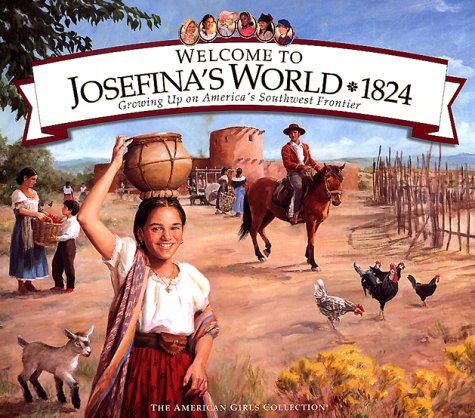
Josefina, An American Girl

Today in class, one of my students shared a book in the American Girl "Josefina" line. The book is Welcome to Josefina's World, 1824: Growing up on America's Southwest Frontier. From the American Girl website is this synopsis:
Inside this beautiful hardcover book you'll see what growing up was like during Josefina's times in 1824 New Mexico. Look inside a Pueblo Indian village, and welcome a trading caravan from Mexico. 
To her credit, the student is critically analyzing the ways in which the series portrays dolls of color, and is finding problems with those portrayals.

One page of Welcome to Josefina's World includes an old, black and white photograph of two Pueblo women. One woman is sitting in front of the other. The camera position is behind and to their left. The woman in back has her hands on the shoulders of the woman in front of her. It is not clear what they are doing, but the caption says that lice were a problem, and that these two women were likely removing lice from each other.

Were lice a problem? Yes. Are they a problem? Yes. Only for Native people past or present? NO. Lice don't care about race, ethnicity, or class. Yet, it is one of those things that is attributed to lower class people of color. I'd have to get a copy of the "Welcome to..." book for each of the American Girls, but I'm willing to bet that the white dolls don't have lice. (If you're in a library with these books, you could help me and readers with this question... Send me an email or post your findings in the comments section of the blog.)

Thanks, Fi, for bringing this book to class.

Update: One of the other "Welcome to..." books (about Felicity, a white character) shows a lice comb as an artifact. I'm glad it is there, but I think that the two images are vastly different in what they convey and what they invoke in the reader. See comments below.

Wednesday, December 06, 2006

Scieszka's ME OH MAYA and Gibson's APOCALYPTO

Mel Gibson's film Apocalypto is about to be released. The previews promise a lot of action, and it looks like it features a lot of stereotypes, too, which means it'll probably do well at the box office. If you are interested in a critical review of Gibson's process of getting this film done, The Nation has one: Mad Mel and the Maya.

NOT RECOMMENDED
In the midst of the media attention of this film, I learned of a children's book by acclaimed author Jon Scieszka. Titled Me Oh Maya, it is part of his Time Warp Trio series of books in which three boys time travel, mostly to the past, but occasionally to the future. Me Oh Maya was first published in 2003 by Viking.

In Me Oh Maya the boys find themselves in a Mayan ball court. A "short brown-skinned guy in a wild feathered headdress stood on top of the wall looking down" at the boys and says to them "Explain yourselves or your blood will be spilled in sacrifice."

This guy turns out to be an "evil high priest" stands over them. His name, they learn, is Kakapupahed.

The Time Warp Trio series is pitched to kids who are "reluctant readers." This sort of book provides readers with clever writing that functions as a hook to draw in a kid who might otherwise not read. In this series, that hook is puns, lots of action, and, as the reviewer at School Library Journal notes, "a little bathroom humor."

In Me Oh Maya, the boys hear the high priests name and think "Cacapoopoohead":


They struggle, unsuccessfully, to contain their laughter. This "evil priest" is corrupt, and with the help of one of his relatives and her son, they manage to trick him and remove him from his position.

Reviews of the book say that kids can learn a lot about Mayan culture by reading this book. I don't think so. What they really learn is that it is perfectly fine to denigrate Mayan names and hence, the people who carry them. They learn that the Mayan's are fools who can be easily tricked ("primitive Indians" you know).

Those are my initial observations. There is much more to say about flaws in Me Oh Maya.

For now, I consider the context. A children's book. A feature length film. Both deeply flawed, yet those flaws escape notice. Why is that?

Monday, December 04, 2006

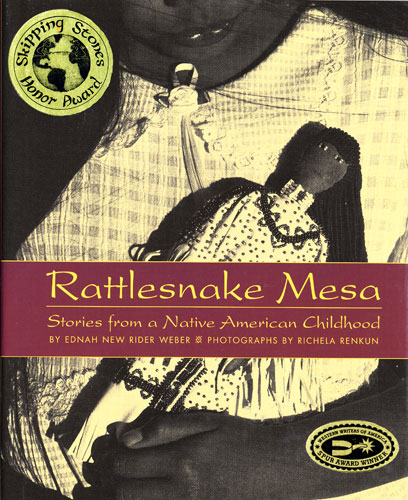
EdNah New Rider Weber's RATTLESNAKE MESA: STORIES FROM A NATIVE AMERICAN CHILDHOOD


[Note: This review is used by permission of its author. It may not be published elsewhere without written permission.]
____________________
New Rider Weber, EdNah (Pawnee), Rattlesnake Mesa: Stories from a Native American Childhood, photographs by Richela Renkun. Lee & Low, 2004, 132 pages, b/w photos; grades 3-up

Rattlesnake Mesa is EdNah New Rider Weber’s recollections of growing up in the early 1900s. After the death of her grandmother, young EdNah is sent to live with her father at Crown Point Indian Agency on the Navajo reservation, and attend the Crown Point Indian School as a day student. Just as she is starting to feel at home, her sense of herself and the world is shattered when she witnesses some children being whipped. “I carried mortal shame, fear, and hurt away with me….I was just eight years old,” she writes. At the end of the school year, EdNah is uprooted once more and sent to the government-run Phoenix Indian School. Here, she finds rigid military discipline and the attempted eradication of everything she is. Despite the loneliness, despite the arbitrary punishment, there is more than a little subversiveness and outright rebellion—mocking the teachers behind their backs, underground games and songs. The children “learned early—laughing was best."

EdNah New Rider Weber is an awesome storyteller; her words will bring young readers into her world.
But several things about Rattlesnake Mesa are very, well, odd. For one thing, the voice shifts throughout the book from Weber’s conversational storytelling cadence to a strange, detached, “objective” outsider rhythm. This happens too often not to be noticed. In a piece about boarding school, Weber recounts how a little girl the students nicknamed “Old Thunder” had an “unbelievable talent—a natural ability to pass her stomach gases as she pleased. Complete control!” And in another section, there is an odd, outsider overemphasis on what people are wearing: “The Zuni women were richly clad in black mantas and white buckskin-wrapped moccasins. Navajo ladies wore velvet shirts, studded with old coins from the 1800s, and exquisite turquoise jewelry.” And there is an—odd—description of a ceremony that wouldn’t have happened quite that way. 

Another oddity is the black-and-white photos that illustrate the book. The endnotes say that in 1998 “[Weber and Renkun] set out to revisit the landscape of Weber’s childhood in New Mexico—searching for old memories and creating new images to recapture them….They searched for faces of children and elders who were part of the land, faces that helped Weber remember the people she had known in her youth.” It’s an interesting project for a photographer to visualize an elderly person’s stories. But there seems to be an unstated assumption that Weber had no memories until she saw these “faces of children and elders who were part of the land.” Otherwise, why would Renkun pose unhappy-looking children dressed in ‘50s-style clothing, to represent the boarding school experience? And what relevance is there for a shawl dancer, wearing moccasins, dancing alone, on hard rocky ground?

Questions remain: Why was it seen as necessary for Weber’s evocative recollections of her childhood to be contaminated with Renkun’s new-agey photographs and perhaps someone else’s writing? Why does Renkun, her husband and her son have wannabe-sounding Lakota names? And why does Renkun dedicate the book to her “Uncle Pete Rock (Che Nodin) full-blood Obijwa [sic], naval commander, athlete, and alumnus of the Carlisle Indian School (1918-1990)”? Carlisle was in operation from 1879-1918. 

This is a very disquieting book. I would like to have seen EdNah New Rider Weber’s stories as she told them, without the “fixing up.”—Beverly Slapin

Sunday, December 03, 2006

Patrick Russell LeBeau's RETHINKING MICHIGAN INDIAN HISTORY

The audience for LeBeau's Rethinking Michigan Indian History is teachers. The material in the book will be helpful to teachers in grades 4-12 who seek to provide students with balanced instruction about Native peoples of Michigan.

LeBeau asks readers to consider these statements:
Stereotypical representations of Michigan's Indians are what most people of Michigan understand and recognize.
The U.S. Constitution protects and upholds Michigan Indian treaty rights.
Michigan's Indians are alive and well in the modern world and are not artifacts of the past.
Michigan's Indians change and adapt to circumstances and events; therefore, they are not frozen in any one image or time period.
Material in the book is teacher-friendly. "Objectives" are listed at the beginning of each lesson, followed by a narrative about the lesson topic, and then a set of Activities.

Some lessons are:
  • Defining Our Terms and Exploring Stereotypes: Building a Specific Context
  • Challenging the "Great Man" Theory of History
  • Indian Treaties and the U.S. Constitution
  • How Historical Maps Influence Thinking about Michigan's Indians
Each lesson includes color illustrations, maps, charts and examples of student drawings. All of this material is also available on the accompanying CD-ROM. Lessons can be used as stand-alone units, and have application in other states (not just Michigan).

LeBeau is an enrolled member of the Cheyenne River Sioux Indian Reservation in South Dakota and is the former director of Michigan State University's American Indian Studies Program.