Wednesday, February 11, 2009

Cynthia Leitich Smith's ETERNAL


Cynthia Leitich Smith's new book, Eternal, was launched yesterday. I read a copy a few weeks ago. It is a page-turner about vampires and angels and... It's quite a ride, from Austin to Chicago. I'll leave it there for you to read. If you're a fan of gothic fiction, take a look at Eternal.

As you may know, my blog is about children's books about American Indians. That's what most of the content is about.

However! I think it important that children and teens know that Native people write stories, and that not all of their stories are about Native people. Cynthia's range of books is a good case in point. If you read her YA novel, Rain Is Not My Indian Name, read her vampire novels, too. Her first one is Tantalize, Eternal is the second, and a third one is in the works.

In Tribal Secrets, Robert Warrior writes about American Indian literature and criticism. He says "producers of American Indian literature continue to push the boundaries of creativity by bringing European vampires to Navajo country..." Warrior notes that such a book "does not fit into standard definitions of Indian writing..." but he goes on to say that the increase in such books "seems more than enough justification for some fundamental reworking of scholarly understandings of American Indian literature, culture, and experience."

In essence, it is important that we be open to what is being written by Native writers. Don't pigeon hole them or their writing. Expand your expectations of what Native writers write about.

Read Native writers, whether their stories are about Native life, or vampires.

So! Eternal. Click on over to Cynsations where you'll learn a lot about the book. There's more at Smith's website including a very cool book trailer that perfectly captures the mood of the book.

Tuesday, February 10, 2009

"What Students Need to Know about America's Wars"

I'm on a listserv for the National Council of Teachers of Social Studies. Yesterday a subscriber posted information about an upcoming "History Institute for Teachers" called "What Students Need to Know about America's Wars." Curious, I checked out the webpages, looking specifically at the video of a session that was on war with Native peoples.

It was an unpleasant experience. Perhaps I should not have taken the time...

The material is developed by the Foreign Policy Research Institute. The lecturer, a man named Skarstedt, notes that there are ideological disagreements over the ways that history of American Indian/United States conflict is presented, but it is clear in his remarks where he stands in the debate.

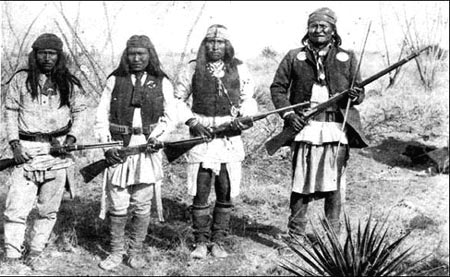
He begins by saying students wonder why they need to study the frontier wars. He tells the teachers gathered in the session why it is important, using Apaches as an example.

He shows a photograph of four Apache men. He carefully describes the weapons they hold and talks at length about how skilled they were. How they were able to blend into their surroundings, very resourceful, could survive for days with little food or water. They knew the terrain and were "tough as nails."

Then Skarstedt asks "What did the US do to get them?"

He shows the next photograph: men on horses. It is the cavalry! On horseback, he tells us, the US was able to wear down, defeat, and capture the Apaches. And here is why studying the Frontier Wars matters:  He says the US learned valuable lessons by fighting the Apaches, lessons that it uses today, in Iraq and Afghanistan. Because of wars with Indians, he says, the US developed its "special ops" teams.

Next slide?

It is a photograph of two men, with weapons, wearing masks. They're in Afghanistan or Iraq (Skarstedt doesn't specify). They, he says, are like those Indians. Tough, well-armed, fast moving, blend into the environment, lots of firepower, willing to endure great sacrifice.

His next photograph is one of soldiers, again, on horseback. They are, he tells us, the special ops unit that is pursuing fighters in Iraq and Afghanistan.

Seeing those images used that way was deeply troubling to me. Apaches and Iraq/Afghan's. Obviously he feels they were/are enemies of the US who must be taken down. Who do you think they are? What do you think they were/are doing?

He argued at the opening of his lecture, for people to recognize the complexity of conflict and how it is presented, and then he goes on to do otherwise. In making his points about war tactics, he introduces and affirms simplistic notions.

Later in the lecture he speaks about the people of Cahokia and Taos Pueblo. Both, he says, are gone. They were very advanced and peaceful, he tells us, but they are no longer around. Probably, he says, due to the warring tribes, of which he names the Apache, Comanche, and Sioux. Of course, the people of Taos are not gone. They're a thriving Native Nation!

I wonder if he's ever tried to give this lecture to an audience that includes American Indians?

______________________
Update, May 3rd, 2011: You can view the entire lecture, or see Skarstedt's slides by going here. Scroll down to the section called "The Frontier Years."

Monday, February 09, 2009

Indigenizing Children's Literature


In 2008, the Journal of Language and Literacy (JoLLE) published an article I wrote. Titled "Indigenizing Children's Literature," it is a critical look at Little House on the Prairie and Thanksgiving Day. The article is one of several published in Volume 4(2), 2008, a special issue devoted to children's literature and literacy. JoLLE is a peer-reviewed online journal. I submitted this paper there, specifically because it is an online journal, thereby making it like my blog (accessible to anyone who has an internet connection).

In the conclusion, I make some connections between images and ideology in those two books and America's wartime activity. I welcome your thoughts and comments on the article.

Sunday, February 08, 2009

Nora Naranjo-Morse


Last weekend I watched Nora Naranjo-Morse's lecture, given at the National Museum of the American Indian, in 2007. She was there that summer working on the pieces for the "Always Becoming" installation.

Her lecture was part of the Vine Deloria, Jr. Native Writers Series. It is archived on the NMAI website and is about an hour long. She read several poems, including one that especially struck me--for its imagery, for its emotion, for its power. It is called "A Telegram." Prior to reading it, she talked about writing that poem when she was a teenager, and finishing it last year.

"A Telegram" is about learning that her brother had been wounded in Vietnam. The poem she read at NMAI has not yet been published, but an earlier version of it is in Hirschfelder and Singer's Rising Voices: Writing of Young Native Americans, published in 1992.

Nora is working on a documentary about Always Becoming. She is blogging about it, too. You can follow the project at her blog, also called Always Becoming. She's a poet, a sculptor, a filmmaker. Studying her work, in an art, lit, or film class, would be an incredibly rich experience.

Her book, Mud Woman, is available from Oyate.

Thursday, February 05, 2009

SLJ Column: "A DIRTY LITTLE SECRET"

Over at School Library Journal's website, there's a column about self-censorship that is worth a look. It's provocative title is "A Dirty Little Secret."

The bulk of the column is about what does not get bought by librarians. The columnist, Whelen (a senior editor at SLJ), writes about their fears and anxieties. Fear of parents, school boards, community members, and students who will object to books with sexual content and gay themes. To avoid confrontation, they do not buy the books.

Rather than provide students with books that reflect reality, then, librarians play it safe. In effect, the librarians are choosing to let the gay students suffer. Is it really that simple? Preserve ones self and well-being, one's job? It's easy to rationalize the decision... "If I avoid that book, I avoid trouble and keep my job, and I can work subtly on this topic in other ways..."

The article also includes a brief mention of a writer who wrote a book about the Trail of Tears. Her publisher asked her to "...tone down her criticism of Andrew Jackson and his treatment of Native Americans..." I don't know the book at all, so can't comment on it one way or another. It is called The Trail of Tears: An American Tragedy, by Tracy Barrett. Rather than change what she wrote, Barrett went with another publisher.

Tone it down? Right! Let's not tell anyone, especially children, that our presidents did terrible things!

The SLJ column calls this decision not to buy a book "self-censorship." In education circles, this is akin to "the selective tradition" or "the hidden curriculum."

Whatever label we use, it is more than just fear and anxiety at work, it is the affirmation of the status quo, an unspoken, and generally unaware desire to perpetuate and preserve a certain image of America. A certain false image that hurts us all as individuals, as members of our communities, and as citizens of the United States.

How long will we deceive ourselves?