
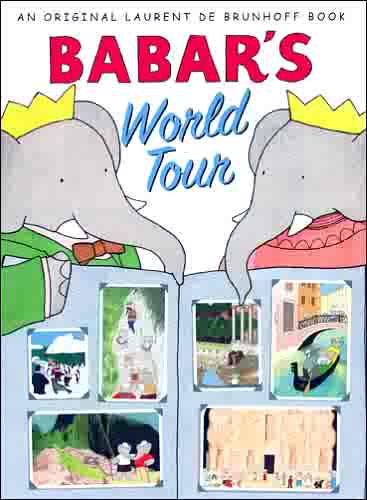
"World tour," I thought to myself. "What did dear old Babar see?"
In the first pages, Babar and his family visit Italy, Germany, Russia, India, Japan, Thailand... where they eat new foods, speak phrases in Italian, etc. At one point, Isabelle notes difference in language and asks "What's wrong with our words?" Celeste explains that "People in different places say things differently. They do things differently, too. They build different kinds of buildings." Note Celeste's reference to people of the present day. She uses present tense words like "say" and "do".
Now, I call your attention to this page from the inside of the book.

Note, specifically, the text from that page, which I've included below (bold text is mine):
When everyone was rested, they went to Angkor in Cambodia, the ancient city of the Khmers. In Mexico, they climbed a pyramid built by the Aztecs. In both places, the original settlers were gone but tourists abounded.
"Will everyone move out of Celesteville one day, too?" Pom asked.
"Never," said Babar. "But apart from us, it happens a lot, as you'll see."
The "it" that happens is being gone, moved out. The "as you'll see" refers to the places they visit next, which include "the cliff houses of the Anasazi in the high desert of the American Southwest," and "the Inca Trail, on the same stones that the Incas had walked..." and "... the remains of the city of Machu Picchu hidden in the Andes Mountains."
Speaking sarcastically.... How nice for the Babar family and other tourists, that the "original settlers" were gone! And what does "gone" mean??? Why are they gone? How does a child understand that word? And how nice that these "original settlers" moved out, leaving these wonderful places for the tourists! And how good it is of Babar to assure Pom that the inhabitants of Celesteville will never move out of Celesteville! Their own home is secure. Forever.
Reviewers of the book failed to note these passages and the messages they impart to the reader. School Library Journal's reviewer finds it lacking because it doesn't have the same adventure and excitement in Jean de Brunhoff's Travels of Babar (which has highly problematic illustrations of "cannibals"). Perhaps if they'd actually come across "savages" (aka "original settlers) the reviewer might have given it a favorable review.
The review in Booklist is more favorable: "Though children listening to the story will get only a glimpse or two of each country before moving on to the next, this colorful picture book provides an inkling of the diversity of places and cultures in the world. A pleasant excursion, recommended especially for those who already know and love Babar and his family."
Perhaps, but I wonder about children of all those "original settlers"?! Will a Pueblo child say "We're not gone as in extinct. We're still here. We're the descendants of the Cliff Dwellers."
There is a great deal wrong with this book. It is very useful for a high school or college classroom, but as a read-aloud for young children? No.


