Monday, December 04, 2006

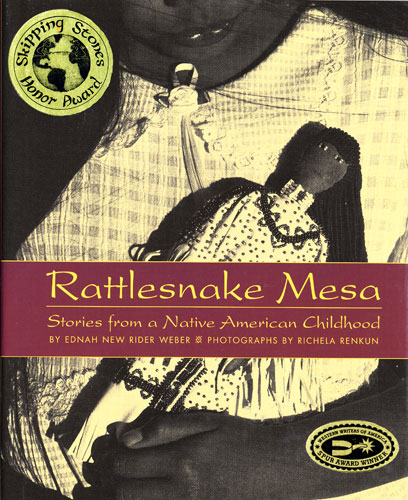
EdNah New Rider Weber's RATTLESNAKE MESA: STORIES FROM A NATIVE AMERICAN CHILDHOOD


[Note: This review is used by permission of its author. It may not be published elsewhere without written permission.]
____________________
New Rider Weber, EdNah (Pawnee), Rattlesnake Mesa: Stories from a Native American Childhood, photographs by Richela Renkun. Lee & Low, 2004, 132 pages, b/w photos; grades 3-up

Rattlesnake Mesa is EdNah New Rider Weber’s recollections of growing up in the early 1900s. After the death of her grandmother, young EdNah is sent to live with her father at Crown Point Indian Agency on the Navajo reservation, and attend the Crown Point Indian School as a day student. Just as she is starting to feel at home, her sense of herself and the world is shattered when she witnesses some children being whipped. “I carried mortal shame, fear, and hurt away with me….I was just eight years old,” she writes. At the end of the school year, EdNah is uprooted once more and sent to the government-run Phoenix Indian School. Here, she finds rigid military discipline and the attempted eradication of everything she is. Despite the loneliness, despite the arbitrary punishment, there is more than a little subversiveness and outright rebellion—mocking the teachers behind their backs, underground games and songs. The children “learned early—laughing was best."

EdNah New Rider Weber is an awesome storyteller; her words will bring young readers into her world.
But several things about Rattlesnake Mesa are very, well, odd. For one thing, the voice shifts throughout the book from Weber’s conversational storytelling cadence to a strange, detached, “objective” outsider rhythm. This happens too often not to be noticed. In a piece about boarding school, Weber recounts how a little girl the students nicknamed “Old Thunder” had an “unbelievable talent—a natural ability to pass her stomach gases as she pleased. Complete control!” And in another section, there is an odd, outsider overemphasis on what people are wearing: “The Zuni women were richly clad in black mantas and white buckskin-wrapped moccasins. Navajo ladies wore velvet shirts, studded with old coins from the 1800s, and exquisite turquoise jewelry.” And there is an—odd—description of a ceremony that wouldn’t have happened quite that way. 

Another oddity is the black-and-white photos that illustrate the book. The endnotes say that in 1998 “[Weber and Renkun] set out to revisit the landscape of Weber’s childhood in New Mexico—searching for old memories and creating new images to recapture them….They searched for faces of children and elders who were part of the land, faces that helped Weber remember the people she had known in her youth.” It’s an interesting project for a photographer to visualize an elderly person’s stories. But there seems to be an unstated assumption that Weber had no memories until she saw these “faces of children and elders who were part of the land.” Otherwise, why would Renkun pose unhappy-looking children dressed in ‘50s-style clothing, to represent the boarding school experience? And what relevance is there for a shawl dancer, wearing moccasins, dancing alone, on hard rocky ground?

Questions remain: Why was it seen as necessary for Weber’s evocative recollections of her childhood to be contaminated with Renkun’s new-agey photographs and perhaps someone else’s writing? Why does Renkun, her husband and her son have wannabe-sounding Lakota names? And why does Renkun dedicate the book to her “Uncle Pete Rock (Che Nodin) full-blood Obijwa [sic], naval commander, athlete, and alumnus of the Carlisle Indian School (1918-1990)”? Carlisle was in operation from 1879-1918. 

This is a very disquieting book. I would like to have seen EdNah New Rider Weber’s stories as she told them, without the “fixing up.”—Beverly Slapin

Sunday, December 03, 2006

Patrick Russell LeBeau's RETHINKING MICHIGAN INDIAN HISTORY

The audience for LeBeau's Rethinking Michigan Indian History is teachers. The material in the book will be helpful to teachers in grades 4-12 who seek to provide students with balanced instruction about Native peoples of Michigan.

LeBeau asks readers to consider these statements:
Stereotypical representations of Michigan's Indians are what most people of Michigan understand and recognize.
The U.S. Constitution protects and upholds Michigan Indian treaty rights.
Michigan's Indians are alive and well in the modern world and are not artifacts of the past.
Michigan's Indians change and adapt to circumstances and events; therefore, they are not frozen in any one image or time period.
Material in the book is teacher-friendly. "Objectives" are listed at the beginning of each lesson, followed by a narrative about the lesson topic, and then a set of Activities.

Some lessons are:
  • Defining Our Terms and Exploring Stereotypes: Building a Specific Context
  • Challenging the "Great Man" Theory of History
  • Indian Treaties and the U.S. Constitution
  • How Historical Maps Influence Thinking about Michigan's Indians
Each lesson includes color illustrations, maps, charts and examples of student drawings. All of this material is also available on the accompanying CD-ROM. Lessons can be used as stand-alone units, and have application in other states (not just Michigan).

LeBeau is an enrolled member of the Cheyenne River Sioux Indian Reservation in South Dakota and is the former director of Michigan State University's American Indian Studies Program.

Thursday, November 30, 2006

Dartmouth, Mascots, and Civility (or lack thereof)

Some weeks ago I wrote about UIUC's "tacos and tequila" frat/sorority "exchange." In weeks following, we learned that across the country, institutions of higher ed have had similar parties, including Cowboys and Indians parties.

Dartmouth's recent experiences around racist activity and representation of American Indians is in today's NY Times. This latest incident is a cartoon in a conservative Dartmouth paper not affiliated with the campus. The cartoon shows an Indian holding a bloody scalp, and the caption reads "The Natives are getting restless." The NY Times article quotes the editorial:

In an editorial, Linsalata wrote: ''While the onus may fall partly on the student body to facilitate an environment more hospitable to Indians, nothing can be done until the Indians themselves lay out measurable goals and steps for how this harmony can be achieved. Patronizing advertisements and excessive use of the race card are antithetical to this goal.''

"...the Indians themselves"?!! Linsalata's remark is outrageous. Dartmouth's Native students speak up regarding negative representations of Native people, and Linsalata says THEY must lay out measurable goals and steps for harmony. Where, in Linsalata's view of the world, is his own responsibility for that harmony?

For more, go directly to Dartmouth's school paper, The Dartmouth.

THIS societal context is the one in which all of you---parents, teachers, librarians, professors, students---must work. THIS mindset is why your work towards helping children know who Native people are, and what US history has been, is crucial. We are all responsible for the views that children hold, the views that they take to heart, that they rely on when they are adults. We can intervene, and we must.

Wednesday, November 29, 2006

Montana's "Indian Education for All" program

I've been hearing good things about Montana's "Indian Education for All" program. Essentially, it is an initiative designed to provide students in Montana with knowledge about American Indians. As is the case with most schools, students learn world and U.S. and state history, but very little of worth is taught about American Indians. In Montana, the school is taking significant steps to remedy that situation.

The program has many components. If you are interested in learning what they're doing, and how you might use their work to modify your teaching, or your district's curriculum, visit the website:

Montana Office of Public Instruction, Indian Education
http://opi.mt.gov/programs/indianed/

Note: Today (Jan 22, 2013), I removed dead links to the articles referenced below.

The National Indian Education website has an article about it, posted in June of 2005: Montana's Public Schools to Teach about State's First People. Indian Country Today ran an article about the program in May of 2006: Montana prepares to implement unique 'Indian education for all' law.

And, the November 2006 issue of PDK features the program on its cover and has several articles about it.

If you are a teacher, parent, librarian, student, or professor in Montana and have first-hand information on the initiative, please share with us. Send me an email, and I'll post it to the blog. Or, use the comments option (below) if you prefer.