Tuesday, September 12, 2006

A Review of Nicola Campbell's SHI-SHI-ETKO


[Note: This review is used with permission of its author, by Beverly Slapin of Oyate. It may not be used elsewhere without her written permission.]

Campbell, Nicola L. (Interior Salish/Métis), Shi-shi-etko, illustrated by Kim LaFave. Groundwood, 2005. 32 pages, color illustrations; grades 1-3

In just four days, young Shi-shi-etko (“she loves to play in the water”) will have to leave everyone she loves and everything she knows—to go to an Indian residential school where, among other things, her name, language and identity will be taken away. Until recently, this was the law and the harsh reality for Native children in Canada, Australia, New Zealand, and the U.S. “Can you imagine a community without children?” Campbell writes in a brief foreword. “Can you imagine children without parents?”

As Shi-shi-etko counts down the days, her large extended family—cousins, aunties and uncles, and Yahyah—fill her with their love, memories, and the strength to endure what they know will happen and what they are powerless to prevent. With her mother, a morning prayer in the creek. With her father, a paddle song in the canoe. With her yahyah, a visit to the woods. A sprig of hemlock, cedar and pine placed into a small deerskin bag.

Too soon, it is time. The cattle truck is waiting. With a prayer and an offering of tobacco, Shi-shi-etko tucks her deerskin bag inside the roots of a big fir tree, to wait for her return. She takes in everything one last time—“tall grass swaying to the rhythm of the breeze, determined mosquitoes, working bumblebees…each shiny rock, the sand beneath her feet, crayfish and minnows and tadpoles…”

LaFave’s rich and evocative digital illustrations, on a palette of mostly reds, complement this sad and gentle story. What happens to Shi-shi-etko at residential school is not told here. It does not have to be. After Shi-shi-etko, read to children Larry Loyie’s As Long as the Rivers Flow, then Maddie Harper’s “Mush-hole”: Memories of a Residential School, then Judith Lowry’s Home to Medicine Mountain, then Shirley Sterling’s My Name Is Seepeetza; all of these that they may know a shameful part of history that must never be repeated.

—Beverly Slapin

[Note from Debbie: Shi-shi-etko and the other books Beverly refers to in the last paragraph of her review are available from Oyate.]

Sunday, September 10, 2006

Native Americans: Lesson Plans

With Thanksgiving approaching, teachers across the country are getting ready to teach children about Native Americans. Unfortunately, far too often, November and Thanksgiving (and Columbus Day) are the only times of the year that Native peoples make an appearance in the curriculum. That is not "best practice!" I urge teachers to teach about American Indians throughout the year. Here's one book to help you do that.

A terrific resource for early childhood teachers is Lessons from Turtle Island: Native Curriculum in Early Childhood Classrooms, by Guy W. Jones and Sally Moomaw.

Published in 2002 by Redleaf Press, the book has a lot to offer. Here's an excerpt from the introduction:

"Throughout this book, we have often relied on outstanding children's literature, usually by Native authors, to introduce positive, accurate images of Native peoples to children. It is our view that, with the possible exception of classroom visits by American Indian people, excellent children's literature is the most effective way to counter deeply held stereotypes and help children focus on similarities among peoples as well as cultural differences. The literature serves as a catalyst to extend related activities into other areas of the curriculum."

And here's an excerpt from Chapter 1:

"Omission of Native peoples from the curriculum, inaccurate curriculum, and stereotyping all amount to cultural insensitivity. This is heightened, however, when well-meaning teachers introduce projects that are culturally inappropriate."

Jones and Moomaw go on to discuss projects such as feathers and headdresses, peace pipes, totem poles, dream catchers, sand paintings, pictographs, rattles, drums, and brown bag vests.

Chapter 2 includes a lesson plan called "Children and Shoes" that uses Bernelda Wheeler's Where Did You Get Your Moccasins? and Esther Sanderson's Two Pairs of Shoes. It includes suggested activities in dramatic play (Shoe Store), math (Shoe Graph) and science (Shoe Prints), all of which convey similarities across cultures.

Chapter 6 is about the environment. Featured are two of Jan Bourdeau Waboose's books, SkySisters and Morning on the Lake. In the "not recommended" section that closes each chapter, this chapter says it is not recommended to ask children to make up Indian stories, and explains why.

As a former first grade teacher, I highly recommend this book to anyone working with young children. It is available from Oyate for $30.

Friday, September 08, 2006

Tintin in America

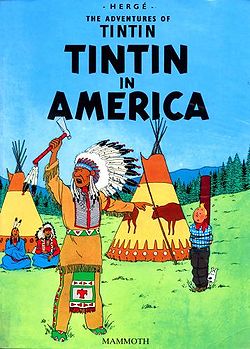
Yesterday's assignment in my class at UIUC was for each student to bring a children's book about American Indians to class. I'll talk more about what they brought in a later post, but for now, I want to talk about a specific book: Tintin in America.

One of the students brought Tintin in America. The author, Herge, is Belgian, and the book was published in Belgium in 1932. I will get a copy and read it, and invite anyone who knows the book to send me your thoughts (dreese dot nambe at gmail dot com).

In the book, Tintin goes to "Redskin City." From what I saw, the Indians are stereotypical characters in feathered headdress and buckskin. On the cover of the book, Tintin is tied to a post in front of two tipis. An Indian appears to be calling to others to join him; he brandishes a tomahawk in one hand and points to Tintin with the other.

An old publication date (1932), originally published in another country... But it was published here, too, in 1979, by Little, Brown. I'll spend some time reading and thinking about this book. There is a fan website called Tintinologist.org that says:

"Hergé had wanted to write a story about the oppression of the Indians in the USA, but his boss, Father Wallez fancied a story about the Chicago crime syndicate that would help illustrate how corrupt the USA really was. (Don't forget that Wallez was all in favour of a strong and unified Europe - without the rightist Hitler - type associations). That was not exactly what Hergé had in mind, so on page 16 he lets gangster Bobby Smiles flee to Redskincity, a town near an Indian camp. However, to stay out of trouble with Wallez, Hergé used the Indians to expose American corruption with the scene where the 'whites' found out about the oil on the Indian reserve, they established a town and oil industry within 24 hours.
Finding a publisher for this book in the USA was impossible. Even in the mid-1940s, American publishers insisted that Hergé replaced the 'coloured' people featured in the comic with 'whites'. Then again, the USA was not the only country that gave Hergé a hard time publishing this comic. Most foreign publishers (i.e. non-Belgian or French) seemed to have problems with the almost apocalyptical scene in which the soldiers move out the Indians of the reserve, and the speed in which the new town is created."

A lot of people here and around the world object to the treatment of American Indians. As the author of tintinologist says, Herge wanted to write a story about the oppression of American Indians in the United States.  In doing so, however, he uses stereotypical imagery. Does that imagery inadvertently negate what they're trying to accomplish? And what about people who don't know it is stereotypical?

Wednesday, September 06, 2006

American Indian Library Association’s “American Indian Youth Literature Award”

For many years, individuals with the American Indian Library Association have worked toward establishing an award for outstanding children’s books about American Indians. Yesterday (September 5, 2006), they announced the first three recipients of the award.

Here is the portion of their press release with details about the books:

---------------------------------------------------

"Beaver Steals Fire: A Salish Coyote Story," by the Confederated Salish and Kootenai Tribes, illustrated by Sam Sandoval, and published by the University of Nebraska Press is the winner for the picture book category. Accompanied by rich watercolor illustrations, the text relates a culturally vital tale from the Salish people of Montana about the significance of the gift of fire and how it should be respected.

Louise Erdrich is the winner of the middle-school award for "The Birchbark House," published by Hyperion Books for Children. Setting her book in the middle 19th century, Erdrich paints a detailed portrait of Ojibwa life through the experiences of 7-year-old Omakayas who lives on the Island of the Golden Breasted Woodpecker on Lake Superior. "The Birchbark House" was Erdrich's first novel for young readers, and the first book she has illustrated. She is a member of the Turtle Mountain Band of Ojibwa and lives with her two daughters in Minnesota.

Update on Sep 30 2023: I (Debbie Reese) no longer recommend Bruchac's work. For details see Is Joseph Bruchac truly Abenaki?

The young adult award is "Hidden Roots," written by Joseph Bruchac and published by Scholastic Press. The book is set within the historical framework of the Vermont Eugenics Program, a Native American sterilization program in the 1930s, and tells the story of the haunting effects of this shameful and tragic deed on one of the Abenaki families victimized by it. Author of more than 70 books for adults and children, Bruchac is of Abenaki ancestry and is a nationally recognized professional storyteller living in Greenfield Center, New York.

-----------------------------------------------------

Thank you, AILA, for establishing this award. Awards do a lot for the longevity of a book. As demonstrated on this blog, and by people who've done this work for many decades, some pretty awful books get printed again and again. They’re hard to displace, but I am hopeful that awards like this one will help change that. We must not forget, though, that the bottom line is sales. All three books are available from Oyate.

If we don’t buy these books for ourselves, for our children, for their friends, for their teachers, they will go out of print, even if they are designated as award winners.